AI Chatbot for SaaS Companies: Boost Growth and Support Fast

When you think of your SaaS company, picture a busy city. Your users are visitors wandering the streets of features, dashboards, and tools. Some know exactly where they’re going. Others? Lost. Confused. Frustrated.
Your support team? They’re the city guides, running back and forth answering questions, fixing issues, and calming frustrated users. But no matter how skilled they are, they can’t be everywhere at once, especially at 2 a.m. when your product’s global audience is awake.
Enter the AI chatbot for SaaS companies. Imagine a guide who never sleeps, never forgets, and can help hundreds of users simultaneously. Sounds like science fiction, right? But it’s reality, and SaaS companies that adopt it are seeing dramatic improvements in support efficiency, user satisfaction, and revenue.
Why SaaS Companies Need an AI Chatbot
SaaS is competitive. Users have options, and slow support or confusing onboarding can send them straight to a competitor. A saas ai chatbot can change that instantly.
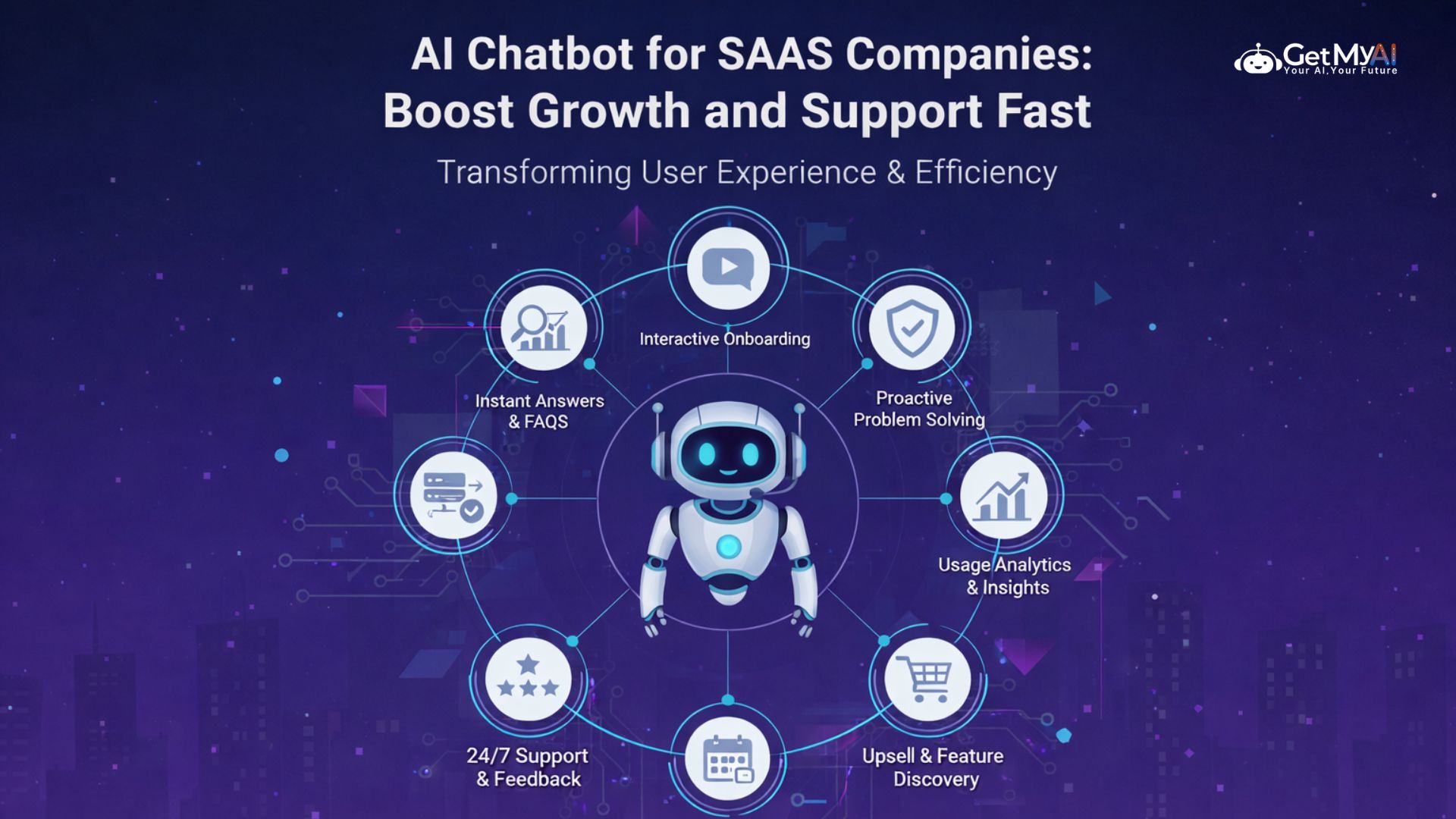
Think of it as a Swiss Army knife for your SaaS city. It:
- Answers repetitive questions instantly
- Walks new users through complex dashboards
- Identifies trends in what users struggle with
- Collects leads and guides potential customers to upgrade
Imagine a new user signing up at 2 a.m. They’re trying to figure out how to set up your integration. Without help, frustration builds. With your AI chatbot, they’re guided step-by-step, completing setup confidently and without contacting your human team.
This isn’t just support, it’s turning users into advocates from the very first click.
AI Voice Agent vs AI Chatbot: Who Wins?
Let’s compare two digital helpers like characters in a short story.
- AI Voice Agent: The friendly talker. Good in meetings, clear on calls, but can hear words wrong, struggle with noise, and costs more as it grows.
- AI Chatbot: The silent genius. Never mishears a question, can handle hundreds of interactions at once, and integrates easily with websites, apps, and email.
For most SaaS companies, the silent genius wins. Users don’t always want to speak out loud. They want fast, clear, readable answers, something a text-based AI chatbot SaaS platform does exceptionally well.
| Feature / Aspect | AI Voice Agent | AI Chatbot (Text-Based) |
| Availability | Limited to scheduled calls or platforms | 24/7 instant response |
| Scalability | Expensive to scale beyond a few users | Handles hundreds/thousands at once |
| User Preference | Good for hands-free interaction | Preferred for quiet, fast guidance |
| Integration | Requires telephony/voice systems | Works with websites, apps, CRM, and email |
| Accuracy | Can mishear or misinterpret speech | Reads exactly what users type, reduces errors |
| Cost | High for scaling teams | Cost-efficient; minimal incremental cost per conversation |
| Escalation | Human only | Can escalate to a human agent when needed |
See the pattern now? The quiet helper usually wins in most SaaS cases. AI Voice Agents work well for talking, but users mainly want help that is quick, correct, and always available, and that is exactly what an AI chatbot for SaaS companies delivers.
How AI Chatbots Actually Work
Before you deploy one, it helps to peek under the hood and understand how an AI chatbot for SaaS companies really operates. Think of it less like a magic box and more like a new team member who never sleeps, never complains, and gets smarter with every conversation.
Training the Bot
Your saas ai chatbot development starts with data. This isn’t just coding; it’s teaching the bot your product language. It digests your documentation: FAQs, knowledge bases, help articles, and even old chat transcripts. The AI maps patterns, learns intent, and understands context.
Example: If your help docs explain, “Integrations take 24 to 48 hours,” your bot can reply fast when a user asks, “When will my integration be ready?” Users get quick answers with no delay. The bot keeps your content organized, pulling the right details from your SaaS support library every time.
What makes this special is that it understands connections. It knows billing info belongs to accounts, upgrade plans belong to subscriptions, and it leads users clearly from question to solution.
Instant Responses
Once trained, your AI chatbot SaaS platform works around the clock. Users get answers while your human team sleeps. It’s not just about being fast; it’s about being reliable. Every answer hits the mark, every tone stays friendly, and every chat feels exactly like your brand. Whether it's 3 AM or 3 PM, your bot is locked in and ready to help on any device.
Custom Actions
Modern bots handle much more than just basic Q&A. They take real action to move things forward:
- Manage and track user subscriptions
- Walk people through how features work
- Handle plan upgrades or downgrades automatically
- Hand off complex tickets to humans with full context
Imagine one clever tool tackling the workload of an entire team. That is the true impact of SaaS AI chatbot development when executed correctly.
Continuous Learning
Every interaction is a learning opportunity. Missed a question? You correct it. Moving forward, your bot nails the response. Over time, it gets sharper, quicker, and more intuitive. Each chat smooths out bumps, tackles issues faster, and keeps your users genuinely happy.
Benefits That Turn AI Chatbots Into Powerhouses
For SaaS teams, an AI chatbot isn't just a perk; it’s a growth engine. Here’s how:
- Around-the-Clock Support: Users find answers whenever they need them, no matter where they are. No waiting and no upset users.
- Guided Onboarding: New users feel safe and sure while learning, so fewer people leave.
- Lead Qualification: Important users are found on their own, so sales talks to the right people.
- Analytics & Insights: See where users feel stuck, what they like most, and why they ask for help.
- Seamless Integrations: Connects with your CRM, support tools, and data tools in one place.
Picture your SaaS without an AI chatbot: 50 new users sign up, half get stuck, some leave frustrated. Now add a chatbot: every user is guided, every query answered instantly, and your conversion rates soar.
Scenarios Where AI Chatbots Shine
Scenario 1: Repetitive Questions Overwhelm Your Team
Digital products, subscription services, or SaaS apps often get the same questions repeatedly:
- “How do I reset my password?”
- “Where can I update billing info?”
- “Do you offer nonprofit discounts?”
If 80% of your queries are repetitive, AI should handle them. Your human agents focus on complex problems, while your chatbot resolves the easy ones instantly.
Scenario 2: Complex Onboarding
For enterprise SaaS with multiple integrations, live agents still matter for unique or highly technical requests. But even here, AI can serve as the first responder: guiding users through setup, walking them step-by-step, and escalating only when human expertise is truly needed.
This hybrid model balances instant help with human judgment, ensuring users never feel stuck while your team isn’t overwhelmed.
Scenario 3: Scaling Fast
Growth is great until your support tickets multiply. A scalable AI chatbot SaaS platform can handle hundreds or thousands of simultaneous conversations. It escalates only the complex ones to humans, keeping response times minimal and user satisfaction high.
Implementation Tips
Getting an AI chatbot up and running doesn't have to be a headache. Here is how to do it right:
Start Small
Focus first on your heaviest hitters, the FAQs, basic setup steps, or urgent support topics that clog your inbox. Password resets, plan upgrades, and integration timelines are perfect candidates. Launching with a narrow scope helps the bot gain user trust while your team gets a feel for how to manage the AI.
Use Real-World Data
Your bot is only as sharp as the data it's fed. Load it up with actual support tickets, customer feedback, and internal docs. Make sure to include common typos, slang, and different ways people ask the same thing. This ensures your SaaS chatbot actually understands how humans talk, not just how manuals are written.
Keep Tinkering
AI isn't a "set and forget" tool. You need to keep an eye on missed queries and awkward answers to retrain the bot regularly. Dig into the analytics to find recurring friction points. If users keep getting stuck on one feature, it might be time to update your bot's script or the product itself.
Make it Visible
A chatbot can't help if it's hidden. Place it front and center on your site, inside your app, and throughout your onboarding flows. Use proactive prompts like, "Stuck on a setup step?" or "Want a quick tour?" Small nudges go a long way in boosting engagement and getting users comfortable with the tech.
Eventually, your bot becomes a reliable, 24/7 partner. It handles the "busy work" of repetitive questions, allowing your human team to focus on high-impact work like customer retention and complex problem-solving.
Real Impact
The results of a well-implemented AI chatbot go far beyond being just helpful; they bring real, measurable benefits to the business.
- A project management SaaS reduced its support tickets by 40 percent. This gave the team time to focus on new features and long-term planning instead of repeating the same answers over and over.
- An analytics platform saw trial-to-paid conversions rise by 25 percent. Instant help lets users explore the software confidently without getting stuck or frustrated.
These examples show that AI chatbots are more than simple tools. They boost sales, improve customer happiness, and save money. Happy users stay longer, support teams work faster, and the whole company runs more smoothly.
Choosing the Right Platform
Not every AI chatbot works the same way. Here’s what to prioritize:
- Seamless Integrations: Your AI chatbot must link easily with your current tools, like CRM, ticketing, and marketing systems. This makes customer data easy to track and stops mistakes.
- On-Brand Responses: Bots should sound like humans on your team. Choose platforms that let you control style, tone, and personality so every chat feels like your brand.
- Scalable Infrastructure: Fast growth should not cause problems. Choose a solution that supports more users, launches, and peak times without expensive upgrades.
- Actionable Insights: Data should guide decisions. Analytics show solved issues, user satisfaction, and weak spots where the bot or process needs work.
- Simple Setup: Managing your bot shouldn't require a whole engineering team. Prioritize user-friendly builders with drag-and-drop interfaces and intuitive dashboards that empower your support staff to make changes on the fly.
The right SaaS chatbot acts as a tireless, silent partner. It manages the 24/7 routine while your team stays focused on big-picture growth, product innovation, and keeping your customers genuinely delighted.
Conclusion
By now, it’s obvious that a saas ai chatbot is more than a neat tool; it’s a hard worker for your SaaS business. These bots pull from your FAQs and help guides to give instant answers, guide new users step by step, and hand things off to humans when the question gets tricky. From handling repeated questions to helping with onboarding, it grows right along with your business.
Getting it right is easy: start with basic tasks, feed it real support data, watch how it performs, and make sure users can see it. The magic comes from choosing a platform that fits your tech, matches your brand, and gives clear insights to improve.
In the end, your chatbot is more than software; it’s a tireless teammate. It reduces the load on your support staff and makes sure users never feel ignored. In the background, it improves customer happiness, builds trust over time, and helps your company grow in a smarter and more stable way.
FAQs:
1. Why do SaaS companies need an AI chatbot?
Because users expect help instantly. An AI chatbot for SaaS companies answers questions anytime, reducing frustration and keeping customers from leaving.
2. Can non-technical teams manage SaaS AI chatbot development?
Yes, if the platform is simple. Many SaaS AI chatbot development tools are built for support teams, not engineers.
3. Is an AI chatbot SaaS platform expensive to run?
Usually not. Compared to hiring more agents, an AI chatbot SaaS platform is cost-efficient.
4. Why choose text over voice support?
In most cases, users prefer reading quick answers. That’s why an AI chatbot often works better than a voice-based system
5. Does a chatbot help during product launches?
Absolutely. An AI chatbot manages high traffic and answers common launch questions instantly.