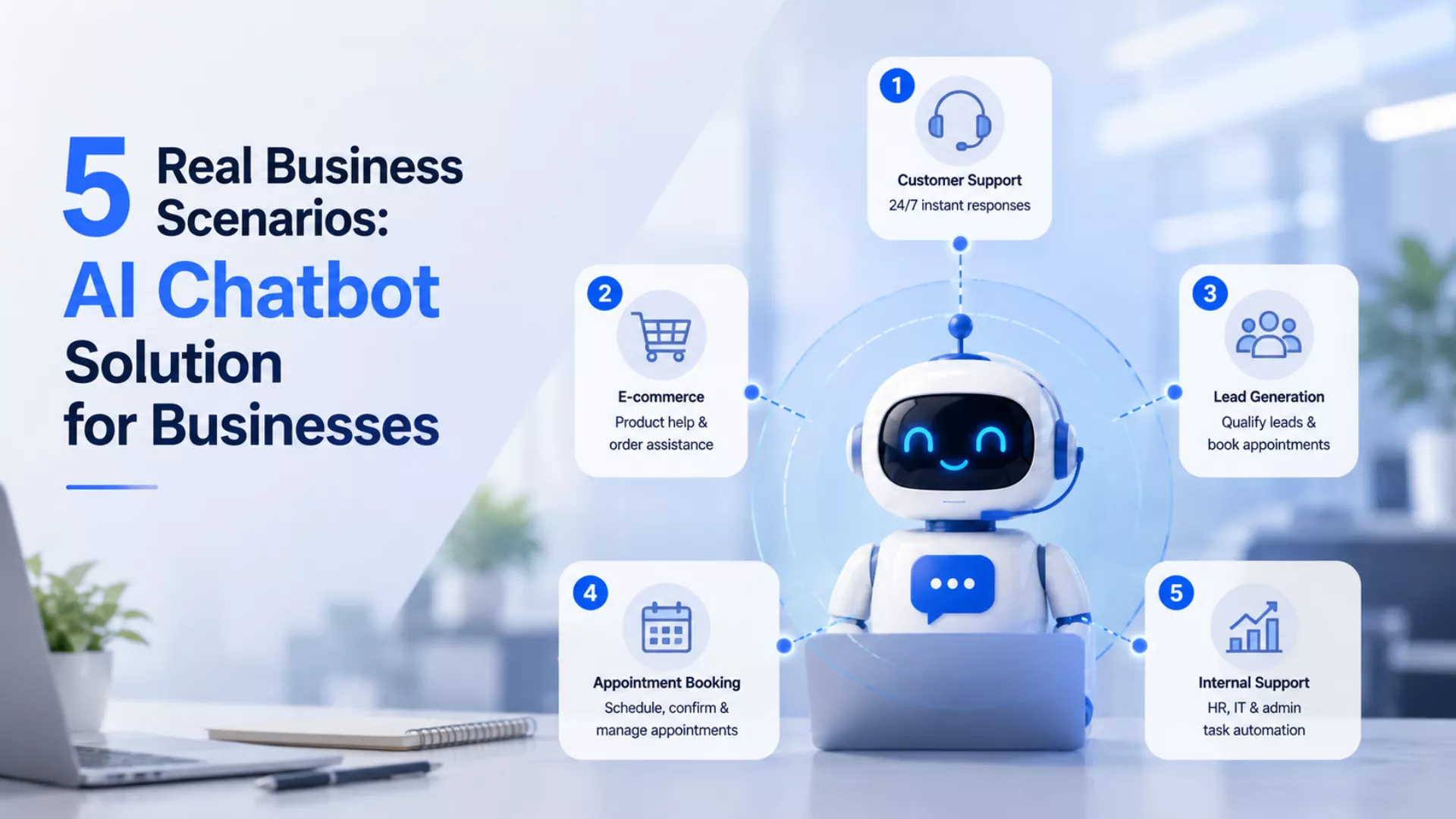
5 Real Business Scenarios: AI Chatbot Solution for Businesses

Let’s be honest. Most companies do not buy technology because it sounds exciting. They buy it because something hurts.
Customers are confused. Support tickets pile up. Staff repeat the same answers all day. Growth feels messy instead of smooth. Leaders start asking hard questions. Where are we losing time? Where are we losing money? Why does scaling feel so heavy? That is where an AI chatbot solution for businesses starts to matter. Not as a shiny feature. Not as a marketing add-on. But as a support infrastructure. A system that answers, guides, retrieves, and improves without burning out your team.
Across industries, the same pattern appears. When AI chatbots are deployed with clarity and governance, results show up in real numbers. Faster onboarding. Higher retention. Lower support costs. Better internal alignment. This article walks through real business scenarios. SaaS companies. Healthcare organizations. Customer support teams across industries. Enterprise internal operations. Each case reveals something simple. When conversational AI is structured, measurable, and aligned with business goals, it stops being a test feature. It becomes operational leverage.
Let’s look at where the impact truly shows.
Scenario 1: SaaS Companies
Software looks easy on the surface. Log in. Click around. Done. But inside, it is layered and complex. Users explore features, connect tools, and try to understand value fast. Some succeed. Many hesitate. Small moments of confusion grow into frustration. This scenario looks at how digital product companies handle onboarding friction and guide users toward real product confidence.
The Core Challenge
SaaS looks simple from the outside. Sign up. Log in. Use features. Upgrade. But inside, it is complex.
Users struggle with onboarding. They do not understand integrations. They get stuck on advanced features. Trial users leave before seeing value. Support teams answer the same “How do I?” questions every day. Feature confusion leads to churn. Slow onboarding delays time-to-value. Integration errors create frustration.
That is where an AI Chatbot for SaaS proves its worth. Users do not read manuals. They click. They test. They expect instant clarity. When setup feels slow or confusing, doubt grows quickly. Small roadblocks turn into canceled trials. What looks like minor friction quietly becomes lost revenue over time.
Strategic Value
A well-designed chatbot inside a SaaS platform acts as a live guide. It explains features in plain language. It retrieves answers directly from documentation. It supports users in-app without forcing them to open new tabs.
The result? Less friction. More clarity. Faster adoption.
Let’s break down the value more clearly.
- In-app contextual support
The chatbot answers based on where the user is inside the product. This reduces confusion fast.
- Documentation-driven retrieval
Instead of static help pages, the system pulls precise answers from updated product documentation.
- Feature discovery analytics
You can see which features users ask about most. That tells product teams where onboarding needs work.
- Churn signal detection
Repeated confusion around billing or integrations often signals churn risk. Chat patterns reveal it early.
- Integration guidance automation
Instead of waiting for support tickets, users get structured, step-by-step help instantly.
Measurable Impact
SaaS leaders do not care about theory. They care about metrics.
When conversational AI is implemented correctly, companies track:
- Time-to-resolution
- Trial-to-paid conversion
- Feature adoption rate
- Ticket deflection rate
- Retention uplift
This is how an AI chatbot for customer service functions inside SaaS. It shortens onboarding loops. It reduces Tier-1 tickets. It gives users confidence. And confidence keeps customers.
Scenario 2: Healthcare Organisations
Healthcare is different. Stakes are higher. Emotions are stronger. Compliance matters. Patients need answers before they even walk through the door. Staff juggles calls, paperwork, and policy checks all day. Small delays create stress. Clear guidance reduces it. This scenario explores how medical organizations simplify communication while keeping processes organized and compliant.
The Core Challenge
Administrative overload is constant. Patients call to confirm appointments. They ask about insurance. They need pre-visit instructions. Staff members answer the same questions daily. Meanwhile, regulations like HIPAA and GDPR create pressure. Every communication must protect privacy.
This is where an AI chatbot for healthcare websites becomes valuable.
Patients feel anxious before appointments. They want clear steps, not long wait times. Staff feel stretched thin answering the same questions again and again. One missing detail can cause delays. Communication gaps create stress on both sides of the desk.
Strategic Value
Healthcare chatbots do not diagnose. They guide.
They help with:
- Appointment instructions
- Insurance clarification
- Procedure preparation steps
- Visiting hours
- Location directions
An AI agent healthcare environment works best when it retrieves approved documentation. It does not guess. It does not improvise. It pulls from structured sources.
Let’s answer a common question directly.
What are the key benefits of using AI chatbots in healthcare?
The key benefits include reduced administrative load, improved appointment completion rates, multilingual patient support, and faster procedural clarity without replacing human care. Healthcare organizations also use internal chatbots. Staff retrieves policy updates instantly. Compliance documentation becomes searchable. HR queries get faster answers.
Measurable Impact
When implemented well, healthcare teams track:
- Call centre volume reduction
- Appointment completion rates
- Administrative workload hours saved
- Patient satisfaction scores
The numbers are simple to deduce. Fewer repetitive calls. Faster answers. Less confusion. And because data governance is built in, privacy remains protected. This is where a structured AI chatbot solution for businesses proves it can operate even in regulated environments.
Scenario 3: Customer Support Operations Across Industry
This scenario is not about one industry. It is about a function. Customer support exists everywhere. E-commerce. Fintech. Education. Logistics. SaaS. Healthcare. Retail. And the pain is always similar. It is the heartbeat of every business. When customers reach out, they expect speed and clarity. But as volume grows, cracks appear. Repetition drains energy. Delays create frustration. Scaling teams becomes expensive. This scenario focuses on how support functions across industries manage high volumes without losing consistency or control.
The Core Challenge
Look across industries, and you will see the same issues.
- E-commerce and retail customers ask about orders and returns.
- Fintech and SaaS companies struggle with logins, billing, and integrations.
- In healthcare and education, people need clarity on schedules, policies, and account access.
Different sectors. Same pressure.
Tickets fill up with repetitive questions. Agents repeat answers all day. As companies grow, volume grows with them. Hiring more staff feels like the only option, but that adds cost and training time. Consistency starts to slip. This is where a Customer support AI chatbot becomes essential. It absorbs common queries, protects team energy, and stabilizes operations before support chaos sets in.
Support queues grow faster than teams expect. One busy week becomes the new normal. Agents rush. Quality slips. Customers repeat themselves. Small delays turn into bigger frustrations. Without structure, growth feels heavy instead of exciting, and morale begins to drop.
Strategic Value
Let’s look at the shift clearly.
| Challenge | Traditional Approach | Chatbot Approach |
| Repetitive tickets | Hire more agents | Automate structured answers |
| 24/7 coverage | Night shifts required | Always-on availability |
| Inconsistent responses | Manual variability | Governance-driven consistency |
| Scaling globally | Add regional staff | Multi-channel deployment |
This is what a Scalable customer support chatbot architecture looks like. It handles Tier-1 queries instantly. It routes complex issues to humans. It maintains tone consistency through centralized governance. Escalation logic becomes structured. First-response time drops dramatically. Cost per interaction decreases. And support headcount stabilizes instead of expanding endlessly.
Measurable Impact
Organizations track:
- First-response time
- Ticket deflection rate
- Escalation percentage
- Cost per interaction
- Support headcount stabilisation
When you compare pre- and post-deployment metrics, the financial impact becomes clear. This is not about replacing people. It is about allowing skilled agents to focus on complex, high-value cases. That is how an AI chatbot for customer service shifts from novelty to necessity.
Scenario 4: Enterprise Internal Operations
Not every challenge faces customers. Some live inside the company walls. Policies, procedures, onboarding steps, and compliance rules. They sit in documents that few people can find quickly. Employees waste time searching. Teams repeat answers daily. This scenario explores how organizations bring order to internal knowledge and reduce silent productivity loss.
The Core Challenge
Employees search for HR policies. IT troubleshooting guides. Expense claim rules. Compliance documentation. Documents are scattered. Email chains grow. Internal tickets multiply. Productivity leaks quietly.
Inside large organizations, answers hide in folders, emails, and old documents. New hires feel lost. Teams interrupt HR and IT for simple things. Small questions create big slowdowns. Over time, scattered knowledge drains productivity and frustrates employees who just want clear direction fast.
Strategic Value
An enterprise chatbot becomes an internal knowledge infrastructure.
- Secure AI chatbot for internal use
- Role-based knowledge access
- Internal workflow support
- Compliance documentation retrieval
- Governance control
When structured correctly, it answers based on internal documentation. It respects access permissions. It centralizes policy retrieval.
Instead of emailing HR, employees ask the bot. Instead of searching five drives, they get direct answers.
Measurable Impact
Companies track:
- Internal query response time
- HR ticket reduction
- Employee onboarding acceleration
- Knowledge search time saved
The savings may not be flashy. But they add up. This is another layer where an AI chatbot solution for businesses creates value quietly. It reduces friction across departments. Less confusion. Faster onboarding. More clarity.
Scenario 5: E-Commerce and Retail Growth
Online stores move fast. Sales spike overnight. Campaigns bring waves of visitors. Questions follow quickly. “Where is my order?” “Can I return this?” “Is this in stock?” The excitement of growth often turns into operational stress behind the scenes.
The Core Challenge
Retail teams deal with waves of questions that rise without warning. A simple promotion can spark hundreds of new messages. Customers want fast updates on refunds, shipping times, and product availability. When responses slow, confidence drops fast, and complaints begin to appear.
During busy seasons, the pressure multiplies. Agents repeat the same answers again and again. Hiring short-term help seems like the only fix, even if the rush lasts just weeks. Growth should feel rewarding, not draining. But without structure, success can quickly become stress.
Strategic Value
An AI chatbot for e-commerce support handles high-frequency queries automatically. It provides order tracking guidance, return instructions, and product details instantly. Customers receive fast answers without waiting in line. Support teams step in only for complex issues. Clear automation absorbs volume without lowering service quality. Sales periods stay smooth instead of chaotic.
Measurable Impact
Retail businesses track improvements through:
- Order status inquiry reduction
- Refund processing clarity
- Peak-season response stability
- Customer satisfaction improvement
- Reduced review complaints
When service speed stays consistent, confidence rises. And confident customers buy again.
How GetMyAI Helps
Technology matters. Structure matters more.
GetMyAI is built as a controlled conversational infrastructure layer. It centralises AI agents inside a single Dashboard. It connects Activity with analytics. It supports multi-channel deployment across website embeds, Slack, Telegram, and WhatsApp.
Every conversation appears in Activity. Unanswered questions are flagged. Teams add answers through Q&A. The system retrain. Improvement loops stay continuous.
Analytics track:
- Total conversations and messages
- Average response time
- Engagement rate
- Chats by country and channel
This visibility transforms experimentation into a measurable strategy.
Customisation stays simple. Appearance. Suggested messages. Security visibility. No code required. Payments and subscriptions are handled securely through Stripe. Payment data is stored with Stripe, not locally. When deployed correctly, GetMyAI becomes more than a chatbot. It becomes structured operational support.
Across SaaS, healthcare, customer service, and enterprise environments, the architecture stays consistent. Training flows remain unified. Governance remains clear. That consistency is what turns conversational AI into dependable infrastructure.
Conclusion
Technology is everywhere. Impact is rare. The difference lies in structure. When deployed without governance, chatbots feel chaotic. When deployed with discipline, they drive measurable gains. SaaS companies reduce churn and improve onboarding clarity. Healthcare organisations cut administrative load. Support teams scale without hiring. Enterprises simplify internal knowledge retrieval.
In every case, the numbers are the mirror. An AI chatbot solution for businesses works best when it connects centralized control, continuous improvement, analytics visibility, and multi-channel reach. That is not hype. That is architecture meeting execution. The future of conversational systems is not about replacing humans. It is about reducing friction, protecting time, and creating structured clarity at scale. And when that happens, impact becomes measurable.
FAQs
1. Can an AI Chatbot for SaaS improve retention?
Yes. Faster time-to-value and reduced confusion increase activation and lower churn.
2. Why is an AI chatbot valuable for healthcare websites?
An AI chatbot for healthcare websites reduces repetitive patient inquiries and clarifies appointment steps instantly.
3. What KPIs define chatbot success in support teams?
First-response time, escalation percentage, cost per interaction, and headcount stabilisation.
4. How does an AI chatbot solution for businesses help internal teams?
It centralises policy retrieval and reduces repetitive HR and IT queries.
5. What measurable benefits appear internally?
Reduced HR tickets, faster internal query resolution, and time saved in document searches.