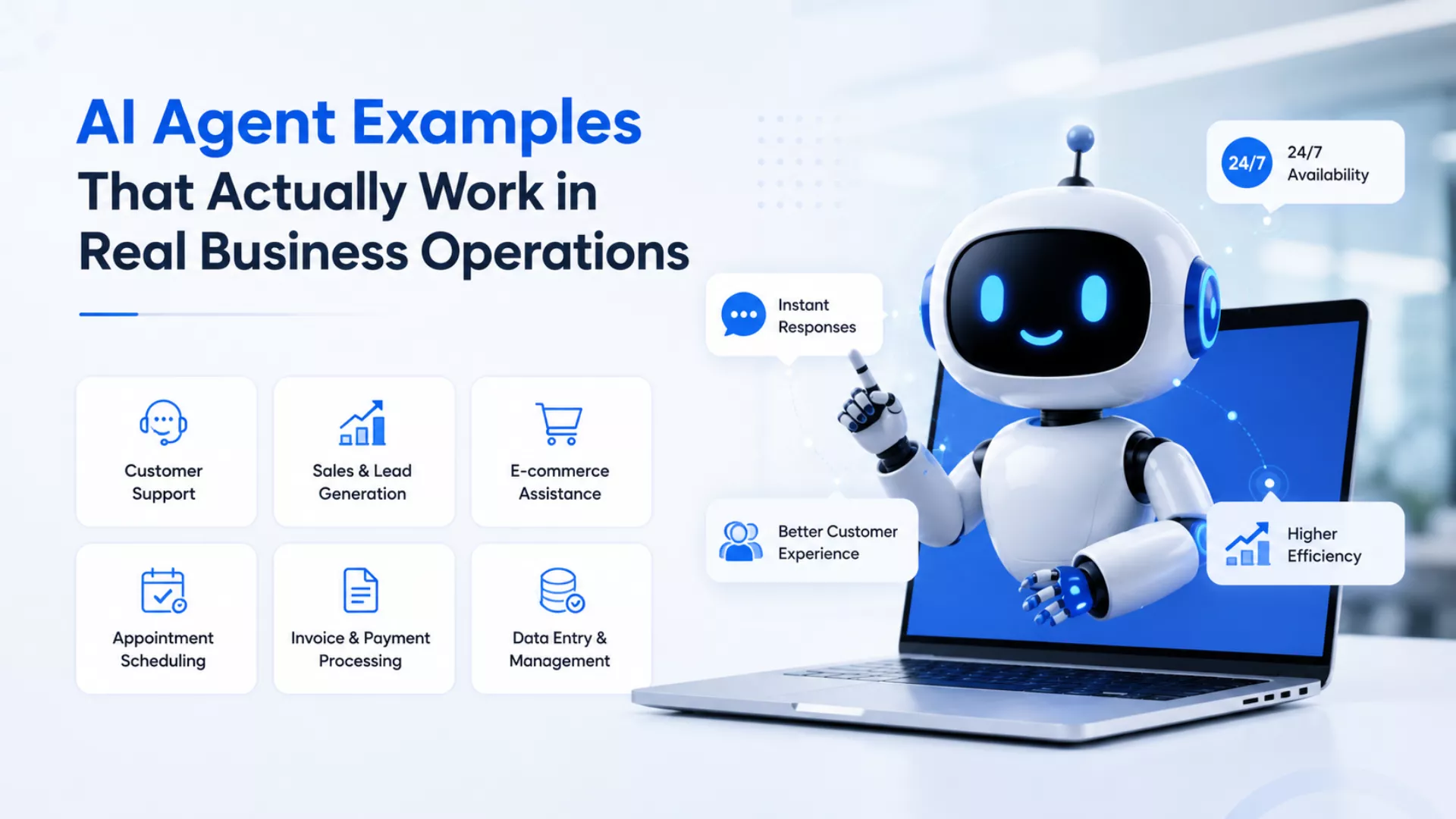
AI Agent Examples That Actually Work in Real Business Operations

Key Takeaways
- Deploy AI agents for customer support on trusted business knowledge instead of standalone models. It's more accurate and far more reliable.
- Treat AI adoption as business process automation, not just chatbot deployment. Bring in governance and workflows from day one.
- Use conversational AI for customer support to handle routine queries, hold onto context and hand off tricky cases smoothly.
- Skip the one-size-fits-all assistant. Specialized multi-agent systems let agents work together across research, compliance and operations.
- Judge success by outcomes, not raw AI capability. Track effort saved, faster workflows and steady improvement from real use.
Customer support teams are under pressure to resolve more enquiries, reduce response times and maintain consistent service without expanding headcount. As a result, many organizations are evaluating conversational AI for customer support to automate repetitive interactions while keeping human agents focused on complex conversations. The challenge is knowing which AI capabilities create measurable business value and which remain limited to product demonstrations or isolated pilots.
AI agents for customer support are autonomous software systems that retrieve information, reason through requests, use connected business tools and complete multi-step support tasks with minimal human intervention. Unlike traditional chatbots, they can automate workflows, assist support teams, escalate complex issues and deliver accurate responses using approved business knowledge across multiple customer channels.
What Are AI Agents?
Most businesses do not need another chatbot. They need software that can complete work, not simply answer questions. AI agents for business are autonomous software systems that understand a goal, break it into tasks, use connected tools and data and decide the next action with minimal human intervention. Unlike traditional automation that follows fixed rules, AI agents observe, reason, plan and act continuously, allowing them to handle customer support, sales, operations and knowledge-intensive workflows that change throughout the day.
It is already underway. The global agentic AI market is projected to grow from $9.14 billion to $139.19 billion by 2034, while analysts expect 40% of enterprise applications to include task-specific AI agents within the next few years. Yet only 17% of organizations have successfully deployed agents at scale, showing that success depends less on buying AI and more on building reliable systems connected to trusted business knowledge.
How Different AI Agents Make Decisions
Not every AI agent reaches decisions in the same way. Modern enterprise systems are defined by how they reason, validate information and coordinate work, rather than by traditional AI classifications. Understanding these architectures helps explain why some deployments consistently deliver business value while others remain limited to simple conversations.
| Agent Architecture | How It Works | Common Business Use Cases |
| ReAct (Reason + Act) | Reasons through a request, retrieves information, then decides the next action. | Customer support, knowledge retrieval, IT help desks |
| Plan-and-Execute | Breaks large goals into smaller tasks and completes them step by step. | Research, onboarding, workflow automation, operations |
| Reflection Agents | Reviews and validates its own output before completing a task. | Finance, legal, healthcare, compliance |
| Multi-Agent Systems | An orchestrator assigns work to multiple specialized agents that collaborate on the final result. | Enterprise workflows, cross-functional automation, complex business processes |
Functional Capabilities of Modern AI Agents
The value of modern AI agents comes from what they can execute, not simply what they can answer. Enterprise AI agents for customer support combine reasoning, memory, planning and connected tools to complete work that previously required several employees or disconnected systems.
Reason Through Business Problems: Agents evaluate a request, retrieve supporting data and decide the next step, reducing unsupported answers across an AI-driven customer experience.
Remember Context Across Conversations: Agents separate short-term chat history from long-term knowledge, retrieving documentation through RAG for genuine customer interaction automation.
Use Business Tools Instead of Working in Isolation: Through protocols like MCP, agents securely connect to CRMs, ticketing systems and databases, enabling true automate customer support with AI.
Plan, Adapt and Collaborate: Large requests get broken into smaller tasks, with agents adjusting mid-workflow and collaborating on research, compliance or an AI-driven qualification workflow.
Govern Every Action: Trust matters as much as intelligence, so platforms validate outputs, log activity and enforce permissions, forming a true customer experience platform.
According to Forrester's The State of Agentic AI, 2026, organizations are realizing that successful deployments depend less on choosing the most advanced model and more on clean enterprise data, strong orchestration and governance. The competitive advantage comes from building a reliable digital workforce, not simply deploying smarter AI.
Real-World AI Agent Examples Across Business Operations
AI agents succeed for one reason: how they're built, not the industry they serve. Whether in support, finance or legal, they draw on trusted knowledge, connect with core systems, learn from real use and involve humans for judgment calls. That's why some become an enterprise conversational AI platform, others don't.
What Successful AI Agent Deployments Have in Common
- Grounded in Trusted Knowledge: Agents retrieve answers from approved documentation and policies through RAG, improving accuracy and reducing hallucinations across support workflows.
- Connected to Business Systems: Linking to CRMs, help desks and calendars lets agents update records, trigger workflows and automate business processes directly.
- Continuously Improve Through Feedback: Repeated questions and conversation analytics reveal documentation gaps, helping teams refine the knowledge base without rebuilding the system.
- Keep Humans in Control: Deployments automate routine work while escalating sensitive decisions to people, building trust and supporting scale over time.
The Human-in-the-Loop mechanism is highly important for AI automation. According to PwC's Global AI Agent Survey, 66% of early enterprise adopters report measurable productivity gains, showing that the strongest results come from combining AI autonomy with human oversight rather than replacing people entirely.
Real-World AI Agent Examples Across Business Operations
1. Customer Support: From Answering Questions to Resolving Requests
Most support teams aren't overwhelmed by hard questions. They're overwhelmed by volume: password resets, order updates, billing enquiries, refunds and policy lookups eating up hours that skilled agents could spend on harder issues.
Modern AI agents for customer support handle these workflows end-to-end, retrieving information from knowledge bases, checking CRM records, validating accounts and interacting with shipping systems to complete actions, not just suggest them. When a request falls outside confidence thresholds, it transfers to a human agent with full context attached.
Gartner estimates conversational AI and autonomous support agents could cut global contact center labor costs by nearly $80 billion, making support one of the clearest enterprise use cases for agentic AI.
2. Shopify Sales & Ecommerce: Every Customer Wants a Different Store
Two customers can land on the same product page with completely different intentions. One's comparing alternatives, another's ready to buy and someone else just wants to check the return policy.
Rather than showing everyone the same thing, an AI chatbot for Shopify reads browsing behaviour, past purchases, inventory and natural conversation before adapting the experience. It recommends complementary products, answers product questions, recovers abandoned carts and even validates transactions before payment.
Adobe Analytics reports that AI-generated retail traffic increased 693% year over year, while converting 31% higher than traditional acquisition channels, demonstrating that personalized decision support performs better than generic recommendations.
See How AI Sales Agents Personalize Shopify Stores
Traditional ecommerce chatbots answer questions. AI sales agents understand buyer intent, recommend products, recover abandoned carts, and guide shoppers toward purchase decisions in real time.
3. Human Resources & Internal Support: The Questions Employees Ask Every Week
Every HR department receives the same questions repeatedly:
- How many leave days do I have?
- Where can I find the reimbursement policy?
- Has my onboarding documentation been approved?
- When will payroll be processed?
Rather than creating another support queue, AI agents retrieve answers directly from internal policies, automate onboarding checklists, screen resumes against defined job requirements and remind employees about pending compliance documents. HR teams spend less time responding to repetitive requests and more time supporting people.
According to SHRM, resume parsing and candidate screening represent 16% of active HR automation deployments, making recruitment one of the earliest enterprise applications of AI agents.
4. Legal & Compliance: Reading Thousands of Pages So Lawyers Don't Have To
Imagine reviewing hundreds of supplier agreements before a regulatory deadline. Finding one inconsistent clause buried inside thousands of pages can delay procurement, introduce compliance risks or trigger expensive legal disputes.
AI agents accelerate this process by retrieving relevant regulations, identifying unusual contract language, comparing agreements against corporate policies and highlighting exceptions for legal review. The objective is not to replace lawyers. It is allowing them to focus on decisions rather than document searches.
Organizations implementing agent-driven contract analysis have reported up to 80% faster processing cycles, while improving auditability and governance across procurement and compliance workflows.
5. Finance & Risk Management: Traditional Analysis vs Agentic Analysis
| Traditional workflow | AI agent workflow |
| Gather reports from multiple systems | Retrieve financial data automatically |
| Build spreadsheets manually | Consolidate information in real time |
| Review historical performance | Evaluate live financial signals |
| Draft risk summaries | Generate structured, audit-ready reports |
| Wait days for approval | Complete analysis in minutes |
Instead of acting as calculators, financial AI agents function as research assistants that connect securely with accounting systems, risk databases and reporting platforms to prepare evidence-backed recommendations.
Case studies show autonomous financial agents have increased analyst productivity by 20% to 60%, while improving commercial credit turnaround times by roughly 30%.
6. Technical Support & Documentation: Giving Engineers Their Time Back
Engineering teams lose valuable hours searching documentation rather than solving technical problems. Modern AI agent assist systems reduce that friction by acting as an intelligent retrieval and execution layer.
They can:
- Search technical documentation using natural language.
- Locate relevant code repositories.
- Identify broken APIs or dependencies.
- Generate and validate code fixes.
- Summarize technical documentation for faster troubleshooting.
The Anthropic Economic Index found that 34% of advanced AI model usage now supports programming and mathematical tasks, making software engineering one of the largest production environments for enterprise AI agents.
7. Hospitality & Guest Services: One Conversation Across an Entire Journey
A guest books a hotel weeks before arrival. Later, they request an airport pickup, ask for an early check-in, change their reservation and finally request restaurant recommendations after arriving.
Instead of treating every interaction as a new conversation, AI agents remember guest preferences, retrieve previous bookings, coordinate with reservation systems and update itineraries automatically across connected travel platforms. The experience feels continuous rather than fragmented because the context follows the guest throughout their journey.
That expectation is becoming mainstream. KPMG found that 70% of consumers would trust an AI agent to manage flight bookings, while 65% would also use one to book hotels, reflecting growing confidence in autonomous travel assistance.
Deploy AI Agents That Deliver
Build document-grounded AI agents that automate customer support while keeping every response accurate and consistent.
How AI Agents Work Together in Multi-Agent Systems
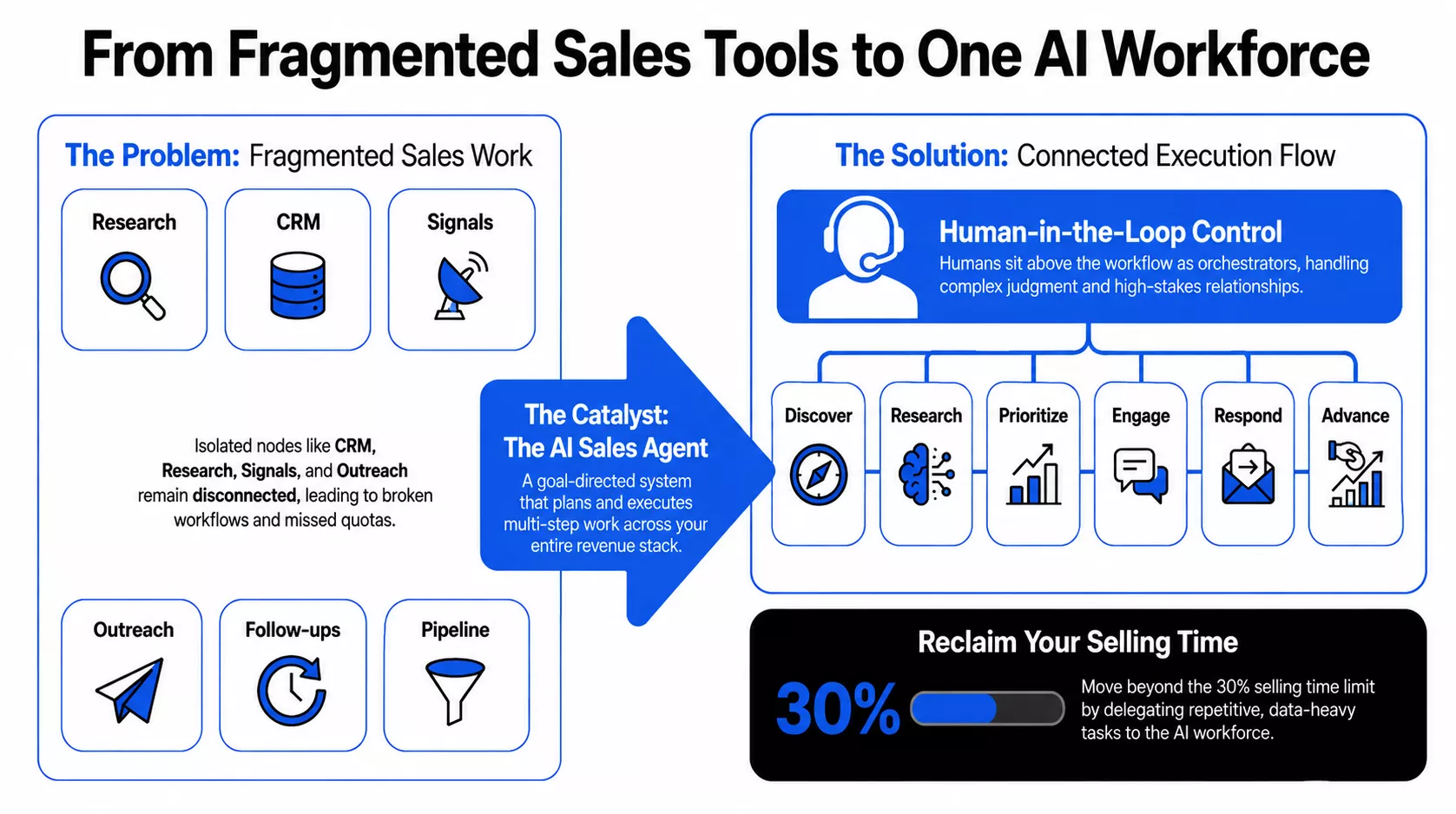
A single AI agent can complete many tasks, but enterprise workflows cannot depend on one capability alone. Research, compliance, customer support, approvals and reporting often require different expertise. Instead of forcing one model to handle everything, organizations increasingly deploy multi-agent systems where specialized agents collaborate to complete complex work.
A typical workflow looks like this:
- Orchestrator Agent: Receives the request and decides how the work should be divided.
- Specialized Agents: Individual agents retrieve knowledge, analyze data, perform calculations, check compliance or interact with business systems.
- Shared Context: Each agent passes its output to the next while maintaining access to the same business knowledge and conversation history.
- Coordinated Delivery: The orchestrator combines the results into one accurate response or completed workflow.
This improves accuracy, scalability and operational efficiency because every agent focuses on a specific responsibility instead of attempting to solve every problem alone. As enterprise adoption grows, coordinated multi-agent workflows are becoming the preferred architecture for managing complex business operations across customer service, finance, legal and internal support.
What's Coming up for AI Agents?
Enterprise AI is moving beyond standalone assistants toward coordinated digital workforces that execute business processes with governance, transparency and human oversight. The next generation of AI agents will be defined less by smarter conversations and more by how effectively they collaborate, integrate and operate across the enterprise.
- AI coworkers will manage complete workflows, coordinating research, approvals, reporting and execution instead of completing isolated conversational tasks.
- Multi-agent orchestration will become the enterprise standard, allowing specialized agents to collaborate through shared knowledge and delegated responsibilities.
- Deeper business integrations through standards like MCP and A2A will connect agents securely with enterprise applications, databases and external services.
- Governance will become a core capability, with audit trails, permission controls, policy enforcement and guardian agents monitoring autonomous decisions.
- Humans will remain responsible for high-impact decisions, while AI automates repetitive work, escalates exceptions and continuously improves operational efficiency through feedback.
Why GetMyAI
By now, one pattern should be obvious.
The organizations getting measurable value from AI are not the ones deploying the biggest models. They are the ones giving AI something trustworthy to work with.
Every successful example in this guide shares the same foundation. Customer support agents answer from approved documentation. HR agents retrieve company policies instead of guessing. Legal agents work against governed contracts. Finance agents analyse connected business data instead of isolated spreadsheets. Intelligence comes from knowledge before models.
That raises a question.
If every department needs its own AI agent, do you build a separate assistant for every team or do you build one trusted knowledge foundation they can all share?
GetMyAI was designed around the second.
Instead of maintaining disconnected bots, each with its own training and inconsistent answers, organizations can build a centralized knowledge layer once and deploy specialized agents wherever work happens. One agent can support customers, another can help employees inside Slack, another can surface technical documentation, while another handles product discovery or internal policies. Each has a different responsibility, but every response comes from the same governed source of truth.
That changes the conversation from deploying AI to operating AI.
As new workflows emerge, you are not rebuilding assistants from scratch. You are extending a digital workforce that already understands your business, works from approved knowledge and improves every time people interact with it. That is how AI moves beyond demonstrations and becomes part of everyday operations.
Put AI Agents To Work
Launch document-grounded AI agents that support customers, employees and business operations from one trusted knowledge base.
FAQs
What is the difference between an AI agent and a traditional chatbot?
Traditional chatbots follow predefined conversation flows and respond to scripted queries. AI agents can reason through requests, retrieve information from business systems, use tools, complete multi-step tasks and adapt their actions based on context instead of following fixed rules.
How do AI agents for customer support improve business operations?
AI agents for customer support automate repetitive enquiries, retrieve accurate information from approved knowledge sources, integrate with business systems and escalate complex requests to human teams, helping reduce workload while improving response consistency and operational efficiency.
Can AI agents integrate with existing business software?
Yes. Modern AI agents connect with CRMs, ticketing platforms, ERPs, collaboration tools, calendars, APIs and internal databases. These integrations allow agents to retrieve information, update records, trigger workflows and support business process automation without replacing existing systems.
Can AI agents work across multiple departments?
Yes. The same knowledge foundation can support specialized AI agents for customer support, HR, finance, legal, sales and technical teams. Each agent performs a different role while accessing approved business information to deliver consistent and governed responses.
How do businesses prevent AI agents from giving incorrect answers?
Organizations reduce inaccuracies by grounding AI agents in approved documentation through Retrieval-Augmented Generation (RAG), limiting responses to trusted business knowledge, applying governance controls and routing uncertain or high-risk requests to human reviewers.
What is a multi-agent system?
A multi-agent system uses several specialized AI agents that collaborate on a shared workflow. One orchestration agent distributes work to dedicated research, compliance, retrieval, or execution agents before combining their outputs into a single business-ready result.
Is conversational AI for customer support suitable for enterprise businesses?
Yes. Enterprise deployments focus on governance, security, integrations and scalability. Conversational AI for customer support is commonly used to automate repetitive interactions while maintaining audit trails, permission controls and human oversight for sensitive decisions.
How do businesses measure the success of AI agent implementations?
Success is measured through operational outcomes such as reduced response times, lower support costs, higher automation rates, improved employee productivity, faster workflows and increased accuracy, rather than the number of conversations an AI handles.