Most leaders believe they understand their cost structure. They track headcount. They monitor revenue per employee. They review technology spend. They debate hiring plans.
Yet very few measure how much time their organization loses simply trying to find information. Internal knowledge loss is rarely visible on a balance sheet. It does not show up as a line item. It does not trigger a budget alert. But it quietly erodes momentum across every department. Employees spend an average of 1.8 hours per day searching for information. That equals roughly 450 hours per year per employee. Nearly a quarter of the workweek.
The issue is not that knowledge does not exist. The issue is that it is scattered. When knowledge lives across shared drives, PDFs, email threads, Slack channels, intranet portals, and disconnected systems, employees become search engines. They hunt, cross-check, verify, and re-verify. Customers feel the delay. Patients feel the delay. Clients feel the delay.
Time friction compounds into operational drag. This is not a storage problem. It is a momentum problem.
The Real Cost of Internal Search Time
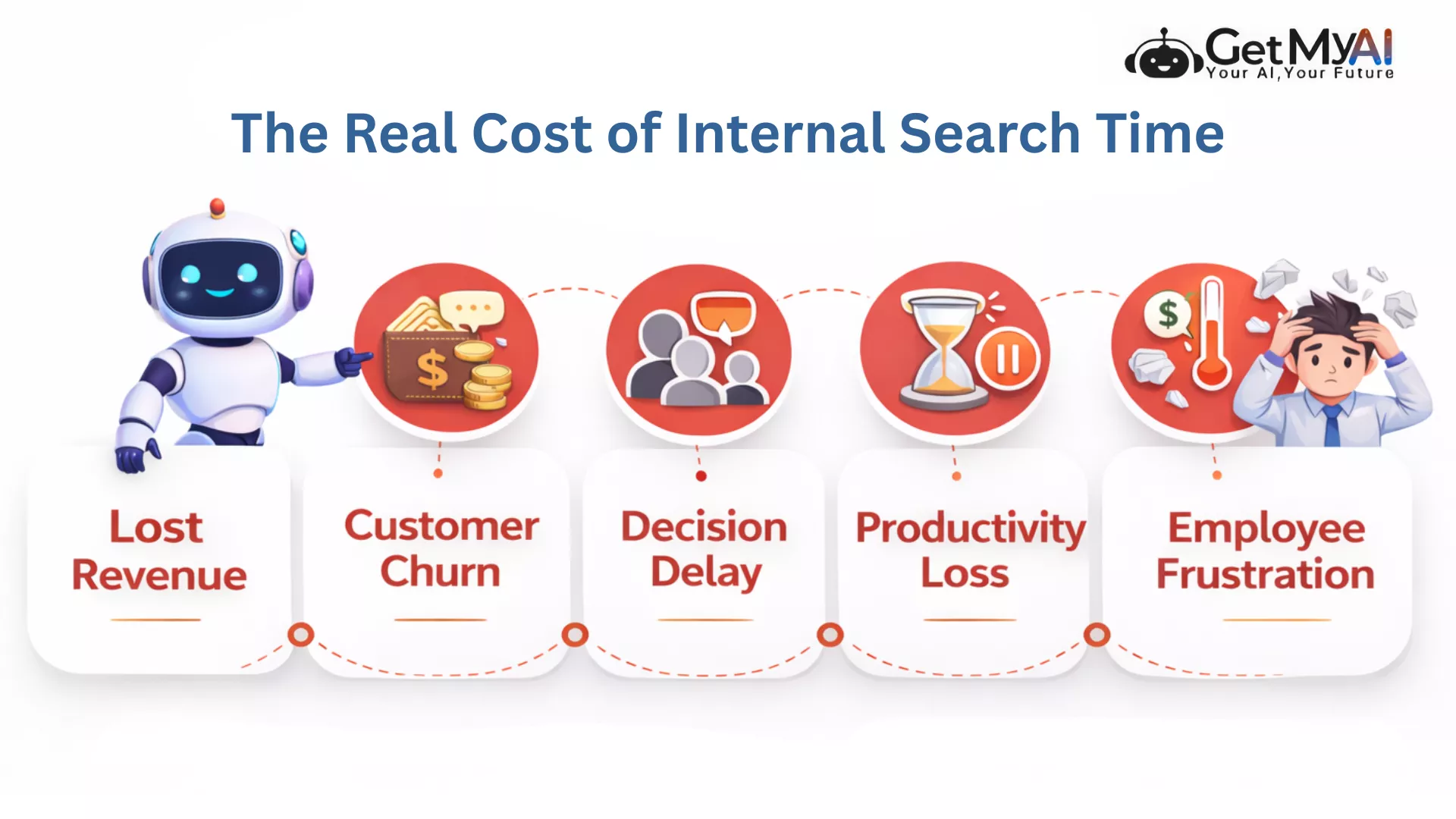
Leaders often convert search time into salary cost. That math is useful, but it is incomplete. The more serious cost is decision delay.
When a support agent spends ten minutes searching for an updated refund policy, the customer waits. When a nurse looks for the latest insurance documentation protocol, patient flow slows. When a sales manager cannot locate the correct pricing sheet, the deal pauses.
Search time interrupts flow. Flow is what keeps customers engaged, teams confident, and operations stable.
International Data Corporation estimates that information inefficiencies cost businesses roughly $19,000 per information worker each year. But even that number understates the impact because the loss is not just monetary.
It is behavioral.
- Customers lose interest.
- Prospects cool off.
- Patients lose confidence.
- Employees feel frustrated.
- Managers lose visibility.
In fast-moving environments, hesitation creates doubt. When information retrieval is slow, trust erodes quietly.
How Knowledge Fragmentation Happens
This problem did not appear overnight. It evolved. As organizations digitized, they adopted tools to improve efficiency. Project management systems. Collaboration apps. Knowledge bases. Email archives. File storage platforms.
Each solved a local problem. Collectively, they created fragmentation. Documentation exists in multiple versions. Policies are updated but not centralized. Teams stores files where it feels convenient. Institutional knowledge remains trapped in conversations rather than structured repositories.
No one system holds authority. Over time, organizations lose clarity about where truth lives. Employees adapt by searching everywhere; it becomes normal. Leaders accept the friction because it feels familiar. But that familiar inefficiency is still inefficiency.
Knowledge fragmentation impacts every sector. But in certain industries, the consequences are sharper and more immediate.
1.Healthcare
In healthcare, information is not just paperwork. It includes treatment protocols, insurance rules, discharge instructions, compliance updates, and patient history. Doctors, nurses, and administrators depend on this information to make fast and safe decisions. When it is scattered across systems, even simple tasks take longer than they should.
For patients, delays create anxiety. Waiting for approval, clarification, or documentation affects trust. In hospitals and clinics, even small slowdowns can impact patient flow. Appointments run late. Billing errors increase. Staff feel pressure.
An AI chatbot for healthcare reduces this friction. It retrieves updated guidelines, insurance details, and policy information instantly from verified sources. Instead of searching through portals or files, staff ask a direct question and receive a clear answer. This shortens wait times, improves coordination, and allows medical professionals to focus on care instead of hunting for documents.
2.Banking and Financial Services
In banking, information means compliance policies, product terms, regulatory updates, risk procedures, and account guidelines. Frontline agents and back-office teams rely on precise documentation. Even minor inaccuracies can lead to customer dissatisfaction or regulatory exposure.
For customers, clarity equals confidence. When answers about loans, fees, or account policies are delayed, trust weakens. Financial decisions are time-sensitive. Slow responses make customers question reliability.
An AI chatbot for banking customer service helps retrieve policy-based answers instantly. It pulls from approved documentation and ensures that responses stay consistent with compliance rules. Agents no longer search across multiple systems. They get direct, structured answers. Customers receive faster service, and the institution reduces the risk of incorrect guidance. Speed and accuracy become part of daily operations rather than occasional success.
3.SaaS and Technology Companies
In SaaS, information includes release notes, pricing updates, feature documentation, integration guides, and troubleshooting steps. Products evolve quickly. Documentation changes often. Teams must stay aligned with the latest updates.
For customers, inconsistency creates confusion. If sales shares outdated pricing or support references old features, trust drops. Onboarding slows. Churn risk increases.
An AI chatbot for SaaS companies unifies access to product updates and knowledge bases through structured retrieval. Support agents access current documentation without switching tools. Sales teams confirm plan details and discounts with confidence. Customers receive reliable guidance every time. Instead of reviewing long change logs, employees interact with an AI-driven system that understands intent. This reduces confusion, speeds implementation, and strengthens customer satisfaction.
4.Manufacturing and Supply Chain
In manufacturing, information means standard operating procedures, safety instructions, quality checks, vendor specifications, and compliance documentation. Production depends on clear and accessible processes. When documentation is fragmented, efficiency declines.
For customers and partners, delays in production or shipment affect confidence. A missing specification or outdated process can slow assembly lines. Small errors compound into larger disruptions.
Structured AI-powered support for manufacturing services allows teams to retrieve updated procedures instantly. Engineers and supervisors access verified documents without interrupting workflow. Instead of searching through shared drives, they receive direct answers. This reduces downtime, protects quality standards, and maintains production flow. Faster retrieval means fewer bottlenecks and more predictable delivery timelines for customers.
5.Professional and B2B Services
Consulting, legal, and advisory firms, information includes case histories, regulatory references, proposals, client documentation, and internal best practices. Institutional knowledge is the foundation of expertise.
For clients, speed signals competence. When advisors pause to search for prior documentation, confidence weakens. Long turnaround times suggest uncertainty.
An AI chatbot streamlines how professionals reach structured information. It delivers relevant documents, summaries, and policy updates almost instantly. Teams respond with clarity and precision. Instead of spending time searching through old records, they invest time in strategy and client care. Faster retrieval increases confidence and improves service quality. Knowledge stays organized and ready when needed.
Why Traditional Knowledge Management Falls Short
Most organizations attempt to solve fragmentation by centralizing storage. They build portals. They create intranet pages. They add search bars. But a single storage location does not mean that extracting the required information will become easier.
Search functions rely on keywords. Employees do not always know the exact phrase to type. They approximate. They skim results. They open multiple files. The cognitive load remains high. Traditional knowledge management requires users to adapt to systems. Modern operational environments require systems to adapt to users.
- Static documents do not answer follow-up questions. If an employee needs clarification, they must open another file or ask a colleague. The system does not continue the conversation.
- Version control becomes unclear. Multiple copies of policies exist. Staff waste time confirming which file is the latest approved one.
- Knowledge updates are slow to reflect across teams. When a policy changes, the update does not automatically guide future queries.
- There is no context memory. The system does not understand previous interactions or user roles, so answers remain generic.
- There is no feedback loop. When employees fail to find information, the system does not learn from the gap.
This is where retrieval architecture changes the equation.
From Search to Retrieval
The shift is subtle but significant. Search requires a question to match a keyword. Retrieval understands meaning. An Enterprise AI chatbot software layer reads structured documents and retrieves answers based on context, not exact phrasing. It reduces the scavenger hunt.
Instead of asking, “Where is that file?” employees ask, “What is the updated refund policy?” and receive a sourced response. That difference matters.
- It removes the intermediate step of hunting.
- It preserves cognitive bandwidth.
- It restores flow.
In practice, this means the AI chatbot connects directly to approved knowledge sources and delivers answers inside the same workspace where teams already operate. There is no need to switch tabs, open multiple folders, or scan long documents. The system identifies the relevant section, presents a clear summary, and links back to the source. Decisions happen faster because the answer appears within the workflow itself.
Why This Is Not Just a Chatbot Discussion
Many organizations assume this is about adding a chat interface. It is not. An Enterprise-grade AI chatbotl is not a pop-up widget. It is a structured retrieval layer integrated into workflows. It enforces boundaries. It retrieves only from approved sources. It escalates when uncertain.
Management matters. Without it, automation increases risk. With governance, retrieval increases confidence. Serious firms are not experimenting with casual chat tools. They are evaluating architecture.
They are moving toward an AI agent platform for business that connects knowledge sources, monitors unanswered queries, and supports continuous improvement. This is about connective tissue across systems.
The Operational Role of AI Agents
When retrieval becomes intelligent, employees shift from searching to deciding. They spend less time navigating folders and more time acting on verified answers. Instead of pausing to confirm details, they move forward with clarity. The workflow feels direct. Questions get resolved in one interaction, not five back-and-forth messages.
That shift improves:
- Response time
- Internal coordination
- Customer confidence
- Compliance accuracy
- Decision velocity
This is why AI agents for business are increasingly deployed not only in customer-facing roles but internally.
- They reduce search loops.
- They eliminate redundant communication.
- They create a single interface for structured knowledge.
Over time, this strengthens execution quality. Teams rely less on memory and more on verified retrieval. Errors decrease because responses are sourced. New hires ramp faster because knowledge is accessible on demand. In complex organizations, this level of structured access becomes a competitive advantage.
Knowledge Architecture as Infrastructure
Boards debate digital transformation. They invest in automation. They modernize CRM systems. Yet knowledge architecture often remains fragmented. If employees must search for answers, productivity declines regardless of the technology stack. A serious conversational AI platform does not replace systems. It connects them. It retrieves across them. It simplifies interaction without simplifying governance.
The question for executives is not whether knowledge exists. It is whether knowledge is usable at speed. Usability at speed defines competitive advantage.
Measuring Momentum, Not Just Cost
The most overlooked metric in organizations is momentum.
How long does it take for:
- Does a customer have a question to receive a clear answer?
- An employee to retrieve a policy?
- A sales team to confirm updated pricing?
- A compliance officer to validate documentation?
These are not abstract questions. They shape daily performance. When knowledge retrieval slows, performance compounds negatively. When retrieval accelerates, performance compounds positively. Momentum builds trust. Trust builds growth.
The Leadership Reflection
Fragmented knowledge feels manageable until it becomes systemic.
Leaders should ask:
- Where are teams losing time searching?
- Where are customers waiting because employees are unsure?
- Where does internal friction delay external response?
If answers require investigation, fragmentation already exists. The solution is not another shared folder. It is structured retrieval. An architecture that reads documents, retrieves meaning, enforces boundaries, and improves over time.
Knowledge is not just information. It is operational fuel. When that fuel is scattered, engines sputter. When it is centralized and retrievable at speed, organizations move with clarity. The companies that recognize this early will not only reclaim hours. They will reclaim momentum. And in competitive markets, momentum is the difference between reaction and leadership.
Knowledge architecture is not an IT detail anymore. It is an executive decision. The question is not whether your organization has information. It is whether your organization can access it fast enough to matter.
FAQs
1. Why are AI agents for business being deployed internally, not just for customers?
AI agents for business reduce knowledge fragmentation by retrieving policy, pricing, and procedural data without requiring employees to search across systems.
2. Can AI reduce churn risk in SaaS?
An AI chatbot for business can ensure consistent product messaging across sales and support teams.
3.Can retrieval speed protect quality standards?
AI-powered support for manufacturing services ensures teams have access to verified procedures without workflow interruption.
4.Can AI improve compliance accuracy?
Enterprise AI chatbot software ensures that every answer is tied to verified documentation.
5.What is the real competitive advantage here?
A conversational AI platform accelerates decision velocity by making verified knowledge usable at speed.