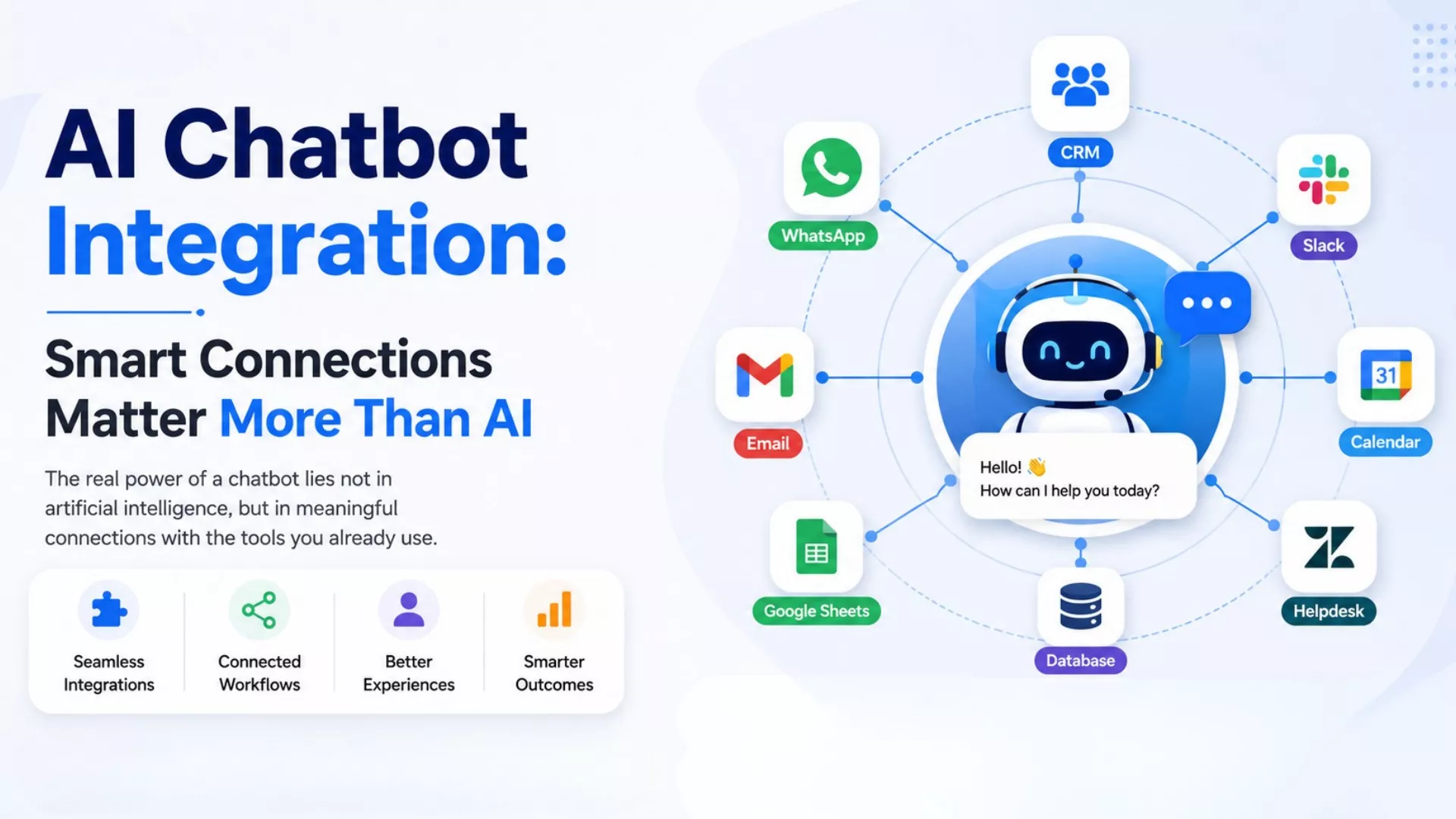
AI Chatbot Integration: Smart Connections Matter More Than AI

Key Takeaways
- A chatbot can be intelligent and still fail if it operates in isolation. Without proper integration, conversations can end without follow-up, context can be lost, and teams may struggle to see what customers previously asked.
- Chatbot integration is more than adding a chat widget to a website. Effective integration determines how conversations, customer information, channels, and internal teams work together.
- Businesses should connect systems gradually rather than integrate everything at once. The article recommends starting with the website and expanding connections based on what the business actually needs.
- API-backed integrations provide stability as chatbot usage grows. APIs help keep messages connected to the right systems and agents, protect data flow during updates, and reduce the risk of fragile integrations.
- Cross-channel continuity can make chatbot conversations more useful. The blog highlights a flow where a customer starts on a website and continues the conversation through WhatsApp without having to restart or repeat earlier questions.
Most teams start with a chatbot because they want faster replies. That makes sense. But speed alone does not fix broken handoffs, scattered tools, or missed follow-ups. We have seen this happen again and again. A chatbot answers questions, but the rest of the business stays disconnected.
This is where AI chatbot integration becomes the real deciding factor.
When a chatbot connects cleanly with your website, messaging channels, and internal tools, it stops being just a support widget. It becomes part of how the business works every day. The goal is not more automation. The goal is fewer gaps.
In this blog, we will explain why integration matters more than raw AI power, why API-backed connections are important even if you never touch code, and how businesses should think about chatbot integration before making a buying decision.
Why Chatbots Fail Without Integration
A chatbot can be smart and still fail. The problem is not intelligence. The problem is isolation.
When chatbots live on their own, they create friction instead of removing it. Customers ask questions. Answers arrive. Then the trail goes cold.
Common signs of weak chatbot integration include:
- Conversations end with no follow-up
- Context gets lost between messages
- Teams cannot review what users asked
- Insights stay trapped inside chat logs
These problems show up fast once volume increases. What works for ten chats a day breaks at a hundred. What works on a website alone does not work across channels.
This is why integration should never be an afterthought. It is the foundation.
What Integration Really Means in Practice
Integration is often misunderstood. Many teams think it starts and ends with adding a chat box to a site. In reality, integration shapes how conversations move, connect, and improve across the business. This section breaks down what integration truly means in day-to-day operations.
Beyond Adding a Plugin
Many buyers hear the word integration and assume it means installing a widget or enabling a feature. That view is too narrow. Real integration affects how information flows between conversations and teams. It decides whether a chatbot feels like a helper or just another disconnected tool on the page.
How Conversations Move Through the Business
Effective chatbot integration services are about smooth handoffs, not simple placement. Conversations should move between channels without dropping meaning or history. When teams view chats with full context, replies feel steady, and customers do not have to repeat themselves.
Connecting the Right Things in the Right Order
Good integration is not about connecting everything at once. It is about choosing what matters first. Most teams begin with the website, then expand carefully. When connections are added in the right order, the chatbot grows with the business instead of creating confusion or extra work later.
Why API Integration Matters Even Without Code
Here is a simple truth. Reliable integrations are built on APIs, whether users see them or not.
Chatbot integration is not about developers writing scripts all day. It is about stability, control, and scale.
APIs make sure that:
- Messages reach the right system every time
- Data does not break during updates
- Conversations remain linked to the right agent
- Growth does not introduce new errors
Without chatbot api integration, integrations become fragile. A small change can break the whole flow and disrupt conversations. With API-backed systems in place, things hold together as volume increases, keeping messages stable, context intact, and integrations reliable as the business grows.
From a buyer’s view, this means fewer surprises later.
From Website Chat to Ongoing Conversations
Most businesses begin with a chatbot on their website. That is the right place to start. It is where questions first appear.
But real value comes when conversations continue beyond the first visit.
This is where WhatsApp chatbot integration plays a strong role. Visitors ask a question on the site. The conversation continues on WhatsApp. No restart. No repeated questions.
This matters because buying decisions do not happen in one session.
For online stores, this matters even more. E-commerce chatbot integration helps answer product questions, manage order updates, and lower drop-offs without pushing shoppers back to forms or email.
- Website starts the conversation
- Messaging continues the relationship
- Context stays intact across sessions
This flow builds trust without adding effort for your team.
Integration That Supports Teams, Not Just Customers
Chatbots are usually viewed as customer-facing, even though their biggest impact is often behind the scenes. With proper integration, teams avoid constant interruptions, reduce back-and-forth, and work with better clarity across everyday tasks.
Chatbots Shape Internal Workflows
Chatbots do more than reply to visitors. They influence how teams handle questions, updates, and follow-ups. With proper AI chatbot integration, conversations are not lost or scattered. Teams see the full picture and can act with confidence instead of guessing what happened in earlier chats.
Less Noise, Better Focus for Teams
Without proper integration, teams move back and forth between tools and repeat routine checks. Integrated systems make work easier. Messages come to one place, information stays consistent, and teams avoid wasting time searching for answers.
Learning From Conversations Without Extra Effort
With strong integration, teams do not need to dig through long chat histories. Looking at Activity before Analytics helps them spot common questions, weak answers, and gaps that need attention. Updating Q&A feels like regular work, not something technical.
Alignment With Sales and Business Processes
Some leaders also think about how chat data connects with sales work. In these talks, terms like Salesforce chatbot integration may come up. What really matters is whether chat conversations fit how teams manage leads, handoffs, and follow-ups across the business.
Integration Services vs One-Time Setup
One of the biggest mistakes we see is treating chatbot setup as a one-time task.
Integration is not static. Businesses change. Content updates. Questions evolve.
Strong chatbot integration services focus on long-term use, not launch day.
- Integration should support content updates without breaking existing conversations or forcing teams to rebuild workflows
- Systems must allow easy improvements through Q&A additions when unanswered questions appear in Activity
- Teams need visibility into performance so integration supports decisions, not just message delivery
This is how chatbots stay useful after the first month.
What Decision-Makers Should Look For
If you are responsible for choosing a chatbot platform, integration should be one of your top evaluation points.
Look beyond feature lists. Ask how the system behaves once real traffic arrives.
Key things to evaluate:
- Does integration scale with message volume
- Can teams review and improve conversations easily
- Are connections stable without technical work
- Does context stay consistent across channels
These answers matter more than fancy demos.
How GetMyAI Brings Everything You Look For in One Place
At this point, the question becomes practical. How does a platform actually make all of this work without adding complexity for teams? This is where our AI Chatbot platform is designed to fit naturally into real business workflows, not sit on top of them.
Built for Connected Conversations, Not Isolated Chats
With AI chatbot integration at its core, it connects conversations across websites and approved messaging channels while keeping everything centralized in the Dashboard. Teams do not chase messages across tools. Every interaction stays visible, traceable, and tied to the same agent and context.
Simple Improvement Without Technical Effort
It is built around continuous improvement, not a one-time setup. When questions go unanswered, they appear clearly in Activity. Teams can add Q&A entries or update documents directly, retrain the agent, and improve accuracy without code or technical dependencies. This keeps the chatbot useful as business needs change.
Clear Visibility Through Activity and Analytics
Teams do not have to guess anymore. GetMyAI lets them review conversations in Activity first, then check patterns in Analytics. Seeing real questions before numbers helps teams understand intent better, making chatbot integration services easier to use for decision-makers.
Designed to Scale With the Business
Whether conversations happen on a website, WhatsApp, Telegram, or Slack, it keeps responses consistent as volume grows. From early-stage use to high daily traffic, the platform supports chatbot integration without breaking context, slowing response times, or forcing teams to rethink their workflows.
Conclusion
AI alone does not fix broken workflows. Integration does.
When done right, AI chatbot integration turns conversations into a connected part of the business instead of a side tool. It keeps context intact, reduces friction for customers, and gives teams the clarity they need to improve over time.
At GetMyAI, we believe integration should feel simple, reliable, and practical. We built our platform so teams can connect channels, review conversations in the Dashboard, improve answers through Q&A, and measure performance through Analytics without technical effort. GetMyAI is designed to grow with your conversations, not slow them down.
If you are evaluating chatbots, do not ask only how smart the AI is. Ask how well it connects. That is where long-term value lives.
Frequently Asked Questions
1. What is AI chatbot integration?
AI chatbot integration connects a chatbot with the channels, systems, and workflows a business already uses. The goal is to make conversations part of the wider business process rather than leaving the chatbot as an isolated support tool.
2. Why does a chatbot need integration?
A chatbot may provide useful answers but still create problems if the conversation ends there. Integration helps preserve context, support follow-ups, connect conversations across channels, and give teams visibility into customer interactions.
3. Is chatbot integration just adding a chatbot to a website?
No. Adding a chat widget is only one part of integration. The article explains that effective integration also involves how conversations move between channels, how information reaches teams, and how the chatbot connects with existing business processes.
4. Why are APIs important for chatbot integration?
APIs help create reliable connections between the chatbot and other systems. According to the article, they help messages reach the appropriate system, keep data stable during updates, maintain connections with the correct agent, and support growth without introducing unnecessary errors.
5. Can a chatbot conversation move from a website to WhatsApp?
Yes. The article gives website-to-WhatsApp conversations as an example of cross-channel integration. A customer can begin a conversation on the website and continue it on WhatsApp while keeping the conversation context instead of starting over.
6. How does chatbot integration help internal teams?
Integrated chatbot systems can reduce the need for teams to switch between tools, repeat routine checks, or search through disconnected conversations. Teams can see previous interactions, identify unanswered questions, and use those conversations to improve the chatbot.
7. What should businesses consider when choosing a chatbot integration platform?
The article recommends evaluating whether the integration can scale with message volume, preserve context across channels, remain stable without constant technical work, and make it easy for teams to review and improve conversations.
8. Is chatbot integration a one-time setup?
No. The blog treats integration as an ongoing process. Business content changes, customer questions evolve, and new gaps can appear in conversations. A useful integration should therefore support ongoing updates and improvements without requiring teams to rebuild their workflows.
9. How can businesses improve a chatbot after integration?
Teams can review actual conversations to identify common questions, weak answers, and information gaps. The article specifically describes using activity and analytics to understand conversations and adding or updating Q&A content when unanswered questions appear.
10. What is more important when evaluating a chatbot: AI capability or integration?
The article's main argument is that businesses should not evaluate AI capability alone. A highly capable chatbot can still create problems if it is disconnected from business workflows. Decision-makers should therefore pay close attention to how well the chatbot connects channels, preserves context, supports teams, and scales with the business.