Customer Success vs Customer Support: Why AI Agents Are Redefining the Line Between Them
 Jan 20, 2026
Customer success vs customer support
Customer Support Chatbot Development
AI chatbot development company
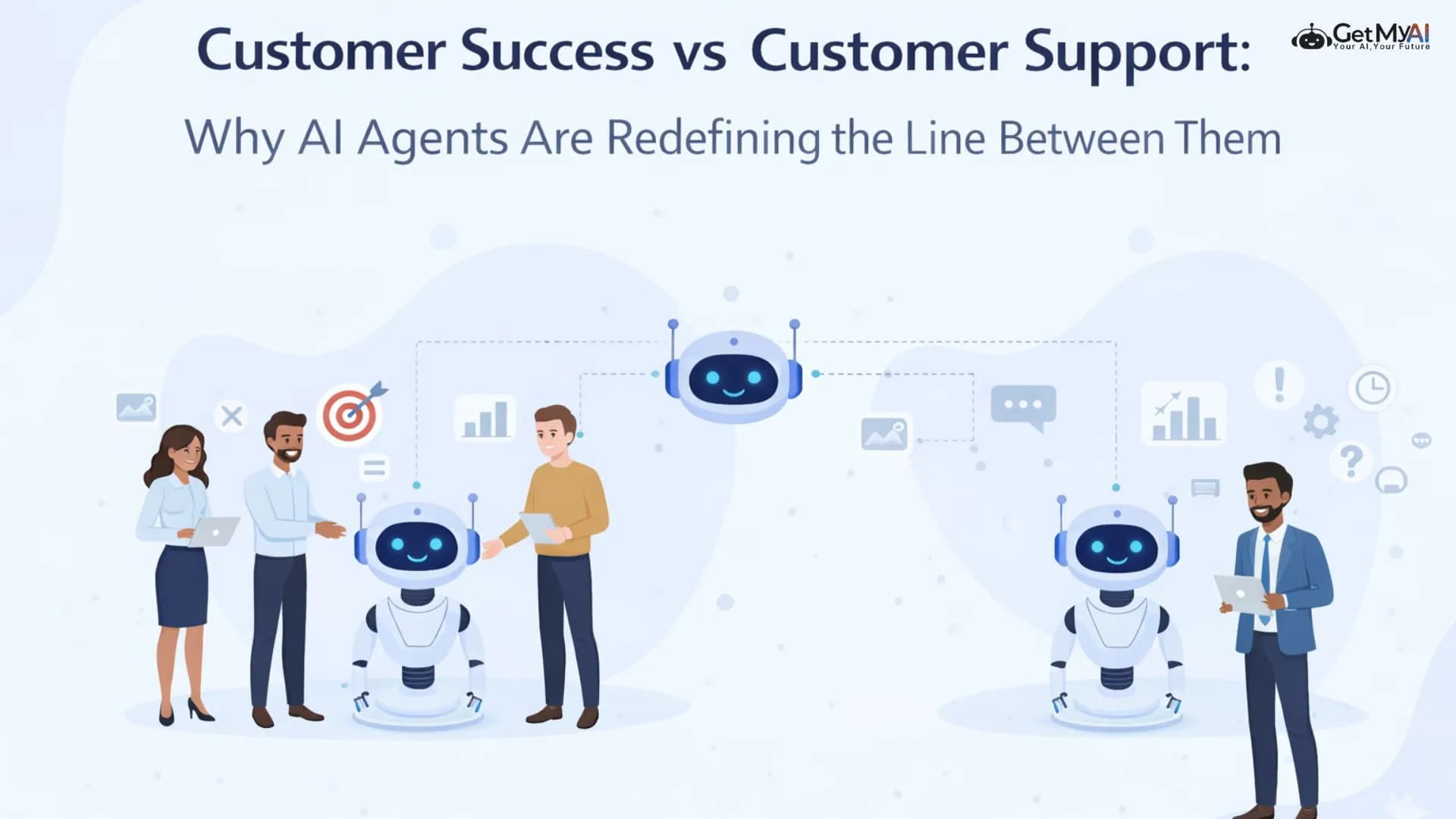
Leaders see this problem every day, even if it is not always named. Customers show up with direct questions and unclear goals, often under pressure to see value quickly. Inside the business, responsibilities are divided. Customer support resolves issues. Customer success focuses on outcomes. On paper, the structure looks logical. In real conversations, it rarely feels that clean.
A single customer message can carry more than one need. A technical question may signal confusion during onboarding. A request for guidance may be triggered by a small error. When teams treat these moments as separate workflows, friction appears. Customers are passed around, context is lost, and the chance to guide them at the right moment disappears. The result is not just slower service. It is mistrust and avoidable churn.
Customer expectations have changed. People no longer separate answers from direction. They expect both in the same interaction. They want problems resolved and clarity on what to do next without repeating themselves or waiting for handoffs.
This is where AI agents shift the model. In a chat-first environment, conversations do not pause for org charts. They flow. The line between customer success vs customer support fades because the customer only cares about the outcome. Did the conversation help them move forward with confidence?
Why Customer Success and Customer Support Were Separated in the First Place
For years, separating support and success was practical. Support teams were built to react. A ticket came in, an issue was fixed, and the case was closed. Speed and accuracy mattered most. The goal was to restore service and move on. This worked because most problems were clear and bounded. A login failed. A feature did not load. A bill looked wrong.
Customer success came later as products grew more complex. Leaders realized that fixing issues was not enough. Customers needed guidance to reach value. Success teams focused on onboarding, adoption, and renewals. They watched health scores and ran playbooks. This work was proactive by design. It assumed time, planning, and human touch.
The split also helped management. Different skills, different metrics, different tools. Support optimized for volume and resolution time. Success optimized for retention and growth. In an era of email and phone calls, this separation reduced chaos.
Why it made sense for human teams:
- Humans cannot be everywhere at once.
- Proactive guidance takes time and context.
- Reactive problem solving needs focus and speed.
This structure matched the limits of people and tools at the time. But it also locked teams into narrow roles. A support agent could see a risk but not act on it. A success manager might never see the early warning signs hidden in tickets. The model assumed customers would accept these boundaries. Today, they do not.
Where the Line Breaks Down in Real Customer Conversations
Customers do not think in categories. They do not wake up and decide to contact support or success. They open a chat and ask what they need to know. One question often carries many signals.
A simple support question like “How do I connect this tool?” may hide a bigger issue. The user might be stuck in onboarding. They might be close to giving up. Treating this as a quick fix misses the chance to guide them to value.
The opposite is also true. A successful moment often starts with a problem. A customer trying a new feature hits an error. That error is not just a bug. It is a moment where confidence can be built or lost.
When teams treat these as separate workflows, friction appears:
- Handoffs delay answers.
- Context is lost between tools.
- Customers repeat themselves.
- Opportunities for guidance slip away.
Leaders see this in metrics. Tickets get resolved, but adoption stays flat. Health scores look fine until they suddenly drop. The issue is not effort. It is structured. Conversations flow, but org charts do not.
This is where the idea of customer success vs customer support starts to feel outdated. The customer only sees one thread. They expect that thread to solve the problem and move them forward. Anything less feels like noise.
How AI Agents Naturally Combine Support and Success
AI agents do not inherit human boundaries. They operate on context, intent, and outcome. In one conversation, an AI agent for customer support can answer a question and guide the user to the next step that matters.
This happens naturally. The agent reads the question, pulls relevant knowledge, and understands where the user is in their journey. It does not stop at the fix if guidance is needed. It continues.
What this looks like in practice:
- Instant answers reduce frustration.
- Gentle prompts guide users forward.
- Early signals prevent bigger problems later.
For example, a user asks how to export data. The agent explains the steps. It then asks if the user wants help setting up reports. That is support and success in one flow.
Importantly, this does not replace teams. It changes their focus. Human agents handle edge cases, strategy, and relationships. The AI handles the steady stream of questions and guidance that make up most interactions.
This is why many teams using GetMyAI see fewer escalations and stronger early adoption. The agent acts as a bridge. It keeps conversations moving toward outcomes without forcing a handoff.
The result is not just efficiency. It is coherence. Customers feel guided, not processed.
What Changes Inside the Business When Support and Success Converge
When AI agents begin to handle both guidance and problem-solving in the same flow, the internal impact is immediate. Teams notice it first in small ways. Fewer escalations. Shorter conversations. Customers arriving at human touchpoints with a clearer context. Over time, the effect becomes structural, not just operational.
The biggest shift is how work gets defined. Instead of asking whether an interaction belongs to customer support or customer success, teams start asking what the customer needs to achieve next. That mindset reduces internal friction. It also changes how leaders think about coverage, staffing, and accountability.
This convergence reshapes daily operations in several practical ways:
- Support teams spend less time repeating answers and more time handling edge cases.
- Successful teams gain cleaner signals about real adoption risks.
- Knowledge gaps surface faster through repeated AI conversations.
- Customers experience fewer handoffs and less repetition.
- Managers see clearer links between conversations and outcomes.
As this pattern settles in, metrics begin to evolve. Resolution time still matters, but it no longer stands alone. Leaders start paying attention to confidence signals, such as whether users complete setup or return with follow-up questions that show progress. This is where customer success vs customer support stops being a debate and starts becoming a shared responsibility.
There is also a tooling shift. An AI Agent for Customer Support needs access to the same knowledge that successful teams rely on. That forces alignment. Documentation improves. Playbooks become more explicit. Assumptions get challenged when the agent cannot answer something clearly.
The strategic benefits show up quickly:
- Earlier detection of churn risk through conversation patterns.
- More consistent guidance across regions and time zones.
- Reduced dependency on individual team members’ memory.
- Faster onboarding without adding headcount.
- Better use of human time for relationship-driven work.
This internal clarity is often overlooked, but it matters. When support and success converge through AI, the organization becomes easier to run. Conversations stop bouncing between teams. Outcomes become visible sooner. That operational calm is often the first real sign that the model is working.
The Role of Customer Support Chatbot Development in This Shift
Not all bots can do this. Many fail because they were built to answer questions, not support outcomes. They rely on scripts or shallow intent matching. When a conversation drifts, they break.
Thoughtful Customer Support Chatbot Development changes that. It starts with a clear view of the customer journey and the knowledge that supports it.
Key elements that matter:
- Context awareness across the session.
- Access to clean, trusted knowledge.
- The ability to suggest next steps, not just answers.
This kind of bot does more than react. It understands when a support question hints at a success risk. It can adjust tone and depth based on where the user is.
Generic bots struggle here. They treat every question the same. That leads to dead ends and frustration. A well-built agent treats the conversation as a path.
Teams that invest in this approach often discover that the old split between support and success starts to fade on its own. The bot handles the overlap. Humans step in where judgment and empathy are needed.
This is also where GetMyAI fits naturally. The focus is on building agents that can carry context and intent through the conversation, without forcing teams to rebuild their processes from scratch.
Why Businesses Are Turning to AI Chatbot Development Companies
Building an agent that blends support and success is not a weekend project. It requires structure, discipline, and ongoing care. This is why many teams look to an AI chatbot development company instead of trying to do everything in-house.
There are three reasons this matters.
First, knowledge foundations. An agent is only as good as the information it can trust. Cleaning, structuring, and updating knowledge takes time.
Second, controlled customization. Every business has its own language, workflows, and risks. The agent must reflect that without becoming brittle.
Third, improvement over time. Conversations change. Products evolve. The agent needs tuning based on real usage.
Working with a partner helps teams avoid common traps:
- Over-automating too early.pr
- Ignoring edge cases.
- Letting content drift out of date.
For leaders, the value is speed with control. You get an agent that supports both support and success goals without losing visibility. That balance is hard to strike alone.
This is one reason GetMyAI is often brought into the conversation. The emphasis is not on flashy demos, but on steady performance in real customer interactions.
From Ticket Resolution to Outcome Enablement
The biggest shift here is how we define success. It is tempting to measure what is easy. Tickets closed. Response time. Deflection rates. These matter, but they are not the whole story.
Real success shows up in how customers feel after the conversation. Do they understand what to do next? Do they feel confident using the product? Do they trust that help is there when needed?
AI-powered chatbot development for customer support helps teams move toward this broader view. The agent becomes a guide, not just a fixer.
Signs you are moving in the right direction:
- Fewer repeat questions.
- Faster onboarding completion.
- More self-driven feature adoption.
This does not eliminate the need for success managers or support leads. It makes their work more focused. They engage where impact is highest.
In this model, the debate about customer success vs customer support loses relevance. The conversation becomes the unit of value. Each interaction is a chance to solve a problem and move the customer forward.
That is the line AI agents erase. Not by force, but by design.
Conclusion
The separation between customer support and customer success was built around human limits. People needed clear roles, clear queues, and clear ownership. AI agents change that reality. They can listen, respond, and guide in a single flow without switching context. For leaders, ownership matters less than outcomes now.
What customers remember is not which team helped them. They remember whether the conversation moved them forward. A fast answer that leaves them unsure still creates risk. A slower reply that adds clarity builds trust. AI agents make it possible to combine speed with guidance in every interaction.
When reviewing your current setup, pay attention to the space between fixing a problem and helping a customer succeed. That gap is where confusion grows, and value slips away. Treating support and success as separate motions often creates that gap without anyone noticing.
AI-powered chatbot development for customer support shows that this gap is not inevitable. With the right design, a conversation can solve an issue and point to the next best step. That shift reframes customer success vs customer support into something simpler. Did the customer leave confident, informed, and ready to move forward?
Latest Articles
Automate. Engage. Convert
Create seamless chat experiences that help your team save time and boost customer satisfaction
Get Started Free