What Leaders Are Really Deciding When They Pay for an AI Chatbot Platform

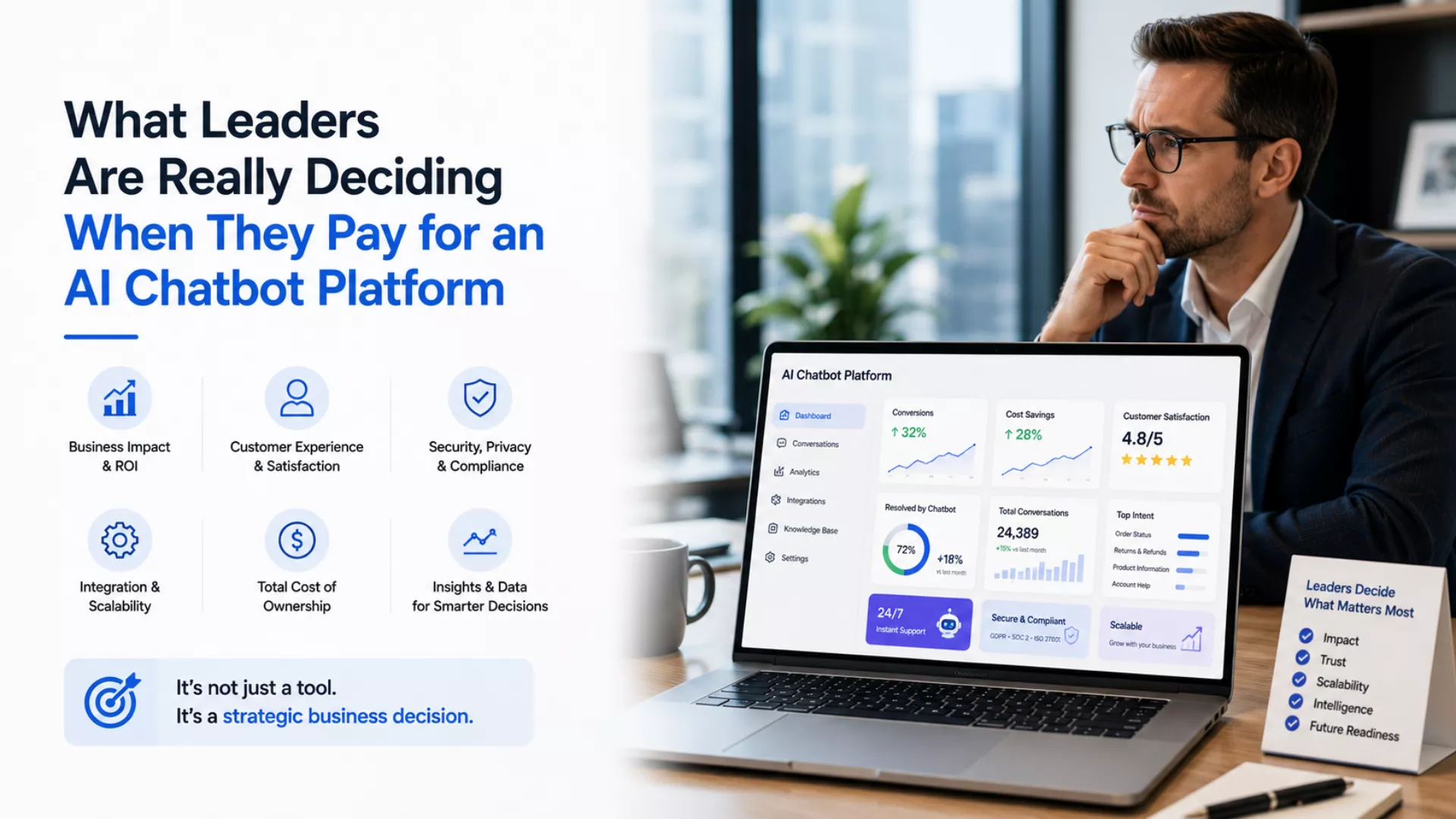
Most businesses do not wake up one morning and decide they want to buy an AI chatbot. That framing is misleading. What they actually decide is whether a tool has earned the right to be depended on. Free tools are everywhere, and many are impressive in demos. Payment happens later, when an AI chatbot for business moves from curiosity to consequence.
At the leadership level, this is not a technology purchase. It is an operating decision. The moment teams rely on a chatbot to answer customers, support employees, or guide processes, mistakes stop being theoretical. Errors become visible. Time is wasted. Trust erodes. That is when cost stops being the primary concern and reliability takes over.
This is why so many AI chatbots remain experiments. They solve a narrow problem in isolation, then collapse under daily use. A smaller group crosses a threshold and becomes infrastructure. Understanding that transition explains why some tools are free forever, while others become worth paying for without resistance.
This article walks through that lifecycle clearly. Not through features or pricing pages, but through how real teams adopt, stress-test, and either abandon or institutionalize AI chatbots. The goal is to explain when payment makes sense and how leaders should think about AI chatbot pricing before committing.
Phase One: Trial Exists to Create Clarity, Not Value
Free chatbots exist for a reason, and it is not generosity. They are designed to reduce friction at the starting line. In the early stage, businesses are not optimizing performance. They are learning. They want to see what questions customers ask, how repetitive support really is, and whether automation is even appropriate for their context.
During this phase, accuracy expectations are low. If the bot answers eight out of ten questions reasonably well, it feels like progress. Teams are exploring volume, tone, and gaps. This is discovery work, not production work, and free tools are well-suited for it because the stakes are limited.
Many teams also use this phase to test internal assumptions. Leaders usually consider their documentation to be flawless until a chatbot brings to light the discrepancies. They perceive customers to be mostly asking about prices, only to discover that the majority of inquiries are related to operations. Free trials reveal these facts quite quickly, and there is no obligation or risk involved.
This is also where concepts like AI organizational knowledge start to matter. The chatbot is only as good as the information it can access and interpret. Early tools reveal how fragmented knowledge really is. That insight alone can be valuable, even if the chatbot itself never graduates beyond testing.
Phase Two: Daily Use Is Where Weak Tools Break
The shift from trial to daily use is subtle, but decisive. One team starts using the chatbot every morning. Another links it in email signatures. Customers begin to expect consistent answers. This is where cheap or limited tools start to show stress fractures that were invisible during experimentation. What felt acceptable in a free AI chatbot now carries real consequences when expectations harden into habits.
Inconsistent responses become the first warning sign. The same question asked twice produces different answers. Tone drifts. Edge cases are handled poorly. At low volume, this is annoying. At scale, it becomes damaging. Teams lose confidence and quietly stop using the tool, even if it technically still works. Trust, once lost here, is difficult to rebuild.
A second issue is visibility. Leaders ask simple questions and cannot get clear answers. How many conversations happened yesterday? Which questions failed? Where users dropped off. Without analytics, decisions are made on instinct instead of evidence, which makes improvement nearly impossible. This is often where a structured AI chatbot platform like GetMyAI stands out by making performance transparent instead of guesswork.
Finally, control becomes a problem. Updating answers requires technical steps. Fixes take days. No one owns the system clearly. What looked simple in a demo now feels brittle in real operations. This is the fork in the road where many chatbots stall and get abandoned. Teams either formalise ownership or quietly move on.
The Hidden Cost of “Good Enough” Automation
When teams tolerate a chatbot that is “mostly fine,” they pay in indirect ways. Support agents double-check answers instead of trusting them. Customers ask follow-up questions that increase volume instead of reducing it. Instead of strengthening customer support automation, the system quietly adds friction where it was meant to remove effort.
Over time, this creates a quiet tax on the organization. No single failure is catastrophic, but the cumulative effect is real. Productivity gains flatten. Frustration rises. The chatbot turns into a liability rather than a lever, and the management begins to doubt the initiative's success in terms of either improved outcomes or just shifted work.
Where the Costs Actually Show Up
- Agents spend time validating answers instead of resolving issues
- Customers lose confidence and escalate more often
- Knowledge gaps remain hidden rather than fixed
- Leaders lack clarity on what the system handles well
This is often where discussions about retrieval methods begin to surface, even if leaders do not use technical language. What they are really asking is whether an AI chatbot for customer support can ground its answers in verified, current information instead of guessing under pressure.
At this stage, free tools rarely recover. They were not designed for accountability or scale. The business has outgrown them, even if no one says that out loud. The next decision is whether to walk away entirely or invest in a system that can grow with real operational demands.
Phase Three: When Paying Starts to Make Sense
Payment becomes rational when the chatbot is no longer a novelty. It is expected to perform. Teams want accuracy they can trust, controls they can manage without engineering support, and data that supports real decisions. This is not about more features. It is about fewer surprises.
A paid chatbot gains its importance by being constant. The top management requires certainty that the replies will be the same today and tomorrow. The updates should not only be a risk-free process but also be enhancing the performance. Such stability alters the behavior of the teams around the tool and whether they will use it in times of stress.
Control is equally important. Business users should be able to manage content, adjust behavior, and respond to changes quickly. When updates require tickets or workarounds, adoption slows. Paid tools remove that friction because they assume ongoing ownership, not a one-time setup.
Analytics complete the picture. When performance can be measured, it can be improved. Leaders can justify investment, refine scope, and expand usage intelligently. This is where concepts like retrieval-augmented generation move from theory to practice, supporting accuracy at scale.
Phase Four: What Leaders Are Actually Paying For
When budgets are approved, leaders are not buying “AI.” They are buying outcomes. Reduced handling time. Fewer errors. Better customer experience. Clearer internal access to information. The chatbot is simply the interface through which those outcomes are delivered, and the AI chatbot platform behind it determines whether those gains are repeatable or fragile.
This is why the best paid systems feel boring in the best possible way. They work reliably. They do not require constant supervision. They integrate cleanly into daily workflows. Over time, teams stop talking about the chatbot and start assuming it will be there, which is often the clearest signal of real operational value.
What Value Looks Like in Practice
- Answers stay consistent across teams and time
- Updates happen without disrupting daily work
- Usage patterns are visible and reviewable
- Responsibility for outcomes is clearly owned
Paid platforms also acknowledge reality. Businesses change. Policies update. Products evolve. A chatbot that cannot adapt without rework becomes obsolete quickly. This is where a paid AI chatbot separates itself, not through intelligence alone, but through stability under constant change.
At this stage, the chatbot starts to reflect the organization itself. It becomes a mirror of internal knowledge, priorities, and clarity. That is why investment decisions here are strategic, not experimental, and why some platforms justify their cost easily over time.
The final transition happens quietly. The chatbot stops being “the chatbot” and becomes part of how work gets done. New employees are told to use it. Teams expect it to know answers. Processes are built around its availability and reliability, and its presence becomes assumed rather than discussed in daily conversations.
At this point, usage expands naturally. What started in customer support moves into sales, operations, and internal enablement. Different teams rely on the same core system, each with tailored behavior and scope. This is where multi-agent usage becomes practical, not theoretical, supported by a stable AI chatbot platform underneath.
Infrastructure status also changes accountability. Usage is tracked. Performance is reviewed. Improvements are planned. The chatbot is no longer judged by novelty, but by contribution. If it goes down, work slows. That dependency signals real value creation and forces clearer ownership across teams and leadership layers.
This is the level where platforms like GetMyAI position themselves naturally, without aggressive selling. The system is not a widget. It is a shared resource that organizations build around because it has earned trust, consistency, and a defined role in operations.
What a Free Version Is Actually For
A free plan should answer one question clearly: Is this worth building around later? A free AI chatbot earns its place when it lets teams test real usage without pretending it can handle scale. That means enough access to feel day-to-day behavior, but clear boundaries so expectations stay realistic.
In the case of GetMyAI, the free tier is intentionally simple. It includes forty message credits per month, one AI agent, and one team member. Teams can train the bot using up to ten links, deploy it across unlimited websites, and work within a modest storage limit. There are no analytics, which is a deliberate signal about where experimentation should end.
This kind of structure makes the free tier useful without being misleading. It allows teams to test knowledge quality, question patterns, and fit inside workflows, while keeping ownership and measurement out of scope. When those needs appear, the AI chatbot platform does not change direction from what the business does. That clarity is what makes the transition to paid usage feel earned instead of forced.
Why Free and Paid Tools Coexist Without Conflict
Free chatbots are not the enemy of paid platforms. They serve different purposes at different stages. A free AI chatbot reduces fear, accelerates learning, and lowers the barrier to experimentation. Paid tools reduce risk and enable scale. Problems arise only when businesses expect one to behave like the other in real operational environments.
Understanding this lifecycle prevents poor decisions. Leaders stop forcing free tools to do enterprise work. They stop overpaying for experimentation. Instead, they align investment with maturity, timelines, and accountability. This is also where pricing becomes a strategic discussion, not a budget reflex.
This perspective also reframes ROI discussions. The question is not whether the chatbot is cheaper than staff. It is whether it improves how staff work. A free AI chatbot may save time early, but value shifts as usage grows and complexity increases across teams and workflows.
When leaders view chatbot adoption as a progression instead of a purchase, decisions become calmer and more grounded. The technology stops being mysterious and starts behaving like any other operational system. At that point, AI chatbot pricing reflects reliability, ownership, and long-term contribution rather than short-term cost.
A Clear Way to Think About the Next Step
If your chatbot is still being tested, free tools are doing their job. If teams rely on it daily but complain quietly, you are at the fork in the road. If performance is measured and ownership is clear, payment is likely already justified. That is often when an AI chatbot for business stops being optional and starts feeling essential.
The mistake is skipping steps or ignoring signals. Businesses that succeed respect the journey from experiment to infrastructure. They invest when the system proves it can handle responsibility, not when marketing promises sound impressive, or features look good on paper.
The most valuable chatbots are not the smartest in isolation. They are the most dependable in context. When reliability, control, and accountability are in place, choosing a paid AI agent feels less like a purchase and more like maintaining something the business already depends on. That is the real test of whether it is worth paying for.
Platforms like GetMYAI are built around this exact transition. The focus is not on pushing teams to upgrade, but on supporting them as usage deepens, expectations rise, and ownership becomes clearer. When a system is designed to grow with the organisation, paying for it feels like a natural continuation, not a forced decision.
FAQs
1. Is a free AI chatbot good enough for a business?
A free AI chatbot is a good starting point for small businesses that want to test conversational AI. It can handle basic customer questions, capture leads, and automate simple tasks. As conversation volume and business requirements grow, upgrading to a paid plan provides more features, integrations, analytics, and higher usage limits.
2. What is the difference between a free and a paid AI chatbot?
Free AI chatbots typically offer limited message credits, basic AI capabilities, and fewer customization options. Paid AI chatbots provide higher conversation limits, advanced AI models, CRM integrations, analytics, workflow automation, multiple AI agents, and better scalability for growing businesses.
3. When should a business upgrade from a free AI chatbot to a paid plan?
Businesses should consider upgrading when they experience increasing website traffic, higher customer inquiry volumes, the need for CRM or help desk integrations, advanced reporting, workflow automation, or support for multiple team members. These requirements often exceed the capabilities of free plans.
4. Can a free AI chatbot generate leads?
Yes. Many free AI chatbots can collect visitor information such as names, email addresses, phone numbers, and inquiry details. This helps businesses capture leads, qualify prospects, and follow up with potential customers more efficiently.
5. What features should businesses expect from a paid AI chatbot?
Paid AI chatbot platforms often include advanced AI models, multilingual support, analytics dashboards, document-based knowledge training, API integrations, appointment booking, lead qualification, workflow automation, role-based access control, and human handoff for complex conversations.
6. Are paid AI chatbots worth the investment?
For businesses handling a high volume of customer conversations, paid AI chatbots can deliver significant value by reducing response times, automating repetitive tasks, improving lead conversion, and lowering customer support costs. The return on investment depends on business goals, chatbot usage, and operational efficiency.
7. Can businesses upgrade their AI chatbot without losing existing data?
Most modern AI chatbot platforms allow businesses to upgrade plans while keeping their chatbot configuration, training data, knowledge base, and conversation history. This makes it easier to scale without rebuilding the chatbot from scratch.
8. How should businesses choose the right AI chatbot plan?
Businesses should compare plans based on monthly conversation volume, AI capabilities, integrations, team size, analytics, customization options, storage, and future growth requirements. Selecting a scalable plan helps avoid frequent migrations as business needs evolve.
9. Can small businesses benefit from paid AI chatbot solutions?
Yes. Paid AI chatbots are valuable for small businesses that need to automate customer support, qualify leads, schedule appointments, or improve customer engagement. Even affordable paid plans can save time, increase productivity, and support business growth.
10. Why is it important to choose an AI chatbot platform that can scale?
As businesses grow, customer conversations, team members, and automation requirements increase. Choosing a scalable AI chatbot platform ensures consistent performance, supports additional integrations and AI capabilities, and allows businesses to expand without replacing their existing solution.