From Document Storage to Decision Support: The Real Shift in AI Knowledge Systems

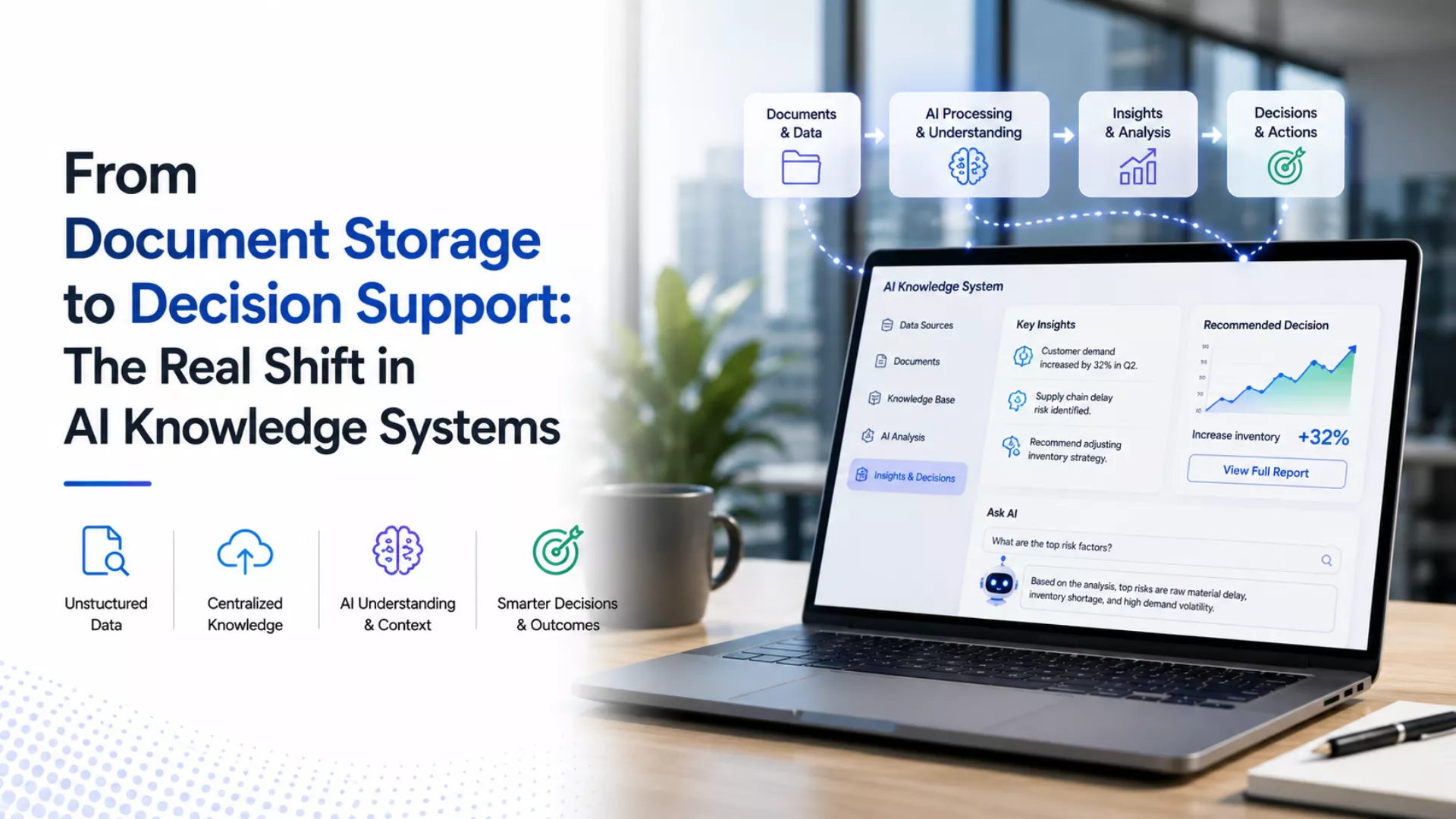
Most organisations believe they have a knowledge problem. In reality, they have a decision problem.
Documents are scattered across drives, wikis, ticketing tools, and inboxes. Policies exist, but no one is fully confident they are using the right version. Teams spend time searching, interpreting, second-guessing, and escalating. The cost is not just wasted hours. It is hesitation, inconsistency, and risk.
What is at stake is not access to information. What is at stake is whether people can act with confidence.
This is why AI knowledge systems matter now. Not because they store more data, but because they change how decisions are supported, tested, and improved across the organisation.
This article combines two ideas that are usually discussed separately:
- The shift from document storage to decision support
- The way AI surfaces knowledge gaps that humans never documented
Together, they explain why AI knowledge management is not an upgrade to your knowledge base. It is a redefinition of what “knowing” means inside a business.
Storing Information Is Not the Same as Supporting Decisions
Traditional knowledge systems were built around a simple assumption: if information exists somewhere, people will find it when they need it.
That assumption has failed at scale.
Most enterprise knowledge bases are technically accurate and practically unusable. They contain documents, not guidance. They provide access, not clarity. They answer what exists, not what I do right now.
Decision-making rarely starts with a document title. It starts with a situation.
Someone asks:
- “Can I approve this?”
- “Is this allowed in this region?”
- “What do we usually do when this happens?”
- “Which rule applies here?”
These are not retrieval problems. They are interpretation problems.
Access vs Usefulness
The core difference between traditional knowledge bases and modern AI knowledge systems is not intelligence. It is intent.
Traditional systems optimise for:
- Storage
- Categorisation
- Compliance
- Coverage
AI knowledge systems optimise for:
- Relevance
- Context
- Decision confidence
- Outcome quality
A PDF policy may be technically “accessible,” but that does not mean it is usable under pressure. AI knowledge systems shift the benchmark from can you find it to can you act on it.
This is why decision support is the real metric that matters.
Decision Support Is the Only Benchmark That Counts
When leaders evaluate knowledge platforms, they often ask:
- How many documents can it store?
- How fast can it retrieve content?
- How accurate are the answers?
These are incomplete questions.
The better questions are:
- Does this reduce hesitation?
- Does this reduce escalation?
- Does this reduce inconsistency between teams?
- Does this help people make the same decision the business would make?
Decision support means the system understands:
- Who is asking
- What role do they play
- What constraints apply
- What exceptions exist
- What outcome is expected
This is where AI knowledge systems fundamentally differ from static repositories.
They do not just surface information. They surface meaning.
And meaning only exists in context.
Why This Shift Is Actually New
Organisations have talked about “knowledge management” for decades. What is new is not the ambition. It is the feedback loop.
Until recently, knowledge systems had no visibility into:
- Which questions were never answered
- Where people got confused
- Which policies contradicted each other in practice
- How language differed between teams and users
AI changes this.
Modern AI knowledge systems can observe interaction patterns at scale across teams, roles, and real-world use cases, rather than relying on assumptions about how information is used.
They see the exact questions people ask, how often the same questions repeat, and whether users accept an answer or keep searching for clarification. They also reveal hesitation, confusion, and workarounds that traditional systems completely miss.
This level of visibility transforms AI knowledge management into something fundamentally different from document-centric systems. Instead of acting as static repositories, these systems learn from every interaction.
They improve as gaps are identified, language is refined, and contradictions are resolved. Over time, the system becomes more aligned with how people actually think and decide, not how knowledge was originally documented.
What AI Knowledge Systems Learn That Humans Never Document
One of the most overlooked benefits of AI knowledge systems is not what they answer, but what they reveal.
Human-maintained knowledge bases only contain what someone thought to write down. AI systems expose what people actually need.
Over time, clear patterns emerge.
Repeated unanswered questions
When dozens or hundreds of people ask the same question in slightly different ways, it signals something important:
- The knowledge exists, but is buried
- The language used does not match how people think
- The rule is unclear, outdated, or poorly communicated
These gaps often go unnoticed in traditional systems because silence looks like success. AI makes absence visible.
Edge-case queries
Humans document the “happy path.” Real work lives in the exceptions.
AI systems surface:
- Rare combinations of rules
- Situations that span departments
- Questions that sit between policy ownership boundaries
These edge cases are where risk lives. AI exposes them early.
Policy contradictions
Different teams often document rules in isolation. Individually, they make sense. Together, they conflict.
AI systems see contradictions because users hit them head-on:
- “Support says yes, finance says no.”
- “This policy allows it, that one blocks it.”
- “The regional rule contradicts the global rule.”
These conflicts are rarely discovered through audits. They are discovered through real questions.
Language mismatches
Employees do not think in policy language. Customers do not think in internal terminology.
AI knowledge systems reveal:
- The words people actually use
- The mental models they bring
- Where official language creates friction
This insight alone can dramatically improve clarity across the organisation.
AI Knowledge Management as a Learning Loop
This is where the conversation shifts.
AI knowledge systems are not just answer engines. They are discovery mechanisms.
They create a continuous loop:
- People ask real questions
- The system attempts to answer
- Gaps, confusion, and friction are surfaced
- Knowledge is refined
- Decision quality improves
Traditional knowledge bases are static. AI knowledge systems evolve.
This is why retrieval augmented generation matters. Not as a buzzword, but as a practical architecture that ties live knowledge to real use.
The system does not hallucinate answers. It reasons over organisational knowledge, observes outcomes, and improves alignment.
This is also where platforms like getmyai are quietly changing expectations by treating knowledge as a living asset rather than a static archive.
What This Means for Leaders and Decision Makers
For executives and managers, this shift has direct operational implications.
Knowledge is no longer owned by a team
In AI knowledge systems, ownership becomes shared:
- Product defines intent
- Legal defines constraints
- Support defines reality
- AI exposes misalignment
This requires governance models that focus on outcomes, not documents.
Metrics must change
Stop measuring:
- Number of documents
- Size of the knowledge base
Start measuring:
- Reduced escalations
- Faster decision cycles
- Fewer contradictory answers
- Higher first-response confidence
Decision support quality is measurable if you look in the right places.
Customer support and internal teams converge
The same AI knowledge system can support:
- Employees making internal decisions
- Support teams handling edge cases
- Customers seeking clarity
This convergence only works when the system is built around meaning, not storage.
This is why conversational AI platforms are becoming central to knowledge strategy rather than peripheral tools.
Practical Signals You Are Still Stuck in Document Storage Mode
Many organisations believe they have implemented AI knowledge management simply because they added a chatbot on top of an existing document repository.
In practice, this often changes the interface but leaves the underlying problems untouched.
Here are signs that nothing has really changed:
- Responses often just copy-paste policy language instead of providing practical, actionable advice on what to actually do.
- People keep asking follow-up questions because the initial help is too vague to support a confident final decision.
- Different departments get conflicting answers to the same query, which causes confusion and damages overall trust.
- The volume of escalations to management or legal experts hasn't dropped, as the system still can't handle complex cases.
- Information updates don’t keep pace with real-world changes, meaning the guidance often describes outdated processes or old rules.
If the system cannot explain why an answer applies in a specific situation, it is not supporting decisions at all.
What a Real AI Knowledge System Looks Like in Practice
A mature AI knowledge system behaves differently because it is designed around real decisions, not static information, and it responds to how people actually work, ask questions, and apply rules in everyday situations.
It:
- Understands role and context
- Surfaces relevant constraints automatically
- Explains reasoning in simple language
- Flags uncertainty instead of guessing
- Learns from confusion
AI in customer support offers this method, at the same time resolving the problems of the teams more rapidly and not raising the risk level, as the agents get explicit guidance for the situation rather than standard policy pieces. It leads to a reduction of the unnecessary back-and-forth process, a drop in the amount of escalated cases, and a rise in the uniformity of handling customer queries regardless of the complexity or sensitivity of the matter.
In internal operations, it reduces reliance on tribal knowledge that only a few experienced employees carry in their heads. Decisions become less dependent on who happens to be available and more grounded in shared understanding, making teams more resilient as roles change or people move on.
At the leadership level, it provides real visibility into how rules and policies are actually applied day to day, not just how they are written. Platforms such as getmyai are adopted not because they store more information, but because they reveal how knowledge is used, misunderstood, or missing entirely.
Why This Matters More Than Ever
Organisations are operating under constant pressure. Decisions that once had days now have minutes. Regulations are more detailed, enforcement is stricter, and the margin for interpretation is shrinking. At the same time, teams are spread across locations, time zones, and functions, often without the shared context that used to come from sitting in the same room. In this environment, even small misunderstandings can turn into costly mistakes.
There is also a basic human constraint that many systems ignore: no one has time to read. Long documents, dense policies, and internal wikis may be well-intentioned, but they do not match how work actually happens. People need clear guidance in the moment, not a search task that pulls them away from the decision in front of them.
AI knowledge systems succeed when they accept these realities instead of fighting them. They do not expect users to learn new structures, remember document names, or interpret legal language on the fly. Instead, they meet people where they are, using natural questions and real scenarios as the starting point.
This is the quiet shift happening across enterprise AI chatbot deployments and AI-powered chatbots more broadly. The value is no longer automation for its own sake. It is the alignment between how decisions are made and how knowledge is delivered.
This shift matters because it helps organisations:
- Reduce the risk of inconsistent decisions across teams and regions
- Support faster decisions without sacrificing accuracy or compliance
- Lower dependency on a few individuals who “know how things work”
- Make complex rules usable by non-experts in real situations
- Keep knowledge relevant as policies, products, and regulations change
Knowledge Is Proven at the Moment of Decision
If there is one idea that matters more than any other, it is this: knowledge only proves its value when someone has to act. Until that moment, information is just stored potential. Documents, policies, and guidelines may exist, but they do not become knowledge until they help someone make a call under real conditions.
This is where many systems fall short. A policy that cannot be applied when time is tight and stakes are high is not useful knowledge. A system that produces an answer but cannot explain why it applies does not build confidence. In practice, people need clarity, context, and reasoning, not just access.
The real promise of AI knowledge systems is not scale or speed alone. It is their ability to support judgment. They help reduce hesitation, prevent inconsistent decisions, and surface the reasoning behind an answer in language people can actually use. That is what makes decisions easier, safer, and more repeatable across teams.
This shift changes how organisations should measure value. The question is no longer how much information the system holds, but how often it helps people move forward without second-guessing. As this mindset takes hold, platforms like getmyai will be evaluated not by the size of their knowledge base, but by how effectively they help people act with confidence.
FAQs
1. What is an AI knowledge system?
An AI knowledge system is a platform that transforms business documents, policies, manuals, and other information into a searchable knowledge base. Instead of simply storing files, it understands context and delivers accurate answers that help employees and customers make faster decisions.
2. How is an AI knowledge system different from traditional document storage?
Traditional document storage focuses on organizing and storing files, while an AI knowledge system retrieves relevant information, understands user questions, and provides context-aware answers. This reduces time spent searching through documents and improves decision-making across the organization.
3. How do AI knowledge systems support better business decisions?
AI knowledge systems analyze information from approved business documents and deliver relevant insights instantly. By giving employees quick access to accurate information, they reduce delays, improve consistency, and support informed decision-making across departments.
4. What types of documents can an AI knowledge system use?
Most AI knowledge systems can process PDFs, Word documents, spreadsheets, presentations, knowledge base articles, SOPs, product manuals, HR policies, contracts, and other business documents. This allows organizations to centralize information and make it easily accessible through natural language conversations.
5. Which teams benefit most from AI knowledge systems?
AI knowledge systems support customer service, sales, HR, IT, operations, legal, engineering, and compliance teams. Any department that regularly searches for information can use AI to find answers faster and improve productivity.
6. Can AI knowledge systems reduce repetitive employee questions?
Yes. AI knowledge systems answer frequently asked questions using approved company documentation. Employees no longer need to search through multiple folders or wait for experts to respond, helping reduce repetitive internal requests and improve operational efficiency.
7. What features should businesses look for in an AI knowledge system?
Key features include document-based AI search, source citations, role-based access control, multilingual support, analytics, secure document management, integrations with business applications, and Retrieval-Augmented Generation (RAG). These capabilities help deliver accurate, trustworthy responses while protecting sensitive information.
8. How do AI knowledge systems improve customer support?
AI knowledge systems provide support teams with instant access to product documentation, troubleshooting guides, policies, and historical information. This enables faster responses, more accurate answers, and a better customer experience while reducing support workload.
9. Are AI knowledge systems secure for enterprise use?
Yes. Enterprise AI knowledge systems typically include encryption, role-based permissions, secure document storage, audit logs, and access controls. These features help organizations protect confidential business information while allowing authorized users to access the knowledge they need.
10. Why are AI knowledge systems becoming essential for modern businesses?
As organizations generate more documents and knowledge every day, finding the right information quickly becomes increasingly difficult. AI knowledge systems transform static document repositories into intelligent decision-support platforms, helping businesses improve productivity, reduce operational costs, and make faster, more informed decisions.