A growing number of UK enterprises are re-evaluating how employee support is delivered because HR teams are balancing rising administrative workloads, hybrid work models and stricter data governance requirements. Internal queries around payroll, leave policies…
Experience Boost
Create. Deploy. Engage. With GetMyAI
Launch GPT-powered conversations that engage, support, and convert — all in one platform.
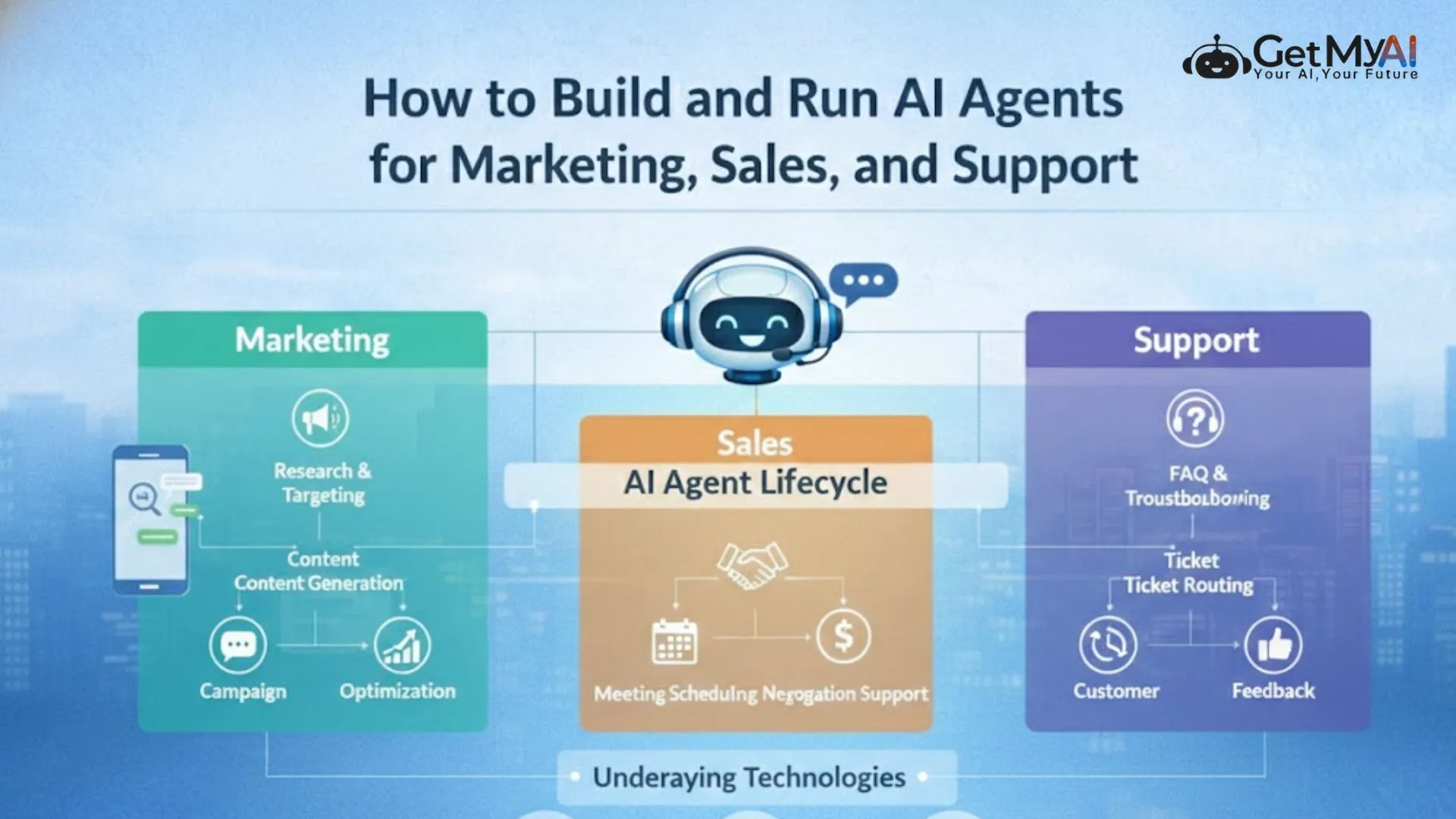
How to Build and Run AI Agents for Marketing, Sales, and Support
GetMyAI
Feb 11, 2026
AI agent for customer support
Most companies think building comes first and running comes later. That mindset creates problems. When you design an agent without thinking about daily supervision, you create operational risk. A strong Intelligent AI agent for businesses is not just about setup. It is about how it behaves after thousands of conversations, policy updates, and product changes. It must perform consistently under real traffic, real pressure, and real customer expectations, not just controlled demo scenarios.
The real pressure starts after deployment. Marketing content changes. Pricing evolves. Support tickets shift. If you cannot monitor responses, review transcripts, correct weak answers, and enforce structured escalation paths quickly, you lose control. This is why build decisions must reflect long-term AI agent reliability and governance, not just launch speed. Governance ensures measurable accuracy, structured review cycles, and documented improvement workflows across departments.
What Makes an AI Agent “Real” in Business Terms
A real agent does more than reply to questions. It handles actual business work. It pulls from verified documents, follows clear rules, and performs structured Actions when required. When designed correctly, it becomes an AI-powered customer support automation layer that reduces repetitive tasks while keeping answers accurate and traceable. Every response should connect back to trusted knowledge. That is how teams maintain control at scale. Without structure, an agent becomes unpredictable. With structure, it becomes dependable and measurable across daily operations.
Key Capabilities That Define Operational Value
Clear role setup for marketing, sales, or support before launch
Strict access limits that define what the agent can and cannot handle
Saved conversation records for internal review
Trigger-based Actions that run only under approved rules
Controlled updates for documents and policy changes
Strong systems require AI hallucination prevention at their foundation. The agent should depend on verified content only. It must avoid making up details. With GetMyAI, curated knowledge sources and defined behavior instructions protect response accuracy and prevent drift over time. Reliability is designed into the system from day one.
Marketing AI Agents: Built to Listen, Run to Learn
Marketing agents sit at the front door of your business. They meet visitors first. They answer early questions about value, use cases, and product fit. A well-designed AI agent for marketing and sales must stay clear, accurate, and aligned with your real positioning. It should guide interest, not invent claims. If the foundation is weak, the confusion spreads fast.
Built to Listen
When building a marketing agent, the first goal is clarity. The agent must reflect approved messaging only. With GetMyAI, you train it on structured documents and apply rule-based instructions so it does not drift away from your real positioning.
Tips for Building:
Define approved product claims before training
Set tone guidelines that match your brand voice
Add fallback rules when questions go beyond scope
A controlled setup strengthens Enterprise AI agent deployment across teams because everyone sees the same message delivered consistently.
Run to Learn
Once live, the work shifts to observation. Marketing conversations show what buyers truly want to know. Patterns show where people struggle. When the same questions appear again and again, it signals weak pages or unclear messaging. This is where your AI agent for marketing and sales turns into a smart feedback system.
Tips for Running:
Review confusion trends weekly
Update content when questions repeat
Adjust instructions after campaign changes
When handled this way, the agent works as a learning engine, not just a chat tool.
Sales AI Agents: Built to Qualify, Run to Protect Revenue
In sales, details matter. A wrong answer about cost or features can damage credibility. An AI agent for marketing and sales needs to stay precise and disciplined in every exchange. Its role is to guide prospects, resolve standard questions, and move qualified buyers ahead without creating false expectations. Every statement should match verified product information. Proper configuration and routine oversight help maintain accuracy, protect income, and ensure conversations support business goals.
Built to Qualify
During setup, define tight boundaries. The agent should know what it can say and what it cannot. Clear guardrails reduce risk and improve consistency. Configure AI agent escalation logic so complex pricing or edge cases move to a human rep without delay.
Tips during build:
List approved pricing statements and lock them in documentation
Define disallowed claims clearly in behavior rules
Set triggers that escalate uncertain cases automatically
Run to Protect Revenue
After launch, supervision begins. Monitor how leads are captured and how objections are handled. Review transcripts weekly. This is where human-in-the-loop AI workflows protect alignment with the sales strategy.
Tips during operation:
Audit promises made in real conversations
Check lead data accuracy before CRM sync
Adjust instructions when packaging or pricing changes
Consistent oversight ensures the AI agent for marketing and sales stays aligned with revenue goals.
Support AI Agents: Built for Accuracy, Run for Trust
Support teams deal with real problems. Refunds. Delays. Account access. Every answer matters. An AI agent for customer support must respond using approved policies only. It cannot guess. It cannot improvise. When customers ask about shipping rules or return timelines, answers must come directly from verified documents. Accuracy builds trust. One wrong answer can create extra tickets, chargebacks, or public complaints.
Built for Accuracy
When setting up the system, focus on structure. Clear inputs lead to clear outputs. This approach builds dependable Conversational AI for customer support that can handle large request loads without making promises outside official policies.
Tips during build:
Use approved support documents only, and avoid promotional content
Configure firm escalation triggers for payment, refund, or compliance matters
Ensure replies stay within the written and approved procedures
Careful setup lowers risk before any real customer conversation begins.
Run for Trust
Launch is only the beginning. Daily supervision keeps the system reliable. Over time, this becomes structured AI customer service chatbot management that improves accuracy without heavy retraining cycles.
Tips during operation:
Review conversation samples weekly, not just dashboards
Correct weak answers using Q&A updates inside GetMyAI
Monitor repeated confusion and update documentation fast
Support agents must earn trust every day. Careful review protects that trust.
Build Priorities vs Run Priorities by Agent Type
Each agent type has a different risk profile. Marketing needs clarity. Sales need precision. Support needs strict accuracy. However, all require oversight. Strong AI agent reliability and governance ensure these priorities stay intact across departments.
Agent Type
Primary Business Goal
Critical Build Focus
Primary Operational Focus
Main Risk if Mismanaged
Marketing
Guide and educate
Clear positioning and approved claims
Pattern review and messaging alignment
Mixed messaging
Sales
Qualify and convert
Pricing guardrails and escalation rules
Promise auditing and lead accuracy
Overpromising
Support
Resolve issues
Policy accuracy and fallback logic
Response correction and monitoring
Incorrect commitments
Actions and Automated Task Triggers
An agent should not just respond. It should act. GetMyAI’s Actions allow structured automation when defined triggers are met. This transforms conversation into execution. Instead of stopping at answers, the system moves the process forward. It connects chat directly to real business outcomes. That is where automation becomes valuable, not just convenient.
For example, in a support context, an AI-powered customer support automation setup can trigger ticket creation when keywords indicate frustration or urgency. In sales, defined triggers can capture email addresses and push them into a CRM. In marketing, form submissions can activate nurture workflows.
These triggers are rule-based. They operate under strict conditions. This prevents uncontrolled automation and supports structured Enterprise AI agent deployment across departments. Actions convert chat into measurable business movement.
Reliability Through Review
Many teams rely only on dashboards. That approach misses context. True governance requires reading transcripts. GetMyAI provides access to detailed logs, enabling reviewable AI conversations for internal oversight.
Regular transcript audits are part of Ongoing AI agent supervision. You examine edge cases, unclear answers, and user confusion. You refine instructions. You update knowledge documents. You monitor performance after every policy change. Reliability does not come from launching an agent. It comes from structured review cycles.
Preventing Hallucination and Drift
Products change. Pricing updates. Promotions end. If your system is not reviewed often, it will start giving outdated answers. That is how errors grow. Preventing drift requires structure, not luck. Strong document control keeps responses tied to approved sources. Clear fallback instructions stop the system from guessing. In GetMyAI, Q&A updates allow fast corrections without rebuilding the entire model. This keeps every AI agent for customer support aligned with current policies.
Drift prevention is not automatic. It requires scheduled reviews after feature releases or pricing changes. Escalation rules must remain active and tested. Change tracking should be documented. Stability comes from discipline, not from the initial setup.
Role of Human Oversight and Operational Discipline
Human oversight defines control. It ensures the system stays within boundaries and follows defined rules. Strong supervision includes:
Monitoring live conversations regularly
Reviewing Actions triggers for correct execution
Validating responses against updated policies
Applying human-in-the-loop AI workflows for complex cases
When a discussion exceeds defined limits, it routes to a human operator. This protects brand reputation and customer trust. A properly managed AI agent for marketing and sales always operates under supervision. Oversight strengthens automation. It does not weaken it.
Scaling Across Departments
As adoption grows, you may deploy separate agents for marketing, sales, and support. This requires coordinated management. An integrated Intelligent AI agent for businesses strategy includes shared governance rules, unified review protocols, and standardized escalation triggers. Centralized supervision improves consistency.
When expanding to multiple regions or product lines, maintain structured training sets for each deployment. Strong Enterprise AI agent deployment depends on consistent documentation control and monitoring cadence. Scaling without governance creates inconsistency. Governance enables scale.
Final Reflection
Building agents is straightforward. Running them with discipline is what determines long-term success. Marketing requires clarity. Sales require precision. Support requires accuracy. All require supervision, correction, and structured automation triggers. An AI customer service chatbot without oversight becomes unpredictable. An agent without review systems drifts. A system without Actions remains passive.
The real decision is not whether to deploy AI. It is whether you are prepared to manage it properly. When building design, escalation rules, action triggers, and review processes work together, your AI agent for marketing and sales becomes a controlled business asset, not an experiment. That is how modern teams build and run agents with confidence.
FAQs
1. How should marketing agents be trained?
Enterprise AI agent deployment for marketing begins with approved product claims and strict tone guidelines.
2. How do you protect revenue with automation?
Human-in-the-loop AI workflows ensure uncertain pricing or complex deals escalate immediately.
3. How does automation reduce repetitive tickets?
AI-powered customer support automation resolves common queries instantly without human intervention.
4. What are Actions in business AI agents?
Actions convert conversations into workflows, enabling AI-powered customer support automation to trigger tickets or CRM updates.
5. How often should agents be reviewed?
Ongoing AI agent supervision should include weekly transcript sampling and post-update audits
Responding faster, operating leaner and serving customers across more channels than ever before: these are the conditions UK businesses are now expected to meet as standard. Enterprise AI chatbot adoption has accelerated sharply in response to these demands, m…
AI chatbot use cases for e-commerce now extend far beyond customer support. Modern e-commerce AI chatbots handle conversational product discovery, abandoned cart recovery, multilingual support, order tracking, returns automation, lead qualification and persona…