Chatbot Service Desk: A Practical Guide for Modern Support Teams

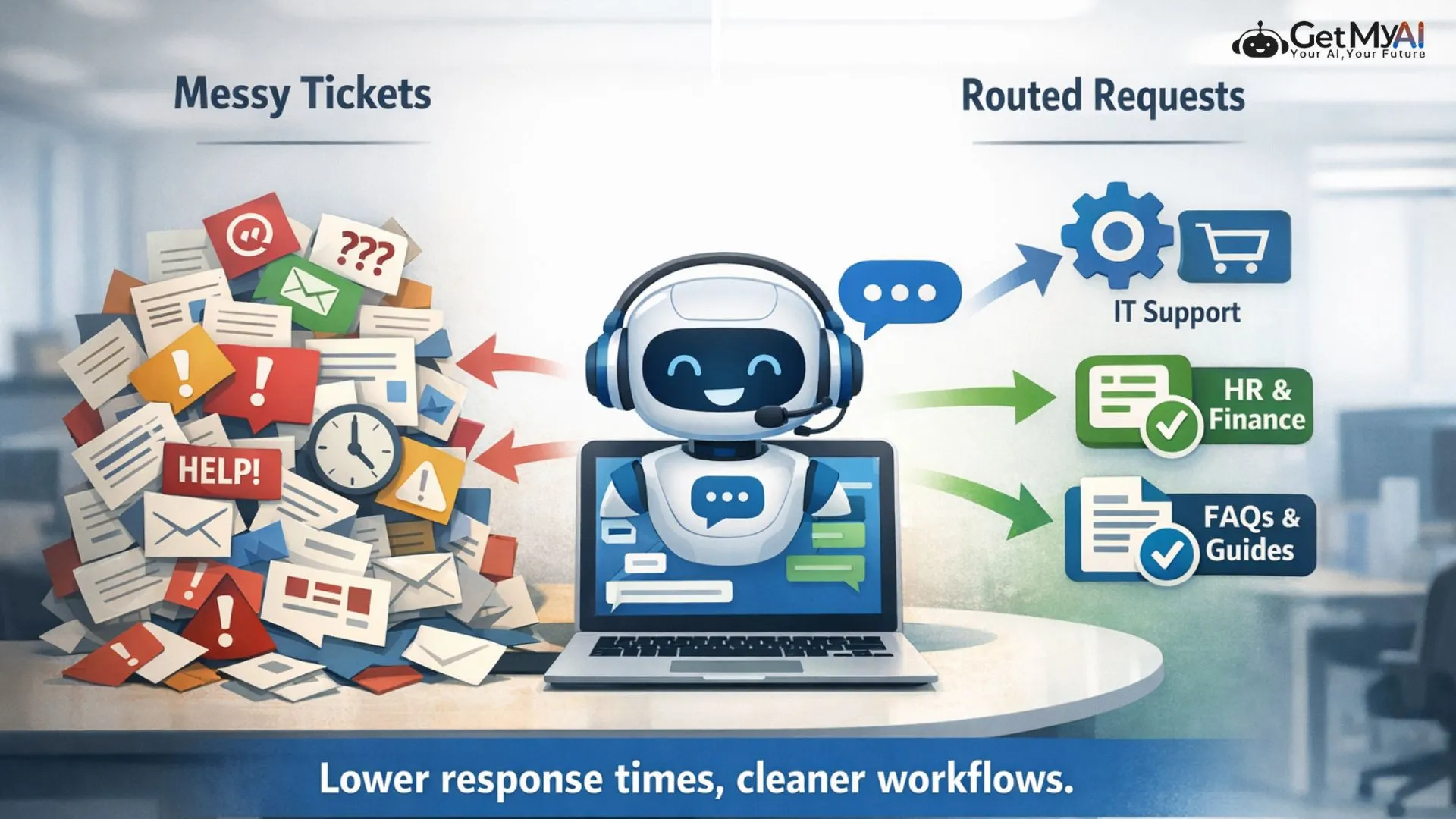
Support teams today are under pressure like never before. Employees expect instant answers. Customers do not want to wait. IT teams are overloaded with repetitive requests. At the same time, businesses are expected to deliver faster service without increasing headcount, budgets, or operational complexity across departments.
This is where a chatbot service desk becomes a practical solution rather than a buzzword. It addresses real, everyday support challenges by reducing response times, organizing knowledge access, and easing the load on already stretched teams.
Instead of relying only on human agents, companies are now using AI-powered chatbots to handle common questions, guide users to the right information, and reduce the number of tickets that reach the service desk. When done right, this does not replace people. It gives them room to focus on real problems that require experience and judgment.
This guide explains what an AI-powered service desk chatbot really is, how it works in real environments, and how platforms like GetMyAI help teams build one without complexity, heavy setup, or ongoing technical maintenance.
What Is a Chatbot Service Desk?
It is an AI-powered assistant that acts as the first point of contact for support requests. It talks to users in plain language, understands what they are asking, and provides answers or guidance instantly. Instead of feeling like a tool, it feels more like a helpful support teammate that is always available, regardless of time or volume of requests.
Instead of asking users to search through documents or submit tickets for simple issues, the chatbot responds in real time. This removes frustration and speeds up resolution for everyday problems. It can answer questions like:
- How do I reset my password?
- Where can I find company policies?
- Why is my application not loading?
- Who should I contact for access approval?
A chatbot for service desk use cases is designed to reduce friction across the entire support experience. It removes unnecessary steps, minimizes waiting, and gives users clear direction at the exact moment they need help. Over time, this leads to better satisfaction and fewer avoidable tickets.
Why Traditional Service Desks Struggle Today
Many service desks still depend on tickets, emails, and support portals to manage support requests. These systems are well-known, but they are not built for speed when it comes to simple questions. Users often have to wait for responses and repeat details, even if the issue has already been documented internally. This slows down work and creates frustration for both users and support teams.
Common issues include:
- Too many repetitive tickets
- Slow replies to simple questions
- Users sending unclear or incomplete details
- Agents copying the same answers from documents
- Information scattered across PDFs, files, and internal systems
A chatbot for IT service desk environments helps fix these problems by sharing information directly with users. Instead of waiting or searching, people get clear answers right away, which cuts down on back-and-forth conversations.
How a Chatbot Service Desk Actually Works
A virtual service desk assistant is not like the older chatbots that followed strict rules. Those bots only worked when questions were asked in a specific way. The present-day assistant is taking greater care in listening and employing AI to accurately determine the necessity of a person, even for brief, casual, or paraphrased inquiries. It is focused on understanding rather than relying on the specific keywords being used.
When a conversation begins, everything feels simple to the user, but more is happening behind the scenes. Someone types a question the same way they would ask a coworker. The chatbot then looks at the intention behind the message. It is much more about what the person is trying to do, not just how the question is being framed.
Once the intent is clear, the chatbot searches through the information it has been trained on. This usually includes documents, FAQs, internal files, and help content that the organization already uses. The system does not look at just the exact phrases, but rather looks for the relevant meaning. Due to this, an AI-driven service desk assistant setting can still provide useful responses, even if the users express the same question in numerous different ways.
The response is then generated based on this understanding. The objective is to deliver a lucid, helpful response that sounds like a human speaking rather than a machine. In case the details are there in the knowledge base, the chatbot can bring it forth immediately, without requiring the user to go through a search or wait for a ticket reply.
From a team’s point of view, managing this process does not need to be complicated. Most chatbot service desk platforms are designed so that teams can upload documents, train the chatbot, and deploy it through a central Dashboard. This allows support, IT, or operations teams to keep control of the knowledge and improve responses over time, while users simply experience faster and more consistent support.
The outcome is an AI chatbot that is user-friendly for consumers and conducive for groups; the automated service desk support bot becomes a logical part of the contemporary support operations.
Where a Chatbot for Service Desk Delivers the Most Value
Not every support issue should be automated. The biggest impact comes from handling high-volume, low-complexity requests.
A chatbot for service desk use cases works especially well for:
- IT support questions
- HR and internal policy queries
- Employee onboarding help
- Access and tool guidance
- General customer support
When these questions are answered instantly, overall satisfaction improves, and ticket volume drops.
Chatbot for IT Service Desk: A Closer Look
IT teams are constantly pulled in many directions. From the moment the workday starts, requests begin coming in for password resets, access permissions, software installations, and system issues. Many of these requests are repetitive, yet they still demand attention. This is where a chatbot used in service desk operations becomes especially useful.
Handling Everyday IT Requests Without Delay
A support chatbot for service desk workflows teams works like a smart front desk that never closes. When someone needs help, the chatbot is ready to respond immediately. One of the things it can do is answer general inquiries, illustrate easy processes step by step, and refer the customers to the appropriate materials without letting them wait for a tech support person to be free. The immediate feedback minimizes annoyance and, at the same time, facilitates the progress of the job.
Collecting Context Before Human Involvement
The capability of a chatbot for IT service desk support to collect context at an early stage is one of its most significant benefits. Rather than users submitting imprecise requests, the chatbot can conduct basic follow-up questions. Moreover, the issue will be more clearly defined before being handed over to a human, and this will consequently save time and reduce the likelihood of confusion for both parties.
Reducing Repetitive Work for IT Teams
Quite a few IT requests are made repeatedly every week, sometimes even dozens of times. A chatbot can take care of these routine questions in the same manner whenever asked and with no tiredness. The chatbot's intervention in issues that are frequent gives the IT team time to concentrate on more intricate and significant tasks that actually need human decision-making and skill.
Guiding Users Through Complex Issues
Not every problem can be solved instantly, and that is okay. When an issue is more complex, the chatbot does not simply stop. It can guide users through the next steps, explain what will happen, and set clear expectations. This makes the process feel organized instead of overwhelming.
Improving the Overall IT Support Experience
A chatbot applied to the IT service desk becomes a reliable tool over time in everyday operations. The users know the correct place for support, and the IT staff's main line is less disrupted by unimportant queries. Consequently, the support experience is more seamless, effective, and advantageous for all the parties concerned.
How GetMyAI Becomes Part of a Chatbot Service Desk
GetMyAI is designed to help teams build and manage a service desk automation chatbot without technical overhead.
Everything starts in the Dashboard. This is where teams build AI agents, teach them company knowledge, and decide how they should respond in real situations.
GetMyAI allows teams to:
- Upload documents such as PDFs, DOCX, PPTX, XLSX, and TXT files
- Train agents using internal knowledge bases and files
- Improve responses using Q&A entries
- Review conversations in Activity
- Measure performance using Analytics
There is no need to deal with a complex AI setup. Everything stays focused on control and ease of use.
Supported Channels for Service Desk Chatbots
An AI-driven service desk assistant works best when it is available where users already communicate.
With GetMyAI, teams can deploy their chatbot across:
- Websites
- WordPress sites
- Slack
This enables support to be available to all users without requiring them to use any new tools. Regardless of whether a worker sends a message on Slack or a customer uses WhatsApp to get in touch, the interaction remains the same.
Activity: Learning from Real Conversations
One of the most important parts of a chatbot for service desk success is learning from real usage.
In GetMyAI, the Activity section shows:
- A full list of chat conversations
- Timestamps for each interaction
- User messages and agent replies
- Unanswered Questions that need improvement
If your documents have mistakes that are not caught up from time to time, all your worries regarding external quality will remain in chains. This results in a straightforward improvement cycle that does not require any technical effort.
Analytics: Measuring What Matters
A chatbot service desk works best when performance is tracked, not assumed. Without clear data, teams are left guessing.
GetMyAI provides Analytics that show how the chatbot is performing over time. These metrics include:
- Total conversations
- Total messages
- Average response time
- Engagement rate
- Chats by country
- Chats by channel
- Peak activity days
- Thumbs up and thumbs down feedback
The insights obtained paint a very clear picture of the chatbot's performance for the teams. Gradually, the data will help to make updates smarter and lead to constant improvement in a way that is not reliant on assumptions.
Customisation Without Complexity
An AI-powered service desk chatbot’s use cases must feel trustworthy and aligned with the brand. If the chatbot feels generic or disconnected, users are less likely to engage with it confidently.
GetMyAI offers customisation directly in the Dashboard, without code. Teams can control:
- Display name and initial message
- Suggested messages to guide users
- Visual style, colors, and layout
- Feedback and regenerate options
- Public or private access
This allows product, IT, or operations teams to manage the experience directly. As a result, ownership stays with the teams closest to users and daily support needs.
Security and Access Control
Security is always an important issue, particularly regarding a support chatbot in service desk workflows settings. Customers must have confidence in the fact that their inquiries and personal information are treated in a professional and ethical manner.
GetMyAI keeps things simple and controlled:
- Files are stored securely
- Only invited teammates can upload or modify content
- Access is managed at the agent level
- Agents can be set as public or private
There is no unnecessary complexity, which helps teams deploy with confidence. This balance makes it easier to move from testing to live use without friction.
Common Mistakes to Avoid
A chatbot service desk only works well when it is set up thoughtfully. Small setup issues can quietly reduce answer quality and user trust over time.
Some common mistakes include:
- Uploading outdated or duplicate documents
- Not retraining the agent after updates
- Trying to automate every possible question
- Ignoring unanswered questions in the Activity
Keeping documents clean and making small improvements over time has a big impact on response quality. Teams that regularly review and adjust the chatbot usually see better performance and stronger user adoption.
Why Chatbot Service Desks Are Becoming Standard
The way people expect support is changing quickly. Users now want help as soon as a problem shows up, not after waiting hours. Meanwhile, support and IT teams want fewer distractions so they can focus on issues that actually need human attention.
A chatbot service desk helps solve these challenges at the same time. It takes care of common questions, responds instantly, and keeps conversations moving smoothly. When support feels quick and simple, people are more likely to trust the process.
As AI becomes more common in everyday business tools, chatbots will stop feeling optional. They will become a normal part of how service desks work. Teams that start using them now will be better ready to grow without lowering support quality.
Why Chatbot Service Desks Are Here to Stay
A chatbot for service desk teams is not about replacing human support or cutting people out. It helps by taking care of routine questions and pointing users to the right answers quickly. This reduces delays and allows support agents to spend their time on complex problems that truly need human judgment.
GetMyAI makes it easy to build, deploy, and improve a chatbot for IT service desk and support use cases without technical barriers. With straightforward training, clear improvement steps, and readable analytics, teams can improve support quality step by step. The system evolves as the organization grows, without adding unnecessary complexity.
The future of user support is going to be through dialogues, quick interactions, and ultimate concern for the user. A properly designed chatbot service desk not only allows the teams to work efficiently but also makes them feel human and accessible. For modern organizations, it is becoming one of the most reliable ways to deliver consistent and trusted support.