Finance has changed fast in the last few years. Customers no longer walk into branches for most tasks. They open apps. They visit websites. They send messages. They expect answers in seconds. This shift has made one thing clear. An AI chatbot in banking becomes a core digital infrastructure. Banks and fintech firms already use AI for fraud checks, risk scoring, and trading. But customer conversations were often left behind. In 2026, that gap is closing. It now handles support, onboarding, lead capture, and product education at scale.
Executives are asking practical questions. What is the real value? Where does it work best? What are the risks? And how should it be deployed? This guide responds to those questions in a straightforward way, without marketing noise. It emphasizes measurable performance, structured rollout, and real-world AI chatbot scenarios.
Why AI Banking Chatbots Matter in 2026?
Digital banking is now always on. Customers expect service at night, on weekends, and across time zones. They want clear answers about loans, cards, fees, and policies without waiting in line. AI banking chatbots solve this access problem. They respond in real time. They guide users step by step. They reduce pressure on support teams. They also give banks a structured way to manage conversations.
In many firms, support teams still answer the same questions every day:
- How do I reset my password?
- What are your loan interest rates?
- How long does account verification take?
- How can I report a suspicious transaction?
These questions do not require a human every time. An ai powered chatbot in banking can handle them instantly. That frees human teams to focus on high-risk and high-value cases.
At the same time, executives want data. They want to see usage, feedback, and response times. Modern chatbot platforms provide analytics dashboards that track total conversations, messages, engagement rate, and peak activity days. This turns conversations into measurable business signals.
Beyond speed and reporting, leadership teams focus on control. They must ensure answers are correct, policy-aligned, and simple to review. A structured chatbot system records conversations, applies filters, and supports steady improvement. It builds responsibility into digital conversations. Instead of random chats across platforms, each exchange is tracked, reviewed, and prepared for refinement.
This is why Intelligent banking assistants are becoming part of digital strategy. They are not just answering tools. They are performance tools.
Key Benefits of AI Chatbots in Fintech
Many leaders ask, What are the benefits of AI chatbots in fintech? The answer must go beyond speed. The value sits in structure, scale, and insight. It means creating a managed AI chatbot system that can process thousands of chats without losing accuracy or compliance. It also means converting daily user interactions into useful data that supports smarter operational and strategic choices.
1. Operational Efficiency
Support teams in fintech handle high volumes of repeated queries. An AI chatbot for banking can automate these repetitive tasks:
- Product FAQs
- Account setup steps
- KYC document guidance
- Fee explanations
This reduces ticket load. It lowers the cost per interaction. It also improves response time. Instead of hiring more agents to scale, firms can scale digitally.
2. Faster Banking Customer Service
Customers do not like waiting. AI chatbots in banking customer service respond in seconds. This reduces frustration and builds trust.
Faster service also lowers customer churn. When users receive quick answers, they are less likely to switch to other providers.
Fast replies also boost first-contact resolution. When an AI chatbot answers common questions clearly the first time, fewer users return with the same issue, and support queues remain under control. This leads to a better user journey and a steady, organized workflow for service teams.
3. Consistent and Risk-Aware Responses
Banking is regulated. Wrong answers can create legal risk. Structured chatbot systems do not make random guesses. If the AI cannot respond with confidence, it can display an enquiry form instead of sharing unclear information.
This protects brand trust and reduces compliance exposure by ensuring customers receive verified guidance instead of incomplete or misleading responses.
It also creates a clean review loop. Unanswered questions appear in the Activity section. Teams can add accurate responses in Q&A and improve future interactions.
4. Personalized Engagement
Modern chatbot AI in banking systems remembers context. If a user asks about a credit card and then about rewards, the conversation stays connected.
For example:
- Suggesting loan options based on user interest
- Explaining product differences
- Offering next steps in onboarding
This supports AI-driven customer engagement in banking. The chatbot does not just answer. It guides.
This feels natural and helpful.
5. Measurable Performance
They also require insight beyond informal feedback. Performance must be measured with concrete metrics, not assumptions, especially in regulated financial environments.
Executives care about data. Good AI chatbot solutions for banks provide clear metrics:
- Total messages and conversations
- Thumbs up and thumbs down
- Positive rate
- Average response time
- Chats by country
- Chats by channel
This helps leadership track adoption and impact over time.
Best Use Cases of AI Chatbots in Banking
Let us explore the most powerful use cases of AI chatbots in banking in 2026. These examples show how AI-driven chat systems go beyond basic FAQ replies and become organized assistants that help with onboarding, compliance support, fraud reporting, and large-scale customer engagement across digital platforms.
Loan and Credit Application Assistance
Application processes in banking often involve multiple forms, document uploads, and verification steps. When the guidance is not simple or the digital flow feels hard to use, users exit before the final stage.
Many users start but do not finish applications. An AI Chatbot & Virtual Assistant for Banking can guide them step by step:
- Explain eligibility
- List required documents
- Clarify timelines
It can also collect structured data before handing it off to a human officer.
Fraud and Transaction Queries
Fraud concerns create stress. Customers want instant help.
A chatbot can:
- Provide steps to block a card
- Guide users to secure reporting
- Explain dispute processes
If unsure, it can collect contact details via an enquiry form, so no request is lost.
Product Discovery and Education
Banks offer many products. Users often feel confused.
An ai services for conversational chatbots in a banking setup can:
- Explain savings account types
- Compare loan options
- Clarify fees and policies
All answers can be trained from official PDFs and documents to ensure accuracy.
Compliance and Policy Guidance
Policy documents are long and hard to read. A chatbot trained on internal documentation can give simple summaries.
It can answer:
- What are AML requirements?
- What are account limits?
- What documents are needed for verification?
This improves clarity and reduces the back and forth.
Internal Banking Support
Chatbots are not only for customers. In fintech firms, Slack-based assistants help internal teams:
- HR policy questions
- IT helpdesk support
- Operations guidelines
This reduces internal email load and speeds up resolution.
How Fintech Companies Use AI Chatbots Strategically?
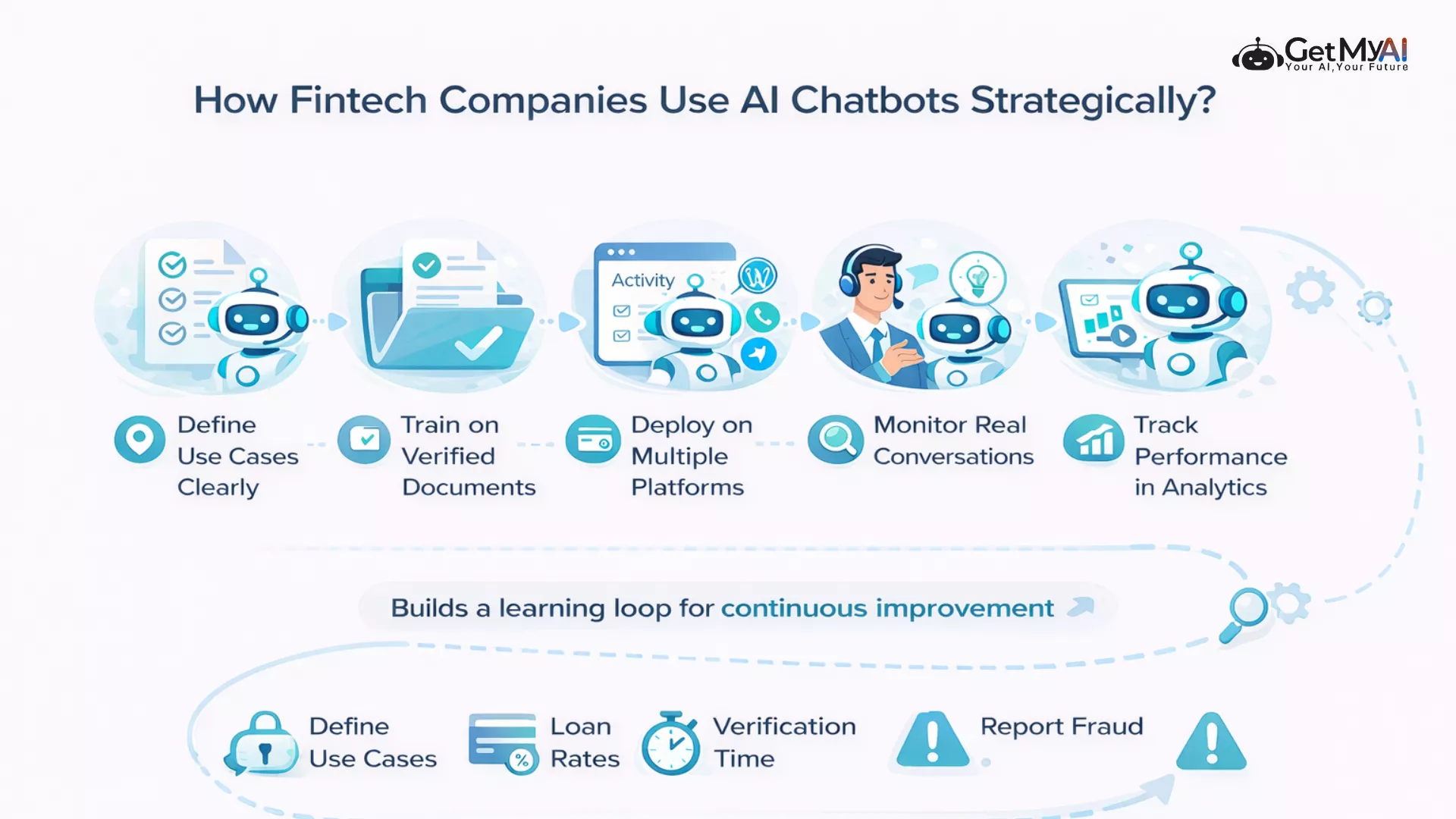
The most successful firms do not treat chatbots as marketing tools. They treat them as structured digital systems.
They follow this pattern:
- Define use cases clearly
- Train the chatbot on verified documents
- Deploy on website, WordPress, WhatsApp, Slack, or Telegram
- Monitor real conversations in Activity
- Improve answers through Q&A
- Track performance in Analytics
This builds a learning loop. Instead of deploying once and ignoring it, they improve it continuously.
Challenges of AI Chatbots in Fintech
It is also important to discuss the Challenges of AI chatbots in fintech.
Poor Knowledge Training
If documents are outdated or conflicting, the chatbot may return wrong answers. Retrieval is meaning-based, not keyword-based. Clean documentation is essential.
Over-Promising Automation
Some firms assume chatbots can replace entire support teams. That is not realistic. Which brings up a common question: Can AI chatbots replace bank customer support?
The answer is no. They automate routine queries and support human teams. Complex, sensitive, or regulated issues still require human oversight.
Legacy System Integration
Executives often ask, What are the best practices for integrating chatbots with legacy banking systems and ensuring minimal disruption?
Best practice includes:
- Start with limited use cases
- Use website embeds first
- Avoid deep system changes in early phases
- Expand gradually
This reduces risk.
Security Concerns
Another common concern: Are banking chatbots secure enough for financial transactions? Security depends on system design. Payment data must never be stored within chatbot platforms. Payment processing can be handled through trusted providers like Stripe, which stores card information securely. Documents should be stored on secure servers. Access should be controlled inside the Dashboard. Visibility settings should allow public or private access during testing. Trust is built through structure and transparency.
How to Implement AI Chatbots in Fintech
Leaders also ask, How to implement AI chatbots in fintech?
Implementation does not have to be complex.
Step 1: Create the Agent
Set up the agent in the Dashboard. Define its role clearly.
Step 2: Train the Agent
Upload PDFs, DOCX files, and other documentation. Add key answers into Q&A.
Step 3: Customize the Interface
Adjust:
- Display name
- Initial messages
- Suggested prompts
- Footer disclaimers
Align it with brand tone.
Step 4: Deploy
Deploy on:
Step 5: Monitor Activity
Review chat logs. Identify unanswered questions. Use the Improvement section to add new answers.
Step 6: Track Analytics
Monitor how often users interact and how engagement grows over time. Another question often asked is, How long does it take to implement a banking chatbot? For straightforward FAQ chatbot use, setup can be completed in a short time. For regulated processes, detailed review and testing are necessary. A phased launch supports safer deployment.
The Future of AI Chatbots in Fintech 2026
It is not about replacing financial staff. It is about structured coordination between AI assistants and operational teams.
We are seeing progress in:
- Real-time multilingual communication
- Advanced intent recognition accuracy
- Stronger reporting and engagement metrics
- Seamless embedding inside digital banking platforms
Banks that treat chatbots as long-term digital infrastructure will gain an advantage.
They will:
- Reduce support cost
- Improve customer satisfaction
- Increase onboarding completion
- Capture structured data for growth
They will also avoid the mistake many firms make. This leads to another question: Why do many banking chatbots fail to meet customer expectations?
Failure often comes from:
- Poor training data
- No monitoring
- No improvement cycle
- Over-promising features
Success comes from discipline.
Conclusion
The AI chatbot in banking is becoming a core layer of digital finance. It supports customers, teams, and leadership with real-time structured conversations. In 2026, the competitive edge will not come from having a chatbot. It will come from managing it well.
Firms can:
- Train with clean data
- Monitor Activity
- Improve through Q&A
- Track Analytics
- Deploy carefully across channels
It will build stronger digital operations. The future of AI chatbots in fintech is practical, measurable, and strategic. It is not hype. It is infrastructure. And for executives, that is what matters most.
FAQs
1.What are the benefits of AI chatbots in fintech?
They improve efficiency, reduce response time, personalize engagement, and provide measurable performance data. They also support structured improvement through real user interactions.
2.How do AI chatbots improve banking customer service?
They answer user questions instantly, shorten response delays, and handle routine support requests. They also record feedback and save conversations for analysis and refinement.
3.Can AI chatbots replace bank customer support?
No. They handle repetitive queries and assist users step by step. Complex or sensitive cases still require human teams.
4.Are banking chatbots secure enough for financial transactions?
Security depends on system design. Payment data should be handled by secure processors like Stripe. Chatbot systems should store documents securely and restrict access through controlled settings.
5.What happens when a chatbot cannot answer a customer's question?
An enquiry form can appear. The user submits their details. The question is saved in Chat Logs. Teams can review it and add the correct answer in Q&A for future improvement.