SaaS leaders in the US face a clear challenge. Customer acquisition costs are rising. Users expect instant help. Support teams are stretched. Revenue teams want better leads. Product teams want faster activation. For years, chatbots were treated as simple FAQ tools. Today, that view is outdated. The AI chatbot transformation happening across the SaaS industry is changing how companies manage support, sales, onboarding, and retention.
This shift is not about adding a widget to a website. It is about building smarter workflows powered by Conversational AI for SaaS. Let us look at what is really happening.
Recent Stats About AI in the SaaS Industry
The numbers explain why this shift is happening so quickly.
According to Gartner, AI will handle up to 80 percent of support issues in the coming years, and support costs could drop by around 30 percent by 2029. That prediction alone explains why boards are paying attention. Support is expensive. Research published by LiveChatAI shows that the average SaaS support ticket costs between 25 and 35 dollars. The same report notes that SaaS firms spend around 8 percent of ARR on support. When margins tighten, that percentage matters.
AI is not only reducing costs. It is improving revenue performance, too. A Forrester Total Economic Impact study cited by Envive reports that AI-driven systems can deliver around 270 percent ROI over three years. This is why AI integration in SaaS platforms is no longer optional. It is now part of the product and growth strategy.
How Are AI Chatbots Being Used in the B2B SaaS Industry?
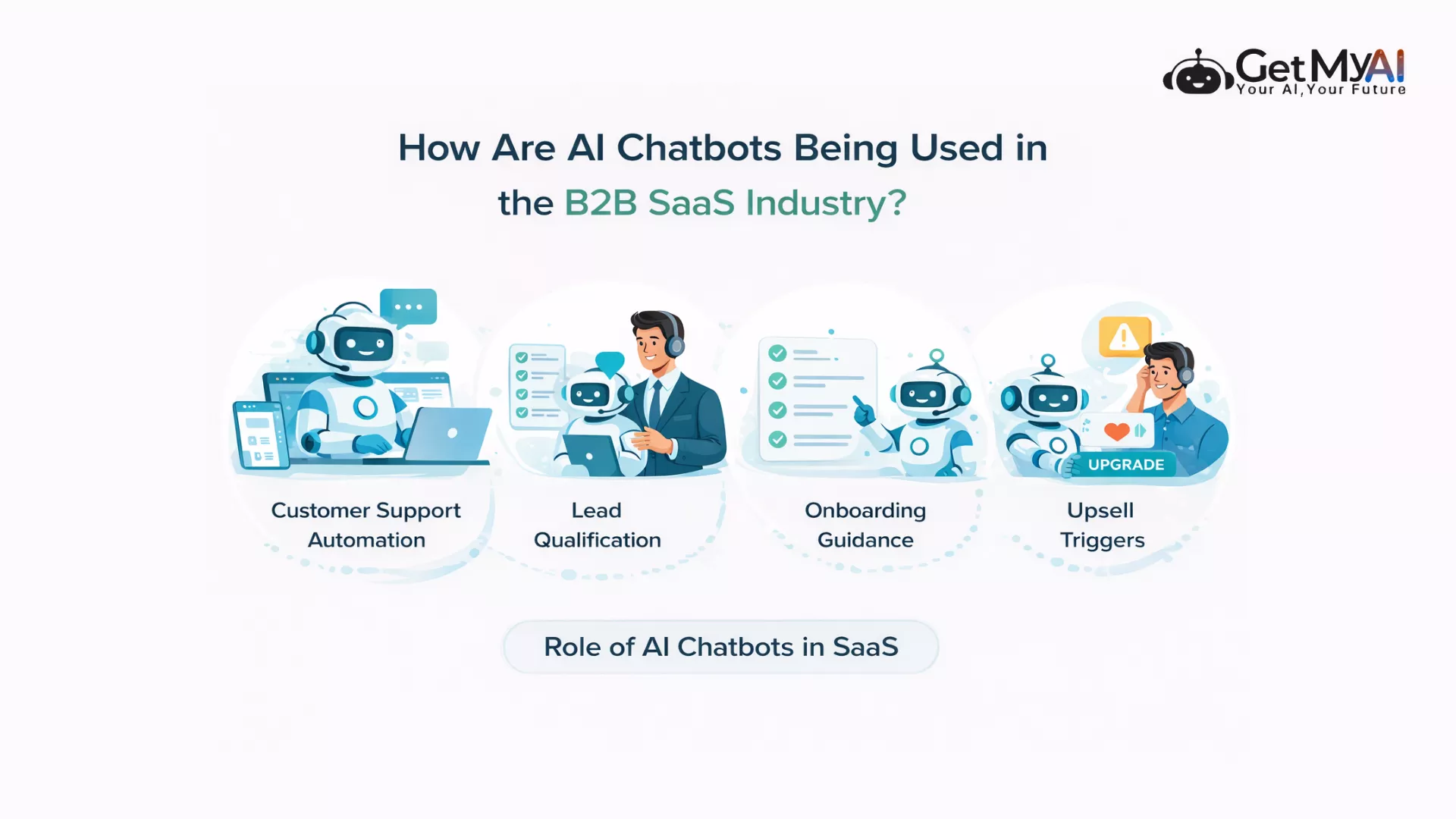
In today’s SaaS platforms, chatbots do much more than respond to basic questions. They function as intelligent virtual agents for SaaS products. You can see them inside apps, on websites, and across messaging channels. They provide real-time assistance where users expect fast and accurate replies.
1. Customer Support Automation
AI chatbots that SaaS companies deploy handle common tickets instantly, resolve FAQs, and provide real-time answers inside the product. This reduces ticket volume, improves response time, and supports consistent service without adding extra support staff.
2. Lead Qualification
Chatbots ask smart questions about budget, company size, and timelines before routing leads. This improves pipeline quality and allows sales teams to focus on serious prospects instead of manually filtering inquiries.
3. Onboarding Guidance
During the onboarding process, AI chatbots guide users step by step, explain product features clearly, and handle setup questions on the spot. This speeds up product adoption and strengthens activation and early customer retention.
4. Upsell Triggers
Chatbots detect usage patterns and suggest upgrades or add-ons at the right moment. By offering relevant recommendations inside conversations, they support expansion of revenue without interrupting the user journey.
5. Retention Monitoring
Chatbots provide proactive help when users show signs of struggle or inactivity. By offering timely assistance and directing users to solutions, they help reduce churn and strengthen long-term product engagement.
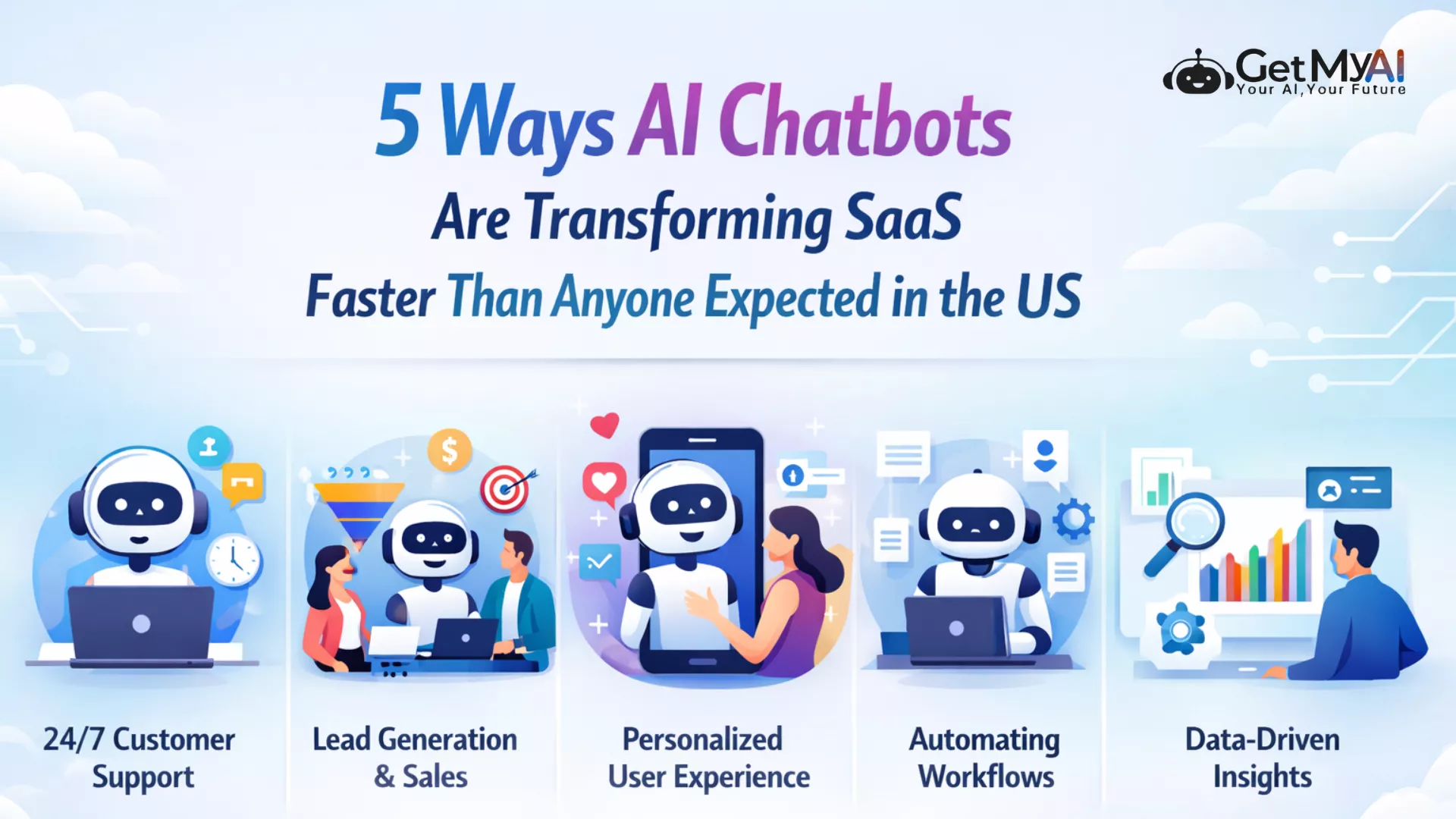
These use cases connect directly to revenue and cost outcomes. Now, let us break down the five biggest transformations.
Role of AI Chatbots in SaaS
The role of AI customer support bots has expanded into:
- First-line support: AI support bots answer common questions instantly, solve basic issues, and guide users to the right resources without waiting for a human agent.
- Guided onboarding: They guide new users through setup, explain important features, and give simple in-product instructions so users can understand the software and see results quickly.
- Lead qualification: Bots identify buying intent through targeted questions, record responses, and connect qualified prospects with sales.
- Upsell recommendations: By tracking user actions, the bot recommends suitable upgrades or add-ons that fit usage habits and help customers gain more value.
- Proactive retention: When signs of frustration appear, the bot responds with quick help and relevant guidance to keep customers from leaving.
This is why many teams now treat chatbot automation SaaS tools as part of their core product stack.
1. Customer Support Cost Reduction
Support is one of the most expensive parts of running a SaaS company. Tickets pile up. Headcount grows. Costs increase quietly over time.
According to research shared by LiveChatAI, the average SaaS support ticket costs between 25 and 35 dollars, and companies spend close to 8 percent of ARR on support. The same source shows that AI-driven support automation can deflect 25 to 45 percent of tickets, and even a 25 percent deflection rate could save around 330,000 dollars per year with more than 200 percent ROI in year two.
That changes the math quickly.
What does this mean in practice?
- Routine tickets get resolved instantly.
- Support teams focus on complex cases
- Response time improves
- Cost per conversation drops
When leaders evaluate AI chatbot SaaS platforms, cost reduction is often the first measurable win. But it is not only about saving money. Faster replies and consistent answers also improve the overall SaaS customer experience. Lower cost. Better service. Clear ROI.
2. Faster User Onboarding and Activation
Winning a customer is only step one. The real challenge begins after sign-up. SaaSFactor reports that 30 to 50 percent of users drop off during onboarding, and churn can exceed 75 percent in the first week. That is not a support issue. It is an activation issue. When users do not reach value quickly, they leave.
Here is where SaaS customer engagement automation makes a difference:
- Chatbots guide users step by step
- Setup questions are answered instantly
- Confusion is reduced during the first session
- Key actions are highlighted in real time
Users who understand the product early are more likely to stay.
Instead of forcing users to search help docs, Conversational AI for SaaS products brings answers into the product flow. It shortens time-to-value and improves first impressions. This is not about adding pop-ups. It is about intelligent assistance during the most sensitive stage of the customer journey. When activation improves, retention improves. And when retention improves, growth becomes more predictable.
3. Revenue Expansion and Upsell Acceleration
Revenue growth is not only about new customers. Expansion revenue often determines long-term success. Envive reports that AI sales agents can increase annual revenue by 7 to 25 percent. The same report notes that 55 percent of companies see more high-quality leads after AI adoption. That tells us something important.
Chatbots are no longer limited to answering support questions. They can:
- Detect buying signals
- Suggest relevant upgrades
- Recommend add-ons
- Encourage demo bookings
- Route high-value prospects to sales
When AI chatbots for SaaS companies deploy and connect with product usage data, they suggest upgrades based on real behavior, not random prompts. This makes upselling feel helpful, not pushy. The chatbot supports revenue growth while sales teams handle high-value deals and deeper conversations.
In this way, AI integration in SaaS platforms directly influences growth metrics. It supports marketing, sales, and product teams at the same time. The result is not just automation. It is smarter revenue acceleration.
4. Sales Qualification Automation
Sales qualification used to be manual. Reps reviewed forms. They followed up blindly. They filtered leads one by one. HubSpot shared that its SalesBot increased qualified lead conversion from around 3 percent to 5 percent. That jump may sound small, but at scale it significantly improves pipeline quality.
Today, chatbots can handle early qualification automatically:
- Ask budget questions
- Confirm company size
- Understand timeline
- Identify urgency
- Capture decision-maker details
This allows sales teams to focus on serious prospects instead of chasing cold inquiries. According to Autobound, 81 percent of sales teams now use AI, and AI-enabled teams see 1.3 times higher revenue growth.
For companies wondering how SaaS teams can measure chatbot ROI, this is a clear area. Better qualification leads to:
- Higher conversion rates
- Shorter sales cycles
- Improved pipeline efficiency
Here, Chatbot automation SaaS companies adopt a sales enabler, not just a support assistant.
5. Retention and Proactive Support
Retention is where real profitability lives. Groovy Web reports that generative AI can reduce churn by 30 to 40 percent when used effectively. That is not an incremental improvement. That is transformational. Proactive support plays a key role.
Instead of waiting for tickets, chatbots can:
- Detect user inactivity
- Identify repeated errors
- Offer help when users struggle
- Surface relevant tutorials
- Guide users back to key features
This is where real-time assistance in SaaS products matters most. When users feel supported before frustration builds, satisfaction increases. Retention improves.
This also strengthens long-term SaaS customer experience. When leaders ask how AI chatbots reduce churn in SaaS, the answer is simple. Early intervention prevents silent drop-offs. The economics are clear. Retaining a customer is cheaper than acquiring a new one. In this way, intelligent virtual agents for SaaS become part of the retention strategy, not just support operations.
Why AI Chatbots Are Becoming Essential for B2B SaaS Growth
The impact of AI chatbots on SaaS growth is now visible in real numbers. From cost savings to revenue lift, chatbots influence support, sales, onboarding, and retention. Their role is tied directly to performance metrics that leadership teams track every month.
- Lower support costs
AI chatbots resolve routine tickets instantly, reduce agent workload, and lower cost per conversation while maintaining consistent customer support quality. - Faster response time
Chatbots provide real-time answers inside the product or website, removing delays and improving the overall SaaS customer experience. - Higher activation rates
By guiding users during setup and answering questions instantly, chatbots help new customers reach value faster and stay engaged. - Better lead quality
AI chatbots qualify prospects through structured questions, ensuring sales teams focus on serious buyers instead of unfiltered inquiries. - Expansion revenue growth
AI chatbots monitor user activity and recommend suitable upgrades or add-on features, allowing SaaS companies to increase account value through well-timed, relevant suggestions.
The benefits of AI chatbots for SaaS businesses are now measurable, not theoretical.
AI Chatbot Analytics: Top AI Chatbot Trends for SaaS in 2026
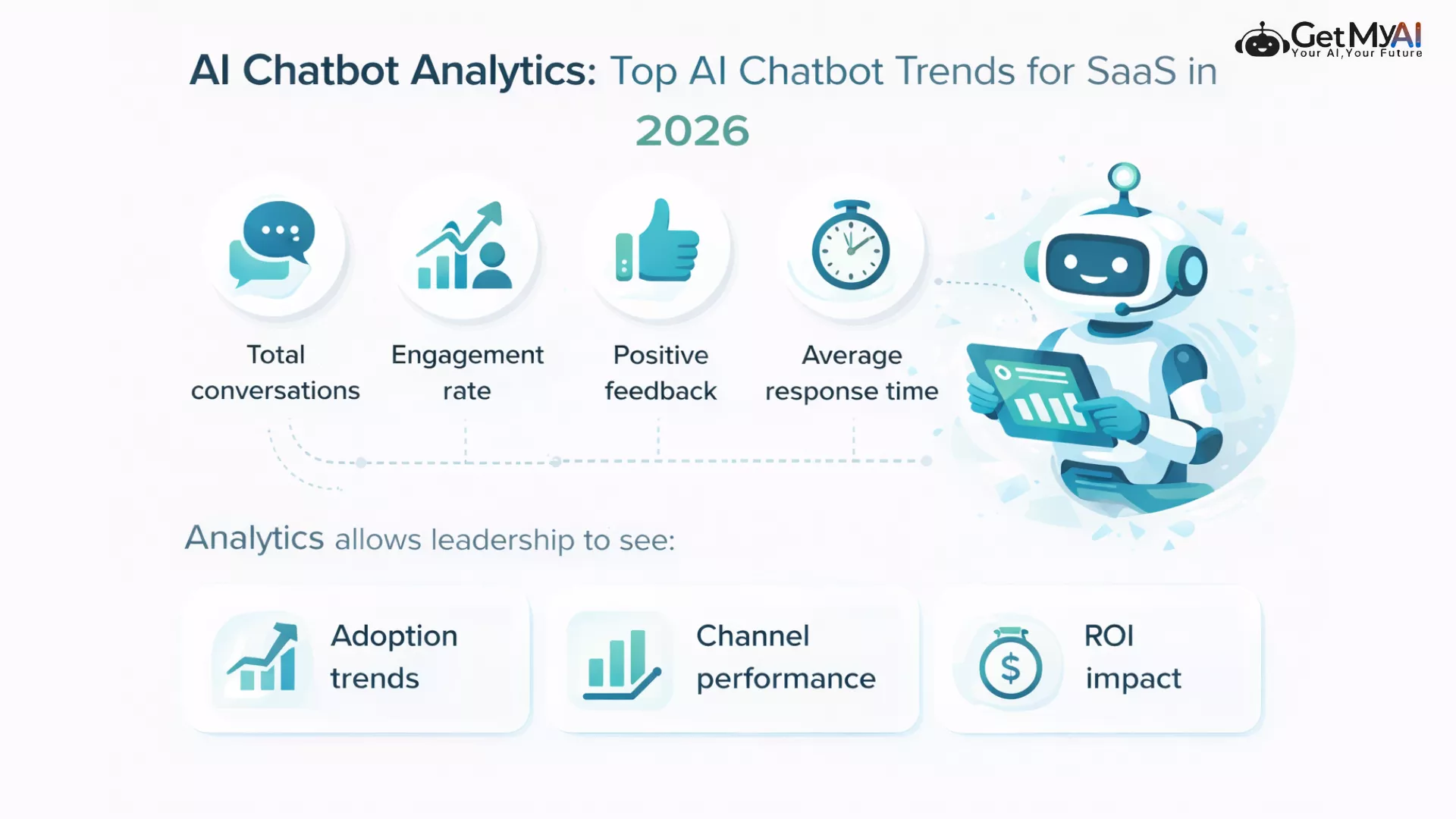
Modern chatbot analytics and insights go beyond ticket counts.
Teams track:
- Total conversations
- Engagement rate
- Positive feedback
- Average response time
- Geographic reach
Analytics allows leadership to see:
- Adoption trends
- Channel performance
- ROI impact
Instead of guessing whether automation works, teams measure it weekly or monthly. Analytics answers the question: Is automation improving SaaS customer experience?
How Does GetMyAI Help SaaS Companies Scale Sustainably?
GetMyAI is built as an AI chatbot that needs more than simple automation. It gives teams one place to manage conversations across the website, Slack, WhatsApp, and Instagram. All interactions use the same trained documents and Q&A, keeping answers consistent and aligned with product knowledge.
This AI chatbot for saas businesses connects daily operations with measurable performance. Conversations are logged in Activity, unanswered questions are flagged, and improvements are made from real user interactions. Over time, the system becomes smarter through continuous updates inside the Dashboard.
- Review real conversations
- Improve answers using Q&A
- Track performance in Analytics
- Flag unanswered questions
- Operate across multiple channels consistently
Conclusion
The future of AI chatbots in SaaS industry conversations is no longer speculative. Support costs are high. Onboarding drop-off is real. Revenue pressure is constant. Retention determines long-term success.
The data shows:
- 25 to 70 percent ticket deflection
- 30 percent or more churn reduction
- 7 to 25 percent revenue lift
- 270 percent multi-year ROI
These are operational results, not marketing claims. The question is not whether the AI chatbots for SaaS companies use will grow. The question is how deeply they will integrate into product, sales, and support systems. For US SaaS leaders, the transformation has already begun.
FAQs
1.How are AI chatbots transforming SaaS growth strategies?
AI chatbots support growth by reducing support costs, improving onboarding, qualifying leads, and driving expansion revenue. Their impact is measurable across cost savings, retention, and revenue performance.
2.How long does it usually take to build a custom AI chatbot for SaaS?
Initial setup can be completed quickly if documents and knowledge are ready. Improvement continues over time as unanswered questions are reviewed and updated.
3.Can AI chatbots improve lead quality and revenue expansion in SaaS?
Yes. Chatbots qualify leads, book demos, recommend upgrades, and route high-intent users to sales teams.
4.What happens if the chatbot automation in SaaS does not know the answer?
The system can show an enquiry form or flag the question in Activity. Teams then add the correct response in Q&A or update documents to improve future answers.
5.Is conversational AI for SaaS safe for handling customer data?
Secure platforms process conversations responsibly. Payment information, for example, can be handled by providers like Stripe rather than stored directly. Proper configuration ensures user data is managed safely.