Picture your two busiest months of the year. Enquiries arrive after hours, over weekends and during viewings when your team is unavailable. Every unanswered message is a buyer who moves on. Every delayed reply is a lead your competitor picks up instead. AI-pow…
Experience Boost
Create. Deploy. Engage. With GetMyAI
Launch GPT-powered conversations that engage, support, and convert — all in one platform.
AI Chatbots in Banking: Helping Local Banks Compete with National Banks in the US
getmyai
Mar 5, 2026
Chatbots for Local Banks
AI Customer Support for Banks
Banking Chatbot Solutions
The U.S. banking industry is changing fast. For many years, the biggest advantage belonged to banks with the most branches and the largest budgets. Today, the situation is different. Customers expect fast answers, digital access, and support at any time of day. A customer who checks their account at midnight still expects help if something goes wrong. A business owner making a transfer after hours wants answers immediately. Waiting until the next business day is no longer acceptable.
This shift is pushing banks toward new tools. One of the most important tools today is AI Chatbots in Banking. These systems allow banks to provide instant service through websites, mobile apps, and messaging channels. Instead of waiting in a phone queue, AI-powered chat support for bank customers can be delivered within seconds through digital banking channels. For community institutions, the impact becomes even stronger. Chatbots for Local Banks help deliver quick customer support without building large internal technology teams or expanding digital support departments.
The result is a new competitive landscape where technology can close the gap between local institutions and national banks.
The New Competitive Reality in U.S. Banking
Growing Technology Gap Between Local and National Banks
The U.S. banking system includes thousands of institutions, from large national banks to small community lenders.
Community banks still play a major role in the economy. According to FDIC data analyzed by USAFacts, community banks hold about $3.2 trillion in assets across more than 4,400 institutions. Even though they serve millions of customers, their technology budgets are often much smaller than those of national banks. Large institutions invest heavily in technology.
For example, Bank of America spends over $13 billion per year on technology and innovation. That level of spending allows major banks to build advanced digital tools, including Intelligent Virtual Assistants for Banks and large-scale automation systems.
This highlights the differences between local bank and national bank tech adoption.
Large banks often build their own AI systems inside their technology teams. Community banks usually need flexible platforms that deliver modern capabilities without huge development costs. This is where Banking Chatbot Solutions become useful. Instead of creating AI systems internally, smaller institutions can deploy chatbots that provide real-time customer query handling across multiple channels.
These tools help accelerate digital transformation in community banking without requiring enterprise-level technology budgets.
Existing Gaps and Challenges in Banking Customer Service
Customer expectations for banking support have changed dramatically in the past decade. Today, customers expect fast answers, contextual responses, and seamless experiences across channels.
Long Response Times
Many banks still deal with slow response times when customers ask questions online. A SouthState banking survey reported that 93 percent of banks take longer than five minutes to respond to online customer requests, and some replies arrive after a full day. Slow replies weaken trust and leave customers frustrated.
Inefficient Escalation Processes
Customer service requests often move through several teams before reaching the right person. This slows resolution and increases workload for support staff. Without Automated Customer Service for Banks, routine questions continue to overload banking support channels.
Limited After-Hours Support
Bank customers often look for help outside normal working hours. Many banks still depend on support teams that work only during office hours. Without digital systems or Support automation in banking, users may wait hours before receiving answers at night or on weekends.
Rising Service Costs
Maintaining large support teams across phone, branch, and digital channels increases operational costs. As customer queries grow, banks must spend more on staffing and infrastructure unless they introduce scalable Automated Customer Service for Banks solutions.
Fragmented Omni-Channel Systems
Many banks operate support across separate systems that do not share data. Phone support, digital portals, and messaging platforms may work independently. This fragmentation makes it difficult for banks to provide consistent Support automation in banking experiences across channels.
AI Chatbots vs Human Agents in Banks
Many banking leaders ask the same question when exploring AI tools.
Will chatbots replace human agents?
The answer is no. The most effective systems combine automation with human expertise.
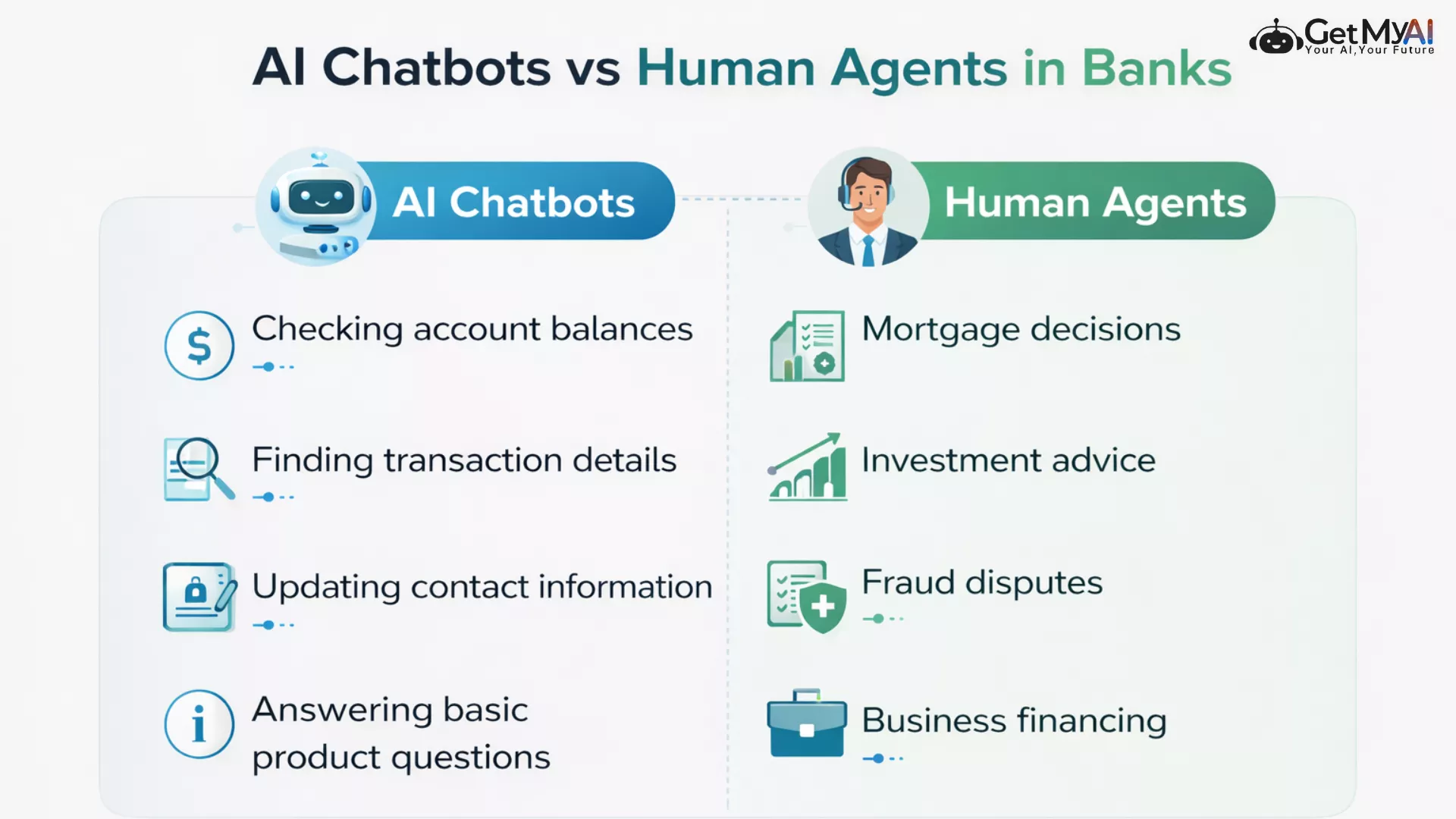
Chatbots work best when handling routine customer tasks. These tasks include:
Checking account balances
Finding transaction details
Updating contact information
Answering basic product questions
Human advisors remain critical for more complex financial needs.
Customers still prefer speaking with experienced bankers when they need help with:
Mortgage decisions
Investment advice
Fraud disputes
Business financing
Research supports this hybrid approach. Gartner predicts that AI will handle 80 percent of routine customer service interactions by 2029. This allows banks to automate high-volume tasks while human teams focus on specialized support.
Research supports this hybrid model. Gartner predicts that AI will manage 80 percent of routine customer service interactions by 2029. This lets banks automate large volumes of simple requests while human teams concentrate on specialized customer support.
This balance allows banks to combine AI Customer Support for Banks with trusted human guidance.
Support Area
AI Chatbots in Banking
Human Banking Advisors
Routine Account Questions
Provides quick balance and transaction updates
Reviews detailed account problems
Customer Information Updates
Guides users through updating contact details
Verifies identity for protected changes
Product Information
Answers basic questions about banking services
Explains advanced product features
Fraud Alerts
Identifies unusual activity and alerts users
Investigate fraud cases carefully
Financial Decisions
Gives simple information about services
Helps customers choose loans or investments
Customer Escalation
Passes complex chats to human advisors
Handles high-priority customer issues
Do National Banks Use Chatbots? Here’s What They’re Doing in 2026
Yes. Major financial institutions throughout the United States already use AI Chatbots in Banking to handle an increasing number of digital customer interactions and online banking support queries.
Banks today receive thousands of support questions daily through their websites, banking apps, and messaging services. Relying only on human support teams makes responses slower and increases service costs. To improve speed and efficiency, many institutions now use Intelligent Virtual Assistants for Banks to automate routine customer service conversations.
These systems allow banks to provide Automated Customer Service for Banks while keeping service available around the clock. Customers can check balances, review transactions, ask product questions, or get help with account issues without waiting in a phone queue.
Adoption is growing rapidly across the banking industry. Industry reports show that some major banks process hundreds of millions of chatbot interactions each year, proving that conversational technology is now widely used in daily banking services.
This shift highlights the growing role of Conversational AI for customer experience. Instead of depending only on call centers, banks now use AI-powered chat systems to manage large volumes of customer questions instantly while allowing human advisors to focus on complex financial conversations.
Scale vs Deployment
For community institutions, this trend offers an important lesson. The discussion around local bank chatbots vs national bank chatbots is no longer about whether the technology works. The real difference lies in scale and deployment strategy.
Platforms Enable Local Banks
Large banks often design systems with internal technology teams, while smaller institutions use specialized platforms to launch modern Banking Chatbot Solutions. With the right tools, Chatbots for Local Banks can provide the same type of AI-powered chat support for bank customers, delivering real-time responses and improving customer experience without large technology investments.
As digital expectations continue to grow, AI Chatbots in Banking are quickly becoming standard infrastructure across the industry.
How do AI chatbots help banks compete?
AI Chatbots allow banks to compete by delivering fast customer assistance, reducing operational service costs, and increasing response speed across digital platforms. For community banks, chatbots provide real-time service without the need to expand support teams.
These benefits allow smaller institutions to offer modern digital experiences similar to large national banks. One of the biggest advantages is availability. Unlike traditional support teams, chatbots provide service twenty-four hours a day. Customers can receive help whenever they need it. Cost efficiency is another important factor.
Research shows that chatbot interactions cost roughly $0.17 per inquiry, compared with about $4 for a phone or branch interaction. Juniper Research estimates that Banking Chatbot Solutions can reduce customer service costs by up to 30 percent through automation.
This makes Chatbots for Local Banks extremely useful. Rather than hiring more support agents, banks can use AI chatbot automation to handle common questions while human staff work on important customer cases.
Key benefits include:
24-hour customer service
Faster responses
Lower service costs
Better operational scalability
Improved fraud monitoring signals
These results show why banks are paying attention to the Chatbot Benefits for Community Banks and the larger benefits of chatbots for community banking growth.
What Features Should a Bank Chatbot Have?
Not all chatbots are designed for financial services. Banks require specialized capabilities that protect customer data while delivering reliable service.
According to Deloitte, modern banking chatbots must connect safely with financial systems while enabling conversational interactions between customers and AI chat support for faster and clearer digital banking assistance.
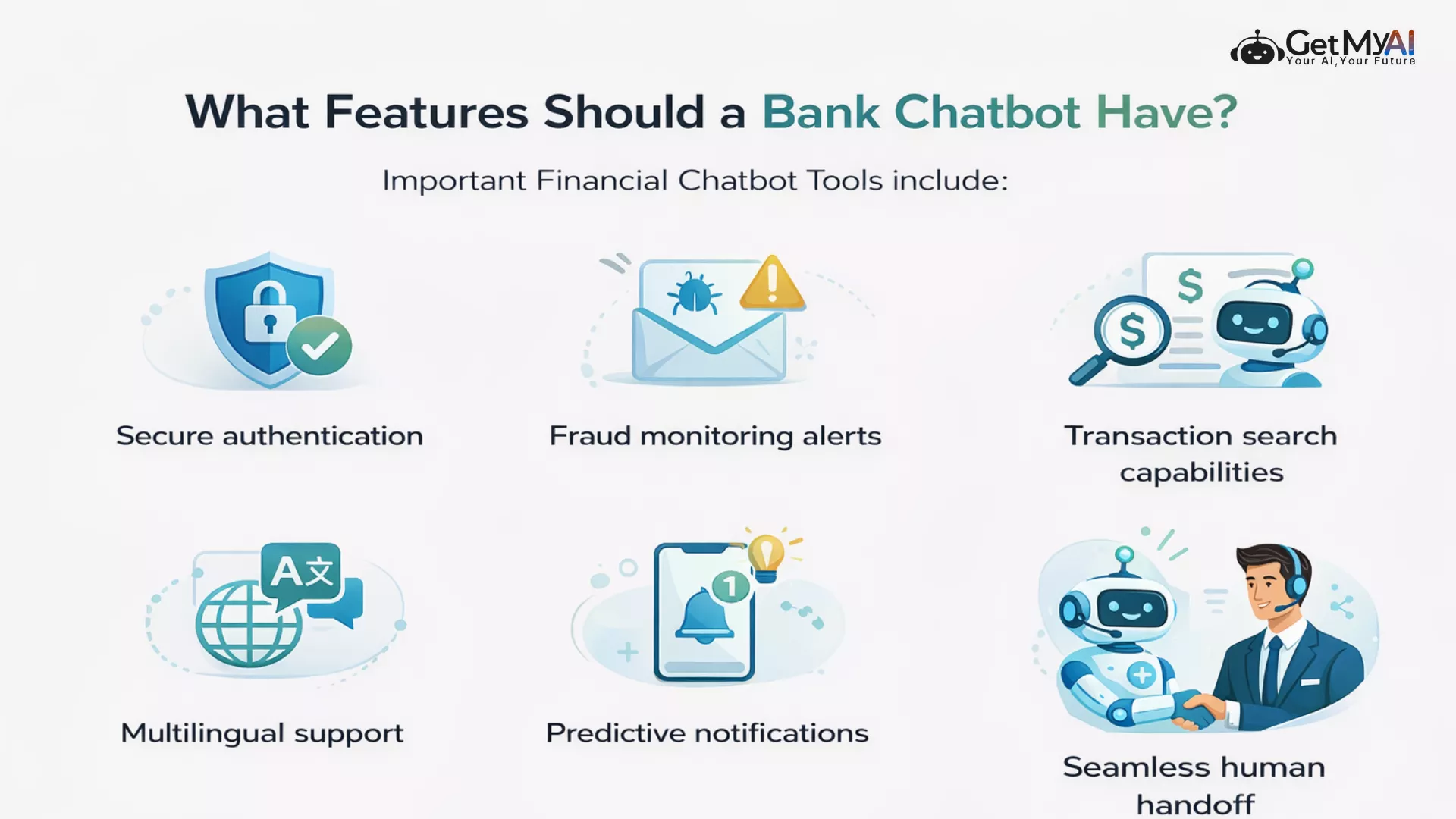
Important Financial Chatbot Tools include:
Secure authentication
Fraud monitoring alerts
Transaction search capabilities
Multilingual support
Predictive notifications
Seamless human handoff
These features support omnichannel banking chatbots that work across digital channels. Customers can interact with AI chat support on websites, mobile banking apps, and messaging platforms while receiving the same accurate responses and consistent banking assistance.
Research from McKinsey shows that Conversational AI for customer experience improves satisfaction when chat systems use personalized customer data. When AI chat tools understand user history, transaction patterns, and account activity, they provide faster and more relevant banking responses.
When reviewing the best AI chatbot platforms for small banks, institutions should focus on security, integration, and scalability. A dependable platform must protect data, connect easily with banking systems, and support more customer conversations as digital banking activity grows.
Finding the Right Balance Between AI and Human Banking Support
The most effective banking support systems combine automation with human expertise. Instead of removing support teams, AI chat tools help them operate more efficiently. Salesforce research shows that 88 percent of service teams state AI support lets them focus on harder customer needs.
This approach improves productivity while maintaining high-quality service. Customers still value human interaction when making financial decisions. PwC research confirms that people prefer human guidance for important financial choices such as loans or investments.
A hybrid support model allows banks to deliver:
Faster first responses
Lower service costs
Higher productivity
Stronger AI customer satisfaction metrics
This combination strengthens trust while still benefiting from AI Customer Support for Banks.
Choose GetMyAI for Institutions of All Sizes
Selecting the right technology platform is critical. Banks evaluating Banking Chatbot Solutions should focus on long-term scalability and security.
Important evaluation criteria include:
Compliance-first architecture
Multi-language support
Integration flexibility
Secure authentication systems
Support for chatbot integration with core banking systems
Accenture research indicates that AI-driven automation can increase operational efficiency by up to 40 percent when integrated with banking systems. IBM also explains that chatbots must connect with digital banking platforms and internal banking systems to work effectively. Platforms built for modern financial institutions help banks launch AI-powered chat support for bank customers across multiple digital channels.
GetMyAI helps institutions implement the best chatbot solutions for small financial institutions without requiring large internal development teams. Community banks can deploy Chatbots for Local Banks that provide modern digital experiences while maintaining operational control.
Conclusion
The importance of AI Chatbots in Banking continues to increase in today’s banking environment. What first appeared as a small automation feature now works as a core part of digital banking support systems.
For national banks, chatbots help manage millions of digital interactions.
For community banks, Chatbots for Local Banks provide a practical way to deliver fast service, reduce operational costs, and compete with larger institutions.
The banks that succeed in the coming decade will not simply automate customer support. They will combine AI Customer Support for Banks with trusted human advisors to deliver responsive, reliable financial service. Those institutions will define the future of digital banking.
FAQs
1. Why should local banks use chatbots?
Chatbots for Local Banks help provide 24-hour customer support, reduce service costs, and improve response times. They allow smaller institutions to deliver modern digital experiences without large technology budgets.
2. Are chatbots secure for banking customers?
Yes. Modern Banking Chatbot Solutions include secure authentication and encryption systems that protect financial data.
3. Do national banks use chatbots?
Yes. Large institutions such as Bank of America, Wells Fargo, and Capital One use AI assistants to handle millions of customer interactions each year.
4. How do banks implement AI chatbots for customer support?
Banks implement AI chatbots by choosing a reliable platform, teaching it with FAQs and financial service information, and placing it on websites or mobile apps. Support teams track interactions and update answers often to improve how AI chatbots respond to users.
5. How much do AI chatbots cost for banks?
Chatbot interactions can cost as little as $0.17 per conversation, making them far more affordable than traditional banking support channels.
Your AI customer support vendor just sent you a case study. Eighty percent automation. Thousands of tickets resolved. Zero human intervention. It sounds like the future of your support team is already here. But before you sign the contract, there is a number y…
A traveler visits your website at 10:43 PM. They know they want a family trip to Japan in March. They have a budget. They have dates. They are ready to talk to someone. Your contact form asks for a name and email. They fill it out, submit it, and open three co…