Instant Conversations: How AI Chatbots Respond On Every Channel

The real bottleneck was never the inbox. For a long time, businesses assumed slow responses were an operational issue. Fix the inbox, add better routing rules, hire more agents, and the problem should go away. In practice, it rarely did. What leaders eventually discovered is that email itself was not broken, but it was no longer aligned with how people communicate or make decisions. Customers do not wait patiently in inboxes anymore. They move, they multitask, and they expect answers in the moment.
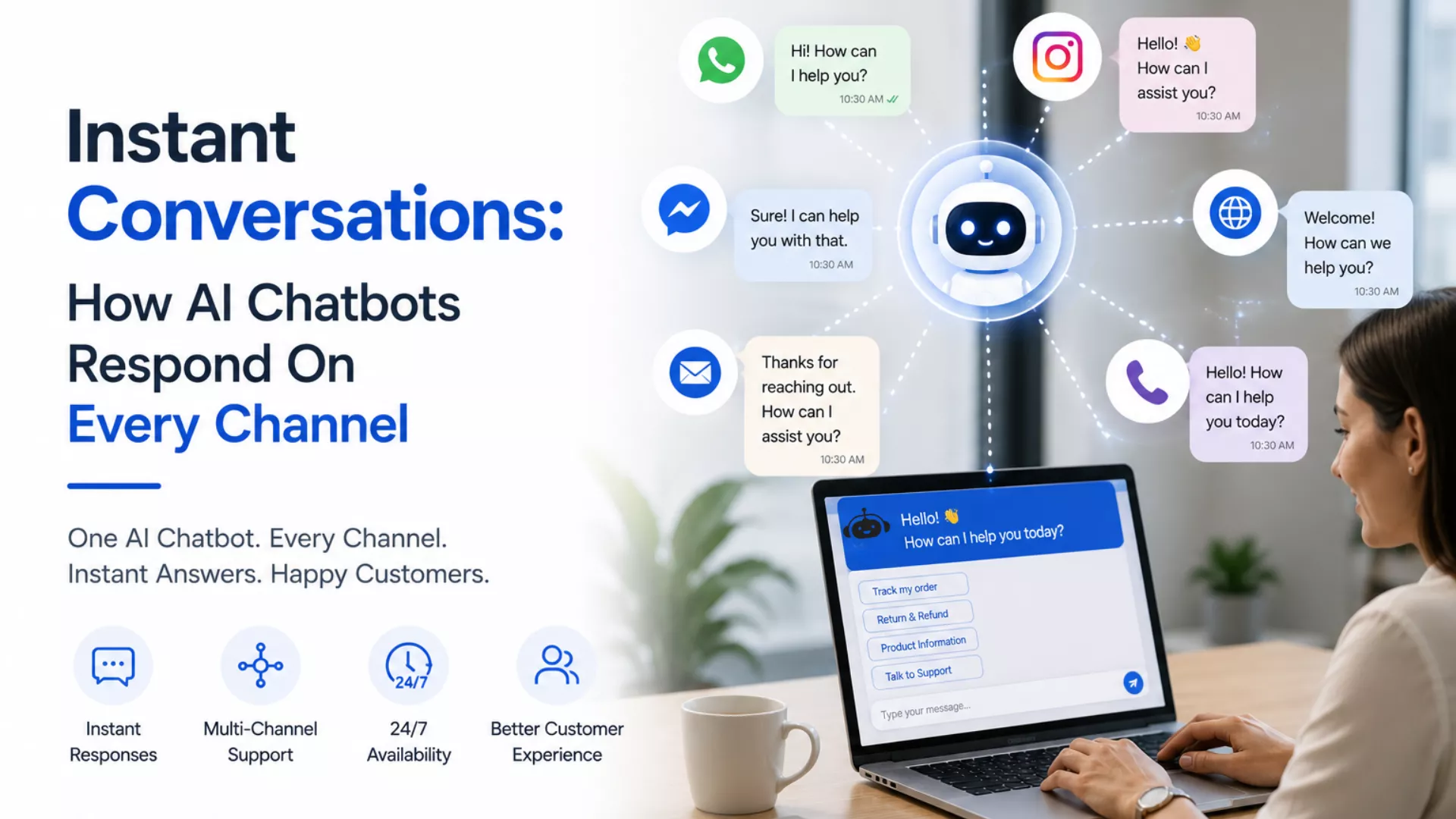
This shift has pushed organizations toward a conversational AI platform that works across touchpoints instead of inside a single channel. The goal is not to eliminate email, but to remove its role as the default response engine. When responses are handled through intelligent, always-available conversations, speed and consistency stop being trade-offs. They become the baseline. That change is now shaping how modern companies think about support, sales, and internal collaboration.
Why Email-Based Responses Break at Scale
Email was designed for asynchronous communication, not for resolving intent quickly. At low volumes, this limitation is manageable. At scale, it becomes expensive and frustrating. Threads grow long, context gets buried, and different people answer similar questions in slightly different ways. The result is an inconsistency that quietly erodes trust.
As organizations grow, email creates structural drag. Every new inquiry joins a queue. Every response depends on availability, experience, and interpretation. Even with templates, quality varies. This is why customer support AI initiatives often stall when they rely too heavily on inbox-based workflows. The system itself resists speed.
An enterprise AI chatbot changes the equation by removing queues altogether. Instead of waiting to be read, questions are handled instantly based on meaning and context. The same logic applies whether the volume is ten conversations or ten thousand. There is no marginal cost to answering another question.
This is not about automation for its own sake. This is about recognizing that email cannot handle growing demand as the main way to respond. When common and repeatable questions are handled by AI-powered chatbots, teams have more time for work that needs real thinking. At the same time, customers get clear answers right away. Growth becomes easier to manage instead of harder.
Website Chatbots Responding at the Moment of Intent
A website is where curiosity turns into intent. Visitors arrive with questions that influence whether they stay, leave, or convert. When answers are delayed, that moment passes. Traditional contact forms and follow-up emails rarely recover it.
Website chatbots exist to capture intent while it is still active. A conversational AI platform embedded on a site does more than greet visitors. It listens, interprets, and responds with precision. This is where AI knowledge management becomes critical. Answers are not improvised. They are grounded in structured, approved information that reflects how the business wants to present itself.
What makes this powerful is timing. The chatbot responds while the user is comparing options or validating assumptions. There is no handoff delay. No waiting period. The interaction feels natural because it happens in context.
Leadership teams can observe the impact through the metrics that are essential. Eventually, they will have lower bounce rates, higher engagement, and less repetition in support requests. Gradually, such dialogues reveal trends as well. You become aware of the questions that are asked the most by potential customers, the areas where people are confused, as well as the explanations that are the clearest.
This is why ai powered chatbots on websites are increasingly viewed as revenue and insight tools, not just support widgets. They turn static pages into living conversations that scale without losing consistency.
WhatsApp and Telegram Customer Support Without Waiting Rooms
Messaging platforms have reset expectations. People are comfortable asking short questions and expect equally fast answers. There is little tolerance for forms or delayed replies. This is where WhatsApp chatbot integration has become a priority for many businesses.
A chatbot for WhatsApp meets customers where they already spend time. It answers questions instantly, handles routine requests, and stays available outside office hours. The same applies to a chatbot for Telegram, which serves communities and global audiences that value speed and simplicity.
Use Case: High-Volume Support Without Queue Build-Up
Think about a company handling hundreds of daily messages about shipping, pricing, or login issues through chat apps. Without some form of automation, wait times drag on, and staff feel overwhelmed. By using AI on platforms like WhatsApp and Telegram, the majority of these queries are handled immediately, while complex issues are handed off to a person. Teams focus on the tough cases, and customers never have to wait in line.
From an operational perspective, this removes the concept of waiting rooms. Conversations do not pile up. They are handled as they arrive, with consistent logic guiding each response. This consistency is what makes customer support AI sustainable as volume grows.
Importantly, messaging bots do not feel robotic when done well. They respect conversational norms. They ask clarifying questions. They escalate when needed. Customers experience continuity rather than friction.
For executives, the strategic value is clear. Instead of expanding teams to match message volume, response capacity scales automatically. Costs stabilize. Satisfaction improves. Messaging channels become assets rather than operational risks.
Slack and Internal Response Automation That Keeps Teams Moving
External conversations are only half the story. Inside organizations, questions interrupt work constantly. Where is the policy document? How does this process work? Who owns this decision? These interruptions fragment focus and slow execution.
An enterprise AI chatbot embedded in Slack addresses this quietly but effectively. Instead of asking a colleague and waiting, employees get immediate answers drawn from shared knowledge. This is where AI knowledge management proves its value internally. Information is not scattered across drives and memories. It is accessible through conversation.
The impact compounds over time. New hires ramp faster. The employees in the top positions devote less time to the same questions. There are no unwarranted holdups in the decision-making process. The chatbot is integrated into the workflow instead of being seen as an additional tool to control.
Use Case: Internal Knowledge Access Without Interruptions
Picture a rapidly expanding business with a remote workforce. Questions regarding vacation time, approvals, or security protocols pop up every day in Slack. Without a system in place, these pings constantly disrupt managers and lead to conflicting answers. With an AI assistant directly in Slack, employees find the right information from one reliable source. This means fewer distractions, faster solutions, and much less internal stress for everyone involved.
Leaders often underestimate the cost of internal friction. Yet it shows up in missed deadlines and diluted accountability. By using ai powered chatbots for internal responses, organizations reduce dependency on individuals and create resilience. Knowledge stays available even when people are not.
This turns chatbots into productivity infrastructure. Not a novelty, but a quiet force multiplier that keeps teams aligned and moving.
What Makes AI Chatbot Responses Better Than Auto Replies
Auto replies were designed to acknowledge, not resolve. They confirm receipt and promise future action. In contrast, modern conversational systems aim to complete the interaction.
- Auto replies fire based on simple conditions such as keywords, forms, or inbound channels.
- AI chatbots interpret meaning, not just matching phrases.
- They recognise what the user is trying to achieve, even when questions are phrased informally or inconsistently.
- This allows conversations to move forward instead of restarting with every message.
The difference begins with understanding. Auto replies rely on triggers and templates. A conversational AI platform interprets meaning. It recognizes intent across messages and adapts responses accordingly. This allows conversations to progress rather than reset with each reply.
Context matters. When a user asks a follow-up question, ai powered chatbots remember what was already discussed. They do not force repetition. This continuity creates a natural experience that feels closer to speaking with a knowledgeable person than interacting with a system.
- Follow-up questions are handled without forcing repetition.
- Prior messages inform future responses automatically.
- Users do not need to restate their problem or reframe the context.
- Conversations feel continuous instead of fragmented.
Helping people find their way is another major benefit. Instead of just dropping one answer, chatbots can point to the next steps, provide a few choices, or walk through different trade-offs. This is particularly useful in AI customer support settings where fixing an issue often takes a bit of back and forth.
Tools like GetMyAI use this method by pulling every response from a specific, controlled knowledge source. This keeps every conversation accurate and professional while making sure the brand voice stays the same. It works reliably no matter how busy things get or which messaging app a customer chooses to use.
For decision makers, the takeaway is simple. Automation that only deflects inquiries shifts work elsewhere. Automation that resolves intent reduces work overall. That is why conversational systems outperform traditional auto replies in both efficiency and satisfaction.
One Knowledge Source: Many Channels with Consistent Responses
Fragmentation is the hidden cost of multichannel communication. When each channel is managed separately, answers drift over time. When changes are made in one location but not in another, that leads to very fine disparities which clients can detect while the company's staff remain oblivious. A little discrepancy at first grows to a point where trust is eroded, and more questions are asked.
A centralised conversational AI Platform addresses this by separating knowledge from channels. The same source powers website chat, messaging apps, and internal tools, ensuring that updates are made once and reflected everywhere. Control improves without slowing responsiveness, because accuracy is no longer dependent on manual coordination across teams.
This structure is built to support real growth. As a company scales, it might launch new bots for things like sales, onboarding, or internal HR. Since these tools all pull from the same core knowledge, the information stays accurate while different departments maintain control. Managing the system stays simple and organized, even as the organization becomes more complex.
Read more: https://www.getmyai.ai/blog/from-document-storage-to-decision-support-ai-knowledge-systems
Why a Single Knowledge Foundation is better:
- Eliminates contradictory answers across channels
- Reduces the manual effort required to keep responses aligned
- Makes updates immediate without retraining teams
- Preserves brand voice and policy accuracy at scale
Visibility improves as well. Leaders can see what questions are asked most often and where they surface, whether on the website, in messaging apps, or internally. This insight informs content strategy, product clarity, and operational priorities, turning conversations into actionable signals rather than isolated interactions.
Use Case: Scaling Support Without Losing Control
The quality of response is one of the things that usually suffers when a company goes into new markets or channels. However, if there's a common knowledge base, the new channels can be brought on board without the need for reworking the logic or making extra content. This setup enables the teams to have one unified voice covering all the platforms, thus providing a large operation without misunderstanding, and it seems to be the same conversation wherever they start it.
How Teams Use GetMyAI to Learn and Improve at Scale
For many organizations, the biggest missed opportunity in customer and internal conversations is learning. Questions get answered, issues get resolved, and then the interaction disappears. GetMyAI is designed to change that by treating every conversation as both a response and a signal.
When teams use GetMyAI, conversations across websites, WhatsApp, Telegram, and Slack are powered by a shared intelligence layer. Leadership, in this case, does not rely on intuition regarding the public's inquiries or the spots of misunderstanding. They are able to observe it firsthand. The questions that get repeated, the policies that are not clear and the issues that cause disputes become visible through actual usage, which is always the case, and not through surveys or guesses.
This visibility allows teams to act quickly. If customers repeatedly ask for clarification about pricing or onboarding, knowledge can be refined once and instantly reflected everywhere. If employees keep asking the same internal process questions, it becomes clear where documentation or workflows need improvement. The conversational AI platform becomes a feedback loop that tightens operations over time.
GetMyAI also helps teams distinguish between noise and patterns. Instead of reacting to isolated complaints, decision makers can identify trends across channels and time. That insight supports better prioritisation, whether it is improving a product explanation, refining a support flow, or updating internal policies.
Importantly, this learning does not create extra work. There is no manual tagging or analysis required. Insights emerge from normal conversations that are already happening. As usage grows, the system becomes more accurate and more valuable, without adding complexity for teams.
For executives, the benefit is strategic clarity. GetMyAI does not just help organizations respond faster. It helps them understand how customers and employees actually interact with the business. That understanding leads to clearer decisions, tighter execution, and continuous improvement driven by real behaviour rather than assumptions.
Conversational Responses Are the New Standard
Email will not disappear, but its role has clearly changed. It is no longer the backbone of real-time communication, especially as expectations continue to rise across digital touchpoints. Businesses that still depend on inboxes as their main way to respond will find it harder to keep up. Customers and internal teams now expect answers right away, not later in the day or the next morning. When replies take too long, frustration builds, and conversations lose momentum.
By adopting ai powered chatbots across websites, messaging platforms, and internal tools, organizations remove that waiting time. Responses are instantaneous, uniform, and rely on common knowledge regardless of the quantity or timing of the inquiries. Teams can then devote less time to clearing queues and more time to performing the tasks that really help the business grow.
This change is not about speed alone. It is about showing up at the right time with clear, useful answers. When people get help without friction, trust grows naturally. That is why conversational systems are becoming the normal way modern organizations stay connected and get work done.
FAQs
1. What is an omnichannel AI chatbot?
An omnichannel AI chatbot is a conversational AI solution that delivers consistent customer support across multiple channels, such as websites, WhatsApp, Telegram, and internal communication tools. It uses a shared knowledge base to provide accurate responses regardless of where the conversation starts.
2. How do AI chatbots provide consistent responses across multiple channels?
AI chatbots use a centralized knowledge base that powers conversations across every supported channel. When business information is updated, the chatbot delivers the same accurate response on the website, messaging apps, and other connected platforms, ensuring a consistent customer experience.
3. Why are businesses moving from email support to AI chatbots?
Email is designed for asynchronous communication, which often leads to delays and long response times. AI chatbots provide instant, context-aware conversations, helping businesses resolve customer questions faster while reducing support workloads.
4. Can AI chatbots work on WhatsApp and Telegram?
Yes. AI chatbots can be deployed on WhatsApp and Telegram to answer customer questions, provide product information, automate routine support requests, and transfer complex conversations to human agents when needed. This allows businesses to deliver 24/7 support on the messaging platforms customers already use.
5. What is the difference between AI chatbots and auto replies?
Auto replies respond to predefined triggers or keywords, while AI chatbots understand user intent and conversation context. AI chatbots can answer follow-up questions, personalize responses, and guide users through complete conversations instead of sending generic automated messages.
6. How do AI chatbots improve customer experience across channels?
AI chatbots provide immediate answers, remember conversation context, and maintain consistent information across every communication channel. This reduces customer effort, shortens response times, and creates a seamless support experience regardless of how customers choose to communicate.
7. What features should businesses look for in a multichannel AI chatbot?
Businesses should look for a shared knowledge base, multilingual support, CRM and help desk integrations, analytics, human handoff, role-based access control, conversation history, and support for channels such as websites, WhatsApp, Telegram, and internal collaboration tools. These features help deliver consistent customer experiences while simplifying chatbot management.
8. Can AI chatbots support both customers and internal teams?
Yes. Modern conversational AI platforms can answer customer inquiries while also helping employees access company knowledge, policies, SOPs, and technical documentation. A single AI chatbot can support multiple business functions using the same trusted knowledge source.
9. How can businesses measure the success of an omnichannel AI chatbot?
Businesses should monitor metrics such as response time, first contact resolution, chatbot containment rate, customer satisfaction (CSAT), engagement rate, ticket deflection, lead conversion rate, and conversation volume across each supported channel. These KPIs help evaluate chatbot performance and identify opportunities for improvement.
10. Why are AI chatbots becoming essential for multichannel customer communication?
Customers expect fast, consistent responses regardless of whether they contact a business through a website, WhatsApp, Telegram, or another channel. AI chatbots help businesses meet these expectations by delivering instant, accurate conversations, reducing operational costs, and maintaining a unified customer experience across every touchpoint.