AI Chatbot Pricing Explained: Cost of Implementation for Businesses

Key Takeaways
- The cost of an AI chatbot for business has shifted from software expense to operational investment tied to measurable efficiency gains.
- High-volume businesses achieve faster ROI as AI agents reduce per-interaction costs and eliminate linear hiring dependencies.
- Pricing models vary between subscription, usage-based, and hybrid, each aligning differently with scale, predictability, and control.
- Implementation cost depends more on data quality, integrations, and autonomy level than on basic software pricing.
- Future pricing will move toward outcome-based models where businesses pay for resolved tasks rather than usage.
The enterprise landscape is entering the Agentic Revolution, where static chatbots are being replaced by AI agents that act, respond, and guide across systems. These agents are action-oriented, capable of executing workflows; context-aware, maintaining continuity across channels; and always-on, delivering consistent support without scaling teams. This transformation redefines automation from a support function into an operational infrastructure that directly impacts efficiency and service delivery.
AI chatbot cost for business now reflects a shift from software expense to operational investment, where AI agents replace repetitive support tasks, reduce per-interaction costs from roughly $6 to $0.50, and scale without additional headcount, making them a core layer of digital operations rather than optional tools.
This shift changes how businesses evaluate cost. Instead of comparing tools, they are comparing operational models. In this context, chatbot cost vs manual support becomes the real decision point. Human-only support scales linearly with hiring and training, while AI agents scale output without proportional cost increases. This creates a measurable efficiency gap, pushing organizations to move from experimentation toward structured investment and long-term deployment strategies.
Who Should Invest in an AI Chatbot
Businesses should invest in AI agents when support volume, response expectations, or operational complexity creates inefficiency at scale. The cost of implementing an AI chatbot in business becomes justified when repetitive queries dominate workflows, after-hours demand exists, or fragmented systems slow response time, turning automation from optional to necessary.
Organizations handling more than 100 daily inquiries fall into the primary investment zone. At an average of $5-$6 per human-handled interaction, this volume creates a monthly cost burden of $15,000–$18,000.
In contrast, AI agents reduce per-interaction cost to approximately $0.50–$0.70, creating a clear efficiency gap. This is where the AI chatbot for customer support cost becomes a measurable advantage, often delivering payback within 3 to 6 months for high-volume teams.
See If AI Chatbots Can Reduce Your Support Costs
Find out how much you can save by automating customer support, reducing response time, and handling high-volume queries with AI.
Qualifying Your Business: The Friction Audit
Use these criteria to determine urgency:
- High Tier-1 Volume: If more than 70% of support queries are repetitive, human resources are being underutilized.
- After-Hours Demand: If your business cannot respond instantly outside working hours, you are losing conversions to competitors.
- Fragmented Data Systems: If customer data is spread across multiple tools, AI agents can unify access and improve resolution speed.
“AI investment becomes necessary when operational friction exceeds the cost of automation.” Businesses that meet these conditions are not evaluating a tool; they are investing in a system that replaces manual inefficiency with scalable resolution.
How Much Does an AI Chatbot Cost for a Business
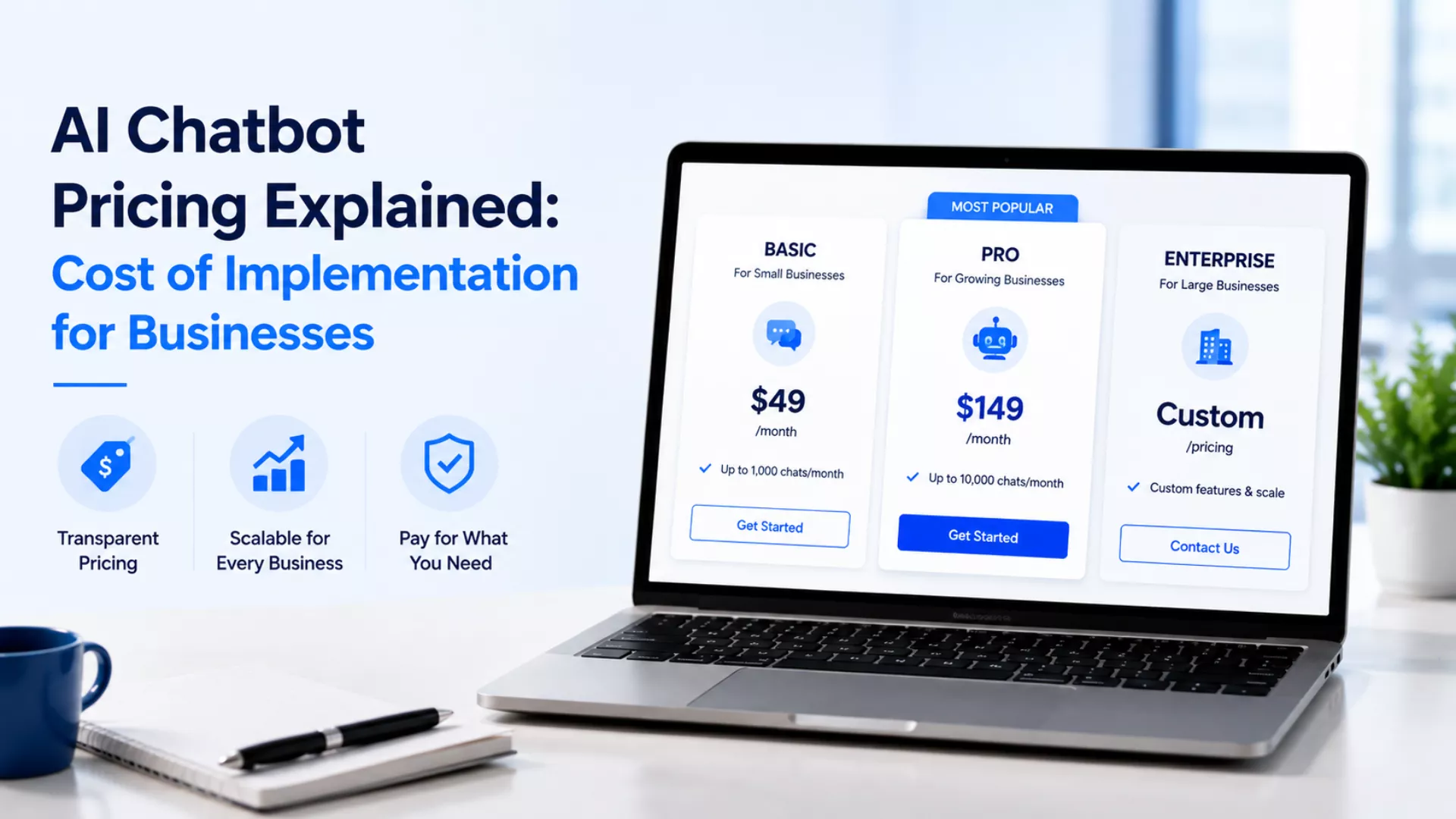
AI chatbot cost for business in 2026 typically ranges from $15/month for basic setups to $5,000+/month for enterprise-grade AI agents. The final price depends on workflow complexity, integration depth, and usage volume, not just the subscription plan. This shift reflects a move from simple tools to scalable operational systems.
Pricing should be evaluated based on operational scope rather than surface-level software costs. The AI chatbot cost per month varies depending on integrations, data processing requirements, and model usage. SaaS platforms offer predictable tiers, while advanced AI agents introduce variability, making it critical to account for scale, data quality, and system dependencies when estimating total cost.
Al Chatbot Pricing Models: Which One Actually Works for You?
1. Subscription Model (Predictable, Scalable)
Businesses pay a fixed monthly fee, making costs stable as usage grows. Platforms like GetMyAl follow this model, allowing businesses to build and deploy AI agents without worrying about per-interaction charges. This model is best for teams with consistent or growing volumes
Latest Trend: Instead of paying for your human staff to access a tool, vendors are now pricing "AI Seats." You "hire" a digital agent with a fixed monthly salary (subscription), just like a human employee.
2. Usage-Based Model (Cost Tied to Volume)
Businesses pay per interaction or resolution. Costs scale directly with usage, which works for low-volume cases but becomes expensive as conversations increase.
Latest Trend: The shift toward Small Language Models (SLMs) like Llama-3 (8B) and Mistral NeMo has crashed the cost of inference. In 2026, cloud inference for SLMs costs roughly $0.10–$0.50 per 1M tokens, compared to $10–$30 for high-reasoning LLMs.
3. Hybrid Model (Controlled Scaling)
Combines a base subscription with usage overages. This provides flexibility while maintaining partial cost predictability for growing businesses. It aligns the vendor’s incentives with yours. If the AI doesn’t solve the problem, you don't pay the premium.
Latest Trend: Outcome-Based Pricing (OBP). Gartner reports that by 2026, 30% of enterprise AI contracts include a "risk-sharing" clause.
What GetMyAI Offers with its Subscription Model
GetMyAI follows a subscription-based pricing model where businesses pay a fixed monthly fee to deploy and scale AI agents without unpredictable per-interaction costs.
| Plan | Price | Message Credits | AI Agents | Team Members | Key Features |
| Free | $0/month | 40/month | 1 | 1 | 500KB storage, train with 10 links, unlimited websites, no analytics, 2 models |
| Standard | $29/month | 2000/month | 1 | 1 | 5 actions/agent, 45MB storage, train with 100 links, basic reports, 5 models |
| Premium | $99/month | 12000/month | 3 | 3 | 10 actions/agent, unlimited links, integrations, remove branding, 7 models |
| Advance+ | $249/month | 40000/month | 8 | 10 | 20 actions/agent, advanced reports, unlimited links, remove branding, 7 models |
This AI chatbot pricing plan allows businesses to start with minimal investment, validate real use cases, and scale predictably as AI adoption grows.
Start Your Free Monthly Trial and Scale as You Grow
Launch your AI chatbot in minutes, automate customer queries, and experience the full platform with a free monthly trial upgrade anytime as your business grows.
Important Features of AI Chatbots
- Context-aware conversations: Modern AI chatbots understand user intent and maintain context across interactions, improving accuracy and reducing repeated queries.
- 24/7 availability: AI agents operate continuously without downtime, ensuring instant responses and consistent support across time zones.
- Multi-channel deployment: Chatbots function across websites, WhatsApp, Slack, Telegram, and Instagram, creating a unified communication layer.
- Automated workflows: Beyond answering questions, AI agents handle tasks such as lead qualification, booking, and routing queries.
- Scalability: AI chatbots handle thousands of interactions simultaneously without increasing costs linearly.
- Analytics and insights: Built-in analytics track conversations, engagement, and performance, helping businesses optimize responses and improve outcomes.
- Continuous improvement: Systems learn from interactions over time, reducing the cost of implementing an AI chatbot in business by improving accuracy without rebuilding workflows.
Top 5 Use Cases of AI Chatbots Across Industries
Autonomous Customer Support (Resolution Agents)
An AI customer support automation platform replaces repetitive ticket handling with end-to-end resolution. These agents connect with CRMs and internal systems to process refunds, update orders, and resolve queries without human intervention. This reduces response time and lowers per-interaction cost significantly while maintaining consistency at scale.
Autonomous resolution systems now handle complex support workflows, where an AI chatbot for customer support integrates with CRM tools to resolve tickets end-to-end, with custom builds typically costing between $40,000 and $120,000, depending on integration depth.
Intelligent Lead Generation and Sales Qualification
An AI chatbot for lead qualification acts as a digital sales representative that engages visitors in real time, evaluates intent, and books meetings. These agents use structured questioning and context to qualify prospects, helping sales teams focus only on high-value opportunities and improving conversion efficiency.
Sales teams increasingly rely on conversational systems that qualify intent in real time. An AI chatbot for lead generation engages prospects, filters opportunities, and books meetings, with custom development costs ranging from $70,000 to $180,000.
Healthcare Patient Management
A HIPAA-compliant AI chatbot for patient management supports appointment scheduling, patient triage, and follow-ups while maintaining strict regulatory standards. These systems integrate with health records and ensure data privacy, making them essential for healthcare environments where compliance and accuracy are critical.
In regulated environments, automation demands precision. An AI chatbot for healthcare supports triage, appointment scheduling, and patient follow-ups, with custom builds often reaching $100,000 to $400,000 due to compliance and validation requirements.
E-commerce Personalization and Operations
An AI chatbot for product recommendations in e-commerce analyzes user behavior and product data to deliver personalized suggestions. These agents also assist with order tracking, returns, and inventory queries, improving customer experience while increasing average order value and operational efficiency.
In retail, personalization drives revenue. Businesses deploy an AI chatbot for e-commerce to recommend products, manage returns, and handle queries, with build costs ranging from $30,000 to $150,000 based on system integrations.
HR and Internal Operations Automation
An AI chatbot for HR automation streamlines internal processes such as leave requests, benefits queries, and IT support. By integrating with internal systems, these agents reduce employee friction and eliminate repetitive administrative tasks, allowing teams to focus on strategic work.
Internal operations are also evolving. An AI chatbot for HR simplifies employee support by handling queries, leave requests, and internal workflows, with typical build costs between $50,000 and $150,000, depending on system connectivity.
Key Factors Affecting the AI Chatbot Implementation Cost
- Level of Autonomy (Intelligence Tier): Higher autonomy increases cost, from basic rule-based bots to contextual agents, while fully autonomous systems with reasoning and tool execution require enterprise-level investment.
- Data Readiness and Engineering: Well-structured data lowers costs and speeds deployment, while fragmented or unorganized data increases effort through cleaning, labeling, and building reliable retrieval systems.
- Integration Complexity: Simple integrations remain cost-effective, but connecting multiple systems or legacy platforms requires middleware, coordination, and validation, significantly increasing implementation complexity and cost.
- Security, Compliance, and Risk Controls: A GDPR-Compliant AI chatbot requires strict data handling, encryption, and audit controls, while frameworks like HIPAA or SOC 2 further increase implementation complexity, time, and cost.
- Ongoing Production and Maintenance Costs: AI systems require ongoing costs for token usage, monitoring, and optimization, as performance tuning and scaling usage increase operational expenses over time.
Challenges in Implementing AI Chatbots in Your Business Platforms
- Data Quality and Preparation: Poorly structured or outdated data reduces accuracy, requiring extensive cleaning, labeling, and ongoing maintenance efforts.
- Integration with Existing Systems: Connecting multiple tools or legacy systems increases complexity, often requiring middleware and careful coordination across platforms.
- User Adoption and Experience Design: Poorly designed conversations or unclear flows reduce engagement, limiting effectiveness and slowing adoption across users.
- Managing Expectations and Scope: Overestimating capabilities leads to poor outcomes when chatbots are deployed without proper training or defined use cases.
- Ongoing Monitoring and Optimization: AI systems require continuous updates, performance tracking, and refinement to maintain accuracy and relevance over time.
Step-by-Step Process of Executing AI Chatbots Across Your Business Platforms
AI chatbot implementation is no longer a complex engineering project. The cost of AI chatbot implementation is now driven more by scope and data readiness than by development effort. GetMyAI standardizes the process, allowing businesses to move from setup to deployment with structured steps rather than custom builds.
Step 1: Create Your AI Agent in the Dashboard
Start by defining the role of your AI agent. This includes customer support, lead qualification, or appointment handling. In the Dashboard, you create the agent, assign its purpose, and prepare it for training. This step establishes the foundation without requiring technical configuration.
Step 2: Train Your Agent with Business Data
Upload documents, add website links, and build Q&A entries to train the agent. The cost of implementing an AI chatbot in business is directly influenced by the quality and structure of this data. Clear, updated content improves response accuracy, while fragmented or outdated data increases effort and reduces performance.
Step 3: Customize the Chat Experience
Configure how the chatbot appears and interacts with users. This includes display name, initial messages, suggested prompts, and visual styling. The AI chatbot subscription model supports this flexibility, allowing businesses to control user experience without additional development or design overhead.
Step 4: Test in Playground with Live Preview
Before deployment, test the agent inside the Playground. Simulate conversations, review responses, and refine outputs. Use the built-in website preview to see how the chatbot will appear in a real environment. This step ensures that the agent performs correctly before going live.
Step 5: Deploy Across Business Platforms
Deploy the same AI agent across multiple platforms where your business operates. This includes:
- Website (embed script or iframe)
- Telegram
- Slack
The cost to integrate an AI chatbot into a website is minimal compared to traditional development, as deployment requires only a script or connection setup. The same trained agent operates consistently across all channels.
Step 6: Monitor, Improve, and Scale
After deployment, use the Activity section to review conversations and identify gaps. Unanswered queries move into Improvement, where they can be converted into Q&A entries. Analytics provides performance insights, including engagement and response trends. This continuous loop ensures the system improves over time without rebuilding.
How to Choose the Right AI Chatbot Pricing Plan
Choosing the right plan depends on volume, use case, and how deeply the AI agent integrates into your workflows. AI chatbot platform pricing scales with business needs, so the correct plan is not the cheapest option. It is the one aligned with your current demand and near-term growth.
Low Traffic: Entry Plan (Start Smart, Minimize Risk)
For businesses with low interaction volume or early-stage adoption, entry-level plans provide a controlled starting point. These plans include limited message credits, basic training capacity, and essential features.
- Ideal for testing real use cases
- Helps teams understand usage patterns
- Positions AI as a workflow tool, not an experiment
An affordable AI chatbot for business support often begins here, especially when the goal is to validate ROI before scaling.
Growing Business: Standard Plan (Balance Cost and Capability)
As interaction volume increases, businesses require more capacity, integrations, and improved response handling. Standard plans introduce:
- Higher message limits
- Integration capabilities
- Basic analytics and reporting
At this stage, the AI chatbot's monthly cost becomes tied to consistent usage and operational reliance. Businesses begin to depend on AI for daily workflows rather than occasional support.
High Volume: Premium or Enterprise Plans (Scale Without Friction)
For high-traffic environments, advanced plans support multiple agents, higher limits, and deeper operational integration. These plans are designed for:
- Multi-channel deployments
- Large-scale conversation handling
- Advanced reporting and control
The AI chatbot subscription model ensures predictable scaling. Businesses can expand usage without recalculating costs for every interaction.
Match Plan to Operational Reality
- If usage is low and exploratory, start with an Entry plan to test real scenarios, validate outcomes, and understand how AI fits into your workflows without upfront risk.
- If workflows depend on AI daily, move to a Standard plan to ensure consistent performance, higher capacity, and integration support for growing operational reliance.
- If AI replaces a significant support load, invest in Premium or Enterprise plans to handle scale, enable multi-channel operations, and maintain performance across high interaction volumes.
Why GetMyAI is the Faster Way to Deploy AI Chatbots
GetMyAI is built for businesses that want to deploy AI chatbots without the cost and complexity of custom development. Instead of building systems from scratch, you start with one input: your use case, whether it’s customer support automation, lead qualification, or internal workflow management.
The platform allows you to define intent, upload business data, and add Q&A, enabling your AI chatbot to deliver accurate, context-aware responses based on real information, not generic scripts. This significantly reduces the cost of implementing an AI chatbot in business while improving response quality from day one.
With GetMyAI, the entire AI chatbot setup process is streamlined. The system automatically structures your data, understands user intent, and prepares responses aligned with your workflows. You can customize the chat experience, configure behavior, and test everything in a live Playground with a website preview before going live.
There’s no need for model training, complex integrations, or engineering teams. What traditionally takes weeks or months of development can now be deployed within hours. This makes GetMyAI a cost-effective AI chatbot platform for businesses looking to automate support, capture leads, and scale operations without increasing overhead.
From website integration to multi-channel deployment across platforms like WhatsApp, Slack, and Telegram, GetMyAI enables businesses to launch, manage, and scale AI chatbots as a core part of their operations, turning automation into a predictable and scalable system rather than a technical project.
Future of AI Chatbot Pricing: Why Costs Will Shift
AI chatbot platform pricing is shifting from fixed software fees to value-driven models tied to automation outcomes. Businesses now evaluate cost based on operational impact, not access, as AI agents move from support tools to core systems that drive efficiency, scale interactions, and reduce manual workload.
Outcome-Based Pricing Will Redefine Cost Structures
Support automation pricing is moving toward outcome-based models where businesses pay for resolved queries or completed tasks instead of raw usage. This approach aligns cost directly with value delivered, making pricing more transparent and easier to justify as AI agents handle increasing portions of customer interactions.
AI Agents Are Replacing Entire Workflows
The pricing of AI chatbot platforms for customer support is evolving because AI agents now handle full workflows such as lead qualification, scheduling, and issue resolution. This reduces dependence on multiple tools and shifts cost comparison from software to operational replacement and efficiency gains.
Multi-Channel Automation Will Become the Standard
The cost of implementing an AI chatbot in business will increasingly reflect how widely the system operates across platforms. As businesses deploy AI across websites, messaging channels, and internal tools, pricing will be driven by coverage and scale rather than isolated chatbot use cases.
Ready to Reduce Support Costs and Scale Your Business?
See how AI chatbots can automate customer interactions, improve response time, and increase conversions across your business without increasing operational costs.
FAQs
1. How much does it cost to build an AI agent?
The cost of building an AI agent depends on its complexity, integrations, deployment environment, and ongoing usage. A simple AI agent may require a modest investment, while enterprise AI agents with multiple integrations, advanced workflows, and security requirements typically cost significantly more. Businesses should also consider recurring costs such as model usage, hosting, maintenance, and monitoring.
2. What factors affect AI agent development costs?
The biggest cost drivers include the AI model used, the number of business integrations, workflow complexity, data preparation, security requirements, customization, testing, and ongoing maintenance. Projects with multiple AI agents or enterprise compliance requirements generally require larger budgets.
3. Is it cheaper to build an AI agent or use an AI agent platform?
For most businesses, using an AI agent platform is more cost-effective than building from scratch. A platform reduces development time, infrastructure costs, and ongoing maintenance while providing built-in features such as analytics, integrations, security, and scalability. Building a custom solution is usually justified only for highly specialized enterprise requirements.
4. What ongoing costs should businesses expect after deploying an AI agent?
Beyond the initial implementation, businesses should budget for AI model usage, message or token consumption, cloud hosting, monitoring, maintenance, security updates, knowledge base updates, integrations, and continuous performance optimization. These recurring costs are an important part of the total cost of ownership.
5. What is the most affordable way to start using AI agents?
Many businesses begin with a cloud-based AI agent platform that offers a free trial or entry-level subscription. This allows teams to validate use cases, measure ROI, and expand gradually without making a large upfront investment.
6. Why do enterprise AI agents cost more than basic AI chatbots?
Enterprise AI agents typically support multiple workflows, integrate with business systems, enforce security and compliance policies, manage large knowledge bases, and serve multiple departments. These advanced capabilities require additional development, infrastructure, and governance compared to a basic customer support chatbot.
7. How can businesses reduce the cost of AI agent implementation?
Businesses can lower costs by starting with a single high-value use case, using an existing AI agent platform instead of building custom infrastructure, integrating only essential systems initially, and expanding automation as measurable business value is demonstrated. This phased approach helps control spending while reducing implementation risk.
8. How do businesses calculate the ROI of an AI agent?
AI agent ROI can be measured by comparing implementation and operating costs against business outcomes such as reduced support costs, faster response times, higher employee productivity, improved lead conversion, increased customer satisfaction, and lower manual workload. Monitoring these metrics helps determine the long-term value of the investment.
9. What hidden costs should businesses consider before building an AI agent?
Hidden costs may include API usage, integration maintenance, data preparation, employee training, workflow redesign, monitoring, quality assurance, compliance reviews, security audits, and ongoing optimization. Planning for these expenses helps businesses avoid unexpected budget overruns.
10. Should businesses build a custom AI agent or choose a ready-made platform?
The right choice depends on business requirements. Organizations with unique workflows, strict compliance needs, or proprietary systems may benefit from a custom AI agent. However, most businesses achieve faster deployment, lower costs, and easier scalability by choosing a proven AI agent platform that can be configured to their needs.