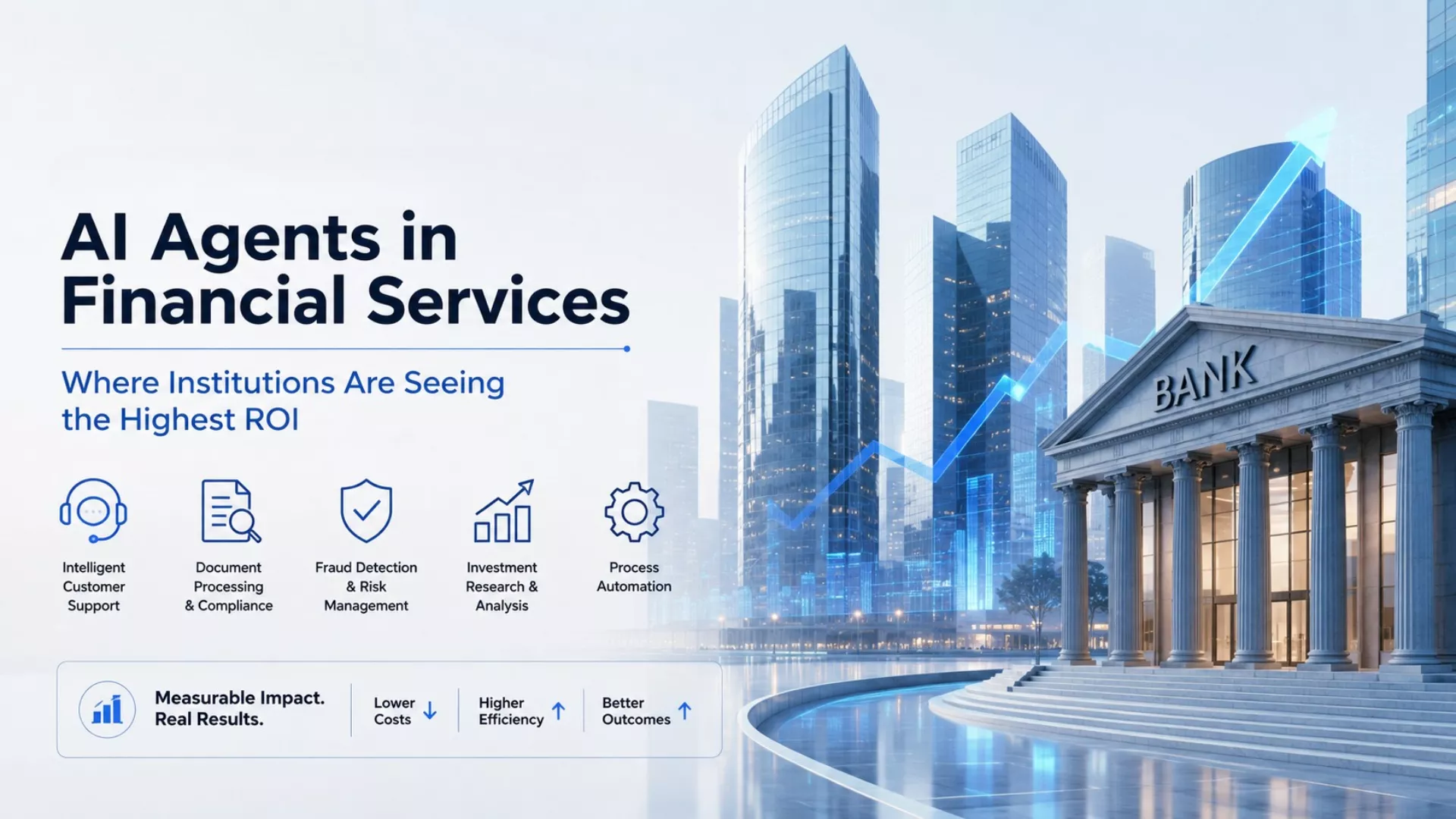
The Business Case for AI Agents in Financial Services: Where Institutions Are Seeing the Highest ROI

Key Takeaways
- Customer-facing AI deployments generate faster payback than back-office automation because they influence revenue, service costs and retention simultaneously.
- Financial institutions that evaluate AI ROI across three distinct tiers avoid the measurement errors that cause most deployments to underperform expectations.
- Platform-based deployments succeed at twice the rate of custom-build approaches, making vendor selection one of the strongest predictors of ROI generation.
- Combining customer-facing AI with operational automation improves operating profit by 249% in modeled scenarios, compared to 60% from customer growth alone.
- Institutions that treat support, lead generation, scheduling and multi-channel engagement as a unified AI layer capture compounding returns that siloed deployments cannot replicate
Most finance executives expect AI ROI to come from back-office efficiency. Reduce headcount in AP. Compress the financial close. Automate reconciliation. The assumption is reasonable, but the data increasingly points elsewhere.
Financial institutions capturing the fastest, most measurable returns are doing so through customer-facing workflows: support automation, lead conversion, advisor productivity and multi-channel engagement. The shift is deliberate. According to BCG AI Radar 2026, 90% of financial sector CEOs expect measurable agentic returns within the year, and over 30% of total AI budgets are now committed specifically to agentic architectures.
AI agents in financial services generate ROI across three primary tiers:
- Process automation (cost reduction, 12 to 18-month payback)
- Risk decisioning (portfolio quality improvement, 12 to 24 months)
- Revenue personalization (top-line growth, rolling 6-month attribution)
Customer-facing deployments in support, lead generation, sales and appointment automation are producing the fastest verified returns across documented institutional case studies.
Where Financial Institutions Are Seeing AI ROI First
Financial institutions often assume the highest returns come from back-office automation. In practice, customer-facing functions deliver faster payback because they influence revenue, service costs and customer retention simultaneously. The following are the operational areas where institutions are consistently seeing returns first.
1. Managing High-Volume Customer Service Demand
Service volume in financial institutions scales with the customer base, not with revenue. Hiring more agents defers the cost problem rather than solving it. AI agents for fintech companies and traditional institutions alike contain this by resolving policy queries, account requests and product questions autonomously, without queue dependency, at any volume.
ROI outcomes: Lower cost per interaction, higher containment rates, reduced queue volumes, faster first-response times.
The CFPB documented $8 billion in annual global savings from customer-facing virtual assistants, averaging $0.70 per interaction.
2. Capturing Lead Opportunities Across Digital Channels
Most institutions invest in driving traffic. Few invest equally in what happens when a prospect arrives. Forms go unsubmitted. Inquiries arrive after hours. Interest exists but goes uncaptured.
A lead generation agent for financial institutions closes this gap at the point of intent:
- Qualify prospects in real time
- Capture after-hours inquiries automatically
- Route leads to the right team without delay
- Reduce cost per acquisition from existing digital spend
Wells Fargo's proactive prompting generated a 15% to 25% lift in product leads from its existing base.
3. Improving Product Discovery and Conversion
| Without AI Guidance | With AI Guidance |
| Customer browses static product pages | Agent surfaces relevant options in real time |
| Customer delays or exits | Customer is qualified and routed immediately |
| Cross-sell opportunity missed | Secondary products identified during active session |
| Advisor contacted too late | Direct path to application created |
Santander's next-best-action framework increased product-per-customer penetration by 22%. Across 120-plus institutions, product sales expanded 2x to 4x when offers surfaced during active sessions.
4. Reducing Advisor Scheduling Overhead
An advisor spending 30 to 45 minutes daily on scheduling loses several productive client-facing hours each week. Across a large advisory network, that compounds into material revenue loss.
- Customer books directly through any digital channel
- Availability updates in real time
- Confirmation issued instantly
- Advisor begins the day with a full, organized schedule
Faster confirmation with automated appointment scheduling reduces the conversion drop that occurs when prospects wait days for a response.
5. Scaling Voice-Based Service Without Scaling Headcount
Voice carries the highest per-interaction cost of any service channel. Fixed contact center infrastructure, staffing and management overhead persist regardless of volume variation. AI voice agents handle routine inbound calls autonomously: account status, payment queries, product information, appointment booking. Complex calls transfer to human agents with context already captured.
Result: Lower cost per call. Expanded availability beyond contact center hours. No proportional staffing increase during volume peaks. For enterprise AI agents for banks, voice frequently represents the highest-cost channel and therefore the strongest near-term ROI target.
6. Maintaining Context Across Every Customer Channel
A customer researches the website, asks a question on WhatsApp, calls to confirm and completes an application on mobile. At each handoff, most institutions lose context. The customer repeats themselves. Abandonment rises.
The conversation continues rather than restarts. AI agent integrations maintain unified customer context across web, mobile, WhatsApp and voice. Intelligent automation in banking that operates in silos produces partial returns. Cross-channel context sharing makes the compounding effect on conversion measurable within the first deployment year.
7. Expanding Market Reach Through Multilingual Service
Language limits growth in ways that do not appear on cost reports until they show up in regional conversion data.
- Customers who cannot engage in their preferred language convert at lower rates
- Multilingual human teams are expensive to staff consistently at scale
- Service quality varies by language team capacity
AI chatbots for international customers deliver consistent, policy-compliant service across languages without proportional staffing increases. Wells Fargo's dialect-capable assistant drove a 40% expansion in reach in tier-2 and tier-3 markets. For institutions with regional growth targets, language support is a market access decision.
See How It Works in Practice
Explore how financial institutions are deploying AI agents across customer-facing functions today.
Why AI ROI in Financial Services Is Different From Traditional Technology ROI
Traditional technology ROI is straightforward. Time saved multiplied by labor cost, offset against deployment expense. It works for tools that replace discrete tasks.
AI agents do not work that way. Their value compounds across layers: direct task automation, elimination of coordination overhead between systems and downstream revenue effects. Most institutions measure only the first layer, which is why Gartner projects that while over 80% of enterprises will deploy generative AI by 2026, only 20% will successfully measure its ROI.
The gap exists because standard evaluations miss what researchers call "operational whitespace": the invisible manual labor required to move data between fragmented legacy systems. In banking, 50% to 60% of all full-time equivalents are tied to operational roles that exist largely to bridge these disconnected systems. That labor does not show up in task-level time studies. It shows up in headcount.
There is also a performance differential worth understanding before committing to a budget. BCG's IT Spending Pulse data shows that agentic AI carries an expected ROI of 13.7%, compared to 12.6% for non-agentic generative AI. The difference is not large in absolute terms, but it compounds over multi-year deployment horizons. Intelligent automation in banking that relies on autonomous, multi-step agents captures value that single-function tools cannot.
Institutions that evaluate every AI initiative using the same ROI model often misjudge performance because different deployments create different forms of economic value.
The Three ROI Tiers: Where Financial Institutions Are Actually Seeing Returns
Once deployment begins, the challenge shifts from where to invest to how to evaluate what has been created. Applying a single ROI lens across fundamentally different value categories produces misleading conclusions. AI workflow automation for financial institutions generates value across three distinct economic categories, each with different payback windows and measurement requirements.
| Tier | Value Type | Payback Window | Core Metrics |
| Tier 1 | Operational Efficiency | 12 to 18 months | Cost per interaction, handling time, error rate |
| Tier 2 | Risk and Decision Quality | 12 to 24 months | Default rates, false-positive rate, compliance exceptions |
| Tier 3 | Revenue Expansion | Rolling 6 months | Product penetration, cross-sell conversion, retention |
- Tier 1: Direct Operational Efficiency: Captures measurable reductions in handling costs, manual effort and processing cycles. Fastest to validate because baseline metrics are clear and improvement is directly observable.
- Tier 2: Risk and Decision Quality: Accenture's 78-institution study found automation leaders achieved 125 basis points of ROE expansion. Mastercard's Decision Intelligence prevents $35 billion in annual fraud losses, reducing false-positive blocks by 40% to 60%.
- Tier 3: Revenue Expansion: Enterprise automation in financial institutions generates its largest long-term returns here. Cross-sell growth, retention improvement and product-per-customer gains compound as personalization models improve with accumulated usage data.
The sequencing matters. Tier 1 pays back fastest and builds the usage data that makes Tier 3 possible. Skipping the foundational layer rarely produces sustained revenue lift.
What the Institutional Evidence Actually Shows
The framework above is validated by documented deployments across named institutions. The pattern is consistent: customer-facing AI agents generate returns that scale with usage volume, not headcount reduction alone.
Support and containment economics
Klarna reduced its cost per customer service transaction from $0.32 to $0.19 over two years. Its AI assistant handles two-thirds of all customer chats autonomously, compressed average resolution time from 11 minutes to under 2 minutes and performs the equivalent labor of 853 full-time agents, contributing approximately $60 million in ongoing annual profit improvement.
Advisor and sales productivity
Morgan Stanley's GPT-4 assistant reached 98% adoption among financial advisor teams, against a typical enterprise software rate of 30% to 40%. Document retrieval efficiency rose from 20% to 80%. During the rollout period, the firm captured $64 billion in net new assets in a single quarter.
Proactive engagement at scale
Bank of America's Erica performs the equivalent workload of 11,000 full-time staff daily. More than 50% of its monthly interactions are outbound, proactively surfacing savings nudges and cash flow alerts rather than waiting for customer-initiated contact.
The shift from reactive to proactive engagement is where the largest long-term retention and revenue returns tend to originate.
Financial institutions evaluating customer support, lending and compliance automation can read about it on Finance AI Agent: Automate Customer Support, Loan Queries & Financial Operations
How Customer-Facing and Back-Office ROI Compound Together
Most institutions evaluate customer-facing AI and back-office automation as separate investments. The economics suggest they should not be.
Customer-facing deployments expand the revenue side: more qualified leads, higher conversion rates, better product penetration and improved retention. Back-office automation works on the opposite side, reducing the cost required to acquire, onboard and serve each customer. This is where operating leverage emerges. The Cost-to-Income Ratio captures it directly.
One way financial institutions measure this effect is through the Cost-to-Income Ratio (CIR), calculated as operating expenses divided by total income. When revenue rises while operating expenses fall, the ratio improves from both directions simultaneously.
The simplified model below illustrates the difference between isolated customer growth and customer growth combined with operational automation. It is intended to demonstrate the economics of operating leverage rather than represent the results of a specific institution.
| Scenario | Revenue | Operating Expenses | Operating Profit |
| Baseline | $10M | $6M | $4M |
| Customer Growth Only | $14M | $7.6M | $6.4M |
| Customer Growth + Operational Automation | $16.1M | $2.14M | $13.96M |
Customer growth alone improves operating profit by 60%. Combined with operational automation, the improvement reaches 249%, a 3.5x gain over baseline.
This is why leading institutions increasingly treat customer-facing AI and enterprise automation in financial institutions as a single transformation initiative rather than separate technology programs.
For the operational mechanics of back-office automation, explore the Enterprise Finance Automation: The AI Agent Advantage guide.
How to Calculate ROI From AI Agent Investment in Financial Services
Most ROI calculations for AI workflow automation for financial institutions fail because they focus only on time savings. Modern AI agents in financial services create value across both cost reduction and revenue growth.
A practical ROI model should measure six areas:
- Customer support cost reduction = interaction volume × cost reduction per interaction
- Lead conversion improvement = conversion lift × lead volume × average product value
- Appointment utilization gains = additional completed meetings × advisor revenue per meeting
- Product penetration growth = increase in product adoption × product margin
- Customer retention impact = reduction in churn × customer lifetime value
- Operational cost reduction = lower servicing and support costs per customer
Unlike earlier generative AI in financial services deployments, agentic systems influence multiple stages of the customer journey simultaneously.
ROI also appears in phases. These phases do not operate independently. Each one builds the data and capacity that accelerates returns in the next. Support cost reduction, faster response times and scheduling efficiencies typically emerge first. Lead conversion improvements and advisor productivity gains follow. Product penetration, retention improvements and revenue expansion usually become measurable later as customer engagement data accumulates.
Your Customer Journey, Finally Connected
Talk to our team about deploying GetMyAI across your customer-facing functions today.
The most common mistake is measuring containment rates or labor savings in isolation. The strongest automation use cases in financial services are evaluated across both revenue growth and cost reduction, providing a more accurate picture of long-term business impact.
Why Financial Institutions Choose GetMyAI to Unify Customer-Facing AI
Most financial institutions struggle to connect those opportunities across the customer journey. Support teams operate in one system. Lead generation happens somewhere else. Appointment scheduling sits in a separate workflow. Customer conversations are fragmented across websites, WhatsApp, voice channels and internal teams. The result is lost context, slower responses and unrealized ROI.
GetMyAI brings these customer-facing functions together through a unified AI layer. Financial institutions can deploy AI agents for customer support, lead collection, appointment booking, policy queries and sales assistance across multiple channels without rebuilding the experience for each touchpoint.
Instead of treating support, conversion and engagement as separate initiatives, GetMyAI enables them to operate as part of the same workflow. A customer can ask a product question, receive guidance, schedule a meeting and continue the conversation on another channel without starting over.
Built-in analytics, CRM integrations, multilingual support, human handoff capabilities and centralized knowledge management help institutions measure performance while maintaining service quality.
The objective is simple: reduce friction, capture more opportunities and generate measurable returns from every customer interaction.
Start With One Workflow
See how GetMyAI unifies customer support, lead generation and appointment booking in one deployment.
FAQs
How do AI agents improve ROI in banking?
AI agents reduce service costs, improve lead conversion and increase product penetration simultaneously. Unlike single-function tools, agentic deployments generate compounding returns across multiple customer journey stages, making ROI stronger over time rather than plateauing after initial deployment.
What is the ROI of AI in fintech companies?
ROI varies by function and deployment tier. AI agents for fintech companies typically see fastest returns from customer support automation, followed by lead conversion and advisor productivity gains. Revenue personalization returns accumulate later as customer engagement data builds.
Why are financial institutions adopting AI automation?
AI-native competitors operate with significantly higher customer-to-labor efficiency ratios than legacy institutions. Intelligent automation in banking allows traditional institutions to match that efficiency across service, acquisition and operational functions without proportional headcount increases.
How is AI used in banking operations and customer service?
AI agents handle policy queries, lead qualification, appointment scheduling, voice interactions and cross-channel engagement autonomously. They also support advisor productivity and compliance workflows, generating returns across both customer-facing and back-office functions.
How to implement AI automation in financial institutions?
Successful implementation starts with high-volume, measurable workflows and establishes attribution frameworks before go-live. Redesigning processes around AI rather than layering automation over existing ones is the most reliable predictor of reaching full production and generating sustained returns.