How Travel Agencies Are Using AI Chatbots to Convert Website Visitors Into Bookings

Key Takeaways
- Travel agencies lose high-intent bookings not from poor packages but from delayed responses that send visitors directly to competitors.
- Responding to travel inquiries within two hours increases conversion probability by 300%; AI chatbots make that response time achievable around the clock.
- Agencies deploying conversational AI for travel report 3 to 5 times higher conversion rates among visitors who engage versus those who don't.
- AI chatbots eliminate lead leakage by capturing structured prospect data after hours and delivering qualified, context-rich leads to consultants each morning.
- Travel agencies that build custom AI chatbots trained on their own knowledge convert more visitors without adding headcount or extending business hours.
A traveler visits your website at 10:43 PM. They know they want a family trip to Japan in March. They have a budget. They have dates. They are ready to talk to someone. Your contact form asks for a name and email.
They fill it out, submit it, and open three competitor tabs. By the time your sales consultant arrives the next morning, that traveler has already had a conversation with another agency. Not because your packages were worse. Because your website went silent at the moment they were ready to engage.
This is the problem every AI automation platform for a travel agency is built to solve. This article covers how AI chatbots for travel agencies close that gap: the workflow, the measurable outcomes, and what to evaluate before choosing a platform.
AI chatbots help travel agencies convert website visitors into bookings by engaging them in real-time conversations the moment they arrive, qualifying their intent through natural dialogue, capturing structured lead data, and handing them off to human consultants with full context. Instead of waiting for a contact form submission, the chatbot responds instantly, 24/7, across every channel, ensuring no high-intent visitor leaves the website without a response.
Why Travel Agencies Lose High-Intent Website Visitors
Your website traffic isn't the problem. Your website's response to that traffic is.
Most travel agency websites are built to display information, not continue conversations. A visitor arrives with a destination in mind, browses a few package pages, and hits one of three dead ends: a contact form, a phone number that rings during business hours, or a generic "Request a Quote" button that leads to a 48-hour wait.
The business cost is measurable. Travel inquiries submitted online are rarely exclusive. A serious traveler typically contacts three to four agencies simultaneously. Industry data shows that responding within two hours increases conversion probability by up to 300%. Waiting 24 hours means the booking has almost certainly gone elsewhere.
The conversion numbers confirm the gap. Online travel agencies average a 2 to 5% conversion rate from visitor to booking. Even destination specialists and luxury tour operators leave a substantial portion of qualified visitors without a meaningful first response. Across broader e-commerce, 43% of users who abandon do so simply because they were not ready to decide yet. Those are not lost customers. They are travelers who need a conversation.
Where leakage typically occurs:
- Visitors who browse multiple packages but find nothing matching their specific situation
- Inquiries submitted after business hours with no immediate acknowledgment
- Travelers who wanted one quick answer and left when they couldn't find it
- High-intent visitors who found a competitor offering instant responses
The question: How many visitors left your website last month without a name, an email, or a single answered question? If you don't have that number, you don't know the size of the problem.
Modern Travelers Expect Conversations, Not Contact Forms
The contact form made sense when travel research happened inside travel agencies. It makes less sense when a traveler is comparing destinations across four browser tabs at midnight.
Buying behavior has shifted fundamentally. Travelers no longer arrive at your website with a finalized decision. They arrive with a situation.
"We're a family of four. October half-term. Beach. Around £4,000. Not too crowded."
That isn't a search query. It's the opening line of a conversation. And a contact form cannot have a conversation.
This shift toward conversational commerce in the travel industry is reshaping how agencies need to engage website visitors. The booking journey for most travel purchases spans multiple sessions across several weeks. Leisure travelers move from initial interest to confirmed booking over 45 to 90 days. Luxury and group travel stretches to six months. During that window, the same traveler returns with new questions, refined preferences, and comparisons made against other agencies.
What keeps them returning to one agency isn't necessarily the best package. It's the agency that reduced uncertainty, answered their specific questions, and helped them move from "we're thinking about it" to "we're ready to book."
A McKinsey and Skift Research report puts this shift in precise terms. More than 60% of travelers say they would choose a travel company offering conversational AI over one that doesn't. Nearly 70% are interested in an AI travel assistant capable of managing or booking an entire trip.
The gap isn't a marketing problem. It's a mismatch between how modern travelers make decisions and what most agency websites are designed to support.
How Do AI Chatbots Help Travel Agencies Convert Website Visitors Into Bookings?
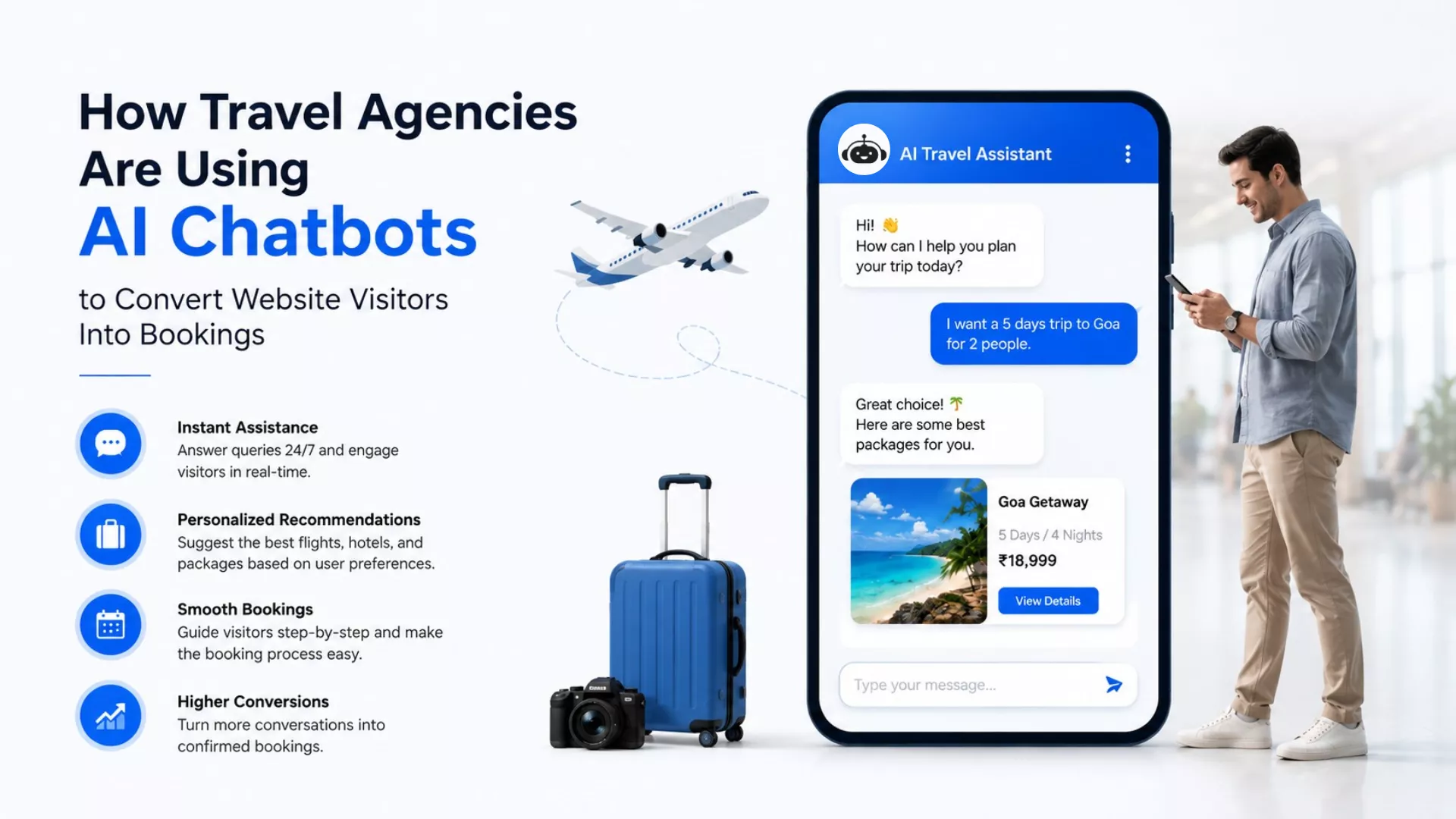
When a visitor arrives on your website, an AI chatbot for a travel agency website conversion doesn't wait for them to find the right form. It opens a conversation based on what they're browsing and responds to their situation.
Here's how that workflow operates from first visit to qualified lead:
- Visitor arrives. Browsing behavior signals intent. A visitor reading three Japan itinerary pages is not the same as one checking visa requirements. The chatbot responds to that context with a relevant opening.
- Conversation begins. The chatbot asks the questions a good travel consultant would ask. Destination. Travel dates. Group size. Budget. Interests. Natural conversation, not a twelve-field form.
- Qualification happens in real time. By the time a visitor has answered four or five questions, the chatbot has captured enough to determine whether they're a serious prospect and which product best matches their needs.
- Recommendations are personalized. Instead of directing the visitor to 40 packages, the chatbot presents two or three options matching what they've described, using AI-driven personalization across the travel booking journey.
- Lead is captured with context. The chatbot collects name, email, and preferred contact time. It can schedule a consultation directly into a consultant's calendar.
- CRM receives a structured record. The full conversation, preference data, and lead score are pushed into your travel CRM with AI chatbot integration automatically. No manual entry. No reconstructing intent from a two-line email.
- A human consultant takes over with context. Your sales team starts the follow-up knowing the destination, budget, travel dates, and group size before the first word is spoken. They close the booking. The chatbot made sure the lead still existed.
Your Website Should Talk Back
Replace static package pages with real-time conversations that qualify visitors before they leave.
How AI Chatbots Increase Booking Conversions
1. Instant response eliminates the most preventable reason bookings are lost.
A travel inquiry submitted at 11 PM doesn't become less valuable because your team isn't online. An AI-powered travel customer engagement platform responds immediately, captures the lead while intent is highest, and prevents the visitor from moving to the next competitor tab.
Zoover, a major Dutch online travel agency, deployed an AI chatbot to initiate context-aware conversations based on browsing behavior. Visitors who engaged with the chatbot converted at 3 to 5 times the rate of those who didn't. Fifty percent of routine queries were resolved without any human involvement.
2. 24/7 availability converts after-hours traffic into morning pipeline.
Over 50% of travel inquiries arrive outside business hours. A travel agency without an AI automation platform responding in real time, those leads hit a voicemail form and move on. The agencies capturing them aren't staffing overnight. They're running AI.
The Address Collective deployed an omnichannel conversational AI agent across their website, Facebook, and Instagram. In one year, the agent generated nearly 6,000 quotes entirely outside human business hours. The result was a 523% ROI on the technology, driven entirely by previously lost demand.
3. Multilingual support removes friction for international travelers.
Staffing natively fluent agents across multiple languages around the clock is financially unviable for most agencies. An enterprise conversational AI platform for travel handles multilingual conversations natively, maintaining cultural context and natural phrasing rather than robotic translation.
Serve Global Travelers. Scale Without Headcount.
Handle inquiries in multiple languages around the clock without expanding your support team.
A global travel booking engine powering 35,000 agency partners deployed a RAG-based conversational AI fluent in English, Spanish, Italian, and French. A traveler in Lisbon received the same instant, high-quality experience as one in Chicago, scaling cross-border conversions without scaling headcount.
4. Fewer repetitive questions mean more consultant capacity.
When consultants spend their mornings answering visa questions and baggage policies, they aren't closing bookings. An AI chatbot for travel agencies absorbs first-line queries across every channel, freeing your team for the conversations that actually require human judgment.
Joker, a Belgian multi-channel travel agency, deployed an AI chatbot as first-line support, delivering omnichannel customer engagement for travel across all platforms. Lead capture volume increased without adding headcount. Human advisors stepped in only for relationship work and complex itinerary planning.
5. Lower contact friction produces more qualified leads entering your pipeline.
High-ticket travel purchases create hesitation. Travelers interested in a bespoke itinerary worth thousands rarely want to fill out a formal contact form as their first move. Conversational AI for travel companies replaces that barrier with a natural, low-pressure opening conversation.
Noorderhuis, a Nordic bespoke tour operator, replaced their static contact form with a conversational AI chatbot for hotel and travel booking. The barrier to first contact dropped immediately, producing a measurable increase in high-intent qualified leads and a shorter path from initial interest to consultation.
The pattern across all three cases is identical: the AI chatbot didn't replace the travel consultant. It made sure qualified leads were waiting each morning.
Practical Ways Travel Agencies Use AI Chatbots
90% of travel organizations already use generative AI in some capacity, yet most deployments stop at answering FAQs. The agencies seeing real conversion gains are using AI chatbots to handle specific, high-value visitor situations that previously required a consultant to resolve.
- A couple browsing honeymoon packages asks whether the Maldives or Mauritius suits them better in November. The chatbot asks about priorities: privacy, activities, budget. It recommends two specific options with brief reasons, then offers to schedule a call with a honeymoon specialist.
- A group organizer arrives asking about a corporate retreat for 22 people. The chatbot recognizes the complexity, gathers the basics, and transitions: "This needs dedicated planning. I've noted your requirements. Let me connect you with our group travel team."
- A family researching Bali asks about visa requirements for their nationality. The chatbot answers immediately from the agency's own knowledge base, then asks whether they'd like family-friendly options in Ubud or Seminyak.
- During peak season, when inquiry volume spikes and consultants are stretched, the AI booking conversion platform absorbs the volume. No inquiries go unanswered. No leads leaked because the team was too busy to respond.
- Each scenario reflects a real operational problem most travel agencies face every week. The chatbot solves them by being available, consistent, and trained specifically on your agency's knowledge, not generic travel information.
Why Travel Agencies Choose GetMyAI to Convert More Website Visitors
GetMyAI is a platform travel agencies can use to build their own, trained on their destinations, their packages, their policies, and their brand voice.
An AI chatbot built on GetMyAI doesn't pull generic travel information from the internet. It answers questions the way your best consultant would, because it's trained on your actual knowledge base. Visitors get accurate, agency-specific responses from the first message.
Building it is straightforward.
- Upload your destination guides, package details, visa policies, and FAQs.
- Configure the conversation flow to match your booking journey.
- Customize the appearance to match your brand. Deploy it on your website in days, not months.
From there, the chatbot handles real-time visitor engagement, lead qualification, multilingual conversations, and meeting booking across every channel. Every qualified lead is pushed directly into your CRM with full conversation context attached. Your consultants start follow-ups informed, not cold.
Travel agencies need an AI chatbot that knows their business. The Dashboard gives your team complete visibility. Review every conversation, identify gaps in knowledge, and improve responses by updating documents or adding Q&A entries.
Bottom Line
Every week, high-intent travelers visit your website, compare their options, and book with the agency that responded first. GetMyAI ensures that the agency is yours. The conversation your consultant didn't have last night doesn't have to be a booking you lose tomorrow.
See It Before You Decide
Build and test your own travel AI chatbot before committing to a full deployment.
FAQs
How do AI chatbots help travel agencies convert website visitors into bookings?
AI chatbots convert visitors by opening real-time conversations the moment they arrive, qualifying intent through natural dialogue, capturing lead details, and routing structured prospect data to consultants. Agencies responding within two hours see conversion probability increase by up to 300% compared to delayed follow-ups.
Can AI chatbots increase booking conversion rates for travel companies?
Yes. Zoover saw a 3 to 5 times higher conversion rate among visitors who engaged with their AI chatbot versus those who didn't. For travel companies, the primary gain comes from capturing after-hours inquiries and eliminating the response delay that sends high-intent visitors to competitors.
How do travel agencies use AI chatbots for lead generation?
Travel agencies use AI chatbots to qualify visitors through conversational intake, capturing destination preferences, travel dates, group size, and budget before any human involvement. That structured data is pushed directly into the CRM, giving consultants a qualified, context-rich lead rather than a blank inquiry form.
Are AI chatbots effective for B2B travel companies?
Yes, particularly for tour operators and travel management companies handling high inquiry volumes. An enterprise AI chatbot solution for tour operators absorbs repetitive first-line queries, qualifies group booking requests, and escalates complex itineraries to human consultants, increasing sales team capacity without increasing headcount.
How do AI chatbots handle multilingual travel customer support?
Modern conversational AI for travel companies supports multiple languages natively, maintaining cultural context rather than relying on translation plug-ins. A global travel booking engine serving 35,000 agency partners deployed AI fluent in English, Spanish, Italian, and French, delivering consistent booking experiences across four geographic markets simultaneously.