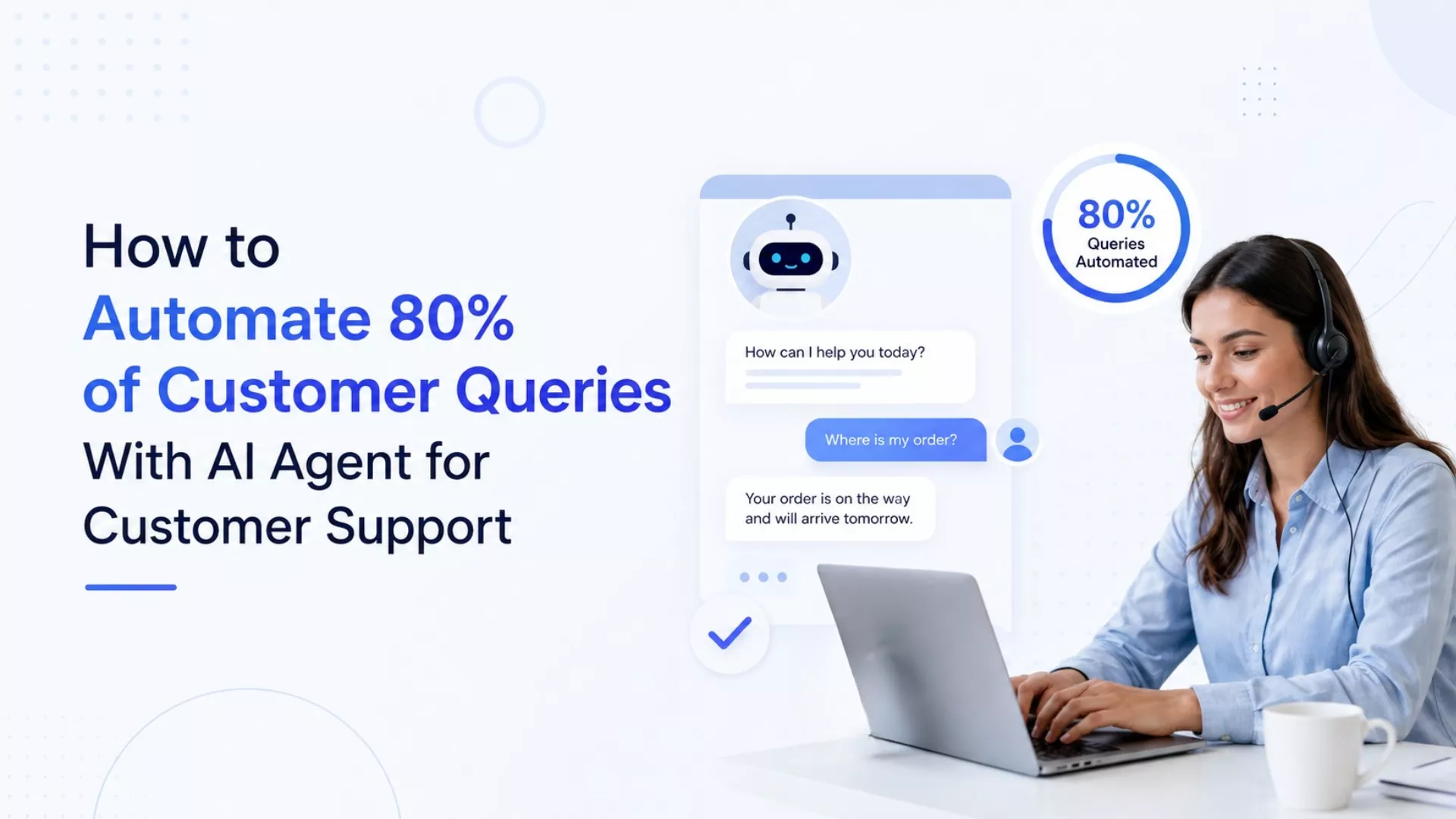
How to Automate 80% of Customer Queries With AI Agent for Customer Support

Key Takeaways
- Vendor automation claims to average 67–80%, but independent benchmarks show 41.2%. The gap is a measurement problem, not a technology gap.
- Your automation ceiling is set before deployment: integration depth and knowledge base quality determine outcomes more than the AI model you choose.
- SaaS businesses with active billing integrations realistically achieve 55–65% resolution; ecommerce and banking face structural ceilings no AI configuration can override.
- The 20% that stays human because it is where customer retention, policy judgment and compliance accountability permanently live.
- Measure verified resolution rate and delayed CSAT in your first 90 days; deflection metrics alone will show success while real performance quietly deteriorates.
Your AI customer support vendor just sent you a case study. Eighty percent automation. Thousands of tickets resolved. Zero human intervention. It sounds like the future of your support team is already here. But before you sign the contract, there is a number your vendor did not include in that deck: only 14% of customer support interactions reach verified, end-to-end resolution without a human stepping in. The gap between what vendors report and what enterprises actually experience is a measurement problem, and it is costing businesses real money.
An AI agent for customer support automates queries by connecting your knowledge base to backend systems like billing, scheduling, and order management. When a customer asks about an invoice, the AI pulls live data and resolves it. No human needed. The queries it cannot access, it cannot resolve.
Why Every Automation Number You've Seen Is Probably Wrong
By 2029, Gartner predicts agentic AI will autonomously resolve 80% of common customer service issues. Daniel O'Sullivan, Senior Director Analyst at Gartner, calls it "a new era in customer engagement." That forecast is real. The problem is what vendors did with it.
Today, that number gets quoted as a current reality, not a 2029 target. And the reason it sticks is that most buyers never ask what "resolved" actually means.
There are three different metrics vendors use interchangeably. They are not the same.
| Metric | What It Measures | What It Misses | Why Vendors Prefer It |
| Containment Rate | Conversations that end inside the bot without a human transfer | Customers who abandoned out of frustration | Produces the highest number |
| Deflection Rate | Queries diverted away from a formal support ticket | Whether the problem was actually solved | Easy to report; conflates avoidance with resolution |
| Resolution Rate | Issues definitively solved by AI, end-to-end, no human touch | Nothing. This is the honest metric | Produces the lowest number |
A customer who gives up and closes the chat window gets logged as a successful deflection. No AI customer support platform can tell the difference between a problem solved and a customer who just gave up.
This is why Decagon reports 80%, Intercom reports 67%, and Zendesk's independent aggregate across global deployments lands at a median of 41.2%. They are not measuring the same thing.
The quartile breakdown from Zendesk makes this even clearer. Top-performing deployments hit 58.7%. Bottom-performing deployments hit 22.4%. Same technology category. A 36-point gap explained entirely by implementation quality, not the AI itself.
Every figure in this article uses a resolution rate where the source supports it. When a customer support automation tool reports deflection, we label it as deflection.
What AI Agents Actually Automate in 2026
The queries an AI agent resolves are not random. When you automate customer support with AI, resolution is a direct output of two things: what the AI knows and what systems it can touch.
| Query Type | Automation Status | What It Requires |
| FAQs & Business Hours | Full | Knowledge base retrieval |
| Policy Questions | Full | Document ingestion |
| Billing & Subscriptions | Full | Billing API with read and write access |
| Appointment Booking | Full | Calendar integration |
| Product Guidance | Full | Multi-turn knowledge base navigation |
| Password Reset | Full | Identity provider (IdP) API access |
| Order Status | Full | Logistics or OMS API |
| Refund Requests | Full | Billing API with write access |
| Technical Troubleshooting | Partial | Diagnostic log integration needed. Without it, AI matches symptoms only |
| Complaints & Disputes | Not Automated | Requires human judgment and escalation authority |
Most deployments do not have all of these integrations active at once. For example:
- Without write-access billing, a refund query stays partial. Without a logistics API, every order status question hits a dead end.
- Without IdP access, password resets stop at the instructions
Each missing integration moves a query from the "Full" column to "Partial" or "Not Automated" which is exactly how a theoretical 80% ceiling becomes a real-world 45–55% outcome for most businesses.
Read access vs. write access is the hard ceiling. Reading your Stripe account tells a customer their next invoice date. Writing to it processes their refund. That single distinction separates full resolution from partial resolution across more query types than most buyers realize when evaluating a platform.
The difference between answering a question and resolving it comes down to features. AI agents equipped with business knowledge, live integrations, and workflow automation consistently resolve more customer queries than standalone chatbots.
Explore AI Agent Features
See the capabilities that turn AI conversations into real customer support resolutions across every channel.
Industry-by-Industry Automation Reality
The same AI. Completely different outcomes. Automation rate is not a technology question. It is a use-case question, and your industry determines the ceiling before you configure a single workflow.
SaaS: Why 55–65% Automation Is Within Reach
SaaS customers buy software and then struggle to use it. That means your support queue is dominated by onboarding friction, feature guidance, and billing questions. Those are exactly the queries an AI chatbot for SaaS onboarding and support resolves without human involvement.
Billing alone drives this. When your AI connects to your billing system with read and write access, invoice questions, subscription changes, and renewal confirmations close themselves. That single integration can hollow out 20% of your queue.
What your human agents gain is time. Not time to handle more tickets. Time to focus on retention conversations, complex API debugging, and enterprise onboarding calls that actually move revenue.
Where automation lands by query type:
- Feature guidance and how-to questions: Fully automated
- Billing and subscription management: Fully automated
- API and integration errors: Partially automated
- Custom enterprise configurations: Human required
Ecommerce: A Tale of Two Automation Rates
An AI agent for ecommerce customer support is simultaneously your best pre-purchase asset and your worst post-purchase tool.
Pre-Purchase: 70–85% automation: Customers ask about sizing, materials, product comparisons, discount codes, and delivery timelines. The AI answers from your catalog, creates cart suggestions, and closes the conversation. No human needed.
Post-Purchase: 35–45% automation: Customers ask where their order is. The AI has no answer. WISMO queries, "Where Is My Order?" make up 30–50% of all retail support tickets. Without a logistics API, the AI cannot touch them.
The strategic implication is direct: In ecommerce, AI drives revenue before the purchase and hits a structural wall after it. Deploy it as a sales tool first, a support tool second.
Banking and Financial Services: Why Compliance Sets the Ceiling at 15–25%
An AI customer support chatbot for banks and financial institutions runs into a wall that no integration can fully remove: regulatory compliance.
KYC, AML, and PCI-DSS frameworks legally restrict what an unauthenticated AI model can access, take action on, or advise on. The ceiling is not a technology limitation. It is a legal one.
What AI handles: Branch location FAQs, general interest rate queries, loan product information, and scheduling advisory appointments.
What requires a human: Fraud reporting, transaction disputes, identity verification, account recovery, and any action touching a live ledger.
The benefit AI delivers in banking is not resolution. It is Tier 0 deflection, absorbing the generic, unauthenticated queries so your compliance-trained staff spends zero time on questions a well-trained knowledge base can answer. That alone reduces queue pressure on your highest-cost agents.
See AI in Your Industry
Explore how GetMyAI automates customer support across SaaS, ecommerce, healthcare, finance, and more.
AI Agent for Customer Support: Five Case Studies with Results
These are not vendor case studies. These are five real deployments with five honest takeaways. Independent deployment with one extractable truth each.
- Klarna deployed AI across customer service globally and resolved 66% of queries autonomously within the first month, handling 2.3 million conversations. For any team evaluating an AI customer support solution for high ticket volume, the lesson is not the number. It is that Klarna's ticket mix was structurally ideal: payment queries, subscription issues, and refund status. That taxonomy alignment is what produced 66%, not the AI alone.
- BQE Software reached 86% resolution with zero hallucinations reported in production. That upper ceiling exists because their query set is narrow, their B2B documentation is pristine, and almost nothing requires write access to resolve. Clean inputs produced clean outputs.
- WeightWatchers automated approximately 70% of interactions while maintaining a 4.6 out of 5 CSAT score. High automation and high satisfaction do not trade off against each other. Transition design determines both.
- Substack crossed 90% resolution with zero human intervention. Their ticket mix is almost entirely subscription and billing management. When your business runs on recurring revenue and your policies are unambiguous, agentic AI for customer support approaches its theoretical ceiling.
- Rippling moved from 38% to 50% deflection after deployment. In HR and payroll, that improvement from baseline matters more than the absolute number. Complexity has a ceiling. Progress still counts.
The 20% That Stays Human: And Why That's the Right Answer
Chasing 100% automation is the wrong goal. The queries that resist conversational AI for customer support are not edge cases waiting for a better model. They are permanent human responsibilities by design. The 20% that stays human is not a gap. It is the work that determines whether a customer churns or renews for five more years.
The five categories that stay human, permanently:
- Policy exceptions: AI applies rules. Humans decide when a loyal five-year customer deserves a refund one day outside the window. That judgment call is not a bug in the system. It is the system.
- Complex diagnostics with ambiguous inputs: "The software is acting weird" is not a query an AI can resolve from a knowledge base. Human agents read between the lines, ask creative questions and diagnose what the customer cannot describe.
- High-emotion and de-escalation scenarios: Angry customers do not want an accurate answer. They want to be heard. No model replaces that.
- Legal and medical interpretation: Regulatory liability cannot be delegated to an AI. One wrong answer in a compliance context costs more than an entire support team's annual salary.
- Secure identity actions: Without verified authentication APIs, account recovery, routing number changes and security overrides require a human with accountability.
A mature AI customer support integration does not eliminate your human team. It promotes them. Your agents stop answering password reset questions and start handling the conversations that actually protect revenue.
Your Realistic Automation Range: Conservative, Likely and Upper Estimates
Where you land depends on what you bring to the deployment. Here are the three honest outcomes.
Conservative: 30–40%
You have a fragmented knowledge base, legacy escalation policies that route too aggressively to humans and little to no active billing or scheduling integration. Most of your transactional queries require write access, which your current stack does not have. The AI functions as an advanced FAQ tool and not much more.
To move up: Audit your documentation first. Integration comes second.
Likely: 45–55%
You run a standard B2B SaaS or mid-market service operation. Billing integration is active. Scheduling works through Google Calendar or an equivalent. Your documentation is moderately maintained and your Tier 1 to Tier 3 ticket ratio follows a normal distribution. This is where most businesses land after a solid first deployment.
To move up: Eliminate policy ambiguity and expand write-access integrations.
Upper Realistic: 65–75%
Your business rules are unambiguous and executable. Your knowledge architecture is unified and version-controlled. You run a subscription-heavy ticket taxonomy. A mature enterprise AI agent for customer support implementation sits ahead of the human queue on every channel.
To move up from here: You are now optimizing, not deploying.
What to measure in your first 90 days:
Choosing the right AI customer support platform starts with measuring the right thing. Track verified resolution rate, not deflection. Then pull your CSAT scores 48 hours after ticket close, not immediately, to catch the silent failures a contained-but-unresolved conversation always produces.
How Much of Your Customer Support Can GetMyAI Automate?
For most businesses, GetMyAI resolves between 45% and 70% of inbound support queries without human involvement. Where you land depends on two things: how complete your knowledge base is and how many backend systems your agent can access.
What GetMyAI automates from day one:
- FAQs, pricing, policies and product questions: answered from your trained knowledge base
- Billing and subscription queries: resolved when connected to your billing system
- Product and service guidance: handled through multi-turn knowledge base navigation
- Technical how-to questions: answered from your uploaded documents and support articles
For ecommerce businesses, order status and shipping queries are also fully automated when GetMyAI is connected to your order management system.
What moves the ceiling higher:
- Upload more documents and fill the gaps after reviewing real conversations
- Backend integrations connected billing and scheduling systems
- Policies written as clear and unambiguous rules that AI can apply without guessing
What stays human by design:
Sensitive complaints and escalations requiring empathy and discretion
Judgment calls that fall outside documented policy
Non-standard exceptions that need manual approval
Every conversation your AI customer support platform cannot resolve gets handed to your team with full context. Whether you want an enterprise-grade AI Chatbot or need an AI customer support agent for a small business, your agents start informed and not from scratch.
As your knowledge base grows, so does the percentage your AI resolves. The ceiling is not fixed.
Build Your AI Agent
Upload your documentation and connect your systems to automate customer support with confidence.
FAQs
How do I choose the right AI customer support platform?
Start with your ticket taxonomy, not the vendor demo. Identify your highest-volume query types, then evaluate which platforms integrate with the backend systems those queries require. Documentation readiness and integration depth determine your automation rate more than the AI model itself.
Is AI customer support better than human agents?
Neither replaces the other. AI handles repetitive, data-driven queries faster and at a fraction of the cost. Human agents handle judgment calls, emotional escalations and policy exceptions that no model should touch. The businesses seeing the highest ROI deploy both with clear boundaries between them.
How secure is AI for customer support in banking?
Security depends entirely on what the AI can access. Without verified authentication APIs, a compliant AI customer support agent for banks and financial institutions operates at Tier 0 only, answering public FAQs and scheduling appointments. It cannot touch live ledgers, transaction data or identity verification workflows without regulated access controls in place.
Can AI agents handle complex customer support tickets?
Partially. AI agents handle multi-turn technical troubleshooting when diagnostic documentation exists. They cannot resolve ambiguous inputs, cross-system investigations or issues outside their knowledge base. The AI should hand off with full context, not dead-end the customer.
What is ticket deflection rate in AI customer support?
Ticket deflection rate measures how many queries never reach a formal support ticket, typically by being resolved through a bot or self-service tool. It is not the same as the resolution rate. A high deflection rate can mask poor outcomes if customers are abandoning conversations rather than getting answers.