Interview scheduling is no longer a coordination task managed through emails and manual follow-ups. It has become an automated workflow where AI agents handle availability matching, booking, reminders, and rescheduling in real time. Instead of recruiters managing back-and-forth communication, businesses now use an AI chatbot for recruitment to streamline the hiring process, reduce delays, and maintain an always-on scheduling system that improves both efficiency and candidate experience.
AI chatbots automate interview scheduling by serving as execution systems that detect candidate intent, match availability via calendar integrations, and complete bookings instantly within the conversation. This removes manual coordination, reduces delays, and ensures continuous scheduling across channels without recruiter intervention.
What is an AI Recruitment Chatbot and How Does It Work?
An AI recruitment chatbot is a system that engages candidates, understands intent, and executes hiring tasks like screening and interview scheduling automatically. It acts as an operational layer in the hiring process, not just a communication tool.
An AI chatbot for recruitment refers to a conversational system that uses natural language processing to manage interactions and trigger actions during the hiring process. It understands user input and responds with actions that move candidates forward.
In practice, it communicates with candidates, qualifies them, and moves them through steps like scheduling or follow-ups. Most companies get this wrong because they treat chatbots as support tools rather than systems that execute workflows.
How Do AI Chatbots Automate Interview Scheduling End-to-End?
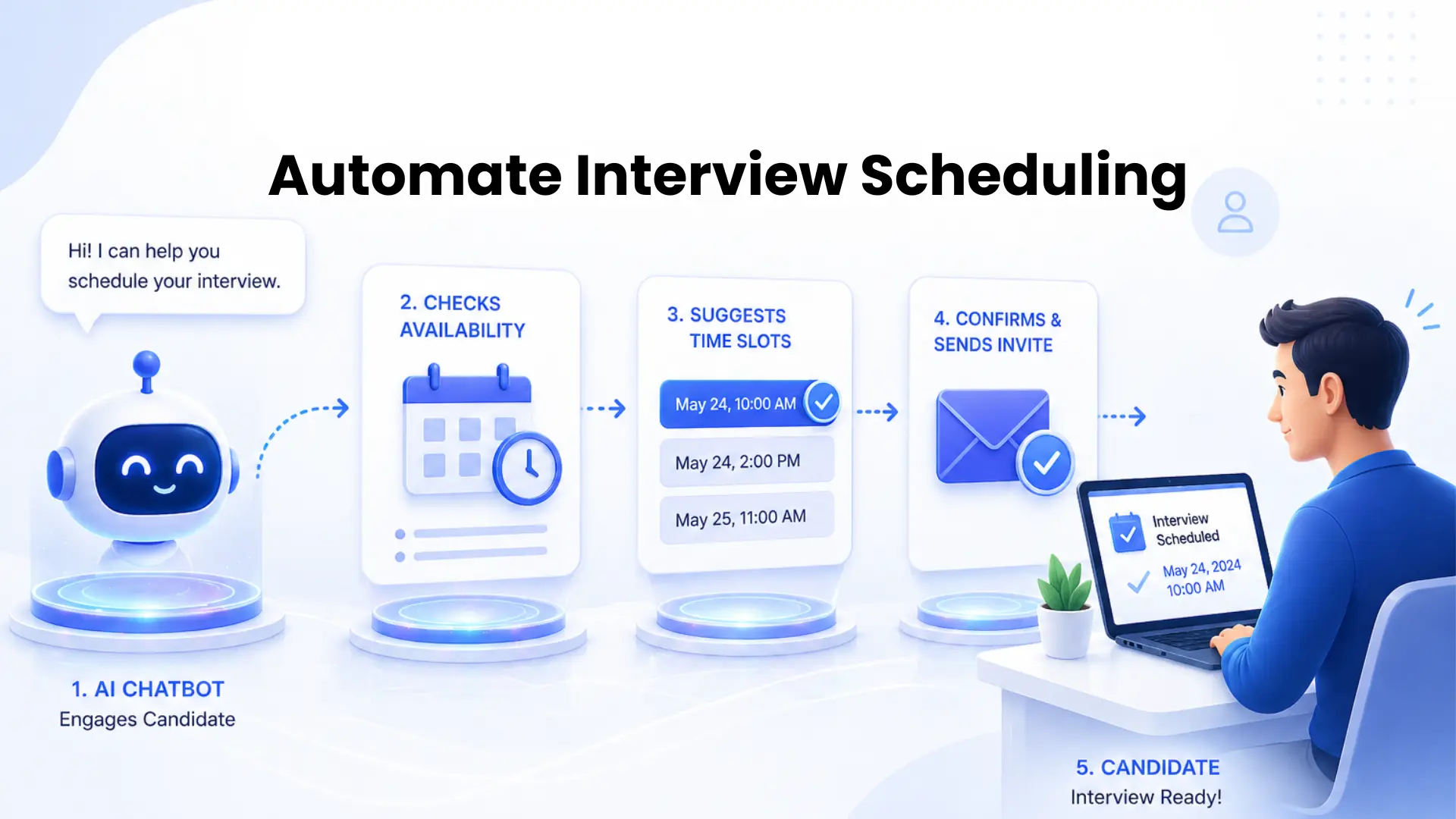
AI chatbots automate interview scheduling by running the full workflow from candidate interaction to final confirmation inside one conversational flow. This replaces manual coordination and allows interview scheduling automation to function continuously in real time.
Step 1: Candidate Interaction and Instant Response
Candidates enter the workflow through a website, WhatsApp, or other channels, where the AI responds immediately and initiates the scheduling process.
Step 2: Intent Detection and Context Understanding
The system identifies role, availability, timezone, and preferences through conversation to guide accurate scheduling decisions automatically.
Step 3: Calendar Coordination and Conflict Resolution
The AI checks integrated calendars, matches available slots, and resolves conflicts automatically.
Step 4: Booking Execution and Confirmation
Once a slot is chosen, the system books the interview and sends confirmation details to all participants instantly.
Step 5: Reminders, Follow-Ups, and Rescheduling
The AI sends reminders, triggers follow-ups, and manages rescheduling requests without requiring manual coordination or intervention.
Common Mistakes to Avoid When Implementing AI Interview Scheduling
Many businesses fail to get results from AI scheduling because they treat it as a basic chatbot instead of a workflow system. The gap is not in the technology, but in how it is implemented and managed.
- Treating chatbot as an FAQ tool: Limits the system to answering queries instead of executing scheduling workflows end-to-end
- Poor training data: Inaccurate or outdated inputs lead to incorrect availability matching and unreliable scheduling decisions
- No fallback logic: Without backup scheduling systems, booking failures stop the process instead of continuing automatically
- Ignoring conversation review and learning workflows: Failing to analyze real interactions and update answers prevents the system from improving accuracy and handling edge cases over time
These mistakes reduce accuracy, create friction, and break automation. The difference between average and high-performing systems comes from continuous refinement, not just initial setup. AI scheduling works when treated as an evolving workflow system, not a static chatbot.
AI scheduling differs from traditional HR tools because it executes hiring workflows directly instead of only recording or tracking candidate data. An AI chatbot for recruitment operates as a system that handles actions like scheduling, screening, and communication in real time.
Traditional systems like ATS platforms focus on storing resumes and tracking candidate stages. In contrast, an AI chatbot for hiring process execution actively manages interactions, captures inputs, and triggers outcomes within the same workflow. This shift reduces delays and removes dependency on manual coordination.
Beyond interview scheduling, AI expands into broader recruitment workflows:
- Candidate Screening and Qualification: Automatically asks questions and filters candidates based on role requirements and responses.
- Application Handling and Data Capture: Collects candidate information conversationally and structures it for internal use.
- Follow-Ups and Communication Automation: Sends reminders, updates, and next steps without requiring recruiter intervention.
Most companies limit AI to scheduling, but its real value emerges when multiple hiring tasks are integrated into a single continuous workflow. AI transforms recruitment from a tracking system into a workflow execution system across multiple hiring stages.
Benefits of AI Chatbots in the Recruitment Process
1. Candidates
- Instantly share availability and receive confirmations without delays in scheduling
- Experience smoother hiring journeys supported by real-time candidate experience automation
- Avoid back-and-forth emails, reducing confusion and improving overall engagement
2. HRs / Recruiters
- Eliminate manual coordination tasks and automate scheduling across the hiring pipeline
- Save 2 to 10 hours weekly within an AI-driven hiring process environment
- Focus more on candidate evaluation and strategic recruitment decisions
Read more about how AI chatbots reduce HR workload and automate employee queries across organizations.
3. Hiring Managers
- Align interviews with real-time availability across multiple stakeholders efficiently
- Reduce delays caused by scheduling conflicts and coordination gaps significantly
- Improve time-to-hire and maintain smoother, faster hiring decision cycles
4. Interviewers (Panel Members)
- Receive automated reminders that reduce missed interviews and scheduling confusion
- Stay prepared with timely updates without needing manual follow-ups or coordination
- Improve interview consistency and reliability across multiple candidate interactions
Bottom Line
Each stakeholder benefits differently, but the common outcome is clear: AI Chatbot for Interview Scheduling replaces fragmented coordination with a single, automated scheduling system that improves speed, efficiency, and reliability across the entire hiring workflow.
Choosing the right solution depends on how well it executes hiring tasks, not just how it responds. The best AI-powered recruitment tools combine automation, integrations, and ongoing learning to simplify hiring workflows and deliver clear results across scheduling, screening, and communication.
Automation Depth
A strong chatbot for hiring automation should handle scheduling, screening, and follow-ups as real actions, not just replies, ensuring tasks are completed without manual coordination.
Integration with Scheduling Systems
Look for platforms that connect with automated interview scheduling HR tools, allowing real-time calendar syncing, conflict handling, and smooth booking across recruiters and candidates.
Learning and Optimization Workflow
Platforms should support reviewing conversations, identifying gaps, and updating answers through Q&A so the system improves accuracy and handles more cases over time.
Multi-Channel Deployment Capability
The platform should work across websites and messaging channels, ensuring conversational AI in hiring stays consistent wherever candidates and teams interact.
What Is the Future of AI in Recruitment and Interview Scheduling?
Recruitment is evolving into an autonomous, data-driven system where AI handles execution and humans focus on relationships and decisions. AI-based scheduling systems will develop into workflow engines that manage hiring from first interaction to final offer with minimal manual involvement.
The move toward skill-based “blind” matching will change hiring. Candidates will be evaluated on proven abilities rather than resumes, improving accuracy and reducing bias through objective data.
Real-time candidate sentiment analysis will also play a key role. AI will monitor engagement, communication, and response behaviour to detect declining interest and help recruiters act at the right time.
The overall direction is human-centric recruiting. As AI-driven hiring process automation removes administrative work, recruiters will focus on relationships, alignment, and strategic decisions.
AI manages execution, while recruiters drive outcomes.
Build and Deploy AI Recruitment Agents with GetMyAI
GetMyAI enables businesses to build and deploy AI recruitment agents that automate hiring workflows without needing technical setup. The platform offers a no-code environment where teams can create, train, and manage agents from a centralized Dashboard, making recruitment more structured and execution-focused.
The platform is designed to give teams full control over how their AI agents operate and improve over time:
- No-code setup: Create and deploy AI agents without engineering dependency
- Dashboard control: Manage agents, training, and usage from a single interface
- Activity + Improvement workflow: Review conversations and improve responses using Q&A
GetMyAI supports multi-channel deployment, allowing agents to operate consistently across:
- Website embeds
- Telegram and Slack
- WhatsApp and Instagram
It also integrates with scheduling systems to automate interview coordination:
- Calendly, Google Calendar, and Cal.com integrations
- Priority-based fallback logic ensures bookings continue without interruption
This helps businesses replace fragmented coordination with a unified, automated recruitment system. GetMyAI enables teams to build AI agents that run recruitment workflows with control, consistency, and scalability.
FAQs
1.What is an AI recruitment chatbot?
An AI recruitment chatbot is a conversational system that interacts with candidates, understands intent, and executes hiring tasks such as screening, scheduling, and follow-ups. It uses natural language processing chatbot HR capabilities to interpret responses and trigger actions. This makes it a core part of smart recruitment technology, not just a support tool.
2.How do AI chatbots automate interview scheduling?
AI chatbots automate interview scheduling by capturing candidate availability, matching it with recruiter calendars, and booking interviews instantly. This process eliminates manual coordination and reduces delays across the hiring pipeline. It is a core example of how to automate interview scheduling with AI in real-world workflows.
3.How do recruiters use AI chatbots?
Recruiters use AI chatbots to manage high-volume interactions, screen candidates, and coordinate interviews without manual effort. With GetMyAI, teams use AI agents to handle automated talent acquisition workflows, allowing recruiters to focus on evaluation and decision-making. This improves efficiency while maintaining consistent communication.
4.What tools automate interview scheduling?
Tools for automated interview scheduling HR workflows include AI chatbots integrated with calendar systems and communication platforms. AI agents made within GetMyAI connect scheduling tools with candidate conversations, enabling bookings, reminders, and rescheduling to happen within a single system. This keeps the entire scheduling process consistent, reduces manual coordination, and ensures interviews are managed in real time.
5.How do chatbots improve candidate experience?
Chatbots improve candidate experience through instant replies, clear guidance, and continuous engagement across the hiring process. They reduce waiting time, remove confusion, and enable candidate experience automation at scale. This results in higher satisfaction and improved conversion across recruitment stages.