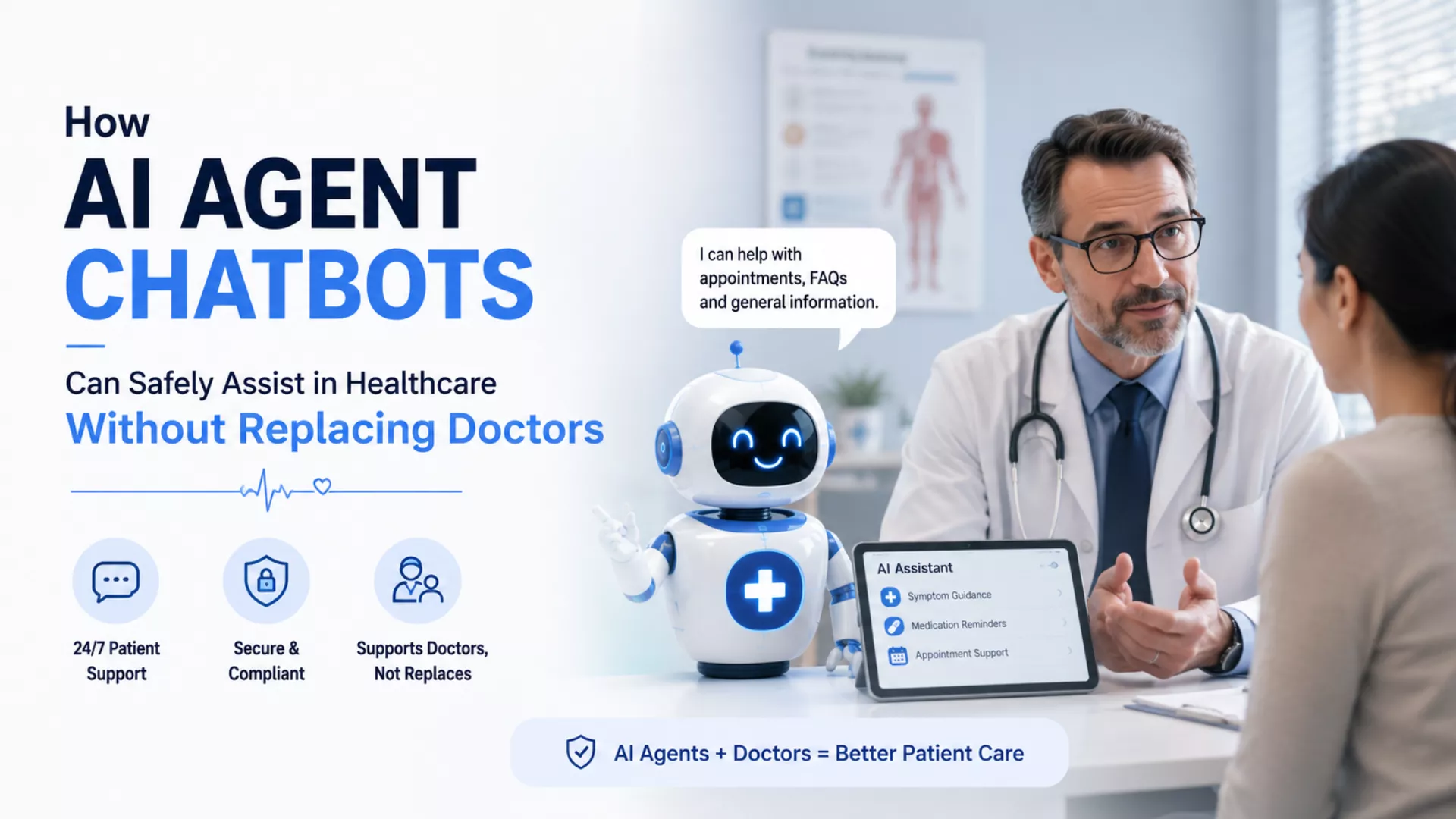
How AI Agent Chatbots Can Safely Assist in Healthcare Without Replacing Doctors

Key Takeaways
- AI chatbots enhance healthcare delivery by supporting, not replacing, medical professionals
- Safe implementation depends on structured training, accurate data, and human oversight
- AI-driven systems improve patient support, triage, and communication efficiency
- Healthcare chatbots work best when integrated into existing workflows, not isolated tools
- Continuous monitoring, analytics, and Q&A refinement ensure reliability and trust over time
Healthcare is one of the most careful industries when it comes to using new technology. Every action, every answer, and every decision can affect a patient’s health. Because of this, people are often unsure about using AI, especially when it is used for automation and talking to patients.
The idea of using an AI chatbot in healthcare brings up an important question: can technology really help patients without risking safety or replacing doctors?
The answer depends on how these systems are built and used. Modern AI tools are not made to replace doctors but to help them by managing repeated questions, making information easier to access, and improving communication. When used the right way, they connect patients and providers instead of replacing human care.
This is where the idea of an AI agent chatbot healthcare system becomes important. Unlike simple chatbots, these systems can understand context, give structured answers, and work within clear limits that keep patients safe.
As healthcare keeps growing, the focus is not about if AI should be used, but how it can be used safely to improve patient care while keeping doctors at the center.
Why AI Chatbots Are Being Adopted in Healthcare
Healthcare providers are under constant pressure to deliver faster, more accessible, and more efficient services. Rising patient volumes, administrative burdens, and limited staff availability make it difficult to maintain consistent communication across every touchpoint.
This is where an AI doctor assistant chatbot begins to play a meaningful role.
Instead of replacing clinical expertise, these systems focus on handling non-critical interactions such as answering common questions, guiding patients through processes, and providing general information. This allows healthcare professionals to focus on what matters most: diagnosis, treatment, and patient care.
The shift toward AI in healthcare patient support is largely driven by the need for:
- Immediate responses to patient queries
- Reduced administrative workload
- Improved accessibility to healthcare information
- Consistent communication across digital channels
However, early chatbot implementations often struggled because they lacked context, relied on scripted responses, and failed to deliver reliable information. This created concerns around accuracy and trust, especially in a medical environment.
Modern systems are evolving beyond these limitations by focusing on contextual understanding, structured knowledge, and controlled interactions.
The Role of AI Agent Chatbots in Patient Support
The role of AI in healthcare is not to diagnose or prescribe but to assist, guide, and support. A well-designed AI chatbot for patient support operates within clearly defined limits, ensuring that it complements medical professionals rather than replacing them.
These systems are now widely used as an AI chatbot for hospitals, helping manage patient communication across multiple stages of the healthcare journey rather than just isolated interactions.
Across the patient journey
Instead of handling one-off queries, AI agent chatbots support patients at different stages of care, creating a more continuous and accessible experience.
Before care
Patients can access general information, understand available services, and get clarity on next steps without waiting for human assistance. This reduces friction at the very first touchpoint.
During care
Chatbots guide patients through processes such as appointment booking, form completion, and general instructions, helping them move through systems more efficiently.
After treatment
Support continues beyond the consultation. Patients receive post-care instructions, follow-up guidance, and answers to common questions, improving continuity of care.
Where AI chatbots provide the most value
AI agent chatbots are designed to simplify repetitive interactions while keeping communication structured and consistent:
- Answer frequently asked questions about symptoms, services, or procedures
- Guide patients through appointment booking or pre-consultation steps
- Provide post-treatment instructions based on verified information
- Assist with triage by directing patients to appropriate resources
At the same time, an AI chatbot for medical queries ensures that responses remain informational rather than diagnostic, reducing the risk of misuse.
A critical boundary to understand
AI chatbots are not designed to replace clinical judgment.
They do not:
Diagnose medical conditions
Prescribe treatments
Handle emergency decision-making
Instead, they guide patients toward appropriate actions, such as seeking professional care or booking a consultation. This keeps responsibility where it belongs, with healthcare professionals.
What this means in practice
When implemented correctly, AI chatbots act as a support layer that improves communication, reduces delays, and enhances accessibility without interfering with medical decision-making.
However, their effectiveness depends on how well they are trained, controlled, and continuously improved. Without structured knowledge and clear boundaries, responses can become inconsistent or unreliable.
This is why healthcare organisations must focus not just on adopting AI, but on implementing it in a controlled and structured way.
How GetMyAI Enables Safe and Controlled Healthcare Chatbots
As healthcare organisations explore AI adoption, the biggest challenge is not capability, but control. It is not enough for a chatbot to respond; it must respond correctly, consistently, and within defined boundaries. This is what determines whether an AI system can be trusted in a medical environment.
This is where GetMyAI begins to play a critical role.
The Core Problem in Healthcare AI
Most chatbot systems fail in healthcare settings because they:
- Rely on broad, unverified data
- Generate responses without clear boundaries
- Lack visibility into how answers are produced
- Do not improve in a structured way
This creates risk, inconsistency, and loss of trust.
How GetMyAI Changes the Approach
Instead of acting as a generic chatbot, GetMyAI enables organisations to build AI agents that are controlled, traceable, and continuously improving.
1. Controlled Knowledge Training
- Train AI using internal documents, PDFs, and verified knowledge bases
- Ensure all responses are grounded in approved medical information
2. Meaning-Based Response System
- Retrieval is based on intent, not keyword matching
- Reduces hallucinations and irrelevant outputs
3. Full Conversation Visibility
- Track interactions directly through the Dashboard
- Identify where responses are accurate and where gaps exist
4. Continuous Improvement via Q&A
- Convert real patient queries into structured Q&A
- Improve accuracy without technical intervention
From Static Setup to Continuous Evolution
Traditional chatbot systems operate as fixed tools. Once deployed, they rarely improve unless manually reworked.
With GetMyAI, the process is different: Train → Deploy → Monitor → Improve → Repeat
This transforms the chatbot into a living system that evolves through real-world usage.
Why This Matters in Healthcare
This structured approach ensures that:
- Responses remain aligned with verified medical knowledge
- Patient interactions stay informational, not diagnostic
- Risk is reduced through controlled outputs
- Performance improves over time without complexity
Instead of introducing uncertainty, GetMyAI brings structure and control to AI in healthcare, making it possible to scale patient communication while maintaining safety, accuracy, and trust.
Are AI Chatbots Safe for Patient Care?
Many people worry about using AI in healthcare. The truth is, safety depends on how the system is built, trained, and managed every day.
Questions like "Are AI chatbots safe for patient care?” are important because wrong or unclear answers can cause serious problems.
Safe systems depend on:
- Limited and trusted knowledge sources
- Clear rules about what the chatbot can and cannot answer
- Human support for important medical decisions
- Ongoing tracking and updates to improve answers
When these steps are followed, AI chatbots act as helpful support tools instead of creating risk.
Understanding the Risks of AI in Healthcare
AI chatbots bring efficiency and accessibility to patient communication, but without proper control, they can introduce risks that affect both safety and trust. Understanding the risks of AI chatbots in healthcare is essential for responsible adoption and long-term success.
Key Risks and Their Impact
| Risk | Why It Happens | Potential Impact |
| Inaccurate responses | Outdated or incomplete training data | Misinformation and reduced patient trust |
| Misinterpretation of queries | Limited contextual understanding of complex medical input | Incorrect or irrelevant guidance |
| Over-reliance by patients | Easy access without clear boundaries between support and diagnosis | Delayed consultation with healthcare professionals |
| Lack of transparency | No visibility into how responses are generated or sourced | Compliance concerns and reduced credibility |
Why These Risks Exist
These risks are not random; they are directly linked to how AI systems function:
- AI depends entirely on the quality and accuracy of its training data
- It lacks clinical judgment and cannot replicate human reasoning
- It may struggle with multi-layered or ambiguous patient queries
- Static systems do not improve unless continuously updated and monitored
What This Means for Healthcare Providers
For AI to be used safely in healthcare environments, systems must operate within clearly defined boundaries. This includes ensuring that chatbots provide informational support rather than diagnostic advice, rely only on verified knowledge sources, and are continuously monitored for accuracy.
When these safeguards are in place, healthcare providers can reduce risk while still benefiting from scalable, AI-driven patient support.
Ethical Considerations and Compliance
The discussion around ethical AI healthcare solutions is central to adoption in medical environments. Trust is built not just on accuracy, but on how responsibly data is handled and how clearly the system communicates its role.
Healthcare organisations must also consider compliance requirements, such as a HIPAA-compliant AI chatbot, ensuring that patient data is handled securely and responsibly.
Transparency, accountability, and data protection are not optional; they are foundational to safe implementation.
AI Chatbots vs Doctors: Understanding the Difference
As AI continues to evolve, confusion around AI vs human doctors' healthcare has become increasingly common. While AI systems are becoming more capable, their role in healthcare remains fundamentally different from that of medical professionals.
The distinction is not about which is better, but about understanding how each contributes to patient care.
Core Differences at a Glance
| Aspect | AI Chatbots | Doctors |
| Role | Provide information, guidance, and communication support | Diagnose conditions, treat patients, and make clinical decisions |
| Decision-making | Based on trained data and pattern recognition | Based on clinical expertise, experience, and judgment |
| Accountability | No legal or ethical responsibility | Fully responsible for patient outcomes and care decisions |
| Context understanding | Limited to input and training data | Holistic understanding of medical history, symptoms, and context |
| Availability | 24/7 instant responses | Dependent on schedules and workload |
Why This Difference Matters
AI chatbots are designed to assist, not replace. They improve accessibility to information and streamline patient communication, but they cannot replicate human reasoning or clinical expertise. This is why they are most effective when used within clearly defined boundaries.
A Collaborative Approach to Healthcare
Rather than replacing doctors, AI is most valuable when it supports them:
- AI handles repetitive queries and provides instant responses
- Doctors focus on diagnosis, treatment, and complex decision-making
- Patients benefit from faster access to information without compromising care quality
Setting the Right Expectations
Understanding AI chatbot vs doctor roles in healthcare is essential for safe and effective implementation. When used correctly, AI enhances efficiency and accessibility, while doctors continue to provide the expertise and judgment that healthcare depends on.
How AI Chatbots Support Modern Healthcare Systems
As adoption increases, it is important to look at AI healthcare chatbot use cases with safety measures in real-world environments.
These include:
- Patient onboarding and pre-consultation guidance
- Appointment scheduling and reminders
- Post-treatment follow-ups
- General information and support services
These applications show how AI chatbots support telemedicine services by extending accessibility while maintaining structured communication.
Benefits of AI Chatbots for Patients and Providers
When implemented correctly, the benefits of AI chatbots in healthcare for patients go beyond basic convenience. They improve accessibility, reduce friction in communication, and enhance how healthcare services are delivered at scale.
For Patients
Faster Responses
- Patients receive immediate answers, reducing uncertainty and stress
Better Access to Information
- Reliable, consistent information is available at any time
Reduced Waiting Times
- Less dependency on phone calls and manual support channels
24/7 Support Availability
- Assistance is accessible even outside hospital hours
Guided Patient Journey
- Help navigating appointments, procedures, and next steps
For Healthcare Providers
Reduced Administrative Workload
- Repetitive queries are handled automatically
Improved Operational Efficiency
- Faster communication reduces bottlenecks
Better Resource Allocation
- Staff can focus on critical and complex cases
Scalable Patient Support
- Ability to handle large volumes without increasing staff
Reduced Operational Pressure
- Lower burden on front-line support teams
The Bigger Impact
This dual benefit creates a healthcare system that is more responsive and scalable. Patients gain faster access to support, while providers operate more efficiently without compromising care quality.
When structured correctly, AI becomes a support layer that strengthens both patient experience and operational performance.
How GetMyAI Supports Continuous Improvement in Healthcare
A key factor in safe AI adoption is continuous improvement. This is where GetMyAI provides long-term value beyond initial deployment.
Through its Activity tracking and Q&A workflow, teams can:
- Identify unanswered or unclear patient queries
- Add structured responses to improve accuracy
- Refine chatbot knowledge over time
This ensures that the system does not remain static but evolves based on real interactions. Over time, this leads to better performance, higher accuracy, and improved patient trust.
Conclusion
AI is not replacing doctors; it is reshaping how healthcare systems operate by improving communication, accessibility, and efficiency.
The real question is not whether AI chatbots can replace doctors in healthcare, but how they can support them safely and effectively.
When implemented with the right safeguards, AI chatbots become a valuable extension of healthcare services, helping patients access information while allowing professionals to focus on critical care.
With platforms like GetMyAI, organisations can build structured, controlled, and continuously improving AI systems that align with the demands of modern healthcare.
Frequently Asked Questions
1. How do AI agent chatbots support healthcare without replacing doctors?
AI agent chatbots assist by handling routine queries, guiding patients, and improving communication efficiency. They operate within defined limits and do not diagnose or treat, ensuring doctors remain central to clinical decision-making.
2. Are AI chatbots safe to use in healthcare environments?
AI chatbots are safe when built with controlled data, clear response boundaries, and human oversight. Their role is informational support, not medical judgment, ensuring patient safety is maintained while improving accessibility and communication.
3. What role do AI chatbots play in patient communication?
AI chatbots improve patient communication by providing instant responses, guiding appointment processes, and sharing verified information. They help reduce delays and ensure consistent communication across digital platforms, making healthcare services more accessible.
4. What are the risks of using AI chatbots in healthcare?
Risks include inaccurate responses, misinterpretation of complex queries, and over-reliance by patients. These challenges can be minimised through structured training, verified data sources, and continuous monitoring to maintain accuracy and reliability.
5. How does GetMyAI ensure reliable healthcare chatbot performance?
GetMyAI enables chatbots to be trained on verified data, monitored through dashboards, and improved continuously using real interactions. This ensures responses remain accurate, controlled, and aligned with approved healthcare information.
6. What are the benefits of AI chatbots for patients and healthcare providers?
Patients benefit from faster responses and easier access to information, while providers reduce administrative workload and improve efficiency. This creates a balanced system where communication improves without compromising professional medical care.