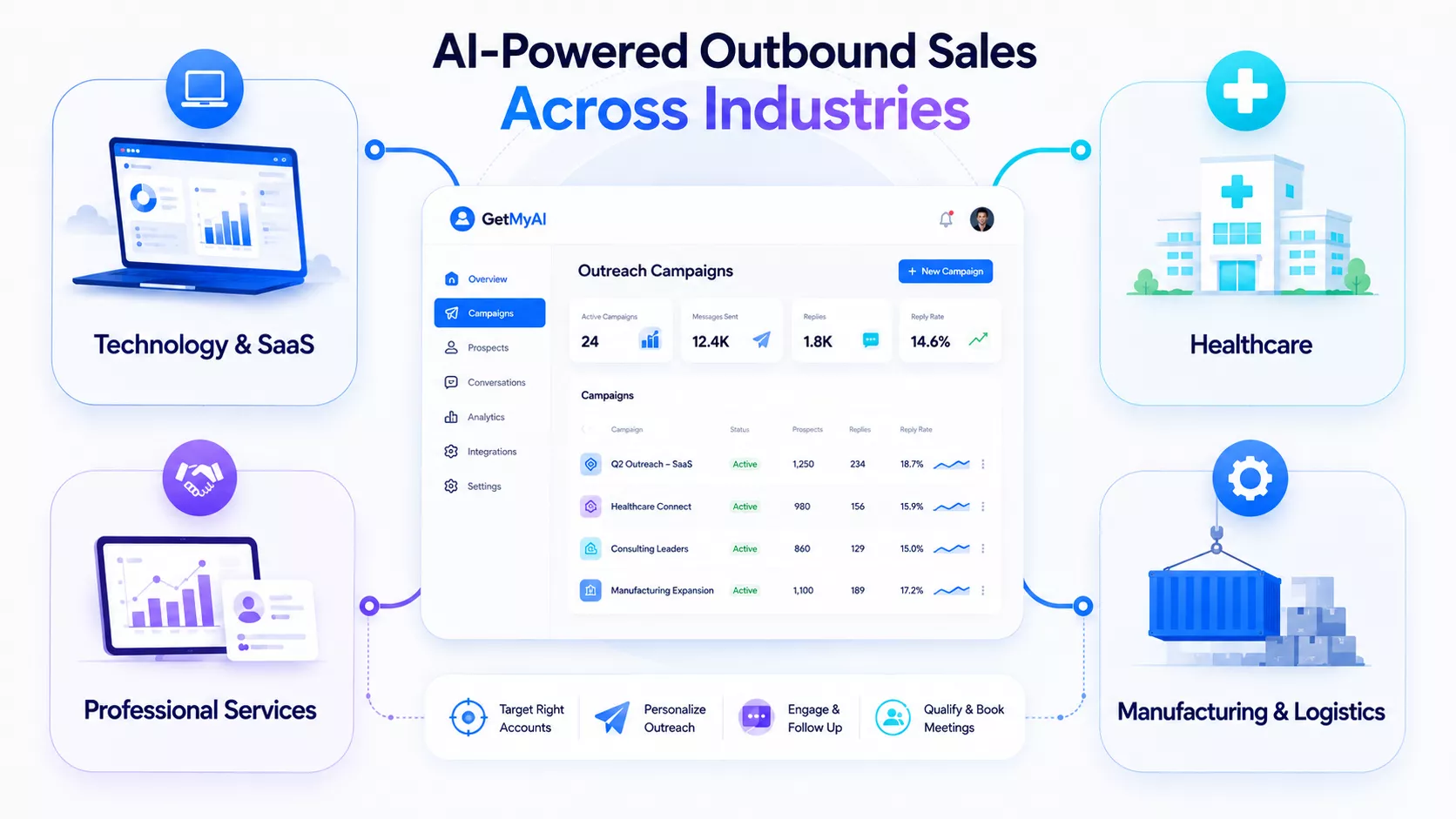
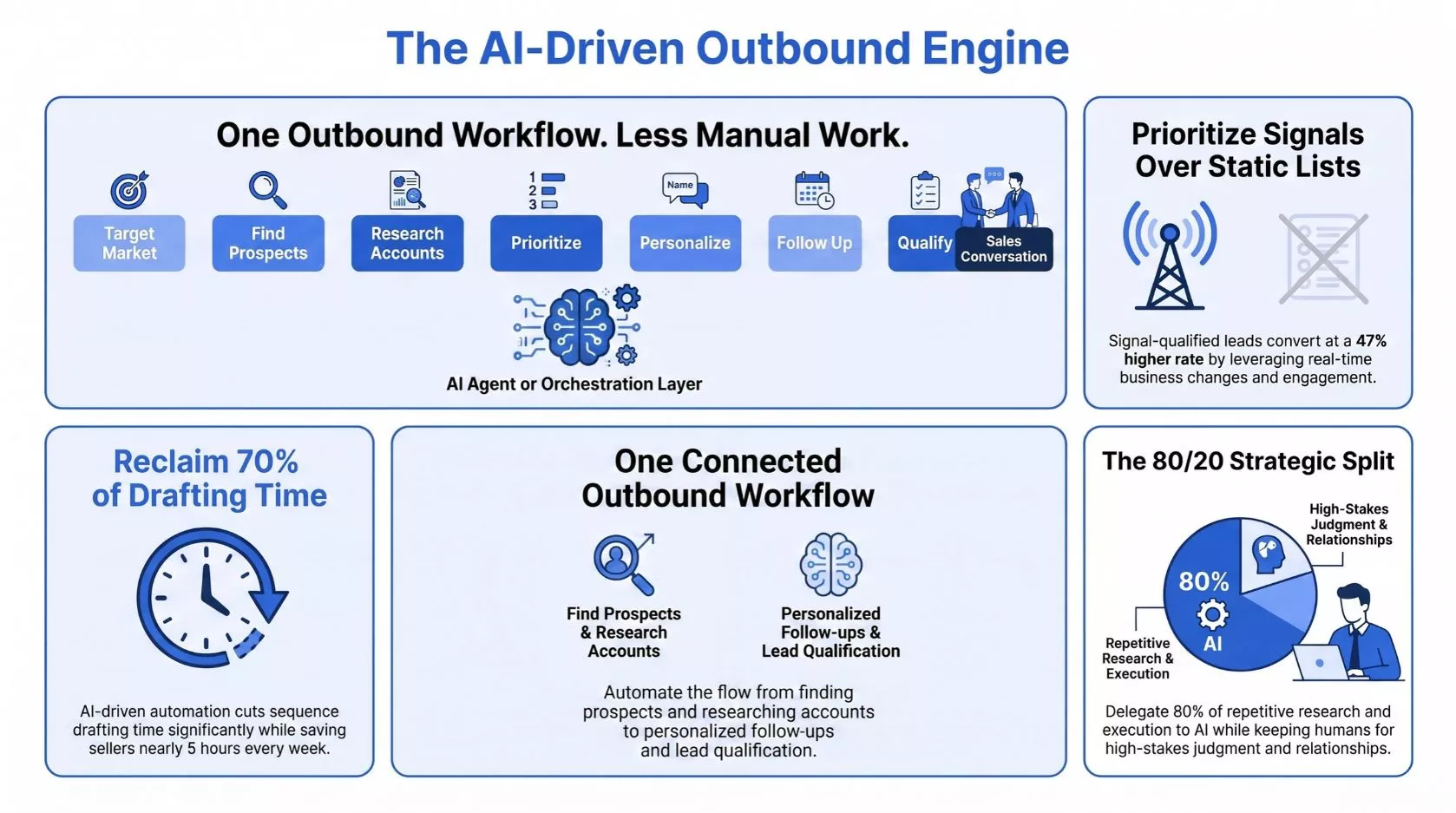
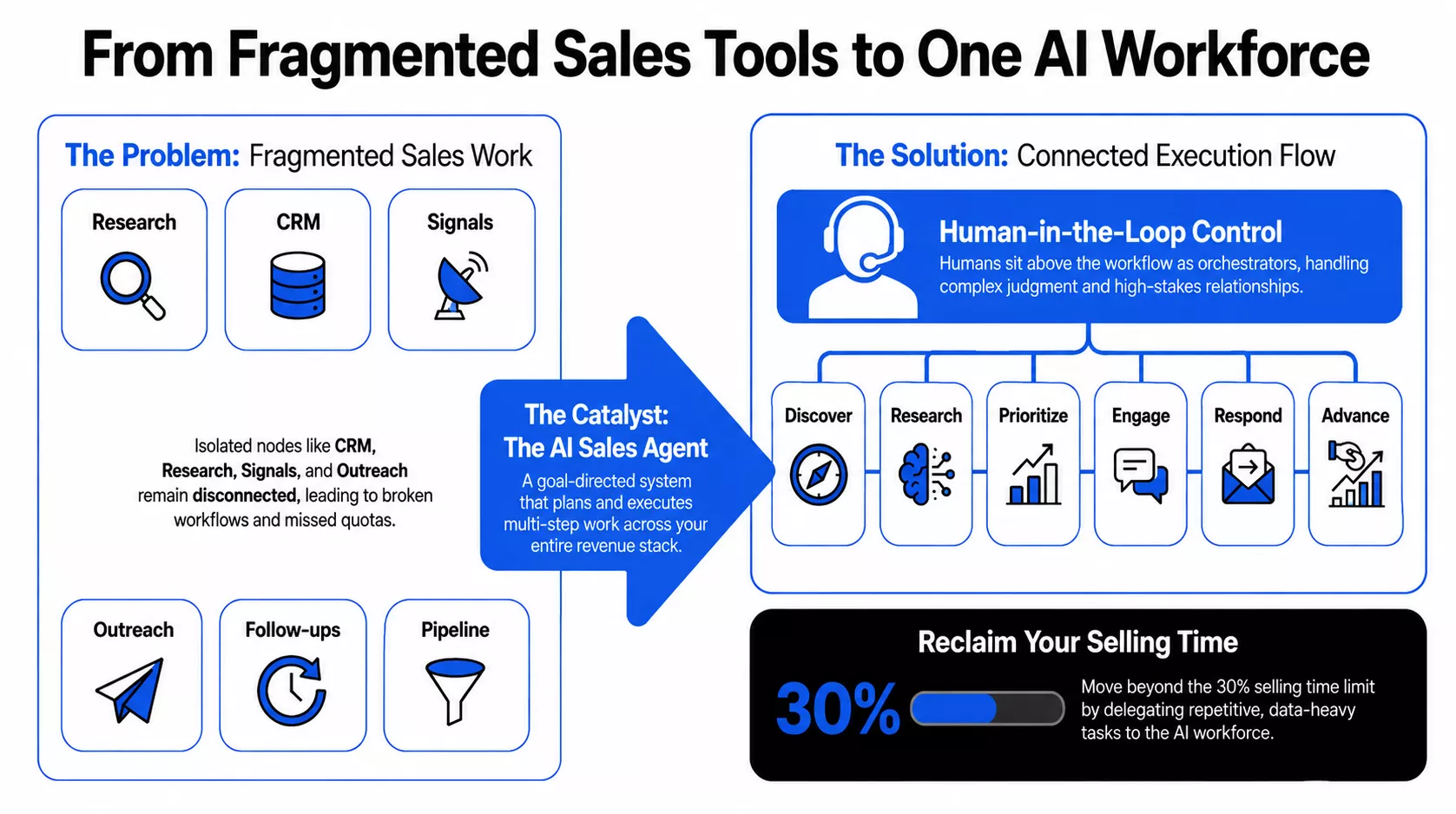
B2B outbound sales is becoming harder to manage manually. Sales teams still spend hours finding prospects, researching accounts, identifying decision-makers and keeping up with follow-ups. Benefits of AI in Sales go beyond saving time: better prospect research…
Experience Boost
Create. Deploy. Engage. With GetMyAI
Launch GPT-powered conversations that engage, support, and convert — all in one platform.
Future of Chatbots: How AI Is Reshaping Business Conversations in 2026
GetMyAI
Dec 30, 2025
future of chatbots
conversational AI for business
AI chatbot for business
AI-powered customer support
enterprise AI chatbots
Key Takeaways
AI chatbots have evolved from basic responders into execution systems that complete real business tasks.
Conversational AI for business now drives workflows, decisions, and outcomes across support, sales, and operations.
Agentic AI chatbots perform tasks, automate processes, and execute actions instead of just generating responses.
Continuous improvement depends on analyzing real conversations and updating knowledge through feedback loops and Q&A.
Integration with systems and high-quality data are critical factors that determine chatbot accuracy, performance, and scalability.
AI chatbots in 2026 function as execution systems that combine conversational AI, workflow automation, and real-time data access to complete tasks, not just answer questions. An AI chatbot for business is used to handle support, qualify leads, book meetings, and trigger workflows across channels like websites, Slack, WhatsApp, and Telegram.
Conversational AI for business now connects customer interaction with operational outcomes such as support resolution, lead qualification, and booking. AI communication tools no longer sit on the surface; they operate inside workflows. AI chatbots now drive decisions, not just responses. Companies adopting enterprise-level AI chatbots are redesigning how conversations translate into action across sales, support, and operations.
The Shift From Simple Bots to Intelligent AI Agents
Before: Chatbots followed rules, matched keywords, and failed outside predefined flows.
After: Enterprise AI chatbots understand intent, maintain context, and execute workflows.
Modern conversational AI platforms evolved through three stages:
Chatbots answer queries
Generative AI gives responses
AI agents execute actions
Today’s AI chatbot software operates with memory, integrates with systems, and supports decision-making. This transition defines the shift from passive conversation tools to active business systems. AI communication tools now connect directly to workflows, enabling real-time execution across channels and use cases.
What Most Businesses Get Wrong About AI Chatbots
Myth: Chatbots are tools for customer support. Businesses often treat them as systems that answer queries and reduce support workload, limiting their role to basic interaction rather than broader operational impact.
Reality: Chatbots are execution systems. Modern AI chatbots for business operations can trigger workflows, integrate with systems, and complete tasks such as lead qualification, booking, and support resolution without manual intervention.
Why: Value comes from automation and integration, not conversation alone. Most companies deploy AI chatbot solutions for businesses as front-end interfaces. This limits impact. The real opportunity lies in AI workflow automation, where systems perform tasks instead of just responding.
Example:
A basic chatbot answers, “Where is my order?” An advanced system tracks the shipment, updates delivery status, and notifies the user.
AI Agents vs AI Chatbots
Agentic AI chatbots extend beyond responses. They perform AI-powered decision support by breaking tasks into steps, connecting to systems, and completing workflows. This is why conversational AI for business is shifting toward agent-based execution models.
Capability
AI Chatbots
AI Agents
Function
Respond to queries
Execute goals
Logic
Prompt-based
Planning + reasoning
Memory
Session-based
Persistent context
Integration
Limited
Deep system integration
Output
Answers
Action
Key Benefits of AI Chatbots for Businesses
AI in customer service now depends on speed and accuracy. Enterprise AI chatbots ensure availability without increasing headcount. AI-driven business communication improves both efficiency and revenue outcomes.
FOR BUSINESS:
Reduce support costs through high-volume automation
Scale conversations without proportional headcount growth
Improve operational efficiency across repetitive workflows
Enable 24/7 support without infrastructure expansion
Lower cost per interaction across global operations
AI-driven support can reduce interaction costs by over 80% in telecom and similar industries.
FOR SALES:
Increase conversions with instant lead response times
Capture and qualify leads through automated conversations
Improve speed-to-lead with real-time engagement systems
Personalize recommendations using behavioral data insights
Drive higher revenue with AI-assisted upselling workflows
Responding within minutes can increase conversion likelihood by up to 21x compared to delayed responses.
FOR USERS:
Get instant answers without waiting in queues
Receive consistent responses across all channels
Experience personalized interactions based on context
Access support anytime without time zone limitations
Resolve queries faster with accurate AI-driven responses
They extend beyond answering questions and now focus on executing real tasks across different functions. These use cases show how chatbots actively support business operations instead of just managing conversations.
Customer Support: Handle customer queries, provide real-time order updates, and reduce ticket volume by resolving common issues instantly without requiring manual intervention from support teams.
Sales & Lead Generation: Capture leads through conversational AI tools for lead generation, qualify prospects based on intent, and trigger automated follow-ups to improve conversion speed and overall sales efficiency.
Appointment Booking: Schedule meetings by checking real-time availability, confirming suitable time slots, and managing bookings automatically without manual coordination or back-and-forth communication.
Internal Operations: Assist teams by retrieving relevant information, answering employee queries, and simplifying routine workflows to improve productivity and reduce dependency on internal support teams.
Feedback Collection: Gather user feedback in real time through conversations, analyze responses, and identify patterns that help improve products, services, and overall customer experience.
Challenges of AI Chatbots (and How to Overcome Them)
AI chatbots must operate with reliable data and system connectivity. Without this, AI communication tools remain superficial.
Problem: Incorrect or misleading answers
AI chatbots may generate responses that appear correct but lack factual accuracy. This becomes critical in business contexts where wrong information can impact decisions, customer trust, or compliance requirements, especially in AI-powered customer support and enterprise environments.
Cause: Weak data grounding
When a chatbot relies on generic or incomplete data instead of validated business information, it produces unreliable outputs. Without a strong grounding in documents, databases, or internal knowledge, conversational AI platforms struggle to maintain consistency and accuracy.
Fix: Use real data sources and validated content
Problem: Limited functionality
Many AI chatbots for business implementations fail to go beyond answering questions. They cannot perform actions like updating systems, processing requests, or triggering workflows, which limits their value to surface-level interaction rather than meaningful operational support.
Cause: No system integration
Without integrating chatbots with systems such as databases or internal tools. This disconnect prevents automation, restricts execution, and reduces the chatbot to a passive interface instead of an active system.
Fix: Enable chatbot integration for business systems
Problem: Compliance risk
Customer service through AI introduces regulatory challenges, especially when handling sensitive data or providing automated responses. Incorrect disclosures, lack of transparency, or improper data handling can lead to legal consequences and loss of customer trust.
Cause: Lack of transparency
When AI chatbot solutions for businesses do not clearly define how data is processed or fail to communicate system limitations, compliance risks increase. Absence of governance, audit visibility, and controlled access creates vulnerabilities in enterprise AI deployments.
Fix: Clear data handling and governance.
How AI Chatbots Actually Learn From Conversations
AI chatbots improve through structured updates, training data refinement, and feedback loops, rather than learning instantly from each interaction like humans.
AI chatbot development relies on:
Training on business-specific documents
Retrieval of relevant information during conversations
Feedback signals from interactions
Example: If a chatbot cannot answer a question, teams update Q&A or documents, and the system improves future responses. This ensures AI platforms deliver accurate and context-aware answers.
The Feedback Loop That Improves Chatbots Over Time
A user asks a question that the AI cannot answer clearly. That interaction is captured in Activity, where the system records the conversation. The unanswered query is then identified and flagged for review. A team member steps in, adds the correct response through Q&A, and updates the knowledge base. The next time a similar question appears, the AI responds accurately, reflecting the improvement made from that earlier interaction.
This loop connects chatbot analytics and insights with real improvement. AI-based chatbots rely on this cycle to refine performance continuously. AI chatbots used by businesses improve not during setup, but through real usage.
Where Chatbots Fit in the Modern Business Stack
Modern AI Stack
System of Record: CRM, databases
Integration Layer: APIs, data flow
AI Layer: Enterprise AI chatbots
AI chatbots now sit at the execution layer. They trigger workflows, retrieve data, and coordinate actions across systems. AI-driven business communication moves from passive interaction to active execution.
When AI Chatbots Fail (And Why)
AI chatbots fail when they operate in isolation from business systems. Without integration, they cannot access real-time data or trigger actions, which limits them to surface-level responses instead of meaningful execution.
Another common failure point is poor training data. When the system relies on outdated, incomplete, or conflicting information, responses become inconsistent or incorrect, reducing trust and usability over time.
Over-automation also leads to breakdowns. When every interaction is forced through AI without a fallback, complex or sensitive queries remain unresolved, creating frustration instead of efficiency.
An AI chatbot for business fails when it cannot act or provide accurate information. Performance depends on integration, data quality, and continuous improvement.
The Rise of Agentic AI Chatbots
THE GOLDEN RULE: If the AI cannot execute an action, it is just a chatbot for query handling.
Agentic AI chatbots represent the next stage of conversational AI in business, where systems move beyond answering queries to executing tasks, connecting workflows, and driving outcomes across support, sales, and operations.
These systems:
Understand user goals
Plan actions
Execute workflows
Learn from outcomes
These systems understand user intent, plan next steps, execute workflows, and learn from outcomes, enabling use cases like booking meetings, resolving issues, and delivering AI-powered decision support through real actions, not just responses.
How to Evaluate an AI Chatbot Platform in 2026
Evaluation starts with one question: Does the platform integrate with your business systems, or does it operate in isolation? The next layer is execution, can it complete actions, or does it only generate responses? Visibility becomes critical once deployed, so the platform must provide clear chatbot analytics and insights, not assumptions.
Scalability determines long-term value. A system that cannot expand across channels will limit growth. Finally, customization defines usability. If the platform cannot adapt to your workflows, it will remain generic.
Modern AI platforms must combine interaction with execution. AI chatbot solutions for businesses should deliver measurable outcomes, not just conversations.
How to Get Started with AI Chatbots in 5 Easy Steps
Understanding how to implement AI chatbots in business workflows requires focusing on real use cases, connecting systems, and continuously improving responses based on actual interactions rather than relying on static setup.
Step 1: Identify a high-impact use case such as support, lead generation, or booking
Step 2: Start with a single workflow and expand based on performance
Step 3: Connect your systems and data sources to enable execution
Step 4: Train the AI using accurate, business-specific content
Step 5: Monitor performance and improve continuously using Activity and Q&A
Why Choose GetMyAI
GetMyAI helps businesses move from handling conversations to driving outcomes. Instead of just responding to users, it enables faster resolutions, higher conversion rates, and consistent engagement across every interaction point.
By connecting conversations with real actions, businesses can reduce response time, improve lead quality, and scale support without increasing operational costs. The result is not just better communication, but measurable impact across sales, support, and overall business performance.
Get Started: Build Your AI Agent
Create your AI agent in minutes, train it using your documents or links, customize the chat interface, and deploy it instantly. From there, use Activity to review conversations and Q&A to continuously improve responses based on real user interactions.
FAQs
1. What is the future of chatbots in 2026? The future of chatbots in 2026 is execution-driven. AI chatbots now complete tasks, automate workflows, and act as operational systems rather than just answering user queries.
2. How are AI chatbots changing business communication? AI chatbots are transforming business communication by enabling real-time, automated interactions that connect directly with systems. Conversations now lead to actions, not just responses.
3. How can businesses use AI chatbots for customer support? Businesses can build AI chatbots with GetMyAI that handle repetitive queries, deliver instant responses, and guide users to solutions. By connecting them with real data, support becomes faster and more reliable.
4. Which AI chatbot is best for business automation? At GetMyAI, we focus on enabling businesses to create AI agents that execute workflows. The best solution is one that integrates with systems and allows chatbots to perform tasks, not just respond.
5. How do AI chatbots improve customer experience? Businesses can create AI chatbots that deliver instant responses, personalized interactions, and continuous support. This reduces wait times and improves overall customer engagement.
We’ve noticed that a surprising amount of a sales rep’s day is still spent preparing to sell rather than actually selling. Building lists, researching accounts, finding the right contacts, writing outreach and chasing follow-ups can consume hours before a mean…
Sales teams have more AI than ever, yet the productivity problem remains. Sales AI Agents can take repetitive work off your team's plate, but adding another tool does not automatically improve execution. In 2026, 78% of B2B sellers missed quota in 2025, w…