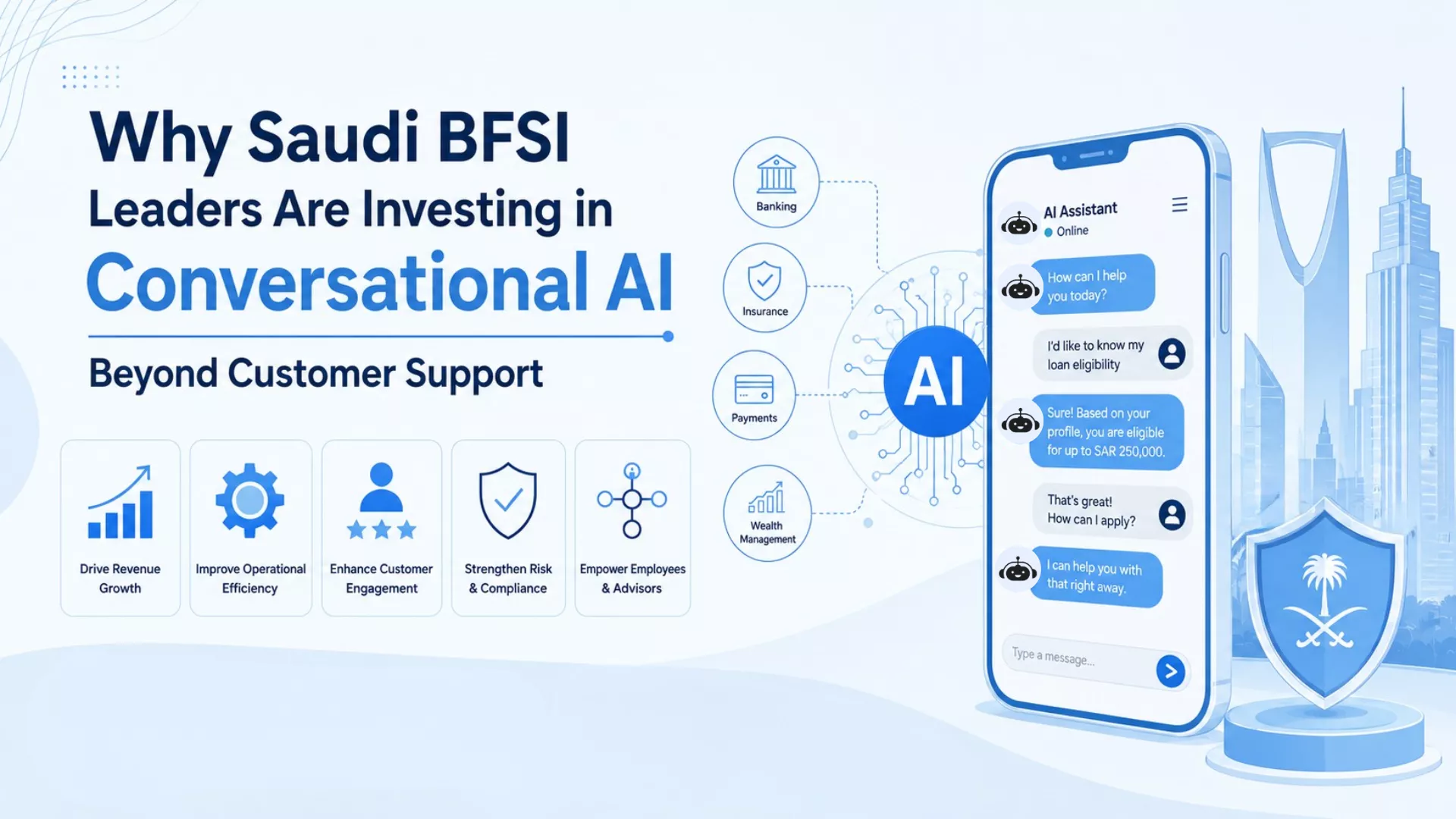
Why Saudi BFSI Leaders Are Investing in Conversational AI Beyond Customer Support

Key Takeaways
- Saudi banks are deploying conversational AI for banks in Saudi Arabia as operational infrastructure, not just customer service tooling.
- Banking AI agents now automate KYC, compliance, fraud investigation and underwriting workflows.
- SAMA regulations and PDPL data governance rules make sovereign AI infrastructure a procurement requirement, not a preference.
- Arab National Bank reduced call-center volume by 22% through AI deployment, demonstrating measurable operational ROI.
- BFSI leaders must assess Arabic NLP capability, governance controls and integration depth before committing to a vendor.
Saudi Arabia's banking sector has moved past the question of whether to adopt AI. The question now is how deeply to embed it.
For most institutions, the first wave of AI deployment looked identical: a chatbot on the website, FAQ automation, basic account inquiry handling. It reduced call volume modestly. It improved response times. It checked a digital transformation box. But it did not change how the bank operated.
That model is being replaced. Conversational AI for banks in Saudi Arabia is now being deployed inside the operational stack: automating KYC workflows, orchestrating compliance case management, accelerating underwriting and replacing fragmented manual processes across the middle and back office.
Driven by the Financial Sector Development Program under Vision 2030 and tightened by SAMA's cybersecurity frameworks, Saudi BFSI institutions are not just upgrading their customer interfaces. They are rebuilding their operational infrastructure around AI-native execution.
This blog explains what that shift looks like in practice, where banking AI agents deliver the most measurable impact and what BFSI leaders need to evaluate before deployment.
From FAQ Bots to Multilingual Banking Experiences
Early AI chatbot deployments in banking were built around one goal: deflect volume from call centers.
- FAQ automation for account inquiries
- Basic transaction assistance
- Branch locator and product information
- Password reset and balance queries
These deployments delivered limited ROI. They handled low-complexity queries but created friction the moment a customer needed anything nuanced. Escalations were frequent and satisfaction gains were marginal.
In Saudi Arabia, the limitations were more pronounced due to customer base diversity. A bank serving both Arabic-speaking nationals and a large expatriate workforce across Hindi, Urdu, Tagalog and English cannot rely on a single-language bot. Multilingual banking chatbot capability is a baseline operational requirement.
Modern conversational AI platforms have addressed this directly. Real-time language detection allows agents to switch languages mid-conversation without losing context. Voice AI agents now handle inbound calls in over 70 languages with native-sounding speech. AI-powered customer engagement in banking has shifted from reactive FAQ handling toward proactive, language-aware service that operates 24/7 without proportional headcount growth.
This was the necessary foundation. What came next changed operations entirely.
Why BFSI Leaders Are Now Investing in AI Agents for Operations
The real investment case for banking AI agents in Saudi Arabia is not customer experience. It is operational throughput.
Saudi banks process over 1.12 billion Mada e-commerce transactions annually. KYC processing, fraud investigation, compliance screening and loan underwriting cannot scale through headcount alone. The 20% tech talent shortfall across the sector has accelerated this realization. AI banking automation in Saudi Arabia is partly a workforce strategy.
Here is where banking AI agents are generating measurable operational impact.
1. Lead Generation and Customer Acquisition
Traditional web forms for mortgage or SME loan applications carry high abandonment rates. AI agents convert this into a conversational workflow.
When a prospect abandons a commercial loan application, the agent triggers a personalized WhatsApp or SMS message, identifies the friction point and guides the user through it directly in the chat. Qualifying questions around income bracket, loan purpose and credit score range are collected in natural language, scored against the bank's risk appetite and pushed into the CRM automatically. High-value leads are routed to the correct advisor with calendar synchronization handled by the agent.
This compresses what used to require human SDR time into a zero-touch acquisition workflow.
Automate BFSI Lead Qualification
Capture qualified banking leads automatically using AI-driven conversations, scoring, and appointment coordination systems.
2. KYC and Account Onboarding
KYC used to take 48 hours. With agentic AI, the same process now completes in under four hours at leading implementations.
AI agents for banking collect the customer's ID, verify it against external databases, check beneficial ownership for commercial accounts and create the account in the core banking system. Human reviewers handle only flagged exceptions. Reduced onboarding abandonment directly improves acquisition economics.
3. Internal Employee Copilots
The enterprise AI assistant for banks' use case is operationally significant but underdiscussed.
Compliance officers get instant access to policy documents and regulatory updates. Loan officers query a client's risk profile without manually pulling legacy reports. IT helpdesks resolve tickets and provision system access without human intervention. Internal AI agents do not face customers. They face employees. Their job is to compress the time between a question and a decision.
4. Fraud Detection and Compliance Monitoring
Traditional rule-based fraud systems generate high volumes of false positives, wasting investigators' time on low-risk alerts.
Agentic AI monitors transactions continuously. When an anomaly is detected, the agent pulls account history, behavioral data and geographic context, drafts a suspicious activity report and can freeze a card proactively while messaging the customer. Escalation happens only when necessary.
For AML compliance, agents cross-reference transactions against sanctions lists, calculate risk scores and generate audit-ready documentation that satisfies SAMA's auditability requirements while reducing manual burden significantly.
Read More: AI Chatbot Compliance Saudi Arabia: Why SDAIA Compliance Matters for KSA & UAE Businesses
5. Relationship Banking and Retention
By analyzing transaction data, AI agents identify cross-sell opportunities with precision. A customer who books an international flight may receive a personalized travel card recommendation the same day. Renewal reminders and loyalty nudges are triggered by behavioral signals, not scheduled outreach calendars. This is AI-driven retention at scale with no proportional increase in relationship manager workload.
Why Saudi Banks Need Sovereign and Compliant AI Infrastructure
Most vendor conversations focus on model capability. Saudi BFSI procurement decisions increasingly focus on infrastructure governance.
Saudi Arabia's PDPL mandates strict data residency requirements. Customer financial data cannot flow through generic public cloud AI systems without compliance risk. SAMA's cybersecurity framework requires that banking AI systems meet standards for observability, access controls, data lineage and audit readiness.
This makes sovereign AI banking infrastructure a procurement requirement, not a differentiator.
| Requirement | Why It Matters |
| Localized data storage | PDPL compliance and regulatory auditability |
| Arabic NLP capability | Accurate intent recognition for Gulf dialect speakers |
| AI observability | Real-time monitoring of model outputs and decision trails |
| Human oversight controls | Bounded workflows that escalate appropriately |
| Deployment flexibility | Private cloud or on-premises options for sensitive data |
Institutions that deploy AI governance in banking as infrastructure, not as an afterthought, gain measurable advantage. Compliance review cycles are shorter. Audit submissions are cleaner. AI systems are defensible to regulators.
The strongest banking AI platforms in the GCC may not be the most capable generative models. They may be the most governable.
Top 5 Operational Use Cases of Conversational AI in Saudi Banking
Use Case 1: AI-Powered Mortgage Prequalification
Agents collect financial documents, extract income and asset data using OCR, validate eligibility against credit policy and generate a draft credit memo. Loan officers focus exclusively on the final judgment call. Lending lifecycle duration compresses significantly.
Use Case 2: Intelligent Appointment Booking for Wealth and SME Banking
Once a lead is qualified, the agent reads advisor availability, offers slots in the conversation and books the calendar invite. Pre-meeting reminders, document collection and rescheduling are handled without human coordination. The advisor receives a briefing document summarizing the prospect's goals and qualifying details before the call begins.
Stop Losing Qualified Leads to Scheduling
Book advisor meetings automatically once a lead qualifies, with minimal coordination.
Use Case 3: AI Copilots for Compliance Teams
Compliance officers query policy documents, retrieve regulatory updates and prepare audit documentation through a conversational interface connected to internal knowledge systems. Regulatory reporting cycles that previously required manual data gathering across disconnected legacy systems are compressed by the agent's ability to track data lineage and validate submissions before filing deadlines.
Use Case 4: Real-Time Transaction Assistance and Dispute Resolution
When a customer disputes a charge, the AI agent logs the reason codes, gathers chargeback evidence, formats submissions for payment networks and issues provisional credit within pre-defined parameters. Human teams handle only complex exceptions. Card issues, failed payments and fraud escalations are resolved faster and with less operational overhead.
Use Case 5: Internal Knowledge Automation for Employees
New employee onboarding, SOP retrieval and internal workflow guidance are handled through conversational agents connected to the bank's knowledge base. This reduces dependence on senior staff for routine queries and accelerates time-to-productivity for new hires.
Saudi Example: Arab National Bank deployed AI chat support with voice-biometric integration and achieved a 22% reduction in call-center volume, translating directly into servicing cost reduction and improved operational scalability.
What Banking Leaders Should Evaluate Before Implementing Conversational AI
Before committing to a vendor for banking AI implementation in Saudi Arabia, BFSI leaders should work through the following evaluation criteria.
- Arabic NLP Capability
Can the system accurately recognize Gulf Arabic dialects and Islamic banking terminology? Translated Western models frequently fail on intent recognition for regional language patterns, creating customer friction and adoption risk.
- Core Banking Integration Depth
Does the platform integrate with your CRM, core banking system and payment infrastructure? Shallow integrations that cannot write back to core systems do not deliver the operational compression that justifies the investment.
- AI Governance and Auditability:
Can the system produce a clear audit trail for every agent decision? SAMA compliance requires explainability. Platforms without observability and data lineage tracking create regulatory exposure.
- Human Escalation Architecture:
Is escalation logic configurable? Fully autonomous AI in regulated banking creates compliance risk. The most effective deployments use bounded workflows with defined escalation thresholds.
- Deployment Model Flexibility
Does the vendor support private cloud or on-premises deployment? PDPL compliance often requires this for customer data handling.
Common Objections
- Our core banking systems are too legacy." Modern AI agents integrate via APIs and middleware. Core system age is a complexity factor, not a blocker.
- AI hallucination is a risk in compliance contexts." Retrieval-augmented architectures with strict guardrails address this directly.
- "We cannot expose customer data externally." Sovereign deployment models exist specifically for this scenario.
- "ROI timelines are uncertain." KYC compression from 48 hours to under four hours is measurable from deployment week one.
Why Saudi BFSI Institutions Choose GetMyAI
GetMyAI is built for the operational complexity that conversational AI for banks in Saudi Arabia actually demands, not the simplified use cases most chatbot platforms are designed around.
Saudi banking serves a highly diverse customer base. GetMyAI supports multilingual AI interactions across 70+ languages from a single platform. Interface alignment is configurable for right-to-left reading behavior, ensuring natural usability for Arabic-speaking customers.
Banks deploy GetMyAI across operational workflows including:
- Lead qualification and proactive application recovery
- KYC guidance and onboarding assistance
- Appointment booking via Calendly, Google Calendar or Cal.com
- Internal employee knowledge retrieval and policy surfacing
- Compliance documentation access for operational teams
All conversations flow into a centralized Activity and Analytics system, giving teams full visibility into adoption rates, unanswered queries and channel performance. When the AI cannot answer confidently, unresolved queries surface automatically inside the Improvement workflow. Teams update knowledge directly from the Dashboard without rebuilding models or retraining workflows.
We give Saudi BFSI institutions one platform to build, deploy, monitor and continuously improve AI agents across the full banking lifecycle.
Build Smarter Banking AI
Modernize banking operations with AI agents designed for regulated, multilingual financial service environments.
FAQs
How are AI chatbots used in Saudi banks?
AI chatbot for banking customer support in KSA handles account inquiries, onboarding guidance, fraud alerts and multilingual service delivery. Banks use them to reduce call-center volume and automate high-frequency, low-complexity interactions across digital channels.
What are the compliance requirements for banking AI chatbots in KSA?
Secure AI banking chatbot solutions in Saudi Arabia must align with SAMA's cybersecurity framework and PDPL data residency rules. This requires localized data storage, audit trail generation, access controls and explainable AI outputs for regulatory review.
How do AI agents improve banking customer experience?
AI chatbot banking customer experience improves through faster response times, 24/7 multilingual availability and personalized product recommendations. Agents resolve routine queries instantly, reducing wait times and freeing human teams for high-value relationship interactions.
How is conversational AI transforming the BFSI sector?
The rise of AI in Saudi Arabia's financial sector is shifting banks from reactive support tools toward operational infrastructure. Conversational AI now automates compliance workflows, KYC processing and internal operations across the middle and back office.
What are the benefits of conversational AI in banking?
AI-powered CX in the Middle East delivers measurable benefits including reduced onboarding time, lower servicing costs, multilingual customer engagement and scalable compliance automation. Banks gain operational throughput without proportional increases in headcount or infrastructure complexity.
What role do AI agents play in banking transformation?
AI agents for banking workflow automation compress multi-step processes like KYC, underwriting and dispute resolution into minutes. They eliminate manual handoffs between systems, reduce processing errors and allow human teams to focus on judgment-critical decisions.
How are AI copilots used in banking?
An enterprise AI assistant for banks supports internal teams by surfacing policy documents, retrieving compliance guidelines and answering operational queries in real time. Copilots reduce dependency on senior staff for routine knowledge and accelerate employee decision-making.