The transition from Industry 4.0 to Industry 5.0 marks a fundamental philosophical and structural shift in manufacturing operations. For the past decade, the singular pursuit of the "Smart Factory" has been heavily biased toward the accumulation of physical and digital hardware: industrial internet of things (IIoT) sensors, advanced robotics, predictive maintenance algorithms and factory automation systems.
While these connected systems successfully illuminated machine performance, they inadvertently created operational complexity for the humans tasked with running them. Factory teams now struggle with fragmented standard operating procedures (SOPs), dashboard overload, dependency on undocumented tribal knowledge and agonizingly slow information retrieval. Today, unplanned downtime and operational inefficiency often stem from information delays and fragmented workflows rather than purely mechanical failures. According to Aberdeen Strategy & Research and Siemens, the baseline cost of unplanned downtime across all general manufacturing sectors now averages an immense $260,000 per hour.
Industry 5.0 introduces a necessary correction, prioritizing human-centric operations, workforce augmentation, operational intelligence and resilience. In this highly complex paradigm, a conversational AI platform for factory operations is specifically designed to eliminate information latency between the machine and the frontline worker.
Why Industry 5.0 Requires Operational AI, Not Just Industrial Automation
While Industry 4.0 optimized machine connectivity, Industry 5.0 focuses on the collaboration between humans and systems, prioritizing cognitive efficiency and operational resilience. The critical difference lies between machine intelligence and operational intelligence.
Despite heavy investments in automation, smart factories still suffer from knowledge silos, scattered documentation, slow SOP access and a dangerous dependency on experienced workers. Predictive AI might successfully alert a human that a machine might break, but it does not solve the subsequent workflow friction of locating the SOP, sourcing the spare part and executing the repair.
AI virtual assistant for factories reduces cognitive overload by transforming fragmented operational knowledge into instant, conversational guidance available with a 24/7 support chatbot to industrial teams across shifts and facilities. Instead of navigating disconnected maintenance systems, scattered SOPs or legacy dashboards during critical situations, technicians can retrieve contextual answers in real time through natural interaction. This is precisely where smart factory AI solutions close the gap, accelerating operational workflows by reducing information delays between incident detection and frontline response.
How AI Chatbots Improve Daily Operations Inside Smart Factories
Operational AI reduces operational friction and improves workforce efficiency through practical, bottom-of-the-funnel (BOFU) manufacturing use cases.
Living SOPs and Maintenance Assistance
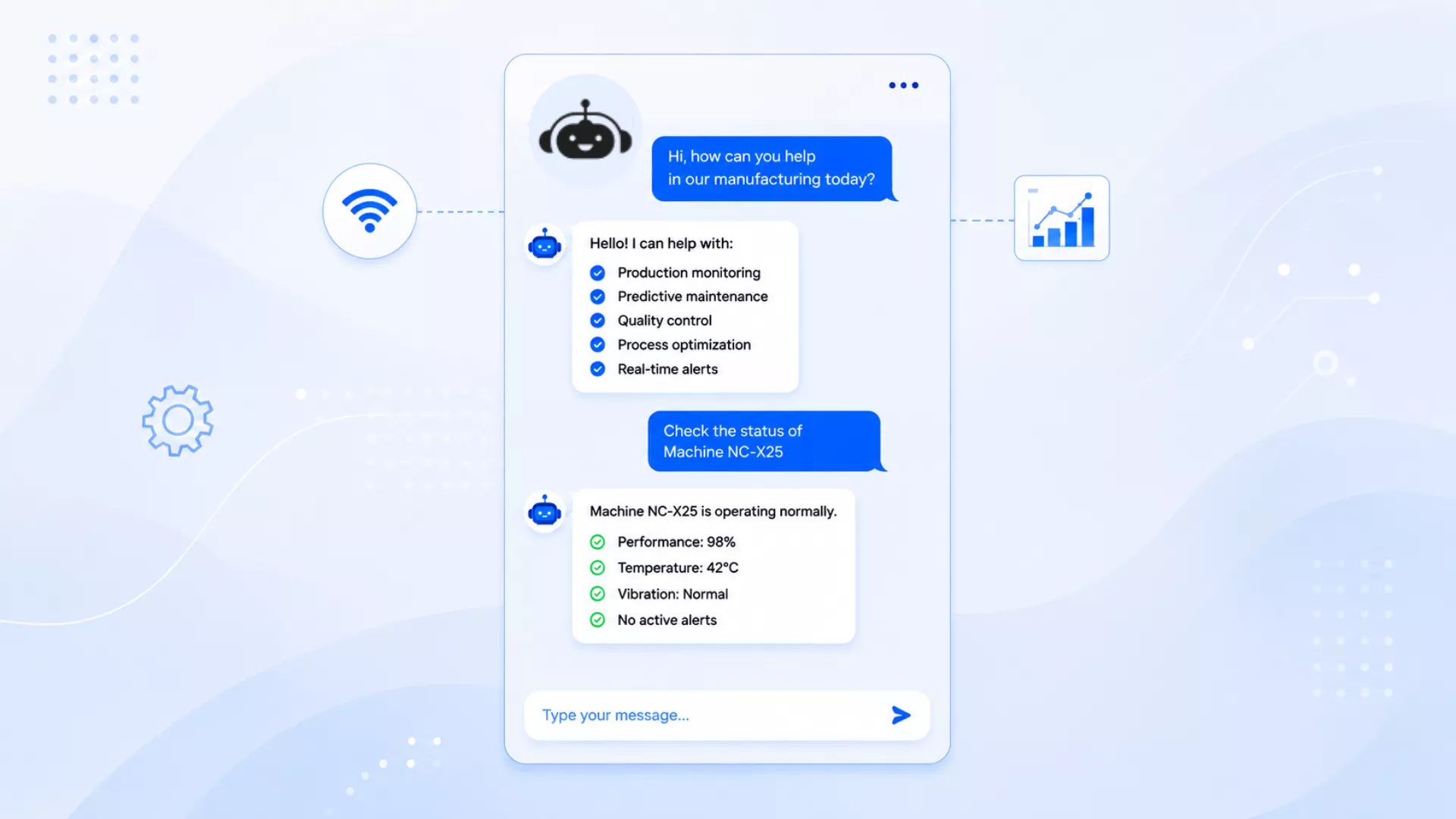
An AI chatbot in manufacturing environments allows technicians to retrieve recalibration procedures instantly without leaving their stations. AI agents can synthesize answers from dense PDFs, OEM manuals, past Q&As and historical operational documents. When a machine alerts to a fault, the operator can ask the AI for step-by-step diagnostic guidance, effectively collapsing the time between incident detection and human intervention.
Supply Chain and Vendor Coordination
AI agents assist with vendor FAQs, logistics communication, procurement documentation and operational inquiries. By automating high-volume administrative workflows, an enterprise AI chatbot for industrial automation allows floor managers to orchestrate operations smoothly rather than drowning in manual coordination.
Workforce Support Without Additional Dashboards
Teams can access critical information through familiar platforms like Slack, WhatsApp, internal websites, or portals. There is no need for complex new interfaces; the AI meets the worker where they are, bypassing "dashboard fatigue" entirely.
Continuous Improvement Workflows
Unanswered operational questions can be reviewed inside system activity logs. Teams can subsequently improve responses through an iterative Q&A workflow, ensuring the AI continuously learns from the frontline, supporting AI-driven quality control, strengthening intelligent factory systems and adapting to the factory's unique operational nuances.
These use cases translate directly into hard returns. For example, the World Economic Forum recognized a Global Lighthouse Network facility that achieved a massive 30% to 40% reduction in Mean Time to Repair (MTTR) within five weeks of deploying a generative AI assistant linked to their SOPs.
The Role and Workforce Benefits of AI Chatbots in Human-Centric Manufacturing
Industry 5.0 prioritizes human-machine collaboration and industrial AI chatbot platforms are the practical expression of that principle. They function as an operational intelligence layer between the frontline worker and the factory's entire knowledge base, SOPs, maintenance histories and operational documents accessible through natural conversation.
- What automation does: Optimizes machines.
- What operational AI does: Optimizes the humans running it.
When a technician encounters an anomalous vibration at 2:00 AM, they do not dig through a 500-page manual or wait for a supervisor. They query the AI and receive immediate, contextualized guidance.
This directly addresses a critical operational reality: 23% of all unplanned downtime in manufacturing stems from human error, workers operating without adequate, immediate guidance. AI intercepts that gap at the point of need. Augmentation, not replacement. Performance, not disruption.
Benefits of AI Chatbots for Manufacturing Workforce
- Reduced Search Fatigue: A core example of how AI chatbots improve factory efficiency is search fatigue elimination, where workers stop losing hours to manual document hunting. Instant conversational access replaces dashboard navigation and SOP digging, directly recovering productive labor hours at scale.
- Faster Technician Resolution: Technicians can resolve equipment issues without supervisory escalation. Step-by-step guidance delivered in natural language reduces MTTR and prevents minor issues from becoming costly stoppages.
- Accelerated Onboarding: New hires access institutional knowledge from day one. AI bridges the gap left by retiring workers, significantly reducing the standard 6–9 month competency ramp-up required for highly skilled roles.
- Tribal Knowledge Preservation: Up to 70% of critical operational knowledge is undocumented tribal knowledge, costing the average industrial organization $47 million per year when lost. AI chatbots capture this undocumented expertise and make it queryable. Junior workers gain instant access to senior-level operational knowledge, protecting business continuity when experienced staff retire.
- Cross-Department Operational Accessibility: The same AI agent serves maintenance, supply chain, HR and floor operations. Instead of separate, siloed tools per department, the facility benefits from consistent, centralized knowledge across the entire operation.
- Global Workforce Accessibility: A multilingual AI chatbot helps manufacturing teams across regions retrieve SOPs, troubleshooting guidance and operational support in their preferred language, reducing communication gaps and improving consistency across distributed factory operations.
Unlock Workforce AI Features
Explore the operational AI features that reduce search fatigue, accelerate onboarding and preserve manufacturing knowledge at scale.
AI Chatbots Beyond the Factory Floor: Supplier and Customer Operations
The value of operational AI in manufacturing extends far beyond maintenance teams and production lines. Modern factories depend on constant coordination between suppliers, distributors, logistics providers, procurement teams and industrial customers. When communication slows down, operational delays quickly ripple across the entire manufacturing ecosystem, creating growing demand for manufacturing AI automation tools for enterprises.
A manufacturing customer support chatbot helps industrial businesses streamline these high-volume operational interactions without relying on fragmented emails, spreadsheets or overloaded support teams.
Key operational use cases include:
- Vendor and procurement coordination for spare parts, documentation and operational inquiries
- Shipment tracking and logistics visibility across warehouses and distribution networks
- Distributor and dealer support for inventory, warranty and technical requests
- Manufacturing service request handling for vendors, field technicians and operational teams
- Conversational access to SOPs, compliance instructions and troubleshooting guidance
These workflows reduce communication friction while improving response speed across the supply chain and operational environments.
Automate Manufacturing Support
Discover how manufacturers streamline technical documentation, distributor support and operational knowledge retrieval using conversational AI.
In many facilities, smart factory customer support automation tools now function as centralized communication layers connecting production teams with external operational stakeholders. Instead of forcing teams to navigate disconnected systems, AI agents deliver contextual information instantly through conversational workflows.
As manufacturing moves deeper into Industry 5.0, AI chatbots for smart factories are becoming part of the factory’s broader coordination infrastructure, helping manufacturers improve resilience, accelerate communication and support complex industrial ecosystems beyond the production floor.
What Manufacturing Businesses Should Look for in an AI Chatbot Platform
To successfully transition to an augmented factory, operational leaders must evaluate AI chatbot platforms based on key capabilities that align with industrial environments:
Knowledge Ingestion Capabilities
The platform must seamlessly ingest and process complex industrial formats, including unstructured PDFs, text documents, historical Q&A logs, intranet website content and dense operational manuals. The LLM must be capable of structuring this raw data into accurate, queryable knowledge.
No-Code Deployment
Operations teams should not require developers or expensive IT retainers for deployment. A no-code platform empowers floor supervisors and continuous improvement managers to securely build, iterate and deploy AI chatbots rapidly. This localized agility ensures the tool evolves at the pace of the factory floor.
Omnichannel Access
Deskless workers require mobility. The platform should offer robust support through existing communication channels like Slack and other internal portals, ensuring information is accessible precisely where the work happens. This makes AI chatbot integrations across existing channels a non-negotiable capability.
Continuous Improvement Systems
The AI chatbots for smart factories must learn over time. Look for platforms that offer activity monitoring, tracking for unanswered questions and iterative Q&A updates. This feedback loop is essential for refining the AI's accuracy and relevance.
Security and Access Controls
Manufacturing data is highly sensitive. The platform must offer strict security protocols, robust access controls and clear delineations between private enterprise data and public information, ensuring that proprietary engineering schematics and operational data remain fiercely protected.
How to Deploy an AI Chatbot in a Smart Factory Environment
Most manufacturing leaders understand the value of operational AI. The real question is how quickly and practically it can be deployed without disrupting existing workflows or requiring extensive IT resources.
The answer lies in structured, no-code deployment.
Step 1: Knowledge Audit
Begin by identifying existing operational knowledge sources: SOPs, PDFs, maintenance manuals, vendor documents and Q&A repositories. Determine what is formally documented versus what exists only as tribal knowledge.
Step 2: Define Deployment Scope
Choose which workflow to target first. Maintenance, onboarding and supply chain coordination are typically the highest-friction starting points. Start narrow, demonstrate value and scale from there.
Step 3: Platform Setup and Knowledge Ingestion
Upload documents, configure Q&A and connect knowledge sources directly inside the platform Dashboard. No engineering team is required. Modern no-code platforms complete this phase in an average of 3.2 weeks compared to 14.8 weeks for traditional custom IT builds, according to Forrester.
Step 4: Pilot and Validate
Deploy with a single team or department. Monitor unanswered questions through Activity logs and identify knowledge gaps before scaling further.
Step 5: Iterate and Scale
Use Improvement workflows to refine responses, upload updated documentation and expand access across departments as confidence builds.
Turn Factory Knowledge Into AI
Transform operational documents and tribal knowledge into conversational workflows accessible across manufacturing teams.
According to the World Economic Forum, 75% of advanced manufacturing facilities now deploy new AI use cases in under six months.
Why Choose GetMyAI for Industry 5.0 Workflows
Industry 5.0 demands operational intelligence that works for the humans running the factory. GetMyAI is built precisely for that gap.
- Conversational Knowledge Access: GetMyAI ingests PDFs, SOPs, manuals, Q&A, website content and operational documents and turns them into a conversational AI agent your workforce can query instantly, no dashboard navigation, no manual searching.
- No-Code Deployment: Operations managers and floor supervisors build and deploy AI agents directly from the GetMyAI Dashboard. No engineering team. No IT backlog. No lengthy implementation cycle.
- Omnichannel Workforce Access: Deploy the same AI agent across Slack, WhatsApp, internal portals and websites, meeting workers inside the channels they already use, without introducing new interfaces.
- Activity and Improvement Workflows: Every unanswered question is automatically surfaced inside the Improvement workflow. Teams review gaps, add Q&A, upload updated documents and continuously strengthen the knowledge system as operations evolve.
- Flexible Knowledge Sources: GetMyAI supports PDFs, documents, Q&A, website content and operational repositories, consolidating fragmented industrial knowledge into one accessible conversational layer.
The result is a factory where:
- Technicians resolve issues without escalation
- New hires reach competency faster
- Tribal knowledge is preserved, not lost
- Every department works from the same operational intelligence
FAQs
Can AI chatbots automate factory operations?
Yes. AI chatbots automate operational workflows like maintenance guidance, supplier coordination, onboarding support, document retrieval and internal communication, reducing manual friction and improving response speed across smart factory environments.
What are the benefits of AI in smart factories?
AI in smart factories improves operational efficiency, reduces downtime, accelerates troubleshooting, preserves tribal knowledge and helps frontline workers access critical information instantly through conversational operational intelligence.
What is the future of smart factories with AI?
The future of smart factories with AI centers on Industry 5.0, where conversational AI, operational intelligence and human-centric automation improve collaboration between workers, machines and enterprise systems.
How conversational AI enhances factory productivity?
Conversational AI enhances factory productivity by reducing search fatigue, accelerating maintenance resolution, improving workforce accessibility and enabling workers to retrieve operational knowledge instantly through natural language interactions.
How do AI chatbots support manufacturing workforce onboarding?
AI chatbots help manufacturers accelerate onboarding by giving new hires instant access to SOPs, operational guidance, troubleshooting workflows and institutional knowledge without constant dependence on senior technicians.