How AI is Changing the Way Sales Teams Prospect and Follow Up in 2026

Key Takeaways
- AI agents are most useful when they handle connected work, from finding prospects through follow-ups and qualification.
- Prioritize accounts based on what their signals mean, not just because someone visited your website or engaged.
- Let AI handle repetitive work, but keep people involved in important accounts, tricky conversations and building relationships.
- AI can save time on outbound, but personalization only works when you give prospects a real reason to care.
- Start with one sales problem, then track whether AI improves conversations, opportunities, pipeline movement and conversion rates.
We’ve noticed that a surprising amount of a sales rep’s day is still spent preparing to sell rather than actually selling. Building lists, researching accounts, finding the right contacts, writing outreach and chasing follow-ups can consume hours before a meaningful buyer conversation begins.
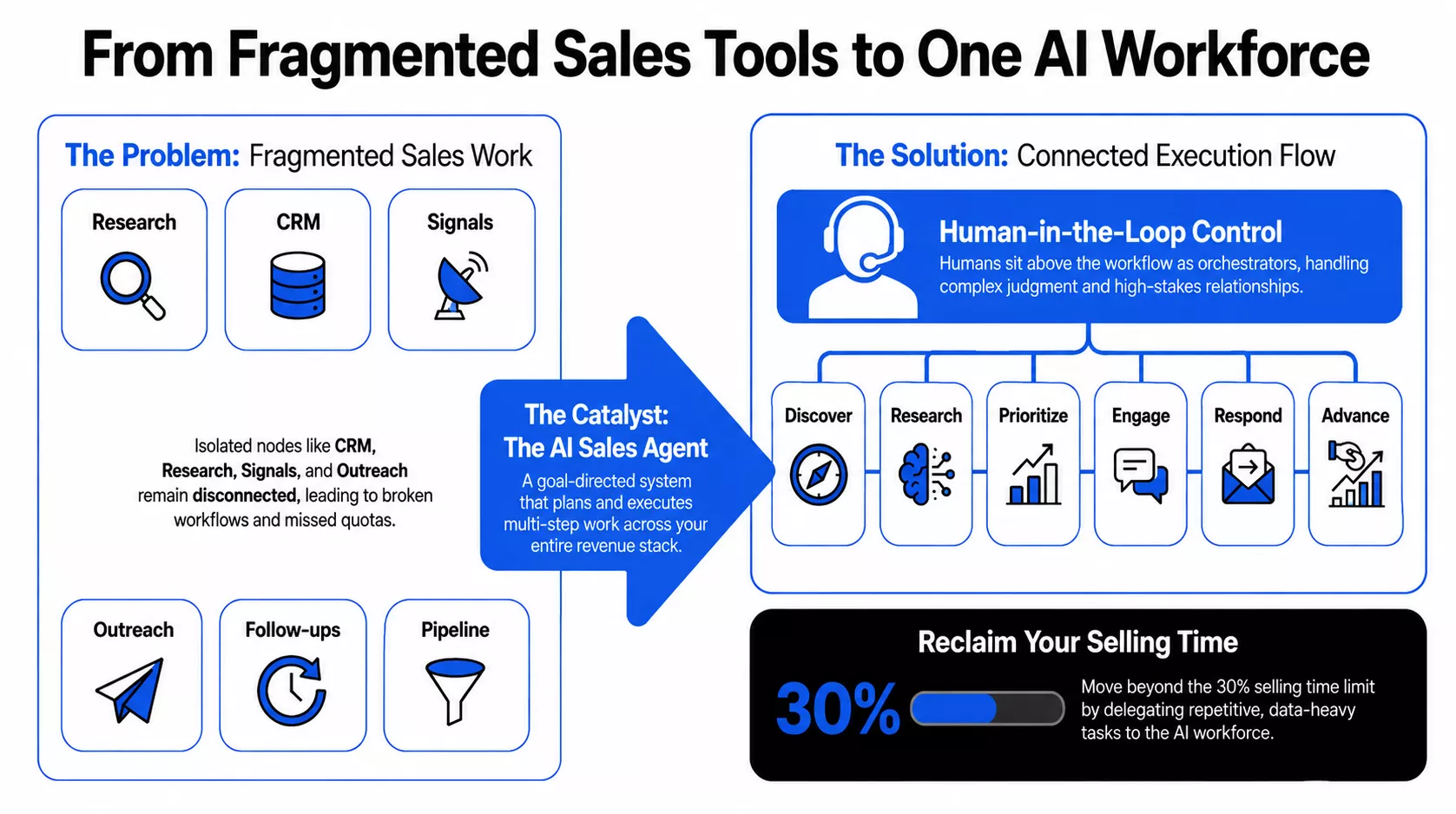
Many SDRs now use generative AI tools such as ChatGPT to write and personalize sales emails, but the surrounding work still remains. The rep still has to research the account, gather the context, decide what matters, draft the prompt, review the output and move to the next task. AI sales agents can handle more of that connected workflow, bringing prospect discovery, research, outreach and follow-ups into the same process.
AI agents for outbound sales help B2B teams automate repetitive work across prospect discovery, account research, lead qualification, personalized outreach, follow-ups and early sales conversations. An outbound sales AI agent can support multiple connected tasks rather than simply generate cold emails. In 2026, the value of AI in outbound sales automation comes from reducing manual preparation and helping teams act with greater relevance, consistency, and speed across the prospecting process, while preserving human involvement where commercial judgment is crucial.
What Can AI Sales Agents Do for Outbound?
An AI outbound sales agent can take on parts of the outbound process that usually consume repetitive human effort. It can find prospects, research accounts, prioritize leads, generate personalized outreach, manage follow-ups, handle some early conversations and hand qualified opportunities to your sales team. In 2026, an AI sales agent is better understood as a workflow that carries work forward rather than a tool that performs one isolated task.
- Find: Identify relevant prospects and target accounts
- Understand: Research company and prospect context
- Prioritize: Rank prospects by fit and relevance
- Engage: Generate and send personalized outreach
- Follow Up: Continue outreach based on engagement
- Qualify: Assess responses and sales readiness
- Hand Off: Route qualified opportunities to sales teams
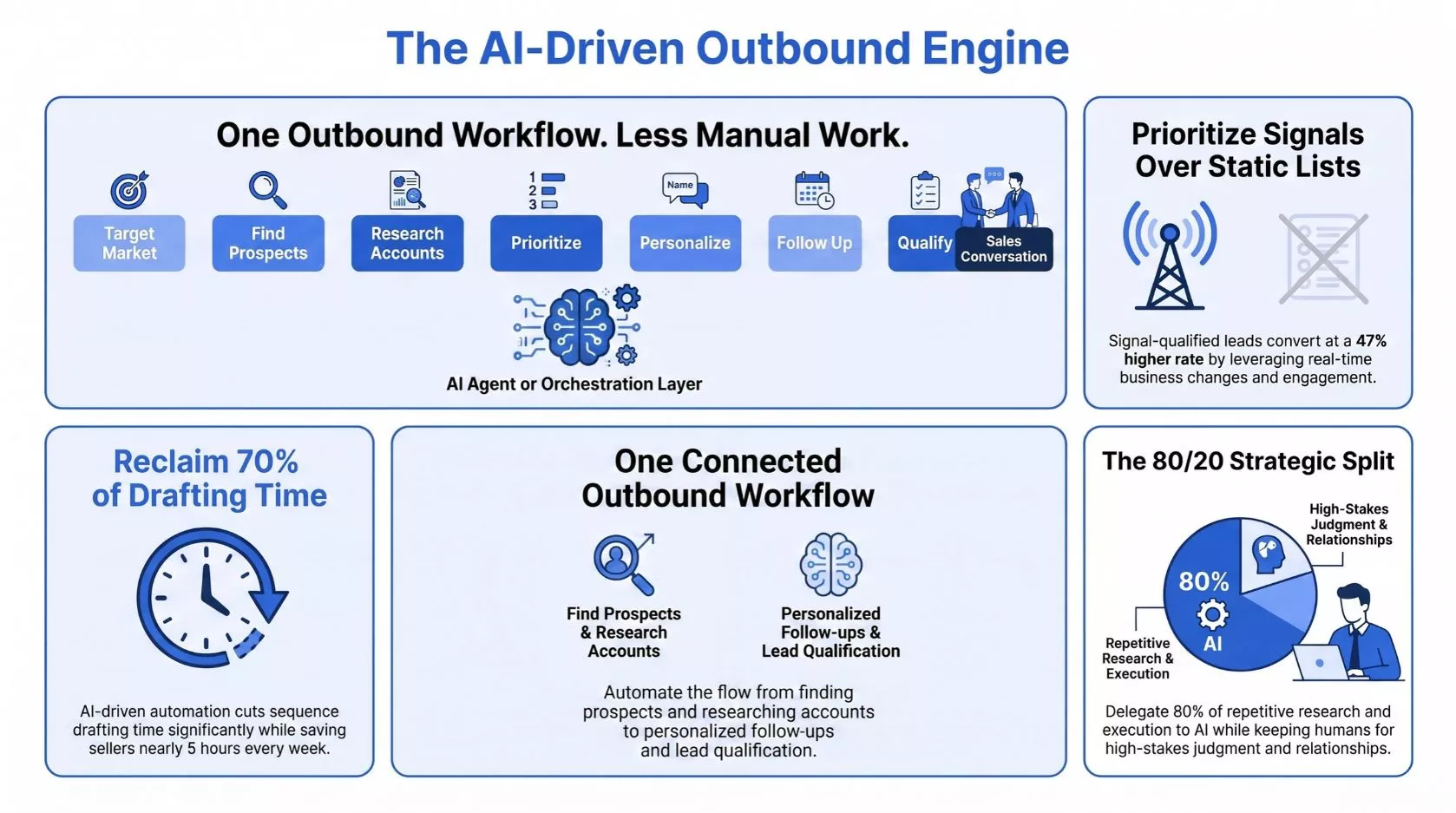
AI can move information from one stage to the next, but the level of autonomy varies. Your campaign rules, data quality, confidence thresholds and approval requirements determine which actions run automatically and which remain with your team. AI-generated outreach can reduce sequence drafting time by up to 70%, yet email writing is only one part of the work that an AI SDR tool can support.
The value of AI agents for outbound sales grows when the tasks are connected. A separate tool may write the email, but a connected agent can carry the prospect from discovery through research, outreach and follow-up.
See How AI Sales Agents Work
Want to understand how AI sales agents work across the full sales cycle? Read our complete guide to AI sales agents.
The 2021–2026 Gap in Outbound Sales
Between 2021 and 2026, outbound sales moved away from static lists and high activity volume toward more dynamic prospecting, contextual outreach and AI-assisted execution. The change is operational as much as technological. Sales teams can now delegate more of the preparation that once had to be completed manually before a rep could engage a prospect.
| Traditional Outbound in 2021 | AI-Assisted Outbound Sales in 2026 |
| Sales teams relied on static prospect lists | Sales teams prioritize accounts based on changing signals |
| Reps researched accounts manually before outreach | AI helps compile account intelligence before outreach |
| Sales teams sent broad, largely prewritten sequences | AI helps create outreach using more account-specific context |
| Reps completed most repetitive prospecting tasks themselves | AI agents handle more repetitive prospecting and outreach work |
| Teams focused heavily on increasing outreach volume | Teams place greater emphasis on qualified conversations and pipeline outcomes |
Curating and verifying a 500-account target list can fall from 8 to 12 hours to around 90 minutes with AI assistance. Manual account research that once took 20 to 30 minutes per account can also be reduced to reviewing an AI-generated context brief in roughly five minutes. By 2027, Gartner predicts that 95% of seller research workflows will begin with AI, up from less than 20% in 2024.
5 Ways AI Is Transforming the Sales Workflow
AI is changing outbound sales by taking on more of the repetitive work that happens before and during early prospect engagement. In McKinsey’s 2026 B2B Pulse Survey, 59% of growth leaders who embedded AI into core workflows identified seller efficiency as a primary benefit. The most useful applications follow the sales workflow itself, from finding the right accounts to handling routine replies.
1. Prospect Discovery and List Building
An AI for sales prospecting can identify companies and contacts based on predefined targeting criteria, reducing the manual work involved in AI prospecting and outbound list building. We still see sales reps jumping between databases, LinkedIn, company websites and spreadsheets to build prospect lists. That process is necessary, but matching companies against defined criteria does not always require human judgment.
An AI prospecting tool for agencies can help narrow the search using:
- Firmographic targeting
- Industry and company size
- Geographic location
- Relevant decision-maker roles
Your team can then spend more time reviewing the accounts worth pursuing by adopting AI for sales prospect automation.
2. Account Research and Sales Intelligence
Once a prospect is identified, an AI agent for outbound sales can compile scattered information into a usable account brief. For AI outreach with account intelligence, the point is not to collect more information. The point is to give the sales team a clearer picture of the account before outreach begins.
An account brief can bring together:
- Company context and business information
- Relevant decision-maker context
- Account fit and potential sales angles
- Prior engagement where available
This gives reps a starting point without asking them to assemble every detail manually.
3. Lead Qualification and Prioritization
AI agents can evaluate prospects against qualification criteria defined by the sales team, then score or prioritize accounts based on the available information. This can help sales teams decide where to spend attention, with signal-qualified leads converting at a 47% higher rate than static target accounts.
Qualification is not the same as predicting the future. An AI SDR tool cannot know with certainty who will buy. It can, however, apply the same qualification criteria across a prospect list and highlight differences in account fit, available information and sales priority. That makes prospect prioritization more consistent, especially when teams are working through large account lists.
4. Personalized Outreach and Follow-Ups
AI outbound for sales automation can generate outreach from available prospect and account context, then manage repeated follow-up activity across a campaign. That matters when the same sales team is responsible for researching prospects, writing messages and remembering who needs the next touch.
Adding someone's job title or recent LinkedIn post to a template is not necessarily personalization. Useful personalization connects a prospect's business context with a relevant reason to start a conversation. AI outreach personalisation becomes more useful when the context behind the message changes what the message actually says.
5. Early Sales Conversation Handling
An AI agent with autopilot email replies can continue working after the prospect responds. This is where an agent differs from a writing tool. The agent can use the conversation itself as input, assess the reply and decide whether the next response can be handled automatically.
A typical reply-handling flow can include:
- Read the incoming email
- Review the conversation context
- Interpret the prospect's reply
- Respond when confidence is high
- Escalate uncertain replies
An outbound sales AI agent can also support qualification by moving suitable conversations toward the next sales stage, particularly when more than 52% of sales professionals abandon prospects after one outreach attempt.
The most practical AI sales agents do not replace the entire sales process. They take ownership of repeatable parts of the workflow so salespeople can enter at higher-value moments.
Still Doing Outbound Tasks Manually?
You have seen where AI can take work off your team's plate. Now see what Sales AI can handle for you.
What AI Signals Can Reveal Credible B2B Buyer Intent?
An AI agent with buying signal monitoring can surface behavioral, organizational and contextual changes that may increase buying relevance. One signal rarely proves an account is ready to buy, so the surrounding business context still matters.
Signals That Show Business Change
Business changes can indicate that an account is entering a different phase. These changes become relevant when your sales team can connect them to a potential commercial need.
- Expansion into new markets or regions
- Rapid hiring across specific business functions
- New initiatives announced by the company
- Changes to the existing technology stack
- Leadership movement within relevant departments
Signals That Show Active Engagement
AI sales intent signals show that an account or buyer is interacting with information related to your business. It can provide a useful prioritization signal, with immediate post-trigger engagement associated with a 5× higher win likelihood, but engagement alone does not establish buyer intent.
- Increased activity across your website pages
- Repeated engagement with relevant content
- Product research across relevant solution categories
- Visits to high-intent product information
- Previous conversations showing renewed engagement
Signals That Become Stronger in Combination
Individual buying signals become more meaningful when several changes appear together. This signal stacking concept reflects a broader shift toward combining concurrent signals before initiating stronger outreach.
- Leadership change within a target department
- Hiring activity linked to the same function
- Website engagement from relevant account contacts
- Product research around related business problems
- Prior conversations combined with new account changes
AI can detect change. It cannot automatically prove relevance. A leadership hire, hiring spike or funding event may matter, but the sales team still needs to interpret what that change means. The job is increasingly about connecting available signals to a problem the business can actually solve.
Timing can create an advantage when high-priority triggers appear, particularly when competitors have not yet acted. The value of AI sales signal detection, however, comes from identifying the right accounts and interpreting why the signals matter before outreach begins.
How to Improve Your Outbound Sales Strategy with AI
The best way to automate outbound sales with AI is to start with the work already consuming sales capacity, not with the AI tool itself. AI outbound sales automation works best when it solves a specific bottleneck and produces a measurable improvement. Gartner found that AI saves sellers an average of 4.8 hours per week, although the commercial value depends on how teams use that recovered time.
1. Identify where reps are losing time
Look at the outbound workflow and identify where manual work is building up:
- List building and prospect research
- Data enrichment and account research
- Writing and personalizing outreach
- Follow-ups and reply handling
2. Decide what should be automated
Start with tasks that are repetitive, rules-based, data-intensive or time-consuming. Not every part of sales should be automated simply because AI can perform it.
3. Define where human review is required
Keep people involved when the situation calls for judgment:
- High-value accounts and strategic opportunities
- Sensitive or complex messaging
- Buyer questions requiring deeper context
4. Start with one workflow
Start with one sales bottleneck, choose the AI capability that can address it and define how you will measure the result. Starting smaller makes it easier to see whether the automation is actually improving the workflow.
5. Measure outcomes, not activity
Track qualified conversations, qualified opportunities, pipeline progression and conversion quality. We've seen the temptation to use AI to increase activity. More automated activity can just create more automated noise.
Research benchmarks project that AI-driven sales enablement could support up to 40% faster sales-stage velocity than traditional enablement methods. The result still depends on how the AI is applied.
What AI Still Shouldn't Do in Outbound Sales
AI agents can automate significant parts of outbound sales, but they should not be treated as independent substitutes for commercial judgment. AI can surface signals, generate messages and handle routine replies, while AI sales automation with human oversight keeps people involved in deciding whether an account matters, interpreting complex buyer responses and developing relationships.
| Delegate to AI | Keep humans involved |
| Prospect discovery | Strategic account judgment |
| Account research | Business problem interpretation |
| Lead scoring | Complex qualification |
| Draft generation | High-value messaging |
| Routine follow-ups | Complex objections |
| Basic reply handling | Relationship development |
AI can send more messages, manage more follow-ups and handle more repetitive sales work. A practical benchmark is an 80/20 split, with AI handling most preparation and routine execution while humans remain involved in strategic accounts, complex objections and important commercial decisions.
How GetMyAI Sales AI Helps You Operationalize Outbound
Understanding what AI agents can do is one thing. Getting them to consistently handle the repetitive work between your sales strategy and a qualified opportunity is another.
GetMyAI built Sales AI around a simple idea: your sales team should not have to manually do every task between defining a target market and starting a qualified conversation. You define who you want to reach and what you want to achieve. Sales AI can take on repetitive work across prospecting, research, outreach and qualification.
You define the target. Sales AI handles the groundwork.
You set the target audience, location, campaign objective and prospect volume. Sales AI finds matching companies, discovers relevant contacts, builds account intelligence and supports evaluation through sales AI with explainable lead scoring.
You provide the direction. Sales AI helps run the outreach.
As an AI SDR platform for B2B, Sales AI supports personalized outreach, campaign execution, follow-ups and engagement tracking. Instead of asking reps to repeat the same research and outreach work hundreds of times, you can delegate repeatable execution to an AI workforce.
You stay in control when judgment matters.
You do not have to choose between complete manual execution and blind automation. An AI agent with autopilot email replies can handle conversations based on confidence thresholds, while uncertain replies can move to approval queues for human review.
You define who matters. Sales AI handles the work of finding, understanding, engaging and qualifying them. It covers prospect discovery, research, scoring, personalized outreach, follow-ups, reply handling and qualification support.
GetMyAI Sales AI gives your team an AI workforce for repetitive outbound work so people can focus on judgment and relationships.
Ready to Rethink Your Outbound Workflow?
Talk to our team about how Sales AI can support your outbound process without removing human judgment.
FAQs
How to qualify leads with AI agents?
Lead qualification uses defined criteria to assess fit, relevance and sales readiness. Sales teams can set those criteria, while Sales AI helps evaluate available prospect information, prioritize accounts and support more consistent qualification decisions.
How does Sales AI work?
We designed Sales AI to help your team automate repetitive outbound work. You define your target and campaign direction, while Sales AI can support prospect research, account intelligence, outreach, follow-ups and early qualification as part of AI sales workflow automation.
How does AI improve outbound sales?
We use Sales AI to help businesses reduce repetitive preparation across prospecting and outreach. Your team can spend less time researching accounts and managing follow-ups, helping improve sales rep productivity with AI while staying involved in strategic decisions and buyer conversations.
How to reduce SDR costs with AI?
AI can reduce the amount of repetitive work handled manually by SDRs, including prospect research, list building, outreach drafting and follow-ups. Teams can then automate repetitive sales tasks and focus more existing sales capacity on qualified opportunities and buyer conversations.
Is AI better than a human SDR for outbound?
AI and human SDRs are suited to different work. AI can handle repetitive research and execution at scale, while human SDRs bring commercial judgment, relationship skills and context to complex conversations. Strong outbound teams often combine both.