We’ve noticed that a surprising amount of a sales rep’s day is still spent preparing to sell rather than actually selling. Building lists, researching accounts, finding the right contacts, writing outreach and chasing follow-ups can consume hours before a mean…
Experience Boost
Create. Deploy. Engage. With GetMyAI
Launch GPT-powered conversations that engage, support, and convert — all in one platform.
AI in Outbound Sales: Use Cases in Different Industries
Shubhendra Kartikeya | Technical Content Writer
Sep 3, 2026
AI Sales Agents for Outbound Prospecting
B2B healthcare prospecting and appointment outreach
AI outbound sales for B2B companie
AI SDR for lead generation
Key Takeaways
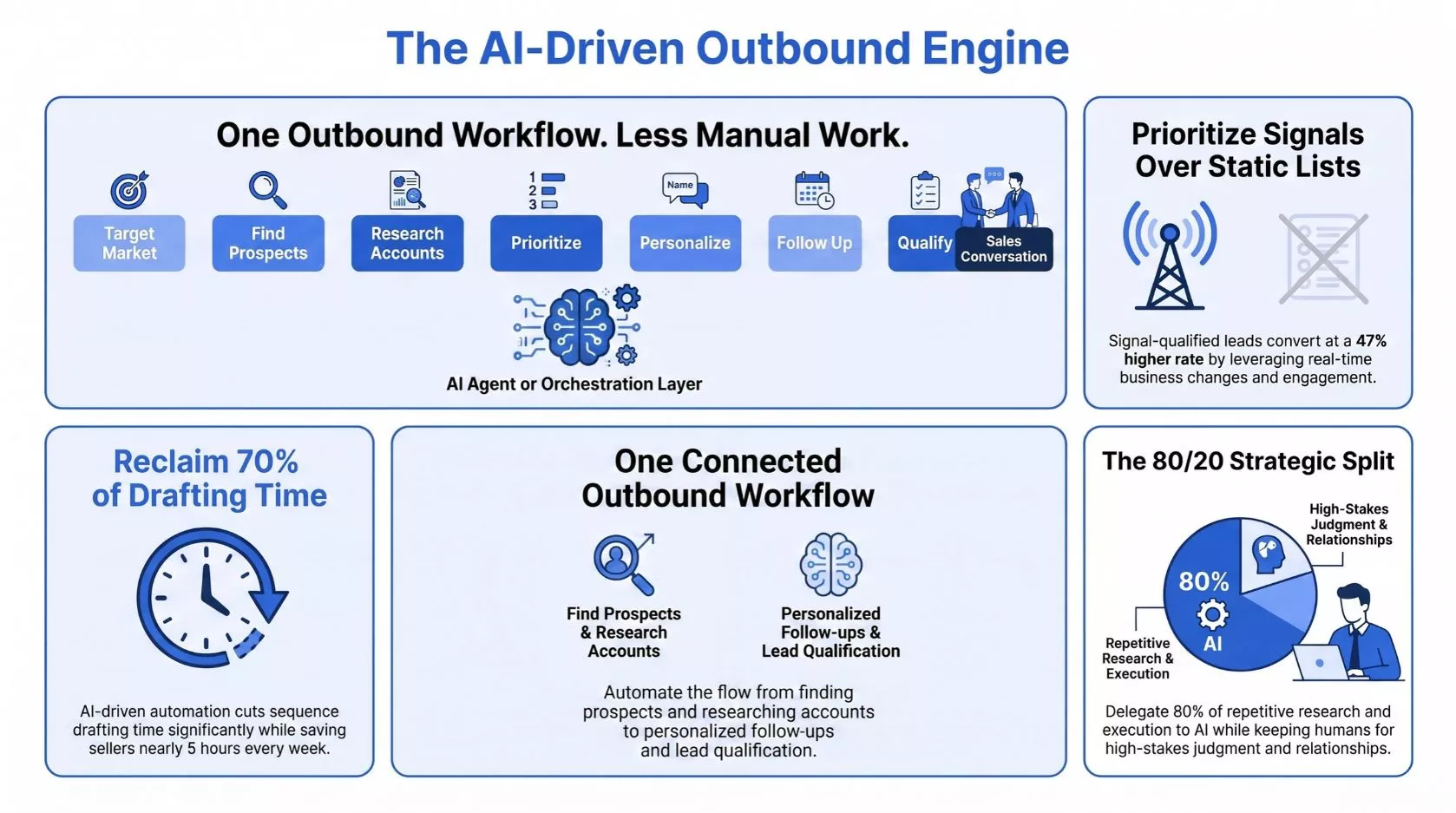
Prioritize the accounts most worth pursuing instead of filling your sequences with more prospects and more activity.
Let the level of AI autonomy match your sales complexity, while you keep control over trust, compliance and technical decisions.
Use meaningful business signals to understand why an account deserves your attention before you start the conversation.
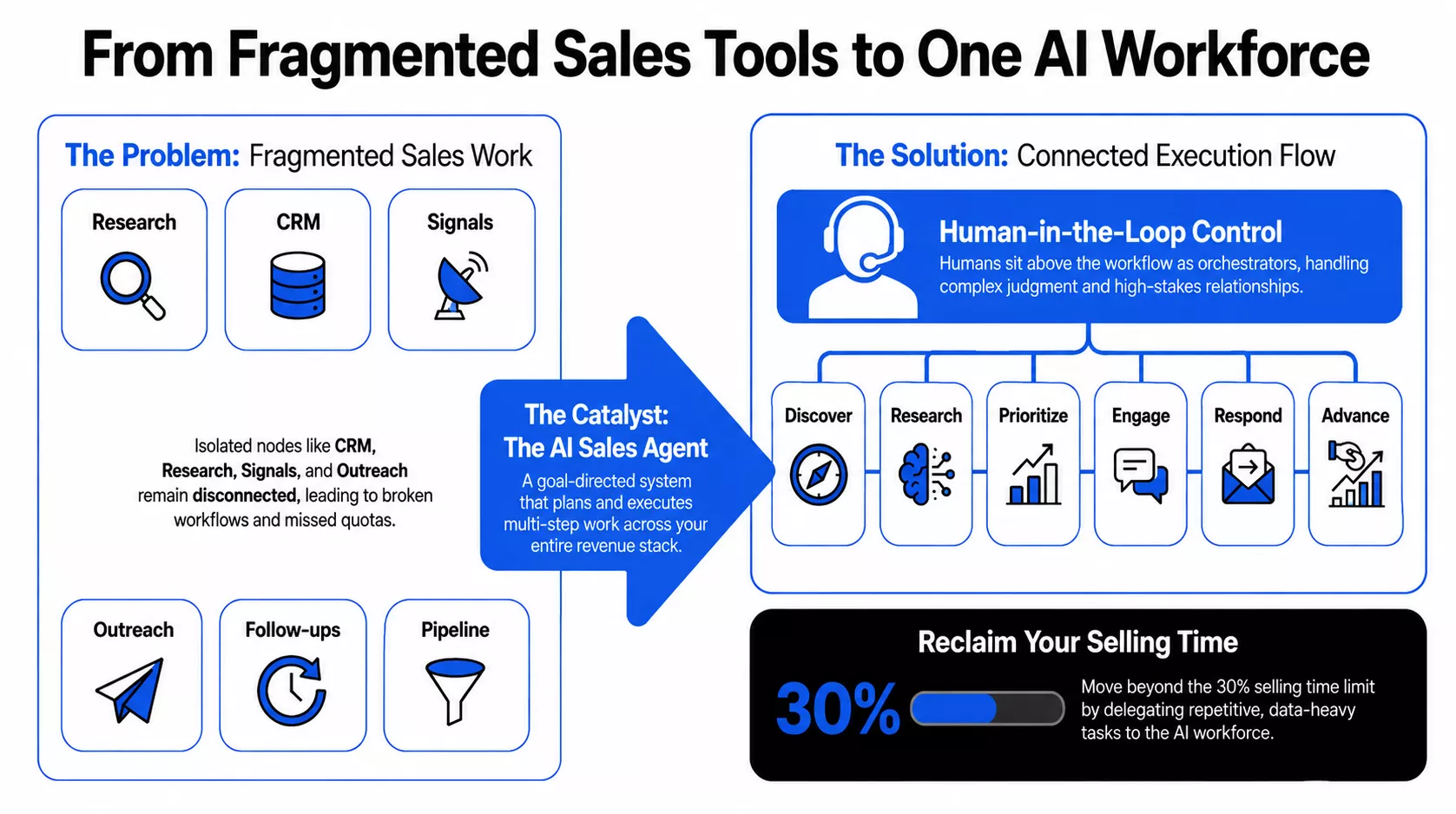
Connect prospecting, research, qualification, outreach and follow-ups so your team spends less time managing repetitive sales tasks.
Treat AI as sales capacity that strengthens seller performance, rather than as a replacement for commercial judgment.
B2B outbound sales is becoming harder to manage manually. Sales teams still spend hours finding prospects, researching accounts, identifying decision-makers and keeping up with follow-ups. Benefits of AI in Sales go beyond saving time: better prospect research, lead qualification and more relevant engagement. AI-based workflow automation can bring these tasks together instead of leaving reps to manage each one separately. The value, however, depends on the industry. SaaS can support more automation, while healthcare, consulting and manufacturing need more control, deeper research and human judgment.
How AI Helps Sales Teams Find the Right Reason to Reach Out
Before: Sales teams worked from static prospect lists. Reps picked accounts based mainly on company size, industry and other basic account characteristics. They added contacts to broad sequences and tried to create relevance through manual personalization.
After: AI with sales signal detection can help teams prioritize accounts based on meaningful changes, monitoring leadership moves, hiring patterns, technology changes, expansion activity and renewed product engagement.
A good prospect is not always a good prospect right now. Business changes can provide the missing context. By weighing those signals against account fit and available information, sales teams can decide which prospects deserve attention before starting another outreach sequence.
How AI for Outbound Sales Changes Across Industries
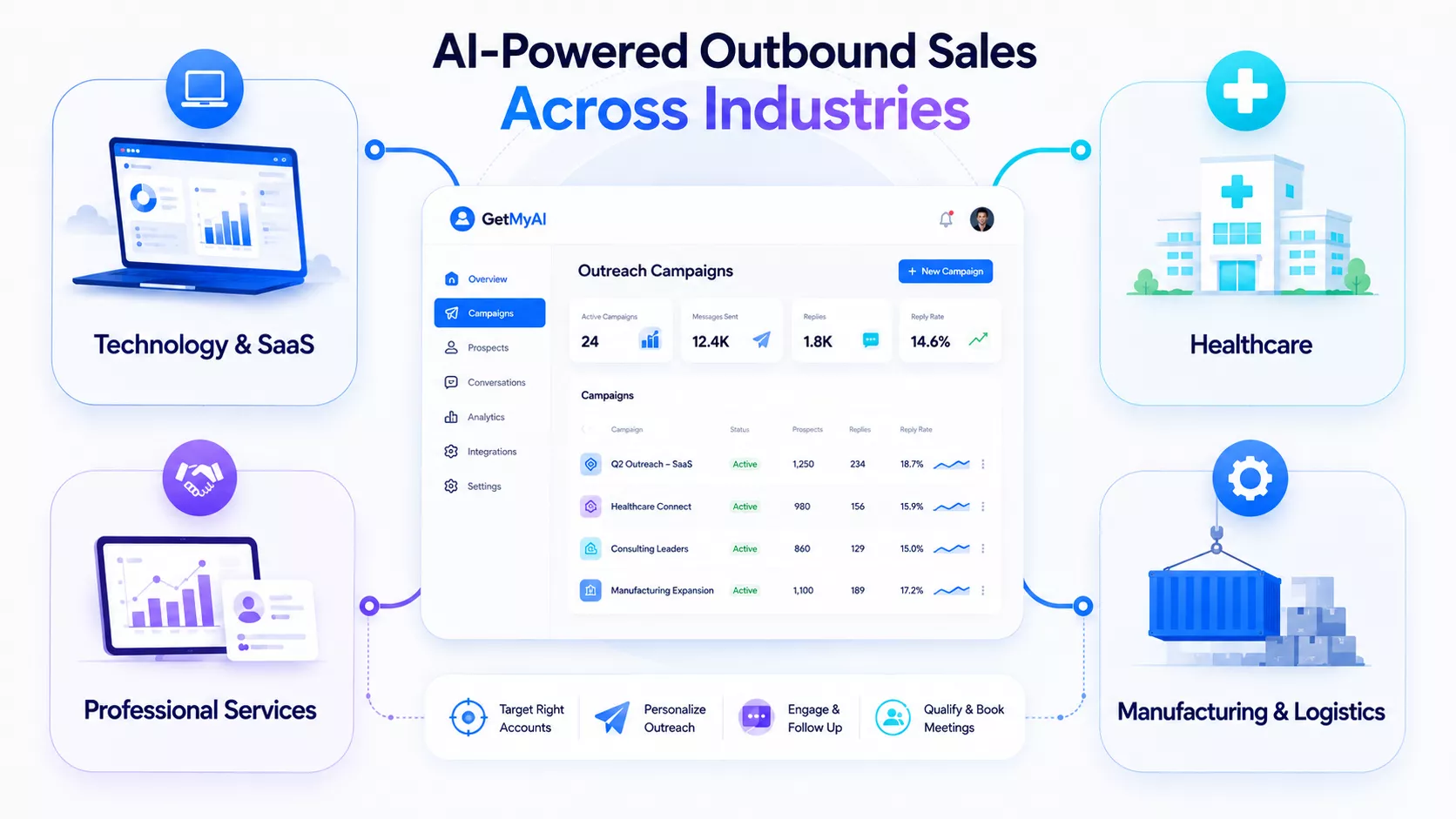
AI does not change the fundamentals of selling; it changes where sales teams can apply leverage. SaaS can use AI sales prospecting to act on product and technology signals. Healthcare benefits more from account intelligence, consulting from relationship and account preparation, and manufacturing from RFQ and supply-chain intelligence. The right application depends on the data available and the decisions sellers still need to make.
So what actually changes when AI enters the picture? The easiest way to see it is to compare the work before AI with what teams can do now.
1. Technology & SaaS: Product Signals and Automated Prospecting
With enterprise SaaS deals taking 6–12+ months and involving 5–10 stakeholders, sales teams need to know where to focus first. That is difficult when SDRs can spend up to 75% of their working hours on account research and activity logging. An AI SDR for B2B tech companies can use digital signals to surface accounts worth pursuing.
Find the accounts with the strongest reason to engage: AI for Lead Generation and Prospecting identifies ICP-fit companies from basic information about a company, behavioral and technology signals, reducing manual list building.
Catch expansion opportunities from product behavior: SaaS Prospecting with an AI Sales Agent can analyze product usage and engagement patterns to surface accounts showing potential expansion opportunities before manual account reviews.
Turn technology changes into sales opportunities: AI Sales Agents for Outbound Prospecting can monitor technology-stack changes and identify companies adopting, replacing or expanding software relevant to the seller’s offer.
Reduce the research burden before outreach: AI for Outbound Sales in B2B Companies can combine hiring, funding, technology and company data to build account context and prioritize prospects.
Achieve 5%–25% reply rates with signal-based outreach: AI for Sales Follow-Ups can use account research and conversation history to personalize follow-ups and keep engagement relevant.
2. Healthcare: Account Intelligence and Complex Stakeholder Mapping
Healthcare B2B sales can take 125–240 days and involve 9–13 stakeholders, spanning clinical leadership, IT, procurement and compliance. AI therefore has greater value in account research and buying-group intelligence than high-volume outreach.
Shorten the research burden across a 14–15 month sales cycle: AI can analyze hospital news, funding, clinical initiatives and organizational changes to build account intelligence before sellers invest time in long-cycle opportunities.
Surface hospital priorities from public signals: AI-powered market intelligence can analyze hospital expansions, clinical initiatives, funding awards and public health developments to identify organizations with relevant operational needs.
Build account briefs in minutes: Healthcare sales prospecting can use AI to combine organizational information, executive changes and current initiatives into a structured account view, replacing weeks of manual account mapping.
Keep patient data outside sales workflows: AI deployment requires strict separation of Protected Health Information because connecting unvetted sales systems to patient-adjacent CRM data can create serious HIPAA exposure.
Prepare outreach while keeping people in control: AI can synthesize approved information into relevant messaging, while human sellers retain responsibility for clinical claims, compliance-sensitive communication and relationship building.
3. Professional Services and Consulting: Relationship Intelligence and Account Preparation
A consulting sale usually depends on a small group of senior people. Partners, Managing Directors and practice leads often own those relationships, and sales cycles average 51–103 days. AI for Outbound Sales in Consulting Firms can take care of the research behind those conversations.
Save up to 80% of account preparation time: AI can synthesize public filings, earnings calls and executive changes into account briefs and customized points of view, reducing the research preparation required from consulting teams.
Find warm introduction paths before starting outreach: Relationship intelligence can analyze professional networks, alumni connections and board affiliations to identify people who can connect a Partner with decision-makers inside target accounts.
Identify strategic initiatives worth pursuing: AI for Outbound Sales in Consulting Firms can scan company news, earnings calls and leadership changes to surface transformation programs, acquisitions and new priorities that may create consulting demand.
Prepare executive-level points of view faster: AI can combine account information with industry research and previous firm knowledge to create a focused POV draft, giving Partners a stronger starting point for high-value conversations.
Protect relationships through human-led outreach: AI can prepare personalized messaging and follow-up context while partners retain control over communication, an important safeguard in a sector where brand reputation and executive trust influence buying decisions.
4. Manufacturing & Logistics: RFQ Intelligence and Supply Chain Signals
Proposal work alone can account for 35–40% of the sales cycle in manufacturing and logistics. Add technical specifications and several stakeholders, and a typical deal can stretch to 60–130 days, leaving clear room for AI-assisted research and quoting.
Spot demand before competitors: AI can monitor factory expansions, shipping activity, import/export data and supply-chain disruptions to identify companies likely to need new suppliers or logistics support.
Cut RFQ processing across a 35–40% proposal workload: AI can extract requirements from unstructured Requests for Quote and match buyer specifications against approved product catalogs to accelerate technical responses.
Match specifications without manual catalog searches: AI can compare engineering requirements against product SKUs, pricing and inventory data, giving sales and engineering teams a faster starting point for accurate quotes.
Find opportunities across distributor networks: AI can analyze distributor inventory and coverage to identify cross-sell and upsell opportunities where product availability or regional demand creates a clear sales opening.
Protect quote accuracy with better data: Outdated product records, fragmented inventory files and inconsistent catalogs can produce incorrect pricing or availability, making reliable internal data essential for AI-driven quoting.
How Sales AI Agent Use Cases Differ Across Industries
The key consideration is where AI can create value without disrupting the way buyers make decisions. The strongest deployments match AI autonomy to the type of sales work being performed: repetitive prospecting can be delegated more readily, while work involving trust, technical judgment or sensitive information requires greater human involvement. This makes AI sales agents less about replacing a sales process and more about deciding which parts of that process can be delegated safely and effectively.
The pattern is clear: AI works deepest in the workflow where data is abundant and the cost of automation errors is manageable. Where buying is regulated, technical or relationship-led, AI moves upstream into research and preparation rather than taking over the conversation.
Need help applying AI to your outbound workflow?
Talk to our team to see where AI can fit into your sales process while keeping the right level of human oversight.
What the Next Phase of AI in Outbound Sales Looks Like
The next outbound model will develop along four connected shifts: AI starts the research, agents multiply seller capacity, buyers bring AI into evaluation and sellers manage the resulting AI workforce.
95% of seller research will start with AI
Gartner projects that 95% of seller research workflows will begin with AI by 2027, up from less than 20% in 2024. Account discovery, company research and signal interpretation will increasingly happen before a salesperson opens the account.
The seller starts with an AI-generated view of the opportunity rather than a blank CRM record.
10 AI agents for every human seller
Gartner projects a 10:1 ratio of AI agents to human sellers by 2028. These agents can continuously monitor signals, research accounts, prioritize opportunities and execute defined outbound workflows.
The new sales model:
The seller increasingly becomes the person directing and reviewing multiple AI workflows rather than manually performing each task.
Buyers will bring AI to the other side
94% of B2B buyers use LLMs during vendor evaluation, while Gartner predicts that AI agents could intermediate 90% of B2B buying processes by 2028. That changes outbound at a fundamental level. Seller-side AI will increasingly encounter buyers who have already used AI to research vendors, compare options and narrow their choices.
The seller becomes the AI workforce manager
McKinsey's research points toward Account Executives managing portfolios of AI agents that continuously monitor market signals and support commercial workflows.
AI handles: Research, monitoring, prioritization and routine execution
Humans handle: Relationships, consensus, judgment and negotiation
The more AI enters the outbound workflow. More human value will move toward the moments where judgment actually changes the deal.
Next steps: Put AI-powered outbound sales into action with GetMyAI
You have seen where AI can strengthen outbound: finding prospects, researching accounts, prioritizing opportunities, personalizing outreach and handling repetitive follow-ups. GetMyAI brings those activities into one AI sales workforce, so you can move from scattered sales tasks to a connected outbound workflow.
1. You define the market. GetMyAI handles the groundwork.
Set your target audience, location, campaign objective and prospect volume. Sales AI can discover matching companies, find relevant contacts, build account intelligence and evaluate prospects with explainable lead scoring.
2. You set the direction. AI runs the repeatable work.
Let Sales AI handle personalized outreach, campaign execution, follow-ups and engagement tracking. Your team can delegate repetitive work such as finding, researching, contacting and qualifying prospects, giving sales reps more time for active opportunities and customer conversations.
3. You decide where AI acts independently.
GetMyAI gives you control over conversational automation through confidence settings, conversation limits and approval queues. High-confidence replies can be handled automatically while uncertain responses can reach your team for review. Campaign-level controls let you apply different levels of autonomy to different sales situations.
You define who you want to reach. GetMyAI Sales AI handles the repetitive work required to find, understand, engage and qualify those prospects. It will give your team more capacity for judgment, relationships and revenue conversations.
Ready to Put AI to Work?
Give your sales team more capacity without giving up control. GetMyAI Sales AI handles prospecting, research, outreach, follow-ups and qualification in one connected workflow.
What are the benefits of AI in sales beyond saving time?
Using AI for sales can improve lead quality, account research, prioritization and sales capacity. Our Sales AI also helps connect these tasks in one workflow, so your team can focus on qualified opportunities.
Can AI help sales teams improve messaging, prioritization and timing?
Yes. AI can use account context, buyer signals and previous conversations to make outreach more relevant. It can also help prioritize prospects and choose better moments to follow up.
How can B2B sales teams adopt AI without disrupting existing workflows?
Start with the work that takes the most manual effort, then add AI around your existing process. Our Sales AI can handle research, prospecting and follow-ups while your team keeps control of key decisions.
Can AI help SaaS sales teams prioritize accounts based on buyer signals?
Yes. Product activity, hiring patterns and technology changes can reveal which accounts are worth investigating. For teams using an AI sales agent for SaaS, these signals provide useful context for deciding where prospecting effort should go first.
How can AI help healthcare sales teams research target accounts?
AI can bring hospital priorities, leadership changes, clinical initiatives and organizational information into one account view. This helps sales teams prepare before outreach while keeping sensitive information and compliance considerations under human control.
Can AI help professional services firms find warm introduction opportunities?
With GetMyAI’s Sales AI, our team can research target accounts, understand key business context and prepare personalized outreach before a Partner starts the conversation. Your team keeps control of the relationship while Sales AI handles the repetitive research work.
Written by
Shubhendra Kartikeya | Technical Content Writer
Technical Content Writer
I've spent quite some time writing technical content in the AI SaaS industry. I provide technical and SEO content writing services across a wide variety of industries, primarily B2B AI SaaS, tech, and marketing. I focus on writing pieces people want to read while also making them visible in AI search engines. At GetMyAI, I turn the platform's AI capabilities into content people can understand and trust. Outside of writing, I spend my time reading up on industry trends and business books.
Sales teams have more AI than ever, yet the productivity problem remains. Sales AI Agents can take repetitive work off your team's plate, but adding another tool does not automatically improve execution. In 2026, 78% of B2B sellers missed quota in 2025, w…
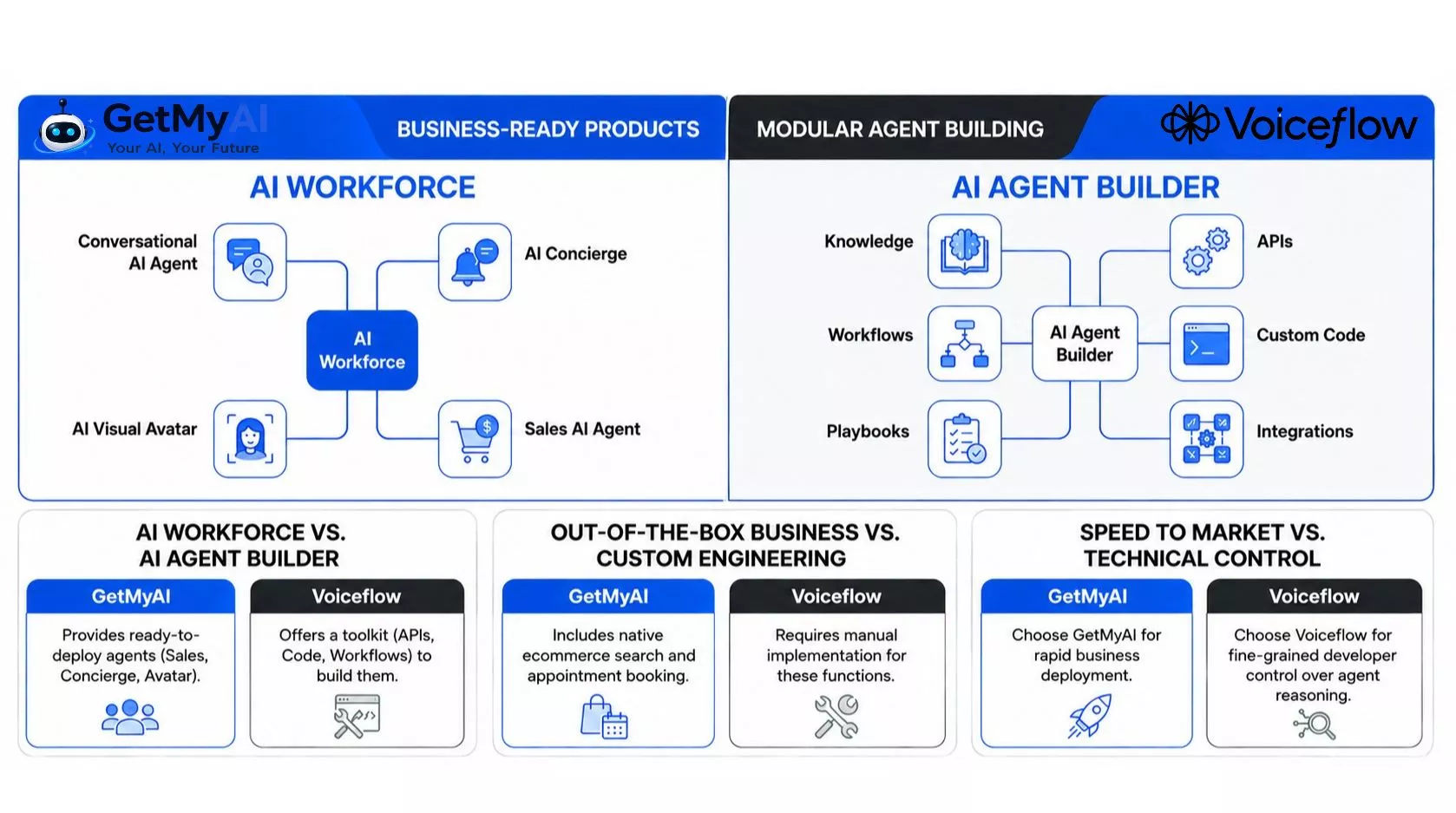
A support team, an ecommerce store and a sales team can all ask for an AI agent. They don't necessarily need the same kind of platform. GetMyAI and Voiceflow reflect that difference in how they are built. GetMyAI and Voiceflow both support AI agents, but they …