How AI Sales Agents Work Across Prospecting, Outreach and Pipeline

Key Takeaways
- Sales AI Agents create value when they execute connected sales work, not when they simply add another tool.
- Precision beats volume when buying signals and account context guide prospecting, outreach and timing.
- The strategical gain come from reclaiming seller time, expanding coverage and improving cost-to-pipeline economics.
- Delegate repetitive, data-heavy work to AI while humans retain complex judgment, negotiation and relationship responsibility.
- Evaluate platforms by autonomy, intelligence and control, then choose connected Sales AI software that supports end-to-end execution.
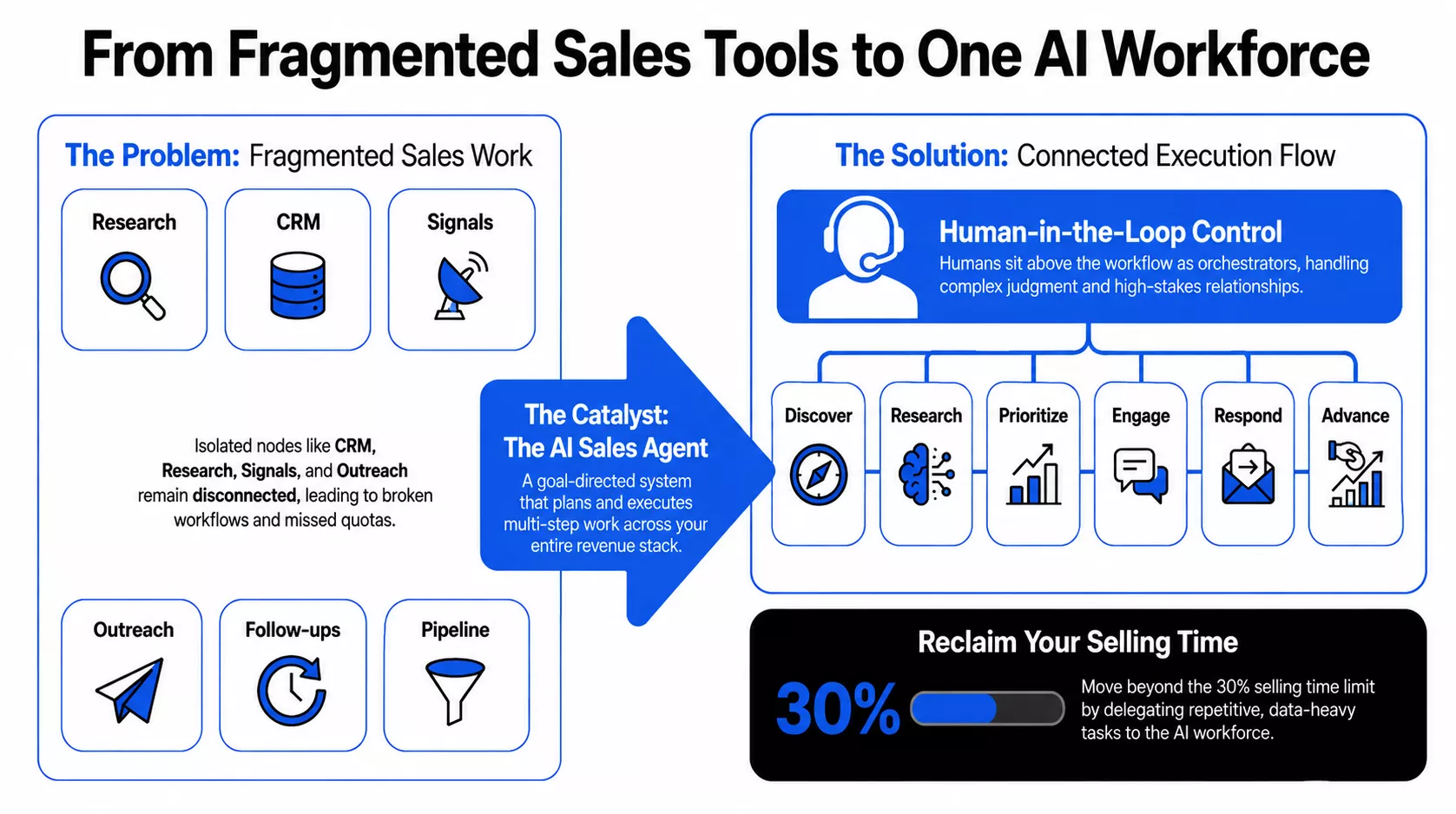
Sales teams have more AI than ever, yet the productivity problem remains. Sales AI Agents can take repetitive work off your team's plate, but adding another tool does not automatically improve execution. In 2026, 78% of B2B sellers missed quota in 2025, while reps still spend only 28% to 30% of their time actively selling. The question is no longer whether your team has access to AI. It is where and how you deploy it.
AI sales assistants can research accounts, monitor buying signals, qualify leads, manage follow-ups and support execution across your revenue workflow. But layering these capabilities onto fragmented processes can create more noise. Companies seeing commercial value are redesigning how work moves between people, data and systems.
What is a Sales AI Agent?
A Sales AI Agent is a goal-directed system that can plan and execute multi-step sales work, such as finding prospects, gathering account context, qualifying buyers, sending messages and updating connected systems. Unlike a traditional tool, it works toward a defined commercial objective within boundaries and human oversight.
| Type | What It Does | Level of Autonomy |
| Traditional automation | Executes predefined rules, such as routing a lead or updating a CRM field. | Low |
| AI assistant/chatbot | Answers questions or generates content when asked. | Low |
| AI copilot | Helps a sales rep draft, summarize or choose a next step. | Assisted |
| AI SDR | Automates sales development tasks such as lead finding, enrichment, initial contact, follow-ups and meeting qualification. | Task-level |
| Autonomous Sales AI Agent | Plans and executes connected tasks toward a defined objective and adapts to data, outcomes and buyer responses. | High, within guardrails |
An AI Sales Development Representative, or SDR, usually handles a specific part of sales development. A Sales AI Agent can coordinate multiple connected actions toward a broader commercial objective. The distinction matters because vendors increasingly label simple automation and generative features as agents.
SDRs are also moving into an Agent Orchestrator role. Instead of building lists and distributing templates, they can set objectives, refine targeting, supervise workflows and step in when judgment is required. 66% of enterprises are reducing entry-level sales hiring as agents absorb junior sales tasks.
How Do AI Sales Agents Work?

A virtual sales AI does not follow one fixed sales process. Their workflow depends on the objective, but the underlying operating model is similar: they take a goal, gather context, determine the next steps, act across connected systems, evaluate what happens and either continue or involve a human when needed.
- Set the objective: The process begins with a commercial goal, such as finding qualified accounts, responding to an inbound enquiry, preparing a proposal or advancing an opportunity. The goal determines the scope of the agent's work.
- Gather context: The agent pulls together relevant information from sources such as CRM records, customer data, communication history, product information, external research and buying signals. Its decisions are only as useful as the context available to it.
- Plan the next steps: The autonomous sales engine breaks the objective into smaller actions and determines the next best action based on the available information and changing conditions.
- Execute across workflows: The agent performs the required sales tasks, which may include AI for prospect research, lead qualification, CRM administration, personalized communication, data retrieval or sales workflow automation across connected tools and channels.
- Evaluate the outcome: After each action, the system assesses what changed. A reply, updated customer signal, missing information or unsuccessful action can change the next step instead of forcing the workflow to continue unchanged.
- Adapt, continue or escalate: The workflow can adjust based on new context, repeat a task or move the opportunity forward. When confidence drops or human judgment becomes necessary, human-in-the-loop oversight takes over.
The Death of “Spray-and-Pray” Outbound
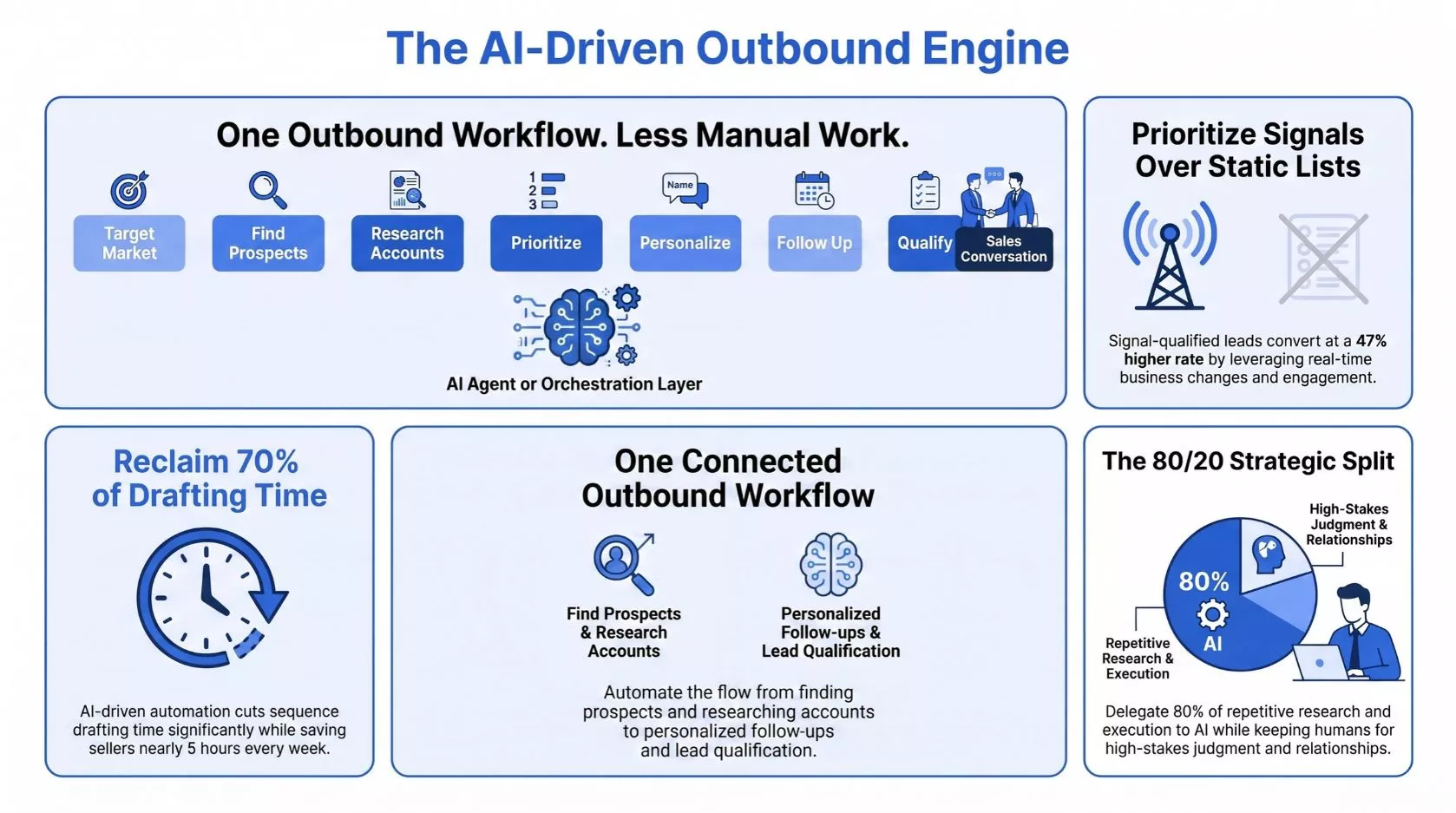
Cheap AI-generated copy has made high-volume outreach easier. It has not made generic outreach more effective. Industry-wide cold email reply rates have fallen to 3.43%, while signal-based, contextual campaigns report 15–25% reply rates.
The difference is context and timing. A digital sales rep can monitor funding, executive hires, technology changes and other buying signals, then research the account and trigger outreach around a relevant event. AI does not make mass outreach the winning strategy. It makes precision at scale more achievable.
Benefits and ROI of AI Agents for Sales: The Real Payoff
Give Sellers More Time to Sell
Sales AI can handle account research, CRM administration and routine follow-ups. McKinsey estimates that AI could automate one-fifth of current sales-team functions, freeing sellers for conversations, deal strategy and closing opportunities.
Cover More Prospects Without Adding More Reps
Automated account discovery, buyer research and signal monitoring can expand prospect and account coverage without increasing the manual workload carried by your sales team.
Respond Before Buyer Intent Fades
Speed-to-lead matters. An inbound lead qualification AI can respond immediately, gather the information needed for qualification and route high-intent conversations before delays weaken buyer interest.
Remove Repetitive Work From the Sales Day
AI sales automation can handle recurring operational work such as CRM updates, buyer context gathering, fit assessment and follow-ups that would otherwise consume selling time.
Improve Cost-to-Pipeline Economics
Better prospect targeting, account prioritization and AI CRM automation can reduce the manual effort required to create qualified opportunities, helping your sales team generate pipeline more efficiently without adding equivalent operational workload.
Sales AI Agent Use Cases Across the Sales Cycle
The AI sales agent use cases have now extended across prospecting, qualification and sales operations. The best deployments focus on specific parts of the sales cycle where work is repetitive, data-heavy or time-sensitive.
Outbound Prospecting and Signal-Based Outreach
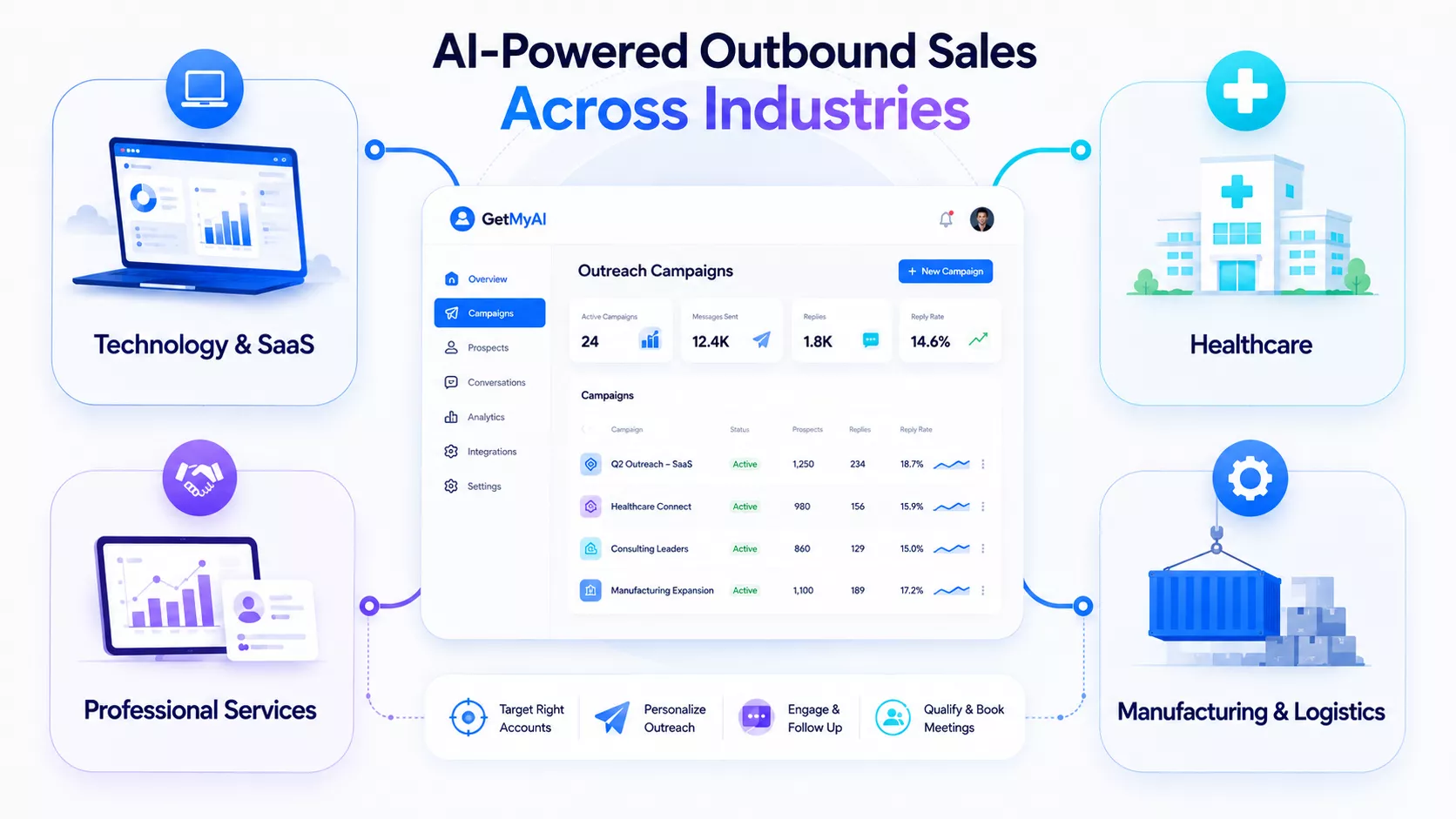
The system can discover accounts, monitor buying signals and research prospects before initiating contact. Funding announcements, executive hires and technology changes can provide context for signal-based AI sales outreach. This supports AI outbound prospecting that prioritizes account fit and timing over sending more messages.
Inbound Lead Qualification
High-intent leads can be engaged as soon as they arrive, with AI for lead generation extending beyond the initial form submission. The workflow can answer questions, gather qualification details and determine whether to continue the conversation, book a meeting or hand the opportunity to a sales representative.
RFP and Proposal Automation
Request for Proposal (RFP) and proposal work involves retrieving information from multiple internal sources and matching it to detailed customer requirements. The system can parse requests, find relevant content and assemble draft responses. Humans retain responsibility for verifying accuracy, approving commitments and making final commercial decisions.
Pricing and Deal Intelligence
Faster quoting depends on bringing the right commercial context into one decision. Customer information, margins, pricing history and market signals can be analysed together, while humans retain control over discounts and other high-stakes commitments.
Account Research and Sales Intelligence
Sellers can enter conversations with current company, contact, website, market and intent information already assembled through AI for sales intelligence. Continuous research also means context can update as accounts change, rather than starting from scratch when a new opportunity appears.
The Famous 5-Minute Rule Is Really About
The value of fast lead response is clear. Buyer intent can fade while a sales team researches the account, finds the right information and decides who should respond. But speed alone does not create a useful first interaction. A generic auto-response may arrive instantly without moving the conversation forward.
The better standard is speed-to-context: how quickly your sales workflow can understand the buyer and use that context to begin a relevant conversation. This means AI for prospect research and account intelligence can inform the next step while the workflow manages the first response and qualification. The goal is to respond with enough context to make the conversation worth continuing for the prospect.
What Should Sales AI Agents Automate?
Use autonomous sales agents when the work is repetitive, data-rich and bounded by clear rules. Keep humans in control when the decision depends on trust, political context, complex judgment or commercial risk.
| Best Suited to Execute with AI | Keep Humans Involved |
| Prospect research | Relationship building |
| Data enrichment | Complex discovery |
| Signal monitoring | Consensus building |
| Initial lead qualification | Strategic negotiation |
| Initial outreach | Executive conversations |
| Follow-ups | Closing |
| CRM administration | High-stakes judgment |
Use the Five-Question Test
Before assigning a sales activity to an autonomous workflow, ask:
- Is the work repetitive?
Repeated tasks with similar inputs and outputs are easier to delegate.
- Is enough data available?
Prospect research, enrichment and lead intelligence work best when the system can access reliable information.
- Are the decision rules clear?
The more ambiguous the decision, the more human judgment the work requires.
- What happens if it gets the decision wrong?
A poorly timed follow-up is recoverable. A bad pricing commitment may not be.
- How relationship-sensitive is the moment?
Complex discovery, executive conversations and negotiation often depend on trust and context that extend beyond the available data.
The Simplified Go-To Rule: Start with tasks that are repetitive and low-risk, then add human oversight as decisions become more complex, sensitive or significant. When you can answer these clearly, it will make the benefits of AI sales agents clearer for your team.
Checklist to Simplify How to Choose a Sales AI Agent
- Can it execute multi-step sales work toward a defined objective, not just generate individual outputs?
- Can it access the information needed to research accounts, understand buyers and support qualification?
- Does it use real prospect context, or does it only change names and other surface-level details?
- Can sellers understand why the system prioritized an account, lead or recommended action?
- Can teams decide when the system acts independently, escalates a task or requires approval?
- Can it manage replies and continue a conversation, rather than stopping after the first message?
- Does it connect prospecting, outreach, conversations, meetings and pipeline activity across the sales workflow?
- Can you connect its activity to meaningful sales outcomes, not just messages sent or tasks completed?
- Can it operate across the communication channels your prospects and customers actually use?
Why Humans Still Own the “Art” of Sales
Maximum autonomy is not the goal. In a Gartner survey of 645 B2B buyers, human sellers outperformed generative AI by 39 percentage points in understanding complex business needs, 32 points in building purchase confidence and 28 points in moving deals through internal buying committees. AI is well suited to repetitive, data-heavy work. Humans remain better positioned for conversations that require judgment, trust, consensus and negotiation.
Why Sales AI from GetMyAI?
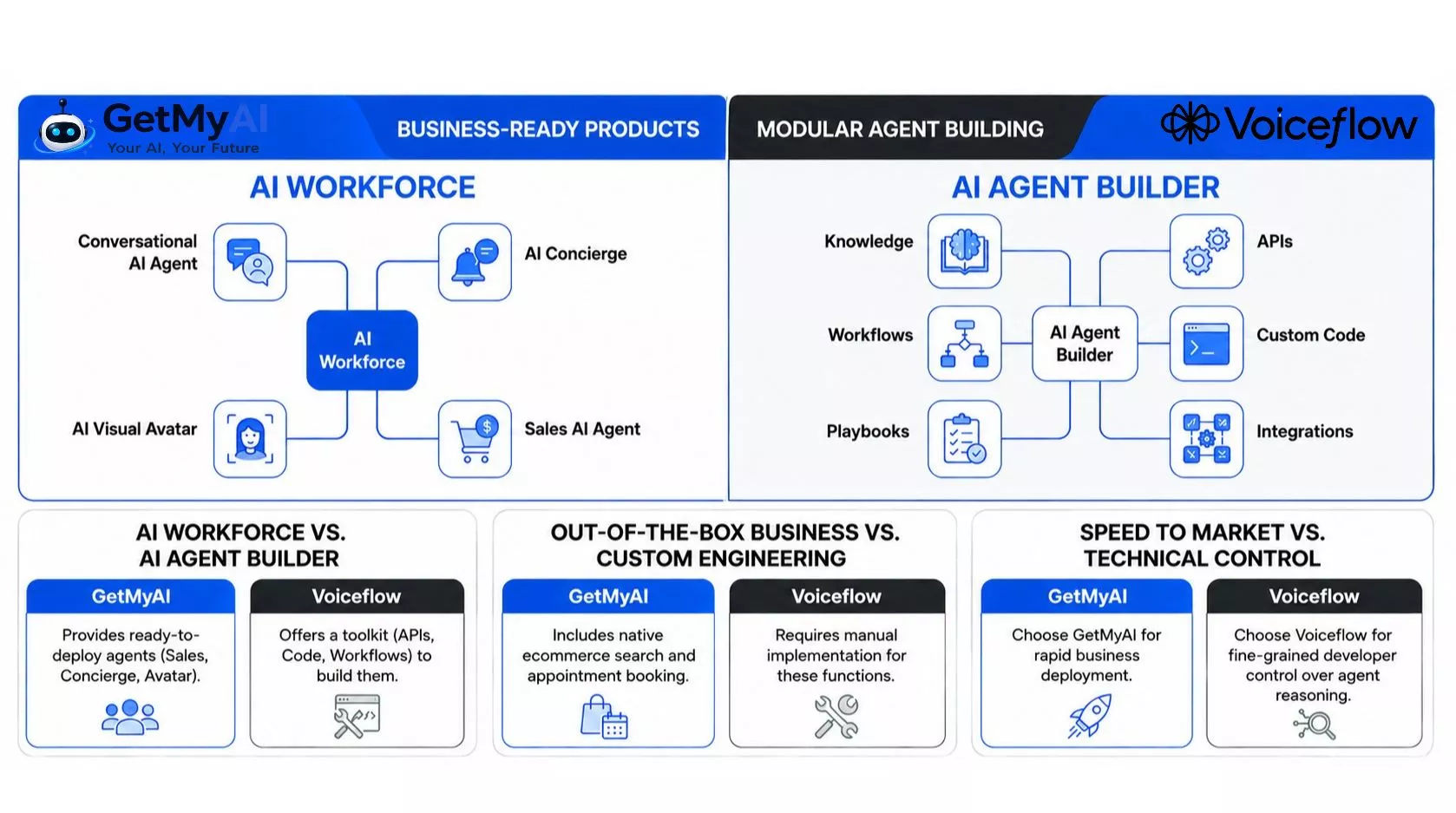
The evaluation criteria above are useful only if a platform can connect them into one operating model. With GetMyAI, you can bring prospect discovery, account intelligence, campaigns and early conversations together through an AI agent for sales that works alongside your team.
An AI Workforce, Not Another Sales Tool
We organize work around an AI Sales Team rather than a collection of isolated features. Our Sales AI coordinates specialized Research AI agents that can discover businesses, find decision-makers, evaluate accounts and prepare prospect intelligence for outreach.
Controlled Autonomy When AI Begins Conversations
When a prospect replies, Autopilot reads the email thread, evaluates the conversation and decides how to respond. AI for email outreach can send high-confidence replies automatically, while uncertain responses move to human review. Teams can also set conversation limits and campaign-specific confidence settings.
See Why a Prospect Was Prioritized
Explainable lead scoring provides more than a score. GetMyAI can show the research and evaluation behind a prospect, including company information, extracted services, website findings, likely pain points and conversion hooks. This gives sales teams context for why an account was prioritized and how the outreach was informed.
You Get Entire Sales Workflow Automation From Prospect to Opportunity
A campaign can begin with a target market and objective, then move through prospect discovery, contact research, account scoring and personalized outreach. This AI sales funnel automation continues when prospects respond, with Autopilot managing high-confidence replies and routing uncertain cases for review before qualified opportunities move into the pipeline for human sales execution.
The result is a connected workflow with a Sales AI agent rather than a set of individual AI features: discover, research, prioritize, engage, respond and advance qualified opportunities. You retain visibility across the process and take control where judgment or relationship management matters most. Explore GetMyAI pricing to see which plan is right for your business.
FAQs
- How to use AI to make our sales work easier?
Use AI to take repetitive sales work off your team’s plate. Start with prospect research, data enrichment, lead qualification, follow-ups and CRM updates. Keep people focused on complex discovery, negotiation, relationships and decisions where judgment carries greater commercial risk.
- How does Sales AI improve the Sales Process?
It improves execution between sales activities. AI can research accounts, monitor buying signals, qualify leads and handle routine follow-ups, so sellers spend less time switching between tasks and more time having conversations that move opportunities forward.
- How to use AI in sales in 2026?
With GetMyAI, you can use Sales AI across prospect research, buying signals, outreach and lead conversations without handing over every decision. Our AI Workforce handles the repetitive work, while you control how autonomously it acts and step in when human judgment is needed.
- How do Sales AI agents communicate with leads?
They use the channels connected to the sales workflow, such as email and messaging. Before responding, they can use prospect context, conversation history and available information to continue the discussion, answer questions or hand uncertain conversations to a person.
- Can AI agents book sales appointments?
Yes. After a lead is engaged and qualified, an AI agent can offer available times and complete the booking through connected scheduling tools. If the conversation requires judgment, the opportunity can be routed to a sales representative instead.
- How do AI agents prioritise leads for outbound messages?
They can combine account fit with buying signals such as funding, executive hires and technology changes. The system can then research the account and prioritize prospects when there is stronger context for a relevant, timely message.