How AI Agents Are Reducing Workload and Costs in K-12 Schools

Key Takeaways
- AI Agent for Education
- Reduce administrative workload by automating repetitive parent, enrollment and IT requests, reclaiming an average of 5.9 hours per teacher weekly for instruction.
- Cut content differentiation time by roughly 85%, from up to an hour per document down to 6 to 8 minutes, without adding staff.
- Streamline admissions operations to cut processing time and manual data entry by 40% each, redirecting staff toward high-value family conversations.
- Mitigate procurement risk by choosing vendors with proven pilots, financial stability and clean system integration, avoiding the scope failures seen in Los Angeles Unified's collapse.
- Close the governance gap early, since only 19% of districts have board-approved AI policies, positioning early adopters as compliance and operational leaders.
Every school district runs on repetition. Parent questions, enrollment requests, policy lookups and IT tickets repeat by the thousands each month. Add fixed budgets, persistent staffing shortages and rising expectations from families and employees, and the picture gets clear fast. Every one of these repetitive tasks pulls time away from student support, instruction and real strategic planning. As districts search for ways to improve efficiency without adding headcount, AI automation has moved from experimental technology to a core operational initiative.
Instead of replacing educators or administrators, AI automation for schools absorbs the repetitive administrative work that slows departments down every single day.
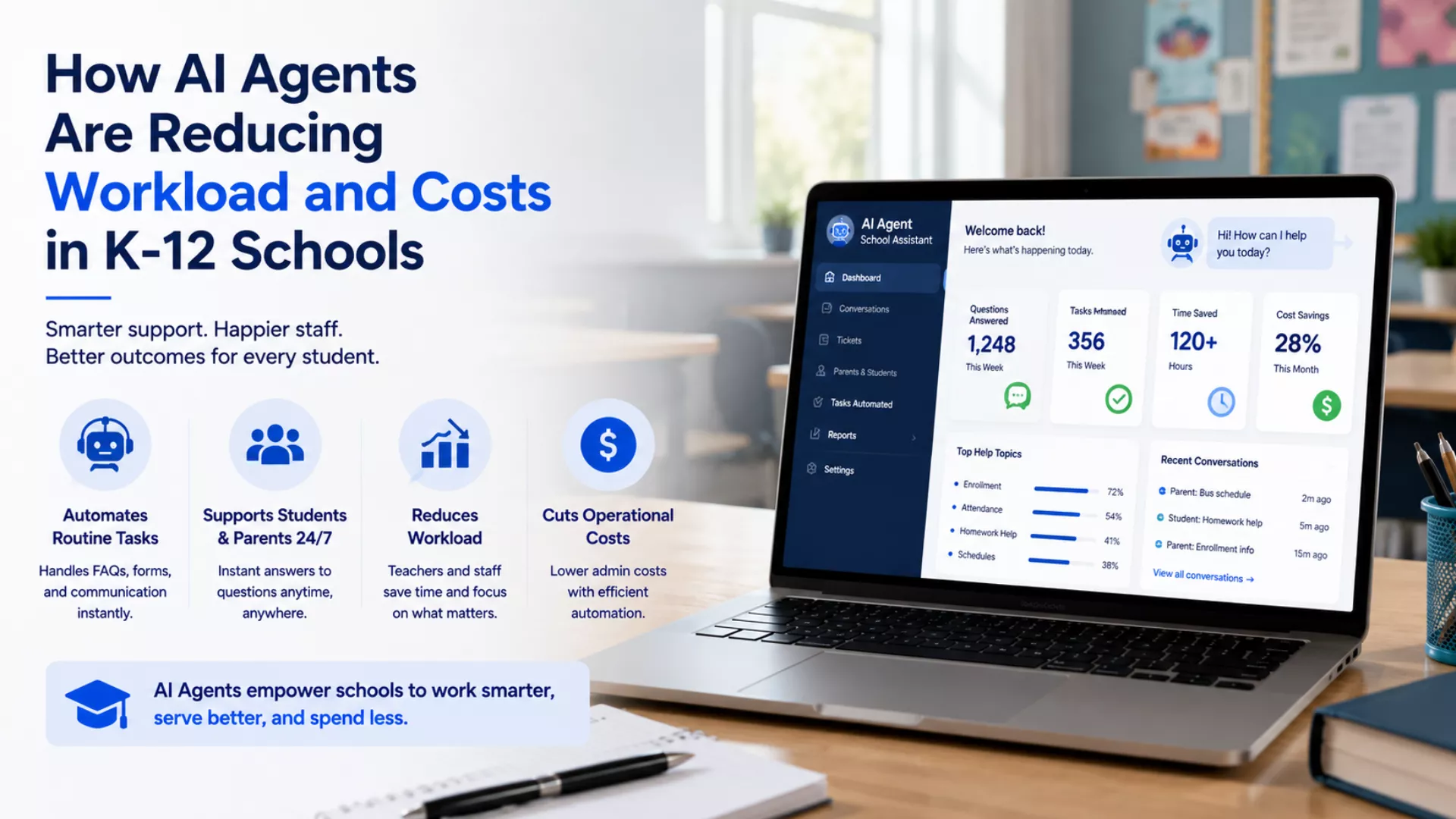
AI agents for K-12 schools automate these routine tasks. They answer parent inquiries, qualify enrollment requests, retrieve district information and route internal requests to the right staff member. The result: shorter response times, lower operational costs and more staff time for the work that actually needs a human being.
Where K-12 Schools Lose the Most Time and Money
The villain here is the sheer volume of repeated, low-complexity requests that never stop arriving. A parent asks about bus routes. A teacher searches for the district's absence policy. An applicant wants to know if enrollment is still open. None of these questions are difficult. All of them consume staff time that should go toward students instead.
According to a Gallup survey of 2,232 U.S. public school teachers, educators who use AI at least weekly report saving an average of 5.9 hours per week, equivalent to roughly six working weeks over a school year. The reclaimed time is most often redirected toward lesson planning, individualized instruction and communication with students and families.
The internal cost is just as real as the external one. Staff feels stretched thin before the first bell rings. Answering the same question for the fortieth time this month is not why anyone entered education.
Meanwhile, only 19% of public schools operate with a formal, board-approved AI policy. Districts are adopting AI faster than they are governing it. The schools solving this well right now are also setting the standard everyone else will eventually follow.
There is a philosophical problem hiding underneath all of this. Staff did not choose education to spend their careers repeating the same answer to the same question. A district that keeps burying skilled people under repetitive requests is not respecting their time. This is not only a teacher's problem. Admissions staff answer the same enrollment questions dozens of times a week. IT teams reset the same passwords every Monday morning.
Front-office staff repeat bus schedules to the same families throughout the year. Every department absorbs its own version of this cost. None of it shows up as a single line item on a budget report, which is exactly why it goes unaddressed for so long.
How AI Agents Automate Everyday School Operations
An AI education agent does not replace staff. It absorbs the repetitive front-line questions so people can spend their time on judgment calls only a human can make.
| Department | AI Agent Task | Business Outcome |
| Admissions & Enrollment | Answers program questions, captures inquiries, and books tours | Faster response to prospective families |
| Parent Communication | Handles routine questions in various languages across web, app and WhatsApp | Removes the language barrier in family engagement |
| Teacher Support | Retrieves policy documents, drafts standard responses, surfaces resources | Free planning time for actual instruction |
| Student Services | Answers common questions on schedules, forms and deadlines | Reduces walk-in and phone volume |
| IT & Helpdesk | Resolves routine queries like password resets and account access | Shortens ticket queues without adding headcount |
| Internal Knowledge | Gives staff instant answers from HR and policy documents | Cuts time spent searching shared drives |
A conversational AI agent for school enrollment automation can hold a bilingual conversation with a parent at 9 p.m., answer admission questions, collect contact details, and book a callback for the next morning. As an AI agent for parent communication, it keeps families informed with timely, consistent responses without requiring staff to stay late.
Beyond administrative efficiency, AI agents for student support help schools answer routine student questions about schedules, forms, deadlines and campus services, reducing walk-in traffic while improving response times.
How AI Agents Reduce Operational Costs Without Replacing Staff
Manual Process: A teacher rewrites one passage into three reading levels. This takes 45 to 60 minutes per document.
AI-Supported Process: The same task takes 6 to 8 minutes with an AI education agent, demonstrating how schools can reduce teacher workload with AI by roughly 85%.
That gap alone reshapes what a teaching staff can accomplish in a week.
- 74% Higher administrative efficiency reported by weekly AI users
- 57% Higher grading efficiency reported by weekly AI users
Multiply either figure across a full teaching staff. Those gains translate into hundreds of instructional hours returned across a district every single month. Cost reduction here comes from removing hours of duplicate effort, so existing staff can absorb more volume without burning out or working unpaid overtime.
Example: Imagine enrollment week at a mid-sized district. Hundreds of inquiries arrive within hours, each one asking about deadlines, tuition or program fit. Staff either stay late to answer them or families wait days for a reply. An AI school assistant absorbs that spike without needing a single extra paycheck. It answers the routine version of the question the moment it is asked, then hands off anything that needs a human judgment call. Staff arrive the next morning to a shorter, more relevant queue instead of a backlog.
Build Your School AI Agent
Create an AI agent trained on your district's knowledge to automate enrollment, parent communication and support.
This same pattern holds true for admissions processing broadly. AI-driven admissions automation has been shown to cut processing time by 40%, while manual data entry drops by another 40%. Staff spend the time they save on the families who need an actual conversation, not a status update.
Weigh this against the cost of doing nothing. A district that never automates these tasks does not save money by avoiding a subscription fee. It pays that cost anyway, in overtime, in burnout-driven turnover and in families who give up waiting and enroll somewhere else.
What You Should Look For Before Choosing an AI Agent for Schools: A Checklist
Selecting the wrong vendor is a slower failure than selecting no vendor at all. Use this checklist during evaluation.
- Compliance first: Confirm the vendor supports FERPA and COPPA requirements, including parental consent for students under 13. Ask whether they maintain a current SOC 2 Type II report and how student data is stored, encrypted and retained.
- Real integration, not a demo promise: Ask exactly how the AI agent connects with PowerSchool, Canvas, Google Workspace, Microsoft Entra ID or any other systems your district already uses. A successful deployment should fit existing workflows rather than forcing staff to adopt new ones.
- Retrieval over Hallucination: Choose a retrieval-augmented generation (RAG) platform that answers questions from your approved policies, handbooks and district documents. Without document grounding, AI can confidently provide incorrect enrollment rules or outdated policies.
- A clear human handoff: Not every conversation should stay with AI. Student well-being, complaints, disciplinary issues and safeguarding concerns should immediately transfer to the appropriate staff member.
The stakes of skipping this checklist are documented, not theoretical. Catawba County Schools ran a narrow, targeted deployment and reclaimed roughly 10 hours per teacher per week. Los Angeles Unified launched a broad, all-in-one assistant under a $6 million contract.
The vendor later reduced its workforce because of financial problems. The district was left with a system that no longer had a team to support or maintain it.
The lesson is not that the AI Agent for Education failed in Los Angeles. The lesson is that an unproven vendor and an unpiloted, oversized scope failed a good idea.
Run your own evaluation the way a careful district would. Start with a 30 to 60-day pilot in a single school or department before any district-wide commitment. Ask your shortlisted vendors what happens if their company is acquired or shut down and get that answer before you sign.
How to Introduce AI Agents in K-12 Education Without Disrupting School Operations
Successful districts rarely automate every department at once. A smaller pilot makes results easier to measure, builds staff confidence and surfaces improvements before any district-wide rollout.
A practical launch follows four steps:
- Pick one repetitive task first: Enrollment inquiries, parent FAQs, IT helpdesk requests or HR policy questions work well, since each generates high volumes of similar requests.
- Train the agent on existing knowledge: Upload policy manuals, enrollment guides, FAQs and website content, so every answer draws from information your district already maintains.
- Measure usage: Track conversation volume, common questions, response times and unanswered queries to see where the agent helps and where it needs more training.
- Improve before expanding: Review unanswered questions and update the knowledge base before adding new departments or schools.
One well-defined use case proves operational value while limiting risk. Once staff trust the system, expanding into admissions, parent communication and internal operations becomes a straightforward decision.
Ready to see how quickly an AI agent can be deployed?
Read our guide on how to build an AI agent chatbot in minutes to understand the process from knowledge upload to deployment.
AI Agents for Education Institutions: Core Infrastructure for Modern Learning
A standalone chatbot answers questions. An AI agent for school administration connects the systems your district already depends on through secure AI agent integrations, creating one accessible knowledge layer. That layer reaches families and staff on the web, a mobile app, WhatsApp or an internal portal. This distinction matters because your student population and service expectations will keep growing.
Your staffing budget will not grow at the same pace. Adding headcount to match rising inquiry volume is not a sustainable plan for most districts.
People like you, the administrators actually responsible for keeping a district running, are not looking for another tool to manage. You are looking for infrastructure that quietly does its job so your staff can do theirs. Districts moving first on this are not chasing a trend. They are avoiding the staffing bottleneck their peers will hit in two or three years. They are building the operational foundation to handle growth without a proportional rise in cost.
Lessons From School Districts Deploying AI Agents
The districts getting the strongest results did not try to automate everything at once. They picked one operational bottleneck, measured the outcome, then expanded from there.
- Catawba County Schools started with targeted assistants trained on curriculum materials, HR documents and district policies. Teachers used them to generate classroom resources and retrieve internal information without searching through multiple systems, reclaiming significant time for instruction.
- Los Angeles Unified took the opposite path. Its AI assistant launched with an ambitious goal of supporting attendance, academics, transportation and student wellbeing through one platform. Integration challenges and vendor instability eventually forced the project to pause before those benefits could be fully realized.
The contrast offers a practical blueprint for other districts. Start with one high-volume workflow such as enrollment inquiries, parent communication or internal staff support. Validate that it reduces workload, integrates cleanly with existing systems and earns staff trust. Once that foundation is in place, expanding AI into additional departments becomes far less risky and far easier to justify.
Build Your First AI Agent
Create an AI agent using your existing school documents and start automating repetitive requests today.
The Bottom Line
Repetitive requests, not teaching itself, drain the most staff time and budget across a district. An AI agents for school administration absorb this work without replacing anyone, cutting response times and operational costs while staff focus on students. The districts that succeed start narrow, validate results and expand deliberately, choosing vendors built for compliance, integration and long-term stability.
ROI Snapshot
| Operational Area | Measured Improvement |
| Teacher time saved | 5.9 hours per week |
| Administrative efficiency | +74% |
| Grading efficiency | +57% |
| Reading-level adaptation | From 45–60 min to 6–8 min |
| Admissions processing | 40% faster |
| Manual data entry | 40% lower |
Why Choose GetMyAI for K-12 School AI Agents?
School districts need more than a chatbot that answers questions. They need an AI automation platform for education that reduces administrative workload, improves response times and scales across departments without adding operational complexity. GetMyAI enables schools to build AI agents that support staff, families and students while keeping educators focused on teaching rather than repetitive tasks.
- Fast Deployment, Faster Results: Build, train and deploy AI agents in minutes using your existing FAQs, policy documents, PDFs, website content and Q&A without coding or lengthy implementation projects.
- Meet Families Where They Are: Deploy AI agents across your website, WhatsApp, Slack and Telegram to provide consistent, multilingual support for parents, teachers and staff through the channels they already use.
- Continuously Improve with Real Conversations: Every interaction is logged in the Activity section, while unanswered questions can be converted into new Q&A entries or supported with updated documents, helping improve accuracy over time.
- Measure What Matters: Built-in Analytics provides visibility into conversations, response times, engagement, feedback, geographic reach and channel usage, helping districts track adoption and optimize performance.
- Built to Scale with Your District: From admissions and enrollment to HR, IT and student services, GetMyAI lets you manage multiple AI agents from one Dashboard as your operational needs grow.
FAQs
How should AI be used by students in K-12 schools?
Students benefit most from AI tools used for approved instructional support, like personalized practice and study aids, inside teacher-supervised boundaries. Districts should define acceptable use, ground responses in verified documents and monitor interactions to prevent academic dishonesty.
How can AI be used by teachers in K-12 schools?
Teachers use AI to differentiate reading levels in minutes instead of an hour, draft parent communications, retrieve policy documents and generate study resources with AI Agent for Teachers. Weekly users report roughly 74% higher administrative efficiency, freeing time for direct instruction and student relationships.
How do you use an AI agent in the classroom?
Deploy an AI agent trained on curriculum materials and district policies so teachers can generate quizzes, study guides and differentiated content on demand. Keep the agent document-grounded, review outputs before distribution and route sensitive student questions to a staff member.
Does an AI Agent for Schools integrate with our existing SIS, LMS and helpdesk systems?
Integration depth varies significantly by vendor. Document-grounded platforms typically connect for knowledge retrieval and multichannel deployment across web, WhatsApp and Slack; deeper SIS or ERP write-access requires separate verification, since not every provider supports it.
What challenges can AI agents solve for schools?
AI agents reduce repetitive administrative work, long enrollment response times, parent communication bottlenecks, routine IT requests and time-consuming policy lookups. They also help districts improve multilingual family engagement, reduce teacher workload and deliver faster support without increasing staffing levels.