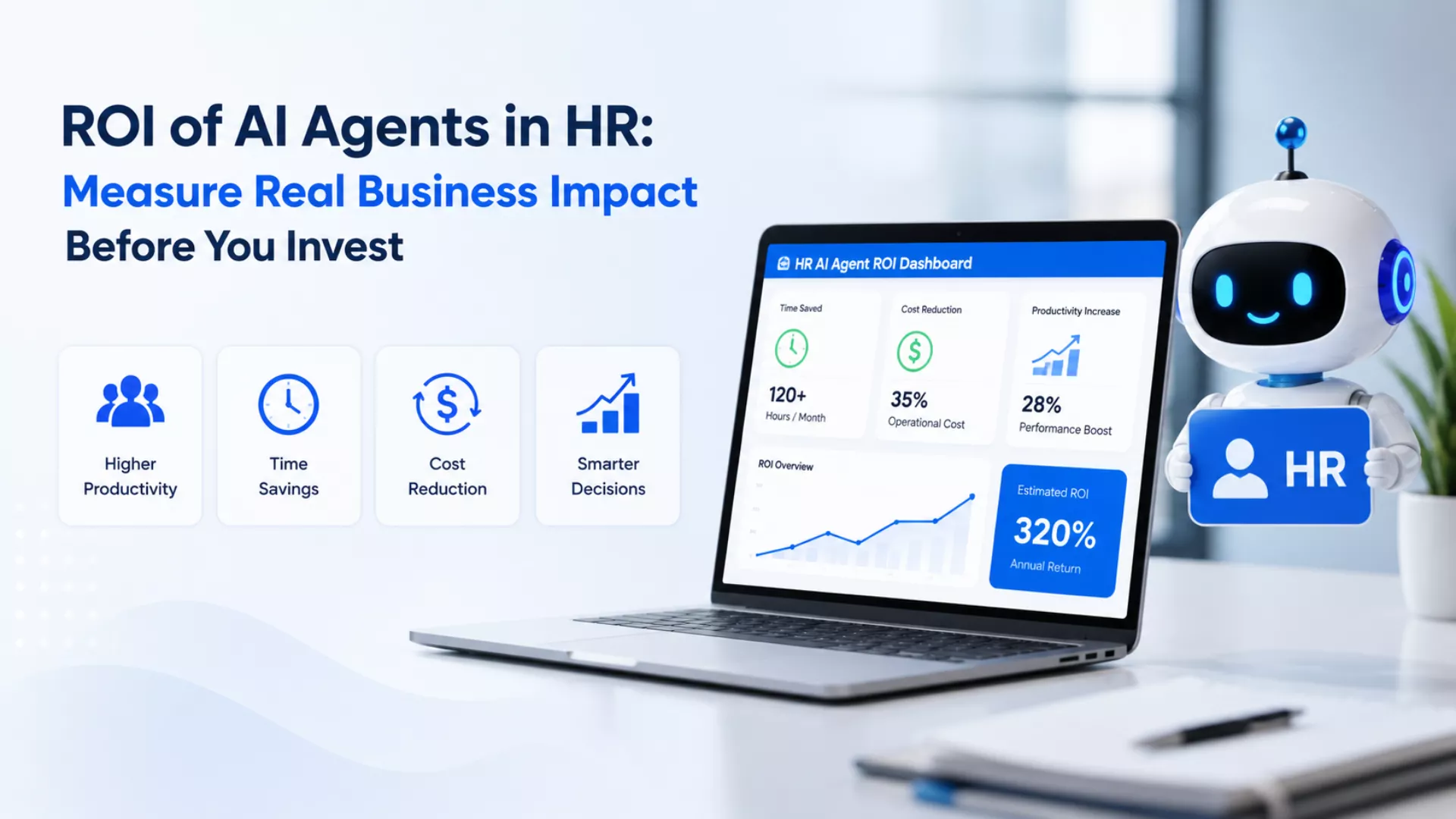
ROI of AI Agents in HR: Measure Real Business Impact Before You Invest

Key Takeaways
- Track real business outcomes like cost per request and hours freed, not conversation counts, to measure HR AI ROI accurately.
- Your HR team gets freed for retention work and strategic planning, multiplying ROI far beyond simple cost-cutting alone.
- Start with high-volume workflows like hiring and onboarding to prove ROI fastest before expanding to complex processes.
- Connect your HRIS, payroll, and ticketing systems. Single-system deployments fail to deliver the ROI enterprise buyers actually expect.
- Choose platforms with native integration and 90-day outcomes, not vendors selling AI features without proving real business results.
AI adoption is racing through enterprise companies. One-third of organizations now use generative AI in operations, sales and finance. But HR departments lag behind significantly. Only 3% of HR organizations have deployed generative AI, according to McKinsey. The gap is not skepticism about technology; it is a missing business case. HR leaders see the potential in an AI Agent for HR, but they need a financial justification before committing to a budget.
The ROI of an AI Agent in HR comes from workflow completion, not conversation count. Your HR team gets back hours. Tasks that took days now run in minutes. You measure success through resolution rate, time savings and HR capacity freed for strategic work.
McKinsey research shows HR administrative work could decline by 60 to 70% with generative AI deployment. SHRM data shows AI adoption in HR grew from 26% to 43% in a single year. The business case exists. This blog walks you through how to quantify ROI before you invest, identify which HR functions return value fastest, calculate the true cost of implementation and learn what separates successful deployments from those that fail to achieve scale.
The Four Layers of ROI in an AI Agent for HR
Most HR technology pitches collapse everything into "cost savings." That framing is incomplete. The ROI of an AI Agent in HR comes from four separate value streams, each measurable on its own timeline. Understanding all four prevents you from undervaluing the deployment or overselling it internally.
| Operational | HR workflows completed end-to-end without escalation |
| Financial | Capacity created; hours returned to your team |
| Workforce | Faster employee self-service and HR execution |
| Strategic | Better workforce planning and measurable business outcomes |
Operational: Does the Work or Just Talks About It
HR Workflow Automation ROI means completing end-to-end tasks. An AI Agent for HR checks eligibility, updates records and confirms changes. Evaluate by completion rate, not conversation volume. High volume with low completion signals systems that talk, not ones that deliver.
Financial: Your Team Gets Back Time for Work That Matters
Financial value creates capacity instead of cutting headcount. Your HR team gets hours back to invest in retention risk, manager coaching and workforce planning. IBM reports HR self-service reduces service delivery costs by 50 to 60 percent.
Workforce: Employees Stop Waiting for Answers
Workforce value comes from self-service adoption, faster HR execution, and an AI agent for employee training that provides real-time guidance during daily work. Employees receive answers in minutes rather than days.
Strategic: The Real Payoff Comes Later
Strategic value compounds over time. Deloitte research shows human-centric AI organizations are 1.6 times more likely to exceed ROI expectations and 2.4 times more likely to outperform financially. This value emerges only after the first three layers stabilize.
Where Enterprise HR Agent ROI Is Highest
Not every HR function returns value at the same speed. Enterprise HR Agent ROI depends on volume, repetition and how standardized the process already is.
| HR Function | Business Impact | ROI Speed | Priority |
| Employee support | High volume, high cost per ticket | Fast | High |
| Recruitment | Faster time to hire | Fast | High |
| Onboarding | Consistency across new hires | Fast | High |
| Payroll | High accuracy requirement | Medium | Medium |
| Benefits | Seasonal spikes in queries | Medium | Medium |
| HR policy | Fewer repeat questions | Fast | High |
| Learning | Higher completion rates | Medium | Medium |
| Performance | Judgment heavy | Slow | Lower |
| Internal mobility | Data dependent | Slow | Lower |
McKinsey's value distribution research shows talent acquisition and onboarding account for close to 20% of AI value in HR. Talent management contributes a similar share, near 20%. Learning contributes roughly 12% and workforce planning contributes close to 15%.
The pattern holds across industries. High-volume, repetitive functions deliver faster ROI because an AI Agent for HR support teams can standardize the answer once and apply it thousands of times.
Functions that need judgment, like performance calibration, take longer to show measurable return. Start where the volume is highest and the decision is simplest.
Transform HR Operations Faster
Deploy AI agents that streamline employee support, automate workflows, and improve operational efficiency.
How to Measure HR Agent ROI
Finance will not approve a budget based on a demo. HR Agent ROI metrics for enterprises must speak the language Finance already uses. Measure across five distinct KPI groups, each trackable from day one.
1. Financial
Track
- Cost per HR request (pre and post deployment)
- Cost per hire
- Implementation and platform costs against hours saved
Question to Ask: Is the cost per request declining month over month and does it justify the total cost of ownership?
2. Operational
Track
- Resolution time (minutes or hours)
- Automation rate (percentage of requests resolved without escalation)
- Workflow completion (end-to-end tasks finished by the agent)
Question to Ask: Are workflows completing at the accuracy rate required to trust the system at scale?
3. Employee Experience
Track
- CSAT (customer satisfaction scores post-interaction)
- Self-service adoption rate (percentage of employees using the agent)
Question to Ask: Is adoption growing and are users satisfied with the speed and accuracy of answers?
4. Productivity
Track
- Time-to-hire (days from job opening to offer)
- Onboarding time (days to full productivity for new hires)
- HR team capacity freed (hours returned to strategic work weekly)
Question to Ask: Are these metrics improving faster than they would have without the agent?
5. Adoption
Track
- HR capacity freed (measured in hours per week)
- Active usage rate (percentage of eligible staff using the system)
Question to Ask: Is adoption staying steady or declining after the initial launch spike?
Key Insight for Readers
Track completed business outcomes, not AI activity. A high number of chatbot sessions tells you nothing about value. A drop in cost per HR request does. An increase in HR capacity, measured in hours returned to strategic work, does.
Practical Tip for Your Team
Pull a baseline before deployment. Cost per request, resolution time and time-to-hire all need a pre-AI number to compare. Without a baseline, any post-launch number is just a claim. Report these five groups together, not separately. Finance leaders want to see cost and adoption side by side, because adoption is what makes the cost reduction real.
Understanding the Real Cost of Enterprise HR Automation
You are not buying software. You are buying an implementation. The license fee represents only a portion of what you will actually spend before ROI shows up.
Total Cost of Ownership Includes:
- Platform licensing: Annual or monthly fees for the AI agent software itself.
- HRIS integrations: Development and testing to connect your existing HR system.
- Payroll system integration: API setup and data mapping between platforms.
- Knowledge base preparation: Time to audit, clean and structure HR policy documents.
- Security and compliance review: Assessment against your SOC 2, GDPR or regional requirements.
- Governance setup: Rules, workflows and oversight protocols you establish before launch.
- Employee and HR staff training: Sessions to teach your team how to use and optimize the system.
- Change management and ongoing optimization: Budget for monitoring performance and refining accuracy over time.
Skip any single component and your ROI timeline extends. A platform with no clean knowledge base cannot answer HR policy questions correctly, regardless of how advanced the model is. You are not just deploying technology; you are redesigning how your HR team works.
- As per Deloitte research, enterprise AI deployments reach initial time-to-value in 12 to 16 weeks. You should expect your first measurable results inside that window, not on day one.
- IBM's findings reveal a specific pattern: integration across HRIS, payroll, ticketing and knowledge systems produces compound ROI. Each connected system adds value on top of the last, rather than value that plateaus after the first integration.
You will see tempting vendor proposals for narrow deployments, one system or one use case only. Resist this. Plan your full integration map before you sign the contract. A fragmented deployment rarely delivers the ROI enterprise buyers expect because each isolated system operates independently instead of multiplying value together.
Enterprise HR Agent Implementation Guide: What Successful Deployments Have in Common
You will fail if you try to deploy everything on day one. Every successful enterprise HR automation deployment follows a maturity path, expanding only when adoption and accuracy hit specific thresholds.
Implementation Maturity
- Level 1: Knowledge assistant answers HR policy questions from your documentation.
- Level 2: Employee self-service layer where staff update their own records without HR intervention.
- Level 3: Workflow automation for multi-step processes like leave requests or benefits changes.
- Level 4: Cross-system orchestration that connects payroll, ticketing and HRIS into one coordinated system.
- Level 5: A multi-agent HR ecosystem where multiple specialized agents coordinate together.
Proven Enterprise HR Agent ROI: Lessons from Real Life Application
IBM's AskHR illustrates what scale looks like. The system now handles 10.1 million interactions per year. IBM reports 50,000 hours saved and $5 million in annual savings. That result did not happen in one release.
Research from McKinsey confirms the pattern: Successful organizations begin with high-volume workflows, then expand once the first use case proves measurable return.
You will be tempted to jump to Level 4 when your data sits at Level 1. Match your deployment ambition to your knowledge base maturity. Clear stated accuracy and adoption thresholds before you fund the next level. This keeps your roadmap tied to evidence, not vendor marketing timelines.
Build Your HR AI Agent
Create HR AI agents that automate employee support and demonstrate measurable ROI from deployment.
A Checklist to Read Before Choosing the Best AI Agent for HR Automation
You are not buying the smartest AI model. You are buying a platform that delivers measurable business value within 90 days. Run every vendor through this checklist before you sign.
Look For
- HRIS integration is built in, not requiring expensive consulting or custom middleware.
- Complete HR workflow automation, not just answers to employee questions.
- ROI dashboards that track the KPIs your Finance team already monitors.
- Enterprise security, governance and role-based access controls you can audit.
- Workflow configuration that your HR staff can update independently without IT.
- Deployment timeline with measurable outcomes in your first 90 days.
- Scalability across hiring, onboarding, support and payroll without cost spikes.
- Human approval controls for sensitive decisions and compliance workflows.
Watch Out For
- Chatbots that answer questions but cannot execute workflows or update records.
- Integrations requiring consulting budgets or months of custom development.
- ROI claims with no customer evidence, benchmarks or verifiable metrics.
- AI models lacking audit trails, permissions or governance controls.
- Platforms where every content update requires your IT team to intervene.
- Reporting dashboards that cannot support executive or board-level review.
- Pricing that escalates sharply as your employee interactions grow.
- Vendors selling AI features instead of business outcomes.
You will see AI Agent benefits for HR only when the platform integrates seamlessly, automates meaningful work and proves measurable value early. The right AI Agent for HR support teams reduces response time, improves self-service adoption and demonstrates operational improvements within your first quarter. The best platform is the one that becomes part of how your HR operation runs, not another system your team manages.
Why Choose GetMyAI for HR AI Automation?
Most platforms stop at chatbots that answer questions but do not automate workflows. Your HR team still handles the actual work. You need a platform that completes HR operations, not just responds to inquiries.
GetMyAI lets you build AI agents trained on your existing HR knowledge and deploy them where your employees work.
How GetMyAI solves it:
- Build AI agents using existing HR knowledge (documents, policies, website content, Q&A)
- Automate HR workflows instead of answering isolated questions
- Qualify employee requests through intent detection
- Route conversations based on intent
- Schedule interviews with candidates through Google Calendar, Calendly or Cal.com when human involvement is required
- Deploy across the website, Slack, WhatsApp, Telegram and internal portals
- Monitor and continuously improve using analytics and conversation insights
Your employees get faster self-service and accurate answers with a 24/7 AI support agent. Your HR teams handle less repetitive work and more strategic initiatives. Your leadership sees measurable improvements through analytics that track adoption and operational capacity freed.
Understanding your implementation cost upfront makes it easier to build a business case and forecast ROI before deployment. Explore our pricing plans to see what's included.
GetMyAI transforms your ROI calculation into measurable business outcomes from day one.
Discuss Your HR Automation
Explore how AI agents integrate with your HR systems and automate enterprise workflows.
FAQs
What is the ROI of an HR Agent?
The ROI of an HR Agent in HR comes from four layers: operational efficiency, financial capacity creation, workforce self-service and strategic business outcomes. Measure through hours returned to your team, cost per request reduction and faster HR execution that frees capacity for strategic initiatives.
How do you measure HR Agent ROI?
Track five KPI groups: financial cost per request, operational resolution time and automation rates, employee experience CSAT and adoption, productivity time-to-hire improvements and adoption usage rates. Pull a baseline before deployment. Compare pre and post-metrics to prove measurable business outcomes, not AI activity.
How much ROI can an AI Agent generate for HR?
We have seen results vary by HR function and deployment maturity. High-volume workflows like employee support and recruitment show faster returns. Organizations achieve measurable improvements in cost per request, self-service adoption and HR capacity freed within the first 90 days. Integration across systems multiplies value over time.
How do AI Agents reduce HR costs?
AI Agents reduce costs by automating repetitive requests, eliminating manual HR intervention and enabling self-service. Your team handles fewer tickets, freeing hours for strategic work. Resolution time drops, meaning faster employee outcomes. Cost reduction comes from capacity creation, not headcount cuts.
What are the benefits of an AI Agent in HR?
AI agents made with GetMyAI help employees get 24/7 accurate answers without waiting. Your HR team will spend less time answering the same question and can focus on hiring and retention strategy. HR Department gains visibility through analytics. Self-service adoption improves, costs per request decline and HR capacity increases for higher-value work.