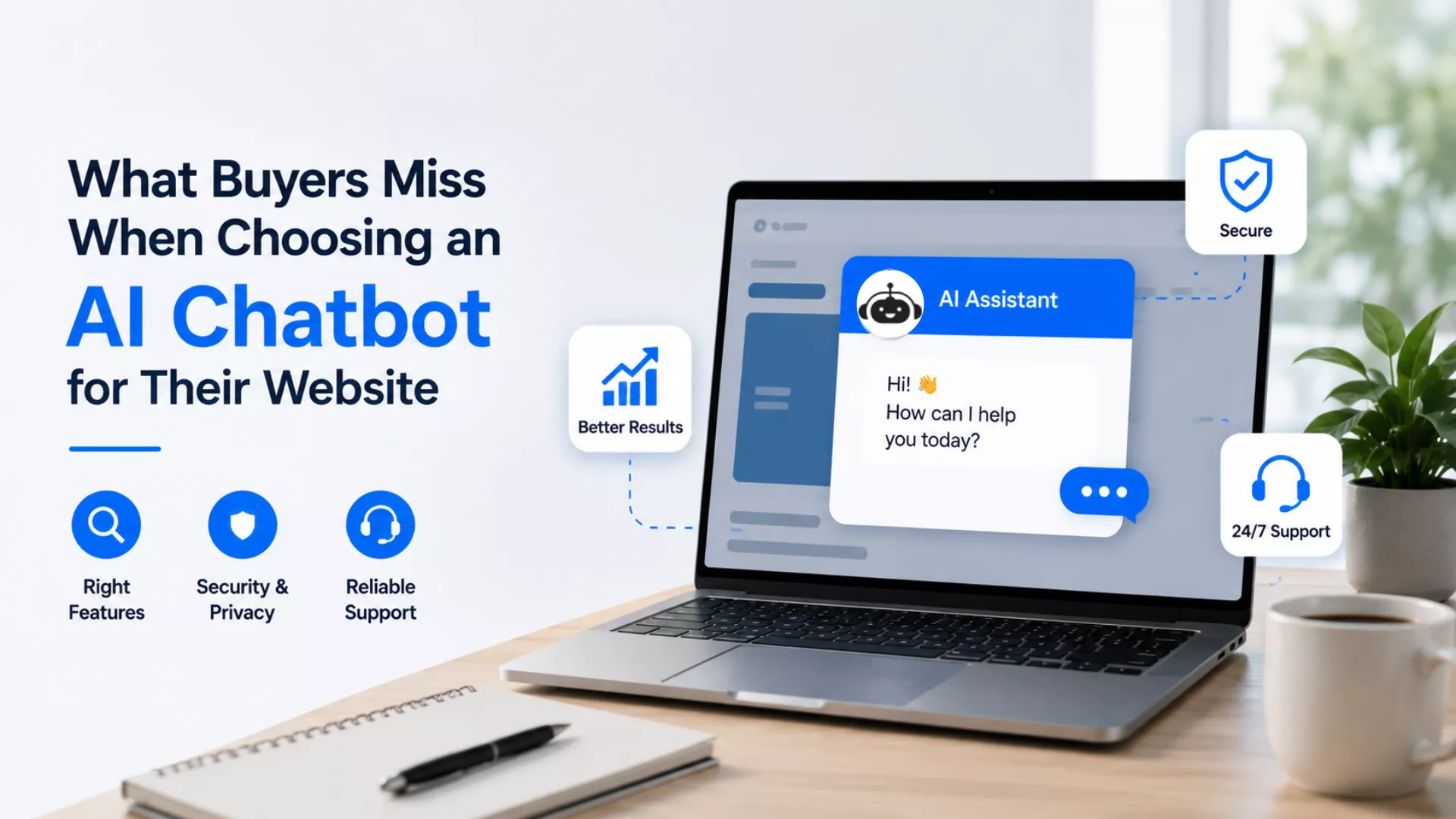
What Buyers Miss When Choosing an AI Chatbot for Their Website

Most chatbot decisions feel simple at first.
A demo runs smoothly. The chat bubble opens fast. The bot answers a few clean questions. Someone on the team nods and says, “This should work.” It feels safe. It feels done. But that moment is usually where the real problem begins, even though nothing looks broken yet.
Choosing an AI chatbot is not about what happens in a demo. It is about what happens after the chatbot goes live. That is when real visitors show up with messy questions, mixed intent, and zero patience, and when your so-called best AI chatbot for website is truly put to the test. That is when buyers feel surprised, trust starts to slip, and revenue quietly leaks without alarms or warnings.
In 2026, chatbots will no longer be a nice extra. They sit on your homepage. They talk to your highest-intent visitors. Many times, they speak before a human ever does. That makes them powerful, but also risky. A chatbot can build confidence fast, or break it just as fast. The cost of getting it wrong today is much higher than most teams expect.
The Hard Truth Figures Most Buyers Ignore
Let’s start with facts, not sales promises. Numbers show what really happens after an AI chatbot goes live on a website. These figures explain why some teams see growth, while others quietly lose trust, leads, and customers. When buyers ignore these signals, they often choose the right tool for the wrong reason, and that mistake shows up later.
The Conversion Gap
When a site visitor sends a high-intent message to a chatbot, they are 5x more likely to convert into a real opportunity. That message shows interest and urgency. If your bot fails at that moment, the chance is gone. This is why chatbots are not just support tools anymore.
The Efficiency Win
AI chatbots can handle up to 80% of routine questions without human help. That saves time and cost. Still, 65% of customers expect a smooth handoff to a human when things get complex. If that handoff feels rough, trust drops fast.
The 2026 ROI and Trust Factor
In 2026, businesses using AI chatbots see an average 340% ROI in the first year, mostly from cutting service costs by 30 to 40%. But 72% of users fear AI can spread wrong information, and one bad chatbot experience can push 30% of customers away for good.
The Mistake Buyers Keep Making
Buyers usually focus on:
- Price
- The look of the chat bubble
- How fast the bot replies
What they should focus on:
- Accuracy over time
- Visibility into conversations
- How improvement actually works
- What happens when the bot doesn’t know
Most chatbots fail quietly. They don’t crash. They don’t throw errors. They just give slightly wrong answers. Confidently. Repeatedly. Even when they promise AI chatbot for instant replies, no one notices the damage until customers stop trusting the brand.
The “Receptionist” Trap
This is the most common mistake. Many buyers install a bot that acts like a receptionist.
- “Hi, how can I help?”
- “Please leave your email.”
- “We’ll get back to you.”
That worked in 2019. It does not work now.
In 2026, buyers expect discovery engines, not message takers.
A modern bot should:
- Share a relevant case study
- Link to a product page or pricing explanation
- Surface an integration detail
- Offer a next step immediately
If your chatbot only collects emails, it’s not helping sales. It’s slowing them down. That’s why positioning GetMyAI as a discovery-driven platform matters.
Context Retention Is Not Optional Anymore
Something that buyers rarely test properly is Context. Many bots forget what the user said three messages ago. They answer questions in isolation. They don’t connect dots. That’s a problem when you are relying on an AI chatbot tool for website visitors who expect consistent, connected answers. Advanced buyers now look for Retrieval-Augmented Generation (RAG). Not as a buzzword. As a practical requirement.
RAG allows the chatbot to:
- Read your latest PDFs
- Use updated documents
- Reference your knowledge base
- Answer with context, not guesses
But here’s the part most vendors don’t say out loud.
RAG only works if:
- Your documents are clean
- Old files are removed
- Content is retrained after updates
GetMyAI doesn’t hide this reality. It’s honest about it.
Accuracy is earned, not promised.
Optimizing for AI-First Buyers
Buyer behavior has changed. Many visitors arrive on your website after researching on AI tools like ChatGPT or Perplexity. They are not browsing. They are validating.
They already know:
- What product do they want
- Which features matter
- What questions do they need answered
These users have high intent.
If your bot opens with: “Hi, how can I help?”
You lose them.
If your bot opens with: “Looking for integration details or pricing clarity?”
You keep them.
This is not about being clever. It’s about being relevant.
The CTA Loop Most Bots Miss
Answering a question is not the goal. Guiding the next step is. A chatbot that answers perfectly but does nothing next is a missed opportunity.
A good CTA loop:
- Answers the question
- Suggests a logical next action
- Keeps momentum
Examples:
- “Would you like to see how this works in a demo?”
- “Want to check a real customer example?”
- “Shall I show you the setup steps?”
This is where GetMyAI shines as an AI chatbot for website leads rather than a static Q&A widget.
Strategy Comes Before Technology
This is where most implementations fail. Not because the AI was weak. Because the strategy was missing.
As the Edtech AI Strategy Report 2026 puts it:
“Strategy must come before technology. Adopting AI simply because competitors are doing so, without a defined goal, is why most AI tools fail to deliver value.”
A chatbot without a clear role becomes noise.
Is it for:
- Support deflection?
- Lead qualification?
- Product discovery?
- Internal help?
GetMyAI forces this clarity early through its Dashboard setup and agent identity controls.
What Buyers Should Actually Compare, But Rarely Do
Not features. Not pricing tiers. Operational reality.
| What Buyers Compare | What Actually Matters | Why It Impacts Results |
| Chat design | Conversation visibility | You can’t fix what you can’t see |
| Message speed | Accuracy over time | Fast, wrong answers destroy trust |
| Number of integrations | Context quality | More connections don’t equal better answers |
| AI buzzwords | Improvement workflow | Bots need constant refinement |
| Pricing | Credit control per agent | Prevents runaway usage costs |
This is the comparison GetMyAI is built around.
Why Activity Matters More Than Analytics
Most platforms push analytics first.
- Charts.
- Graphs.
- Percentages.
But numbers don’t show confusion.
Conversations do.
GetMyAI puts Activity before Analytics for a reason.
Activity shows:
- What users actually asked
- How the bot responded
- Where it failed
- Which questions went unanswered
From there, improvement becomes simple:
- Review unanswered questions
- Add to Q&A
- Upload updated content
- Retrain
No engineering. No tickets. No delays.
Human Escalation Is Not a Weakness
Another buyer myth for you.
“If the bot escalates, it failed.”
That’s wrong.
Escalation is a feature.
Remember the number: 65% of customers expect seamless escalation when things get complex.
A good chatbot:
- Handles routine questions
- Knows when to step aside
- Hands off context cleanly
As Matt Gillin, CEO of Relay Network, puts it:
“The chatbot benefit is the ability to close the loop with the customer along a process, efficiently and in a delightful way... but the moment customers see a dull, drab personality, they hit the X button.”
GetMyAI is designed to support humans, not replace them.
Industry Lens: Where This Matters Most
AI chatbots do not fail the same way in every industry. The risk changes based on what customers expect and how much a wrong answer can cost. In some industries, a slow or unclear response means a lost sale. In others, it means lost trust. This is why choosing the right AI chatbot solution for businesses depends heavily on where and how it is used.
E-commerce
In online stores, speed decides everything. Shoppers arrive ready to buy and want clear answers right now. An e-commerce chatbot must guide decisions fast, or the visitor leaves the page.
- Product availability and shipping timelines
- Returns and product comparison questions
Logistics
For them, accuracy builds confidence. Customers track orders closely and expect updates that match reality. A logistics support chatbot must reduce confusion, not create it.
- Shipment status and delivery delays
- Document access and order references
Healthcare
Here, mistakes are not forgiven. Users rely on information to make real decisions. A healthcare chatbot must stay accurate, updated, and easy to review by teams.
- Appointment and service clarity
- Policy and treatment information
This is why GetMyAI is built for operators and service teams, not just marketing. In high-impact industries, visibility and control matter more than flashy answers.
The Interface Is the Product
This insight matters.
As Tom Siebel explains:
“We are using Generative AI to change the computer interface... the human-computer interface in many systems is just dreadful.”
Your chatbot is no longer a widget. It is the interface.
GetMyAI treats it that way.
What Does GetMyAI Do For You?
We did not build GetMyAI as a gimmick or a demo toy. We built it for real work, real teams, and real customer questions. Our goal is simple. Help you stay in control while your AI chatbot platform works at scale. You see what it says, how it performs, and where it needs to improve, without guessing or hoping for the best.
Built as a System You Can Trust
GetMyAI works as a controlled and visible system. You always know what the chatbot is doing and why. It improves over time because you guide it, not because it guesses.
We designed it for teams who care about:
- Accuracy in every answer
- Trust with every visitor
- Conversion without pressure
- Long-term ROI that holds up over time
Where GetMyAI Fits Best
This is why teams choose us when they want results that last, not quick wins that fade. They use GetMyAI to turn real conversations into real progress, without losing clarity or ownership along the way.
- A system that helps teams guide visitors instead of just replying
- A tool that fits smoothly into daily website operations
- A setup that grows with traffic, questions, and expectations
- A solution built for real-world workflows, not theory
- Fast responses that stay accurate and easy to manage
We believe strong chat experiences should work alongside people, not replace them. The goal is to make every interaction clearer, more helpful, and more human, even when it starts with AI.
What Happens After the Demo Is Over
Most chatbot failures do not look scary or broken. They look fine on the surface. That is what makes them risky, especially when teams rely on an AI chatbot for business that appears stable but quietly underperforms. The answers sound confident, the chat works, and nothing crashes. But over time, small mistakes build up. Trust slowly drops, and teams often notice too late.
GetMyAI is built for the things buyers often miss. We focus on what happens after launch, when content changes, and when real users test your chatbot every day. If you are choosing a chatbot in 2026, pick one built for real use, not just demos. That is where GetMyAI stands apart.
FAQ
1. What should businesses look for when choosing the best AI chatbot for a website?
Businesses should evaluate more than just pricing and chatbot design. The best AI chatbot should offer accurate responses, knowledge base integration, workflow automation, analytics, human handoff, CRM integrations, security, and continuous learning capabilities to support long-term business growth.
2. Why do many businesses choose the wrong AI chatbot?
Many buyers focus on demos, visual appearance, or basic features instead of testing how the chatbot performs with real customer conversations. A successful AI chatbot should maintain context, provide reliable answers, and improve over time based on business knowledge and user interactions.
3. How is an AI chatbot different from a traditional live chat widget?
A live chat widget simply connects visitors with support agents or allows manual conversations. An AI chatbot understands customer intent, answers questions using your business knowledge, qualifies leads, automates repetitive tasks, and provides support 24/7 without requiring constant human intervention.
4. Why is context retention important in an AI chatbot?
Context retention allows an AI chatbot to remember previous messages during a conversation, making responses more accurate and relevant. Without this capability, customers often receive repetitive or disconnected answers, leading to frustration and lower trust.
5. Can an AI chatbot help increase website conversions?
Yes. A modern AI chatbot can answer product questions, recommend relevant solutions, qualify leads, guide visitors to pricing or product pages, and encourage the next step in the buying journey. Faster responses and personalized assistance often lead to higher conversion rates.
6. Should an AI chatbot always answer every customer question?
No. A well-designed AI chatbot should recognize when it cannot confidently answer a question and seamlessly transfer the conversation to a human agent. Human escalation improves customer satisfaction and prevents incorrect or misleading responses.
7. Which industries benefit the most from AI website chatbots?
AI chatbots are valuable across industries including ecommerce, healthcare, banking, education, real estate, telecommunications, SaaS, travel, and professional services. Any business handling frequent customer inquiries can improve efficiency and customer experience with AI-powered conversations.
8. How can businesses improve the accuracy of an AI chatbot?
Businesses should regularly update the chatbot's knowledge base, remove outdated content, review conversation history, monitor unanswered questions, and retrain the AI whenever products, services, or policies change. Continuous optimization is essential for maintaining reliable performance.
9. Can an AI chatbot integrate with existing business systems?
Yes. Most modern AI chatbot platforms integrate with CRM software, helpdesk systems, ecommerce platforms, calendars, knowledge bases, and other business applications. These integrations help automate workflows and provide customers with accurate, real-time information.
10. What is the biggest mistake businesses make after deploying an AI chatbot?
The most common mistake is assuming deployment is the final step. AI chatbots require ongoing monitoring, conversation reviews, knowledge updates, and performance optimization to maintain accuracy, build customer trust, and deliver long-term ROI. Businesses that continuously improve their chatbot achieve better customer experiences and stronger business results.