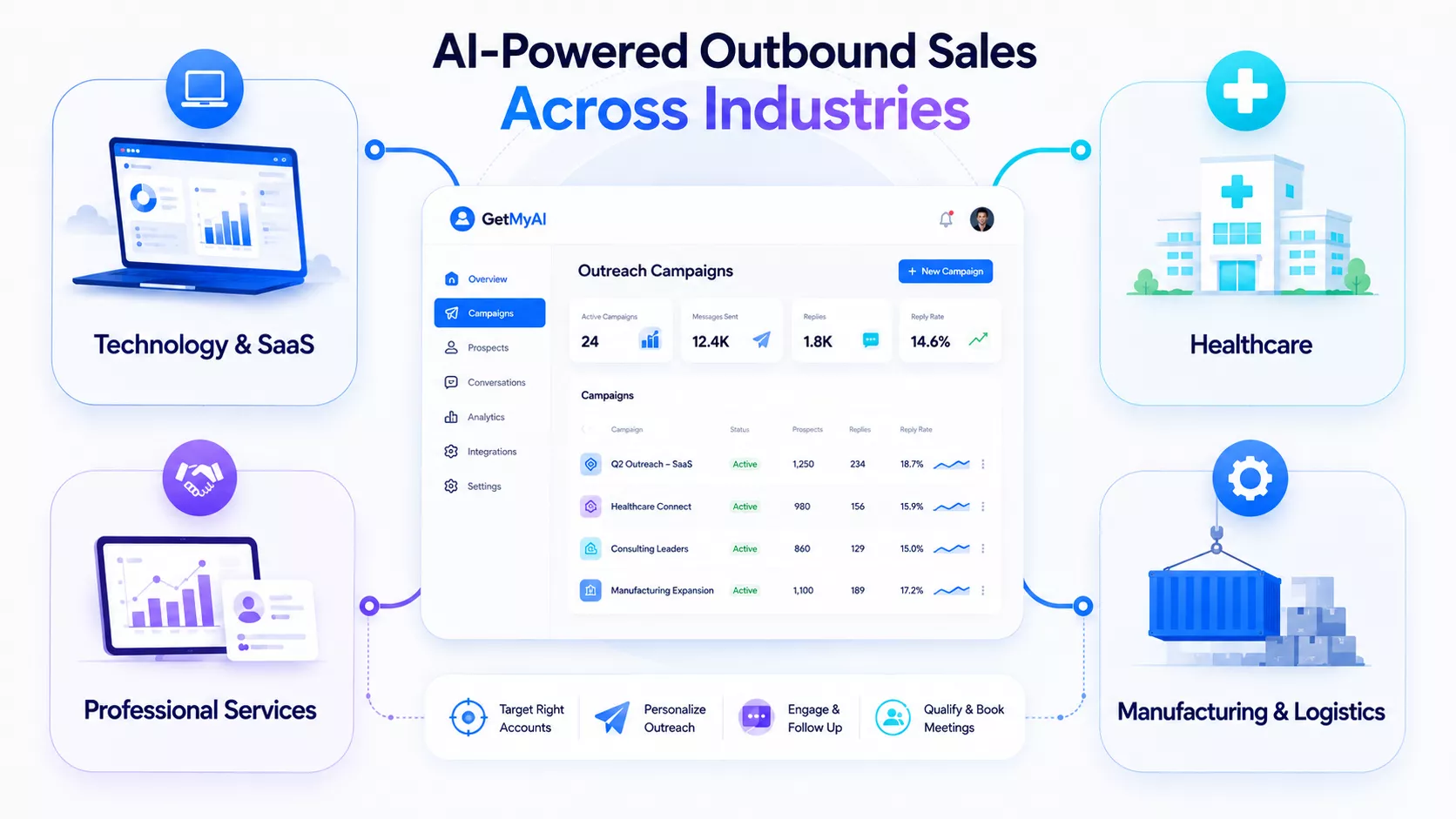
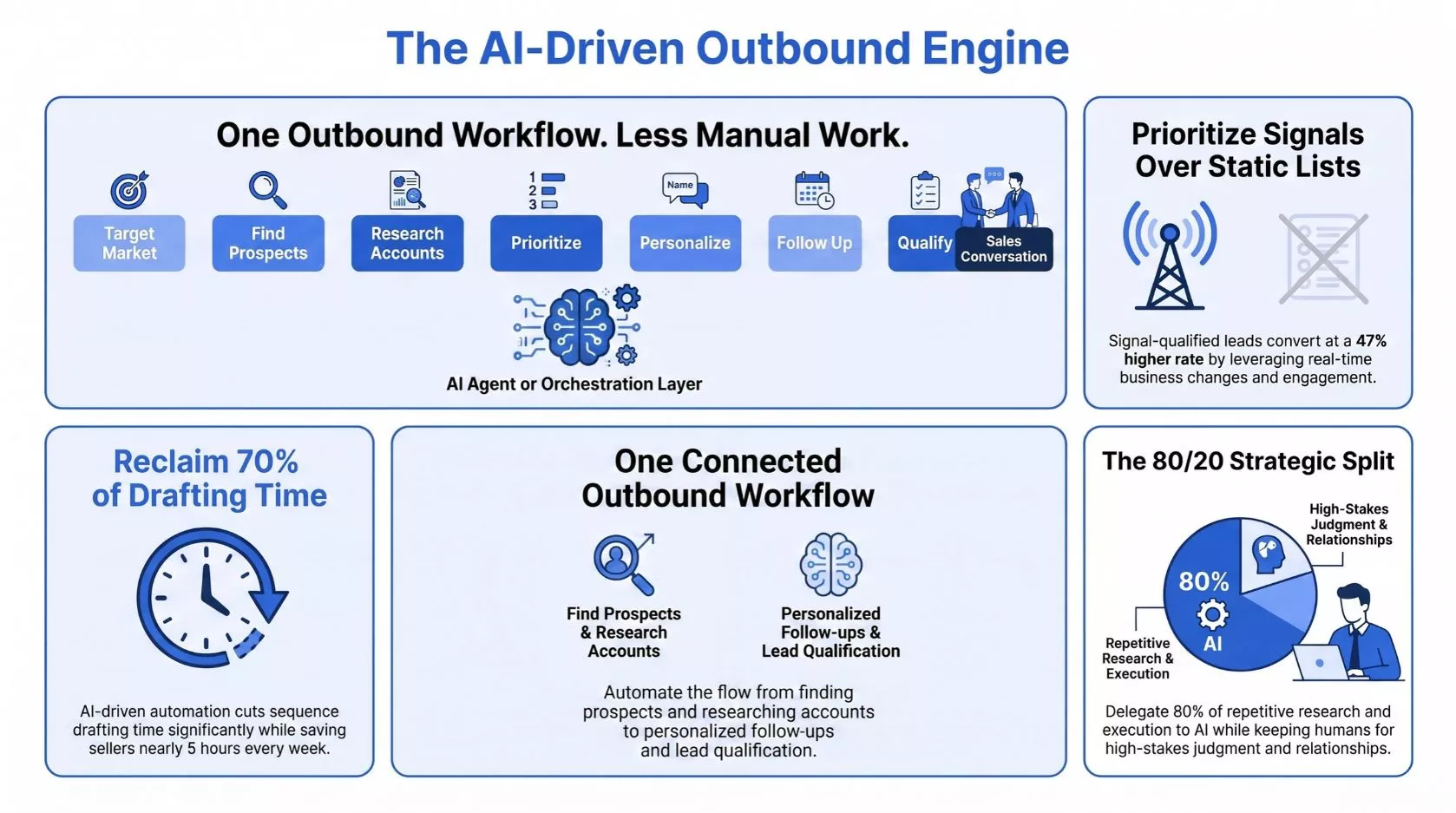
B2B outbound sales is becoming harder to manage manually. Sales teams still spend hours finding prospects, researching accounts, identifying decision-makers and keeping up with follow-ups. Benefits of AI in Sales go beyond saving time: better prospect research…
Experience Boost
Create. Deploy. Engage. With GetMyAI
Launch GPT-powered conversations that engage, support, and convert — all in one platform.
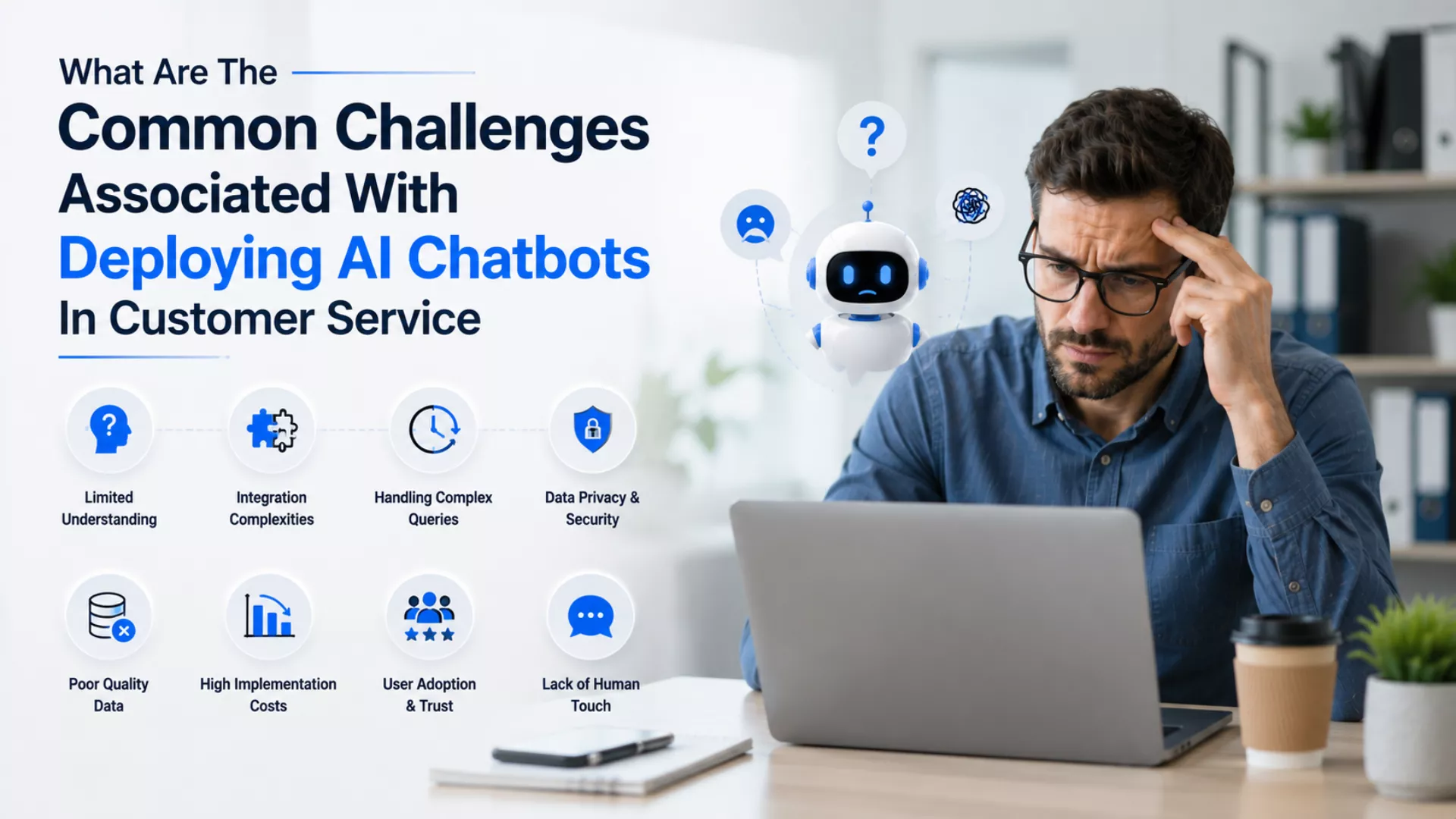
What Are The Common Challenges Associated With Deploying AI Chatbots In Customer Service
getmyai
Mar 27, 2026
Deploying AI chatbots in customer service
Chatbot implementation challenges
AI chatbot development challenges
AI chatbot integration challenges
Key Takeaways
Deploying AI chatbots in customer service fails when systems lack integration, structured data, and continuous improvement workflows.
Most chatbot implementation problems come from poor strategy, not technology limitations or model capabilities.
AI chatbot integration challenges prevent bots from executing real tasks, limiting them to basic question answering only.
Solving these challenges requires structured training, feedback loops, and consistent performance monitoring.
Businesses overcome issues with the implementation by building AI agents that integrate, learn, and scale efficiently.
Customer support is under constant pressure. Teams are expected to respond instantly, manage increasing volumes, and stay available around the clock. To meet these demands, businesses are turning to AI chatbots to automate support and improve efficiency.
However, many deployments fail to deliver the expected results. Instead of reducing workload, they introduce new challenges, frustrated users, incomplete resolutions, and increased reliance on human support.
Across industries, the pattern is the same. Chatbots provide inconsistent answers, struggle with real issues, and often leave conversations unresolved. Customers lose trust quickly, while support teams step in to recover failed interactions. The problem is not the technology itself, but how these systems are designed, integrated, and maintained after deployment.
Why Do AI Chatbots Fail in Customer Support?
Most AI chatbot failures are not caused by technology limitations, but by how systems are designed, deployed, and maintained. These failures typically fall into three categories:
Design failures: Poor conversation flows, weak user experience, and a lack of clear interaction paths make it difficult for users to get meaningful outcomes.
Data failures: Incomplete, outdated, or unstructured data leads to inaccurate responses and unreliable outputs.
Strategy failures: Lack of ownership, unclear goals, and missing success metrics result in systems that cannot scale or deliver measurable value.
Failures often begin with unclear ownership and undefined success metrics. Teams deploy bots without aligning workflows, data sources, or escalation paths, resulting in fragmented systems that cannot support real customer interactions at scale.
Businesses focus on deploying tools instead of building systems. This is why enterprise chatbot deployment challenges persist even with advanced AI models. These underlying gaps are what lead to the recurring challenges seen across most chatbot deployments.
Common Challenges in Deploying AI Chatbots in Customer Service
1. Poor Accuracy and AI Hallucinations
One of the biggest AI chatbot limitations in customer service is the inability to ensure response reliability at scale. When systems lack structured grounding, outputs become inconsistent, making it difficult for businesses to depend on automation for critical customer interactions or decision-sensitive scenarios.
This happens when:
The AI relies on general knowledge
There is no grounding in business-specific data
This creates:
Trust issues
Legal risks
Poor customer experience
Fix:
Use structured knowledge (documents, Q&A)
Ensure accurate training data
Continuously improve using real conversations
2. AI Chatbot Integration with Existing Systems
A major AI chatbot integration challenge with existing systems is the gap between conversational interfaces and operational execution. Without direct system connectivity, chatbots remain disconnected from workflows, limiting their ability to contribute to resolution-driven support or business-critical processes.
They cannot access:
Customer data
Billing systems
Internal workflows
Result: They answer questions but cannot resolve problems.
Fix:
Integrate with backend systems
Enable action-based workflows
Move from chatbot → AI agent architecture
3. Inability to Handle Complex or Multi-Step Queries
A core shortcoming lies in handling layered interactions that require sequencing, dependency tracking, and contextual continuity. Most systems are not designed to manage evolving queries, making them ineffective for real-world scenarios that extend beyond simple, single-turn conversations.
Multi-step problems
Edge cases
Context-heavy conversations
This highlights core AI chatbot customer service limitations.
Fix:
Use multi-step reasoning systems
Implement escalation flows
Combine AI with human support
4. Chatbot User Experience Challenges and Low Adoption
Often result from poor interaction design rather than technical capability. When conversations lack structure, clarity, or direction, users struggle to navigate responses, leading to disengagement and reduced effectiveness across customer support journeys.
Most users experience:
Robotic replies
No personalization
Confusing flows
Result:
Low engagement
High drop-off rates
Fix:
Design guided conversations
Use suggested messages and clear prompts
Align tone with brand
5. Chatbot Fallback and Escalation Issues
These will arise when systems fail to guide conversations forward during uncertainty. Instead of maintaining flow, poorly designed fallback mechanisms interrupt user journeys, making it difficult to transition interactions toward meaningful resolution or alternative support paths.
Typical issues:
No clear fallback responses
No human handoff
Dead-end conversations
Fix:
Add structured fallback logic
Enable escalation paths
Capture unanswered queries for improvement
6. Data Privacy Issues in AI Chatbots
These become increasingly complex as systems interact with sensitive user data across multiple touchpoints. Without clear control over data access and processing, businesses face challenges in maintaining compliance and ensuring responsible handling of customer information.
Common privacy issues are:
Improper data handling
Lack of visibility
Compliance gaps
Fix:
Secure data storage
Controlled access
Clear data handling practices
7. AI Chatbot Scalability Issues
They surface when systems are not architected for simultaneous growth in usage and complexity. As interaction volumes increase, maintaining consistent performance and response quality requires infrastructure designed to handle both scale and variability.
Typical scalability issues include:
Slow response time
Performance drops under load
Inconsistent answers
Fix:
Use scalable architecture
Monitor performance through analytics
Optimize continuously
8. AI Chatbot Maintenance Challenges
These arise when systems are treated as static deployments rather than evolving components. As customer expectations shift and business data changes, maintaining accuracy and relevance requires ongoing refinement, monitoring, and structured update processes.
Commonly include:
Outdated knowledge
Declining accuracy
No feedback loop
Fix:
Use continuous improvement systems
Update Q&A regularly
Review Activity logs
9. Cost and ROI Uncertainty
Cost visibility remains a major concern, especially when enterprise chatbot deployment challenges are tied to unclear value measurement. Without defined benchmarks and tracking mechanisms, businesses struggle to connect investment with tangible outcomes, making long-term optimization difficult.
Many businesses underestimate:
Infrastructure costs
Integration costs
Maintenance effort
This creates pressure on teams to justify results, turning what should be efficiency gains into ongoing operational friction.
Fix:
Start with high-impact use cases
Track ROI metrics
Optimize usage over time
10. Organizational and Strategy Challenges
Many problems businesses face with AI chatbots stem from fragmented decision-making and unclear execution priorities. Without a defined roadmap and operational alignment, teams struggle to connect chatbot initiatives with actual business outcomes, leading to stalled adoption and inconsistent performance across use cases.
Common problems businesses face with AI chatbots:
No ownership
Misaligned teams
Unrealistic expectations
Fix:
Define clear goals
Align teams
Treat AI as a system, not a tool
How to Overcome AI Chatbot Development Challenges
To successfully overcome AI chatbot implementation challenges, businesses must move beyond isolated deployments and adopt a system-level approach focused on integration, real use cases, and continuous improvement.
1. Start with High-Impact Use Cases
Focus on areas where automation can deliver immediate value, such as FAQs, lead qualification, and high-volume support queries. This ensures faster adoption and measurable outcomes early in the deployment.
2. Build for Action, Not Just Conversation
Chatbots should not only respond to queries but also execute tasks. Enable access to backend systems, automate workflows, and design interactions that lead to resolution, not just responses.
3. Use Hybrid Support Models
Combine AI with human support to handle complexity effectively. While AI manages speed and scale, human agents handle edge cases and critical interactions, ensuring a balanced and reliable support system.
4. Implement Continuous Learning Systems
AI chatbots must evolve with real usage. Use activity logs, feedback loops, and Q&A updates to continuously improve accuracy, fill knowledge gaps, and adapt to changing business needs.
5. Track Performance Metrics
Measure key performance indicators such as response time, engagement, and resolution rates. Continuous monitoring helps identify gaps, optimize performance, and ensure long-term ROI.
Best 5 Practices for AI Chatbot Implementation
Successful AI chatbot deployments are not defined by the technology alone, but by how effectively systems are designed, integrated, and continuously improved. The following best practices help ensure long-term performance and scalability:
Prioritize depth over breadth in early stages: Instead of trying to automate everything at once, focus on solving a few high-impact use cases thoroughly before expanding to broader workflows.
Design conversations around real user intent: Move beyond scripted flows and keyword triggers. Build interactions based on actual user behavior, queries, and outcomes to ensure relevance and usability.
Ensure tight integration with core business systems: Chatbots should be deeply connected to CRM, billing, and internal tools to enable real task execution, not just surface-level responses.
Plan for failure with structured fallback and escalation: Every system should include clear fallback paths and seamless human handoff to prevent dead-end conversations and maintain user trust.
Treat AI as a continuously evolving system: Regularly monitor performance, update knowledge sources, and refine responses using real interaction data to maintain accuracy and relevance over time.
GetMyAI: AI Agent Chatbot Platform for Customer Service
From Chatbots to AI Agents: A Better Way to Build Customer Support
Most chatbot deployments fail because they are built to respond, not to resolve. GetMyAI addresses this gap by enabling businesses to build AI agents that go beyond answering questions; they execute workflows, integrate with systems, and continuously improve over time.
Unlike traditional chatbots, AI agent chatbot platforms like GetMyAI are designed to operate as a connected layer across your support ecosystem. They combine structured training, real-time interactions, and continuous optimization to deliver reliable, outcome-driven support at scale.
What GetMyAI Enables
Understands user intent with precision: Delivers accurate, context-aware responses based on structured training data.
Uses structured knowledge for reliable outputs: Combines documents and Q&A systems to reduce hallucinations and improve consistency.
Continuously improves through real interactions: Learns from activity, unanswered queries, and feedback to refine performance over time.
Supports multi-channel deployment: Operates seamlessly across website, Slack, Telegram, WhatsApp, and Instagram.
Integrates with business systems and workflows: Connects with internal tools to enable task execution, not just conversation.
Automates scheduling and actions: Integrates with tools like Calendly and Google Calendar for real-time task completion.
What Makes GetMyAI Different
GetMyAI is designed to operate as a scalable, integrated system for enterprise-grade customer support.
Built for execution, not just interaction: Enables end-to-end workflows by connecting conversations with underlying business processes.
Continuous improvement by design: Learns from real interactions to improve accuracy and maintain performance over time.
Unified multi-channel experience: Delivers consistent support across all touchpoints through a single AI layer.
End-to-end performance visibility: Provides structured analytics to track usage, engagement, and resolution efficiency.
No-code, scalable deployment: Allows teams to deploy and expand AI capabilities without technical dependency.
What Winning AI Deployments Will Look Like in 2026
AI chatbots fail when they are deployed as isolated tools. Winning deployments in 2026 will look very different. They will be built as connected systems, designed to handle real workflows, not just conversations. Businesses that succeed will focus on structure from the start, ensuring their AI can access data, integrate with systems, and improve continuously based on real interactions.
Winning deployments will be defined by:
Strong integration with business systems
Clean, updated, and structured data
Clear ownership and defined success metrics
Continuous improvement through real user feedback
The shift is already happening. The focus is moving away from basic automation toward AI agents that can understand context, take action, and evolve. Businesses that build these systems will not just improve support performance; they will create a long-term advantage in how they operate and scale.
FAQs
1. What are the challenges of AI chatbots in customer service?
Common challenges include poor accuracy, weak integration, limited handling of complex queries, user experience issues, and ongoing maintenance and scalability concerns.
2. Why do AI chatbots fail in customer support?
AI chatbots fail due to poor implementation, lack of integration with systems, weak training data, and absence of continuous improvement and performance monitoring processes.
3. How to overcome AI chatbot development challenges?
Focus on structured training, system integration, clear use cases, continuous improvement through feedback loops, and combining AI with human support for complex scenarios.
4. What are the limitations of AI chatbots?
AI chatbots depend on training data, struggle with complex queries, lack emotional understanding, and require continuous updates to maintain accuracy and relevance.
5. How to improve chatbot performance?
Improve performance by updating training data, reviewing real conversations, optimizing responses, integrating systems, and tracking key metrics like response time and engagement regularly.
We’ve noticed that a surprising amount of a sales rep’s day is still spent preparing to sell rather than actually selling. Building lists, researching accounts, finding the right contacts, writing outreach and chasing follow-ups can consume hours before a mean…
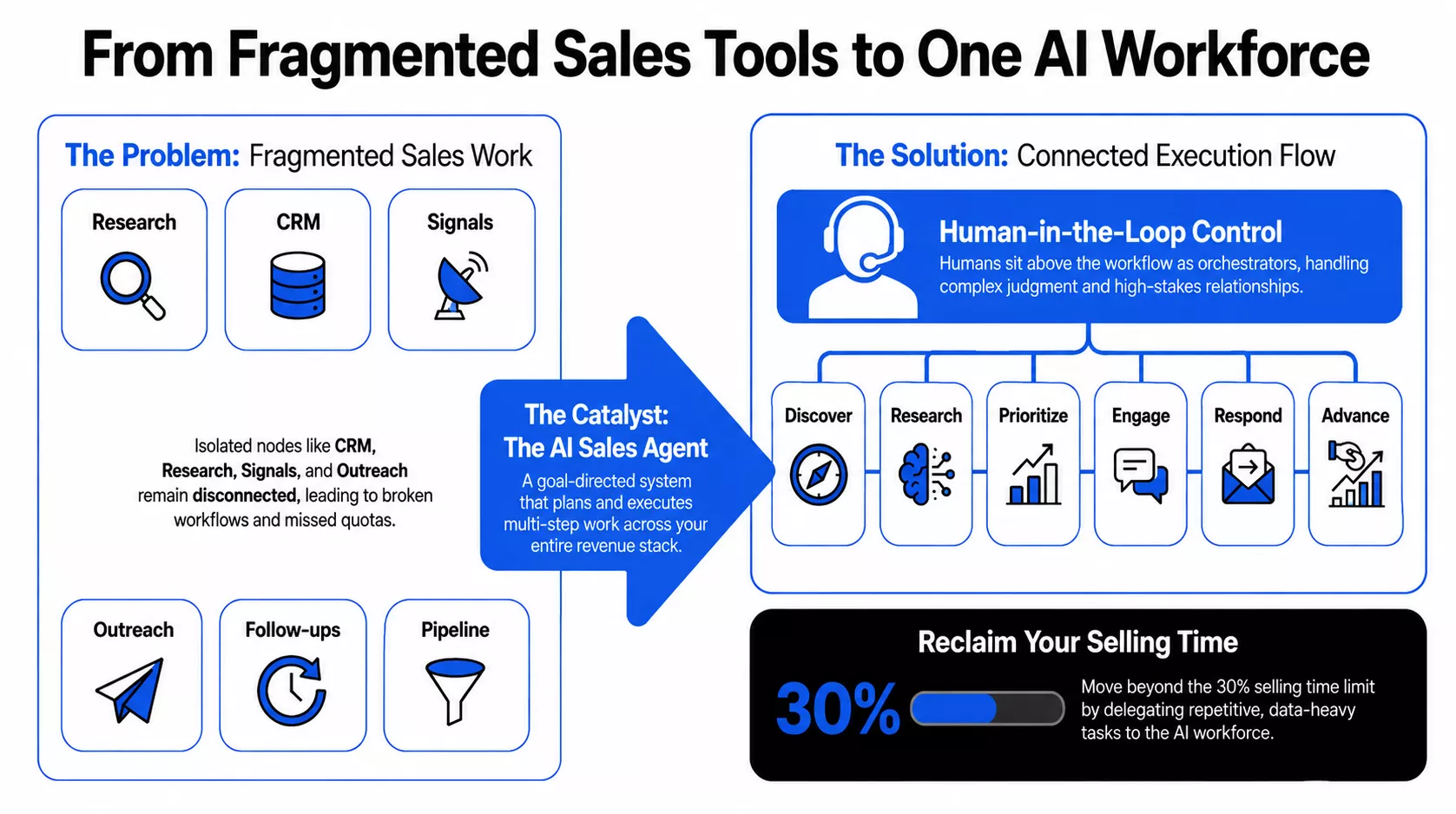
Sales teams have more AI than ever, yet the productivity problem remains. Sales AI Agents can take repetitive work off your team's plate, but adding another tool does not automatically improve execution. In 2026, 78% of B2B sellers missed quota in 2025, w…