How AI Chatbots Increase Financial Product Conversions

Key Takeaways
- AI chatbots improve financial product conversions by accelerating decision-making. Real-time conversational support helps users clarify eligibility, documentation, repayments, and onboarding questions before they abandon the journey.
- Conversational AI reduces application drop-offs across banking, insurance, wealth management, and FinTech. Guided onboarding, contextual recommendations, and persistent follow-ups help institutions maintain engagement during complex financial decisions.
- Modern AI systems function as operational infrastructure, not just support tools. Financial institutions now use conversational AI across qualification, onboarding, servicing, appointment booking, and customer acquisition workflows.
- Scalable conversational engagement lowers operational costs while increasing conversion capacity. AI agents now automate up to 90% of routine financial inquiries and significantly reduce support interaction costs without reducing response quality.
- Successful financial AI deployments depend on trust, explainability, and governance. Institutions should prioritize contextual conversations, multilingual support, secure document training, audit visibility, and human escalation pathways before deployment.
Financial products are rarely impulse purchases. Customers compare rates, review terms, question eligibility, and pause whenever something feels unclear. Even small delays during this process can break momentum and push potential buyers toward competitors. Many financial institutions still struggle with slow response times, fragmented onboarding experiences, and disconnected digital journeys. These gaps create uncertainty and decision delays exactly when users are closest to conversion.
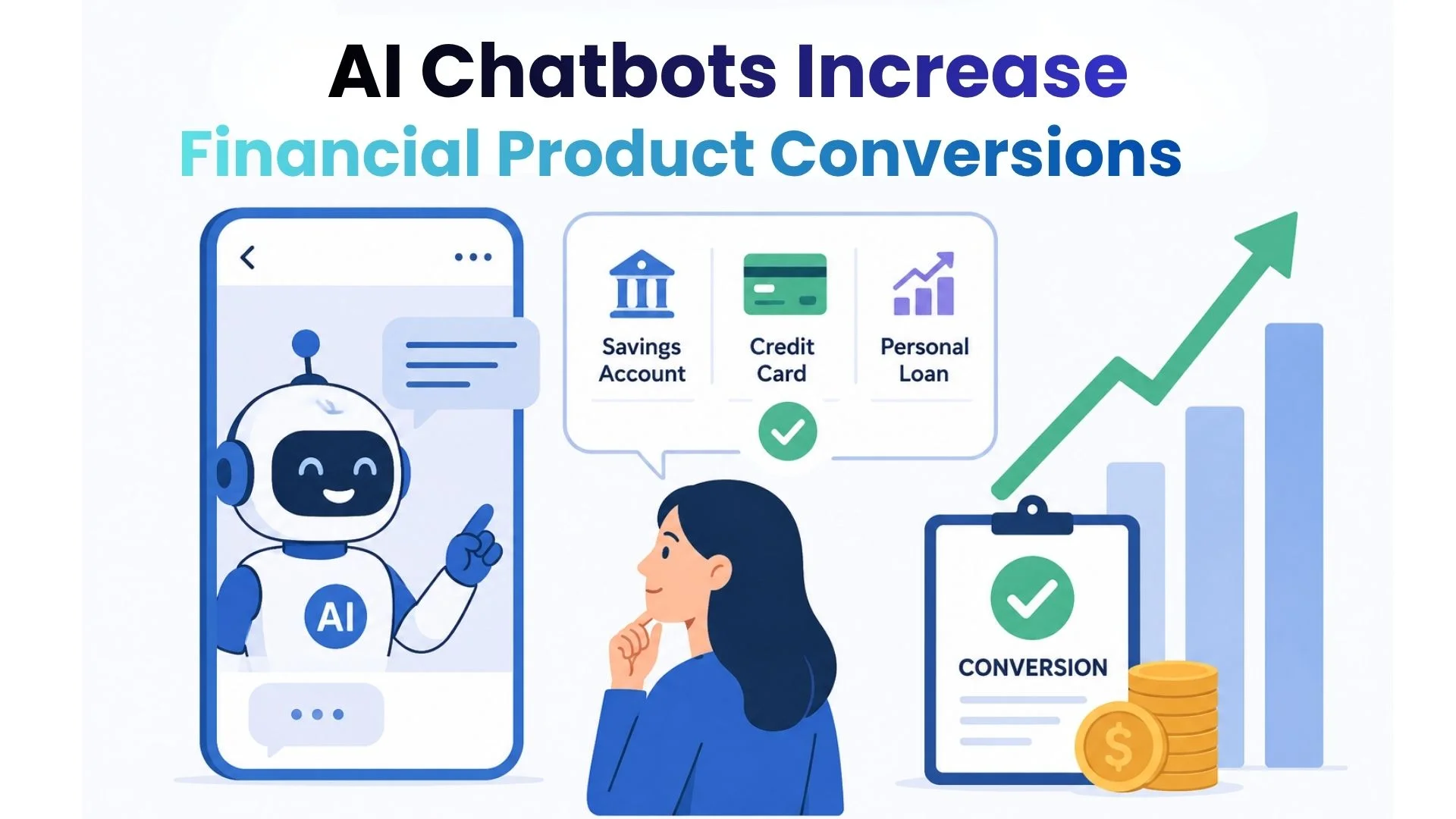
An AI chatbot for financial services platforms improves customer conversions by delivering immediate, contextual, and personalized assistance during high-intent financial interactions. These systems use conversational AI to simplify onboarding, answer product-specific questions, qualify leads, and maintain engagement across channels, helping banks and financial institutions convert more users without creating additional operational bottlenecks.
Why Banks Lose High-Intent Customers
Financial institutions lose high-intent customers when digital journeys create uncertainty, delays, or interruptions during critical decision-making moments. Complex onboarding flows, slow responses, and disconnected support systems reduce trust before the customer reaches conversion.
Where Financial Product Conversions Typically Collapse
| Customer Pain Point | What Happens | Business Impact |
| Delayed responses | Users wait for clarification on loans, insurance, or investment products | Leads compare competitors before receiving answers |
| Static onboarding forms | Customers must self-navigate complex financial processes | Higher application abandonment rates |
| Unclear eligibility criteria | Users do not know whether they qualify | Qualified prospects leave before applying |
| Confusing documentation requirements | Customers cannot understand required financial documents | Incomplete applications and drop-offs increase |
| No real-time assistance | Customers cannot resolve objections instantly | Conversion momentum disappears |
Why Financial Customers Leave Before Converting
- Financial applicants need immediate clarification on eligibility, documentation, repayments, and compliance requirements before completing applications confidently.
- Banking customers frequently switch between comparison, verification, and decision stages during a single financial product journey.
- Human-only support teams cannot maintain instant engagement across websites, mobile apps, and messaging platforms simultaneously.
- Deloitte research found 74% of users prefer human support when chatbot interactions feel inaccurate or overly scripted.
- Modern customers expect automated financial assistance that guides decisions proactively instead of acting like static customer support.
Stop Losing Qualified Financial Leads
Reduce onboarding delays and guide customers before they leave your website.
How Conversational AI Increases Financial Product Conversions
Financial institutions increase conversions when they simplify customer journeys, accelerate response times, and guide customers through complex decisions in real time. An AI chatbot for banking improves conversion performance by combining instant engagement, contextual assistance, personalization, and scalable customer interaction across the entire financial journey.
Real-Time Engagement Prevents Lead Decay
Financial intent drops quickly when users cannot get immediate answers. Customers researching loans, insurance, credit cards, or investment products often compare multiple providers simultaneously.
An AI sales chatbot for finance engages users the moment they land on a product page, open an application flow, or hesitate during onboarding. Real-time interaction preserves buying momentum and prevents high-intent leads from leaving before qualification begins.
This operational speed creates a measurable business impact. Financial institutions using AI-driven engagement systems report conversion uplifts between 10% and 25% in high-performing implementations.
NLP and ML Enable Contextual Financial Conversations
Traditional rule-based chatbots struggle with layered financial questions because they depend on rigid workflows. Modern conversational systems use natural language processing and machine learning to understand intent, context, and customer goals during live interactions.
An AI-powered banking assistant can answer eligibility questions, explain repayment models, clarify documentation requirements, and adjust recommendations based on user responses within the same conversation.
This creates a major trust advantage in finance, where uncertainty often blocks conversion decisions.
Conversational Onboarding Helps Users Move Faster
Financial onboarding flows often overwhelm users with static forms, financial terminology, and multi-step qualification requirements. Conversational interfaces simplify this process by guiding users one step at a time.
Instead of forcing customers through long application pages, conversational AI systems support:
- Product discovery
- Eligibility clarification
- Document guidance
- Loan pre-qualification
- Insurance onboarding
- Investment suitability assessment
This reduces cognitive overload and improves completion rates across complex financial journeys. Some institutions now report loan support and onboarding time reductions of up to 75% through AI-assisted workflows.
Hyper-Personalization Improves Product Relevance
Financial products require contextual relevance to convert effectively. Generic recommendations reduce trust and create decision fatigue.
An AI chatbot for banking analyzes conversational signals, behavioral intent, and product interests to deliver highly relevant financial recommendations during live engagement. These systems can identify opportunities for:
- Credit product upgrades
- Insurance add-ons
- Refinancing offers
- Investment recommendations
- Personalized savings products
This form of AI-driven customer acquisition improves upsell and cross-sell performance because recommendations appear naturally within the conversation instead of feeling promotional.
Deliver Personalized Financial Recommendations in Real Time
Guide customers toward relevant financial products through contextual conversational engagement.
Persistent Follow-Ups Increase Conversion Continuity
Financial product decisions are not made in a single session. Customers often leave applications unfinished while comparing rates, reviewing documents, or discussing decisions internally.
Conversational AI systems maintain continuity through intelligent follow-ups, reminders, and contextual re-engagement. An AI-powered banking assistant can reconnect with users about incomplete applications, expiring offers, or pending documentation requirements without restarting the entire process.
Financial teams managing diverse regional markets can extend follow-up continuity using an AI agent for multilingual communication. This persistence improves lead recovery while reducing dependency on manual sales outreach.
AI Chatbots Scale Financial Engagement Efficiently
Human-only engagement models cannot maintain instant, personalized interaction across thousands of simultaneous financial conversations. AI systems solve this scalability challenge without proportional staffing growth. High-intent financial conversations can transition more efficiently into advisor consultations through an AI appointment booking chatbot working 24/7.
The best AI chatbot for financial services platforms now automates up to 90% of routine financial inquiries while significantly reducing operational costs. Industry benchmarks show support interaction costs dropping from approximately USD 3–6 per human-led interaction to nearly USD 0.25–0.50 through AI agent deployment.
This operational efficiency allows financial institutions to increase engagement capacity while maintaining faster response times and consistent customer experiences across channels.
Where AI Chatbots deliver the Highest Conversion Impact in BFSI
Conversational AI delivers the strongest conversion impact when financial institutions apply it to high-volume customer journeys that require continuous guidance and fast decision support. The most successful deployments focus on reducing delays, simplifying onboarding, and guiding customers through financially sensitive decisions in real time.
Banking: Simplifying High-Intent Customer Decisions
Modern lending and insurance teams use conversational AI solutions for financial institutions to improve onboarding speed and customer qualification workflows.
| Use Case | Conversion Impact |
| Loan pre-qualification | Reduces drop-offs by instantly clarifying eligibility and documentation |
| Credit card recommendations | Improves upsell relevance through contextual product matching |
| Digital onboarding | Simplifies multi-step account opening journeys |
| Mortgage assistance | Guides users through rates, approvals, and repayment structures |
An AI chatbot can guide users through a loan application conversationally instead of forcing them through static forms. Customers receive immediate clarification on interest rates, income requirements, and approval criteria while remaining inside the application journey.
AI-assisted KYC onboarding has reduced onboarding time by up to 80% in some banking deployments, especially where document verification and eligibility workflows previously required manual review.
Insurance: Improving Policy Qualification and Renewal Conversion
Insurance journeys often fail when customers cannot understand policy coverage, pricing models, or claim conditions quickly enough. An AI chatbot for insurance lead generation systems simplifies these journeys by turning policy exploration into guided conversations.
High-Impact Insurance Use Cases
| Use Case | Conversion Impact |
| Policy guidance | Reduces confusion around coverage and exclusions |
| Quote qualification | Improves lead quality before agent escalation |
| Renewal engagement | Prevents churn through proactive follow-ups |
| Claims assistance | Maintains engagement during high-trust interactions |
Insurance chatbot automation also improves renewal retention by proactively engaging customers before policy expiration. AI systems can explain updated coverage options, identify upsell opportunities, and answer objections immediately during renewal discussions.
Investment & Wealth Management: Simplifying High-Trust Engagement
Wealth management requires contextual education, risk clarification, and guided onboarding before customers commit financially. A chatbot for investment firms helps reduce hesitation during early-stage financial discussions.
High-Impact Investment Use Cases
| Use Case | Conversion Impact |
| Portfolio onboarding | Simplifies investor entry processes |
| Investment education | Improves trust through contextual explanations |
| Risk-profile guidance | Helps users understand suitable investment paths |
| Meeting scheduling | Accelerates advisor engagement for high-intent prospects |
Conversational AI also supports financial advisors by handling repetitive qualification and onboarding conversations before human escalation becomes necessary.
FinTech & Payments: Recovering Revenue in Real Time
FinTech platforms rely heavily on speed, transaction continuity, and user convenience. AI systems improve conversions by intervening immediately when payment or subscription issues disrupt the customer journey.
High-Impact FinTech Use Cases
| Use Case | Conversion Impact |
| Failed payment recovery | Prevents transaction abandonment |
| Subscription billing support | Reduces churn and support dependency |
| Conversational checkout guidance | Improves payment completion rates |
| Transaction clarification | Reduces uncertainty during digital payments |
AI agents can identify failed payment patterns, explain transaction issues instantly, and guide users toward resolution without forcing them into delayed support queues.
Many financial institutions now use AI agents to handle between 65% and 90% of routine interaction volume, allowing human teams to focus on high-value financial conversations while maintaining scalable customer engagement.
Why AI Chatbots Are Becoming Infrastructure Instead of Support Tools
Financial institutions no longer view conversational systems as isolated customer support layers. Modern BFSI organizations are integrating conversational AI for finance directly into customer acquisition, onboarding, qualification, servicing, and day-to-day activities because financial engagement increasingly starts through a Website AI Chatbot, but conversations now continue seamlessly across various messaging channels as well.
This shift represents a broader transition from systems of record to systems of action. Earlier banking systems stored customer information and processed transactions after manual input. Today’s AI-driven systems actively guide customers, qualify opportunities, trigger workflows, schedule meetings, answer compliance questions, and support onboarding in real time.
An always-on customer support chatbot now functions as operational infrastructure rather than a reactive support channel. These systems support autonomous workflows, proactive engagement, multilingual interactions, and scalable customer communication without proportional staffing increases.
This transformation is accelerating rapidly across the industry. Research shows that 100% of surveyed global systemically important banks planned increased AI investment in 2025. Under aggressive adoption scenarios, the global AI market in BFSI is projected to exceed USD 1 trillion by 2034.
As embedded finance and omnichannel banking expand, AI chatbot integrations are becoming foundational to how financial institutions engage, convert, and retain customers digitally.
What Financial Institutions Should Evaluate Before Deploying AI Chatbots
Financial institutions should evaluate conversational AI platforms based on operational reliability, customer trust, and governance readiness instead of surface-level automation features. In banking and insurance environments, inaccurate responses, weak escalation handling, or outdated financial information can directly damage customer confidence and conversion outcomes.
A secure AI chatbot for banking customers should support contextual conversations that maintain continuity across onboarding, qualification, servicing, and follow-up interactions. Financial users expect immediate answers that remain accurate, explainable, and compliant throughout the journey.
Institutions should evaluate whether the platform supports:
- Secure document training and controlled knowledge updates
- Real-time information retrieval and version accuracy
- Human escalation pathways for sensitive financial situations
- Audit visibility across conversations and interactions
- Governance controls for public and internal deployments
- Multilingual AI agent capabilities for global customer engagement
Purely rule-based bots often fail in finance because financial conversations rarely follow predictable paths. Customers ask layered questions involving eligibility, repayments, compliance, documentation, and risk simultaneously.
Trust is equally important. Research shows 95% of consumers expect explanations for AI-made decisions. This makes explainability and transparency essential for any GDPR-compliant AI chatbot deployed in regulated financial environments.
The most practical method combines AI scalability with human oversight instead of pursuing fully autonomous financial interactions.
Why Choose GetMyAI for Financial Customer Engagement
GetMyAI helps financial institutions deploy AI-driven customer journeys that support qualification, onboarding, engagement, and appointment workflows across digital banking environments. The platform is designed for organizations that need conversational engagement to function operationally across customer acquisition and servicing instead of acting like a basic support widget.
1. Real-Time Financial Engagement
Engage visitors the moment they land on your website with auto-show initial messages, suggested prompts, and 24/7 conversational support. GetMyAI helps financial institutions guide users toward relevant services, applications, and onboarding flows in real time instead of relying on delayed callbacks or static forms.
Pro Tip: Use the built-in website preview inside the Playground to test chatbot positioning, conversation flow, and user experience before deployment.
2. Conversational Lead Qualification
GetMyAI supports guided Q&A-based interactions that help businesses qualify users naturally through conversation.
- Q&A-based qualification flows
- Conversational customer data capture
- CRM-style lead collection
- Enquiry form fallback for unresolved or complex cases
This helps financial teams qualify leads naturally while reducing application abandonment.
3. Context-Aware Financial Conversations
AI agents maintain conversation continuity across customer journeys, reducing repetitive interactions during financial discussions involving applications, approvals, or documentation clarification.
4. Automated Financial Appointment Booking
GetMyAI supports meeting booking through Calendly, Google Calendar, and Cal.com integrations with fallback logic across platforms to maintain scheduling continuity.
5. Omnichannel and Multilingual Deployment
Deploy AI agents across websites, WordPress, WhatsApp, Telegram, and Slack while supporting multilingual engagement and right-to-left alignment for regional customer experiences.
GetMyAI also supports continuous optimization through Activity logs, unanswered question tracking, and Improvement workflows that help teams refine responses using real customer interaction data.
Create Smarter Financial Customer Journeys
Improve banking engagement with contextual AI conversations and multilingual deployment support.
FAQs
How do AI chatbots increase financial conversions?
An AI chatbot for financial services improves conversions by delivering instant answers, guided onboarding, contextual recommendations, and continuous engagement throughout complex financial journeys, helping users complete applications faster and with greater confidence.
Can AI chatbots improve loan application conversions?
Yes. Conversational AI helps users understand eligibility, repayment terms, and documentation requirements in real time, reducing application abandonment and improving completion rates during digital loan onboarding processes.
How are banks using AI chatbots for lead generation?
Banks use lead generation chatbots to qualify prospects conversationally, collect customer intent data, recommend relevant products, and route high-intent users toward applications, advisors, or appointment booking systems automatically.
How do fintech chatbots generate leads?
FinTech companies use AI-driven customer acquisition systems to engage visitors instantly, recover incomplete onboarding flows, explain payment issues, and maintain personalized follow-ups that improve lead conversion across digital payment and subscription journeys.
Why is multilingual support important in financial AI chatbots?
A multilingual AI agent helps financial institutions support customers across regions and languages while maintaining conversational consistency, improving accessibility, and reducing communication barriers during onboarding, servicing, and product qualification interactions.
What should financial institutions evaluate before deploying AI chatbots?
Organizations should evaluate conversational accuracy, secure document training, escalation pathways, audit visibility, governance controls, and GDPR-compliant AI chatbot capabilities before deploying AI systems in regulated financial environments.