How Telecom Companies Are Using AI Agents to Scale Customer Operations Without Reducing CSAT

Key Takeaways
- Scaling customer operations now depends more on resolution speed and accuracy than on expanding contact center headcount.
- AI agents handle repetitive support workflows autonomously, allowing human teams to focus on complex, high-value customer interactions.
- Leading telecom providers measure solution rate and customer effort, not just deflection rate or call reduction metrics.
- Successful deployments integrate directly with billing, provisioning, CRM and network systems to enable end-to-end issue resolution.
- The strongest customer experience outcomes come from combining AI-driven efficiency with human judgment, empathy and escalation support.
A single network outage can generate thousands of customer inquiries in a matter of minutes. Add billing disputes, service activation requests, plan changes and retention concerns and the strain on telecom support operations becomes impossible to ignore. Yet expanding customer service teams indefinitely is neither practical nor cost-effective. As providers search for new ways to increase capacity and improve responsiveness, AI-powered telecom support is becoming a key operational capability for managing customer demand at scale.
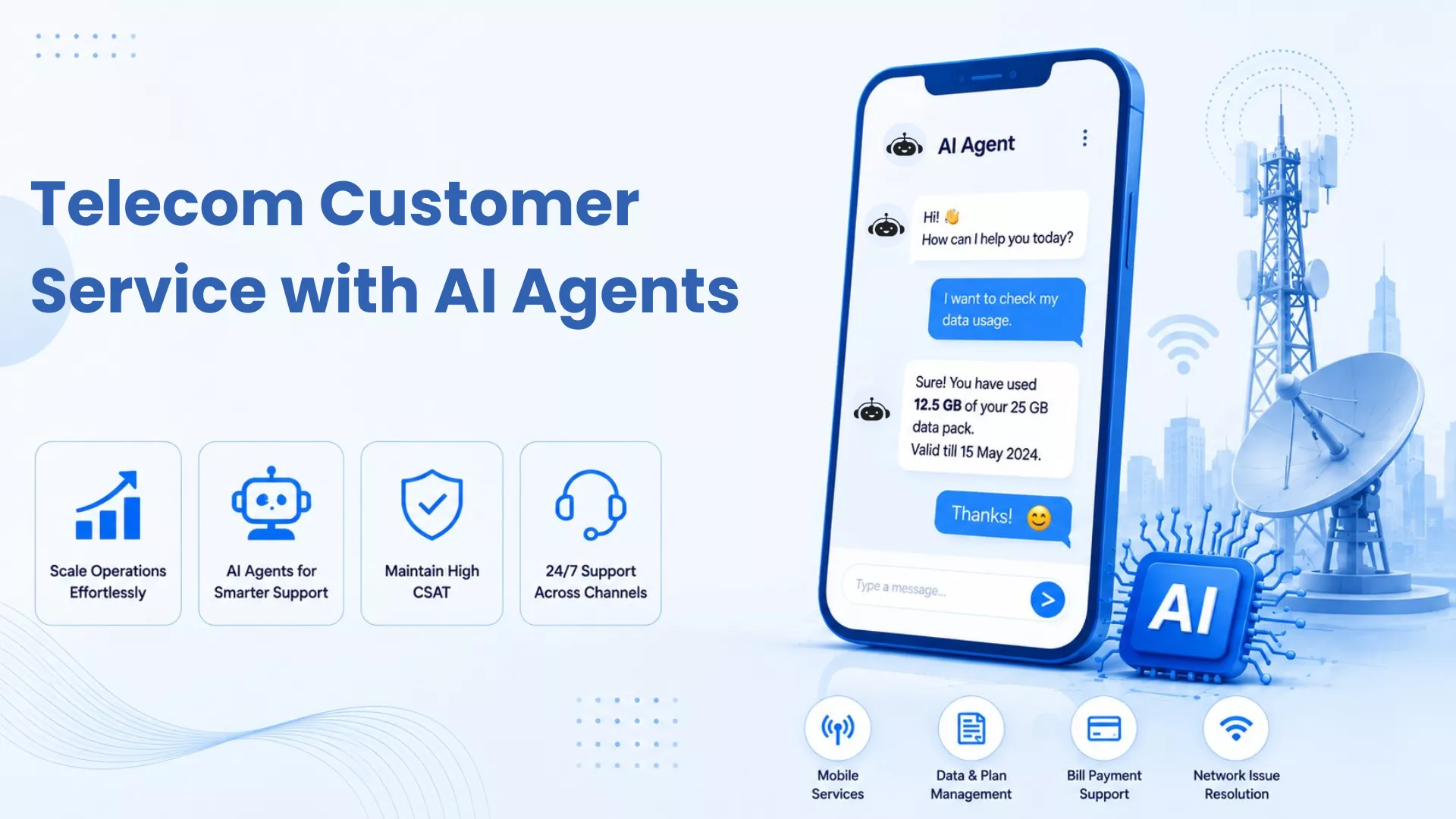
AI agents in telecom enable providers to scale customer operations by autonomously resolving billing issues, running network diagnostics, processing service requests and coordinating customer interactions across channels. As telecom companies move beyond basic chatbot deflection, AI customer service automation in telecom is becoming a core operational strategy for increasing support capacity, reducing resolution times and maintaining customer satisfaction scores without continuously adding headcount.
McKinsey estimates that effective deployment of generative AI can improve telecom customer support productivity by 30% to 45%. The significance of that figure extends beyond efficiency. It signals a broader shift in how telecom providers approach customer service. The competitive advantage is no longer determined by how many tickets can be routed or deflected. It increasingly depends on how many customer issues can be resolved completely through autonomous, zero-touch workflows before they ever reach a human queue.
Why Telecom Customer Support Is Getting Harder to Scale
At first glance, most telecom support issues appear straightforward. A customer reports slow internet speeds. The reality behind that request is far more complex.
It Happens Behind a Support Ticket
Before an issue can be resolved, agents often need to investigate multiple systems:
- Network status and outage data
- Account provisioning records
- Billing and payment history
- Device and service configuration details
- Previous support interactions
Traditional Contact Centers Struggle to Scale
Legacy contact centers depend on large support teams to compensate for fragmented data, disconnected workflows and siloed systems. As a result, agents spend a significant portion of their day searching for information, documenting interactions and routing requests instead of solving customer problems.
The Productivity Gap: Telecom representatives spend up to 68% of their day on administrative "bridge work" searching for data and documenting logs rather than solving subscriber problems.
The Customer Expectation Gap
While support teams navigate internal complexity, customers expect immediate answers. That gap is becoming increasingly expensive. According to industry research, 46% of telecom customers who switch providers cite poor customer service as a key reason for churn. Subscribers are no longer benchmarking their experience against another telecom operator.
They are comparing it against the frictionless experiences delivered by digital-first companies, many of which rely on an always-on customer support chatbot to handle inquiries at any hour without queue delays. Closing that gap is part of why conversational AI for telecom customer care is gaining traction, giving providers a way to meet rising expectations without adding proportional headcount.
Where Ticket Deflection Falls Short
For years, operators attempted to manage rising support volumes through:
- IVR menus
- Scripted chatbots
- Decision-tree workflows
- Ticket deflection initiatives
These reduced contact volumes on reports and dashboards. They rarely reduced customer effort. Instead of resolving issues, many systems simply inserted additional steps between the customer and a solution. Customers repeated information, navigated rigid menus and ultimately escalated to a human agent anyway. True automated customer support in telecom means eliminating those steps entirely, not redistributing them across a longer self-service path.
The Real Challenge Telecom Leaders Must Solve
For telecom operators, the biggest challenge is delivering fast resolutions without sacrificing service quality. That is why the conversation around telecom AI customer service has evolved. Leading operators are shifting their focus from deflecting interactions to resolving them, with the goal of improving efficiency without compromising customer satisfaction scores.
Resolve More, Escalate Less
Automate repetitive telecom requests while maintaining service quality and customer satisfaction.
Where AI Agents Deliver the Biggest Impact in Telecom Customer Operations
The most successful telecom AI deployments share a common trait: they target high-volume workflows that consume significant agent time but follow repeatable resolution patterns. Rather than replacing entire support teams, AI agents take ownership of routine operational work that slows down contact centers and frustrates subscribers.
Billing and Account Resolution
Billing disputes remain one of the largest drivers of inbound support volume. AI agents can cross-reference usage records, billing history, plan details and payment activity in real time to explain charges, validate disputes and issue approved credits automatically.
Vodafone's generative AI-powered assistant increased first-time resolution rates from 15% to 60%, demonstrating how faster answers directly improve customer experience when common issues are resolved without escalation.
Technical Troubleshooting
Many technical issues follow predictable diagnostic paths. AI agents can run network checks, perform remote device resets, validate service configurations and identify known outages before a human agent becomes involved.
TELUS reported that 91% of customers engaged with AI-guided self-service troubleshooting, helping the company prevent hundreds of thousands of support calls from reaching its contact centers.
Subscriber Growth and Retention
AI agents increasingly support revenue-generating workflows, not just support functions.
| Workflow | How AI Agents Create Value |
| Plan upgrades | Analyze usage patterns and recommend better-fit plans |
| Customer onboarding | Automate identity verification and service activation |
| Churn prevention | Trigger personalized retention offers before cancellation requests occur |
| Loyalty programs | Deliver targeted discounts based on customer history |
Operators using AI-driven retention campaigns have reported conversion rates significantly higher than traditional mass-market promotions because offers are delivered when customer intent signals appear, not after a churn event begins.
AI agents increasingly support revenue-generating workflows, not just support functions. An AI chatbot for lead generation can identify upgrade opportunities, qualify inbound interest and route high-intent subscribers to the right offer before a human representative becomes involved.
Omnichannel Support and Proactive Service
One of the biggest causes of telecom customer frustration is repeating the same issue across multiple channels. Modern conversational AI for telecom maintains context across websites, mobile apps, voice channels and WhatsApp conversations. Customers can switch channels without restarting the interaction.
Leading providers are also using agents proactively with real-time language translation AI. Instead of waiting for support volumes to spike during network disruptions, agents identify affected subscribers and send outage notifications, status updates and expected resolution times automatically.
The Metric That Works with AI Chatbot for Telecom Industry: Solution Rate
For years, telecom contact centers measured success through deflection rates. The assumption was simple: if fewer customers reached a human agent, support operations became more efficient.
That metric made sense when automation was limited to IVR systems and rule-based chatbots. It makes far less sense in an environment where AI agents for telecom customer support automation can investigate issues, execute actions and resolve requests autonomously.
The problem is that deflection does not measure whether the customer actually received a solution.
| Traditional Support Metrics | Modern AI Agent Metrics |
| Deflection Rate | Solution Rate |
| Calls Avoided | Issues Resolved |
| Chat Containment | First Contact Resolution |
| Cost Per Contact | Customer Effort |
| Queue Reduction | Resolution Speed |
This shift is critical for maintaining customer satisfaction scores at scale. Customers rarely judge a support interaction based on the channel they used. They judge it based on how quickly their issue was resolved and how much effort was required to reach that outcome.
The best telecom operators design AI workflows around resolution, not containment. When an AI agent identifies a billing exception, a complex technical fault, or signs of customer frustration, it escalates the conversation immediately. The human representative receives the conversation history, diagnostic results, customer sentiment and previous actions taken, eliminating the need for customers to repeat information.
This explains why leading telecom providers are seeing higher automation rates without sacrificing CSAT. AI-powered customer interactions handle routine work independently, such as billing checks, outage queries and plan modifications. Human teams stay focused on situations that require judgment, negotiation, or empathy. The customer experiences a faster path to resolution, regardless of whether the issue is solved by an AI agent, a human agent, or a combination of both.
Stop Measuring Deflection
See how resolution-first AI workflows improve customer satisfaction at scale.
How Telecom Operators Are Building AI-Assisted Support Teams
One of the less discussed benefits of AI customer service automation in telecom is how it changes the work performed by human support teams. Telecom representatives spend up to 68% of their time on administrative and repetitive activities, including searching for information, documenting interactions and handling routine requests. That leaves less time for the conversations that influence customer retention, account growth and long-term loyalty. AI agents reduce this operational burden by taking ownership of high-volume, repeatable support tasks.
As AI agents in telecom absorb billing inquiries, outage checks, password resets and plan modifications, the number of routine interactions reaching human agents begins to decline. What remains are the conversations that require context, judgment and flexibility. Human agents spend more time handling churn-risk customers, service disputes, enterprise accounts and complex support escalations. The result is a noticeable shift in the complexity curve of the contact center. AI does not diminish the importance of human agents; it increases the value of the work they perform.
The change becomes obvious when comparing a typical support day before and after AI enters the workflow.
- A Support Agent Before AI Assistance
A customer calls about an unexpected charge on their bill. The agent opens multiple systems to review billing records, account history, payment status and previous support interactions. While handling the conversation, they manually document notes and search internal resources for answers. By the time the issue is resolved, a significant portion of the interaction has been spent gathering information rather than helping the customer.
- A Support Agent Working Alongside AI
The same billing inquiry arrives, but the AI has already summarized previous interactions, surfaced relevant account activity and highlighted potential causes behind the charge. Recommended next actions are available before the conversation begins. The agent spends less time navigating systems and more time addressing the customer's concerns, clarifying options and strengthening the relationship. The interaction becomes focused on resolution rather than information retrieval.
This is becoming increasingly common across telecom customer service operations. AI delivers speed, consistency and scale across routine interactions, while human agents provide judgment, empathy and problem-solving for complex situations. Together, they create a support environment capable of handling growing customer volumes while protecting the customer satisfaction scores that matter most.
What Telecom Leaders Should Look for in an AI Agent Platform
Not every AI platform is built for the complexity of telecom customer operations. The most effective AI agents in telecom do more than answer questions. They connect directly with the systems, workflows and support processes required to resolve customer issues from start to finish.
- The first priority is integration. An AI agent should be able to access billing systems, account records, service provisioning data and knowledge sources without creating additional operational silos. Without access to the right information, even the most advanced AI struggles to deliver accurate resolutions.
- Telecom leaders should also evaluate how well a platform supports omnichannel experiences. Customers increasingly move between websites, mobile apps, messaging channels and support teams. Maintaining context across those touchpoints reduces customer effort and improves resolution speed.
- Equally important is human escalation. When a customer reaches a complex issue or sensitive situation, the AI should transfer conversation history, relevant context and previous actions to a support representative automatically.
- Finally, visibility matters. Strong analytics, conversation monitoring and continuous improvement workflows help teams identify unresolved questions, refine knowledge sources and improve performance over time. A customer feedback chatbot embedded within these workflows ensures that subscriber sentiment is captured at the point of resolution, not through a separate survey sent hours later.
The success of telecom AI customer service initiatives depends less on the AI model itself and more on how effectively the platform integrates with customer operations, support teams and business systems.
Why Choose GetMyAI for Telecom Customer Operations
Successful telecom AI deployments depend on more than conversational capabilities. They require a platform that can connect knowledge, automate workflows, support multiple channels, and continuously improve through real customer interactions.
GetMyAI enables telecom providers to build and deploy AI agents that do more than answer questions. Teams can create AI-powered telecom support experiences that handle billing inquiries, service requests, troubleshooting workflows, onboarding journeys, and customer retention interactions from a single platform.
With GetMyAI, telecom organizations can:
- Deploy AI agents across websites, WhatsApp, Telegram, Slack, and other customer touchpoints
- Connect knowledge sources including documents, Q&A content, websites, and internal resources
- Monitor conversations through Activity logs and identify unanswered questions for continuous improvement
- Track adoption, engagement, feedback, and performance through built-in Analytics
- Collect leads and customer information through intelligent forms embedded directly into conversations
- Enable meeting booking through Calendly, Google Calendar, or Cal.com when human assistance is required
- Maintain seamless escalation paths between AI and human support teams
As customer expectations continue to rise, telecom providers need more than ticket deflection tools. GetMyAI helps organizations build AI agents focused on faster resolutions, lower support effort, and better customer experiences at scale.
Whether your goal is reducing support volumes, improving response times, increasing customer satisfaction, or scaling operations without expanding headcount, GetMyAI provides the foundation to make AI customer service automation in telecom practical, measurable, and operationally effective.
Build Your Telecom AI Agent
Launch AI-powered support workflows across every customer touchpoint from one platform.
FAQs
Can AI agents improve CSAT in telecom?
Yes. AI agents in telecom improve customer satisfaction by reducing wait times, resolving issues faster and maintaining conversation context across channels. The most successful deployments focus on complete issue resolution, helping operators improve service quality without increasing support headcount.
What is the difference between AI agents and telecom chatbots?
An AI chatbot for telecom industry environments typically answers questions and follows predefined workflows. AI agents go further by accessing systems, performing actions, running diagnostics, processing requests and completing multi-step tasks without requiring constant human intervention.
How do AI agents reduce telecom support costs?
AI customer service automation in telecom reduces costs by handling repetitive inquiries, automating diagnostics, processing account requests and reducing average handle times. This allows support teams to manage higher customer volumes while focusing human expertise on more complex interactions.
How does conversational AI improve customer experience?
Conversational AI for telecom improves customer experience by delivering consistent responses, maintaining context across touchpoints and reducing the need for customers to repeat information. This creates smoother interactions and supports stronger customer experience management across digital channels.
What should telecom companies look for in an AI platform?
The best telecom call center AI solutions combine backend integrations, omnichannel support, analytics and human escalation capabilities. Operators should prioritize platforms that support AI-powered customer interactions while connecting seamlessly with existing customer service and operational systems.