How AI Agents Engage Candidates Instantly and Reduce Drop-Off in Recruitment

Key Takeaways
- Candidates do not wait for slow hiring teams. Every delayed reply, missed update and scheduling delay increases the chance of losing qualified applicants to faster employers.
- Answering candidate questions is only one part of the job. AI recruitment agents deliver the biggest gains by qualifying applicants, scheduling interviews and keeping every hiring stage moving.
- Conversation counts do not prove recruitment success. Track response times, application completion, interview attendance and offer acceptance to understand whether hiring is actually improving.
- Recruiters spend more time hiring when AI agents take care of repetitive work such as candidate communication, interview coordination and routine qualification.
- The best recruitment results come from combining AI with recruiter expertise, giving candidates fast support while keeping hiring decisions where they belong, with your HR team.
Recruitment teams rarely lose qualified candidates because another employer offers a higher salary first. It is silence. Every hour a candidate waits for an answer makes another offer look more attractive. Today's job seekers expect the same fast, personalized interactions they receive from banks, retailers and food delivery apps. AI recruitment agents that reduce candidate drop-off keep hiring conversations active by answering questions, sharing updates and guiding candidates through every stage, helping recruiters maintain momentum instead of rebuilding a shrinking talent pipeline.
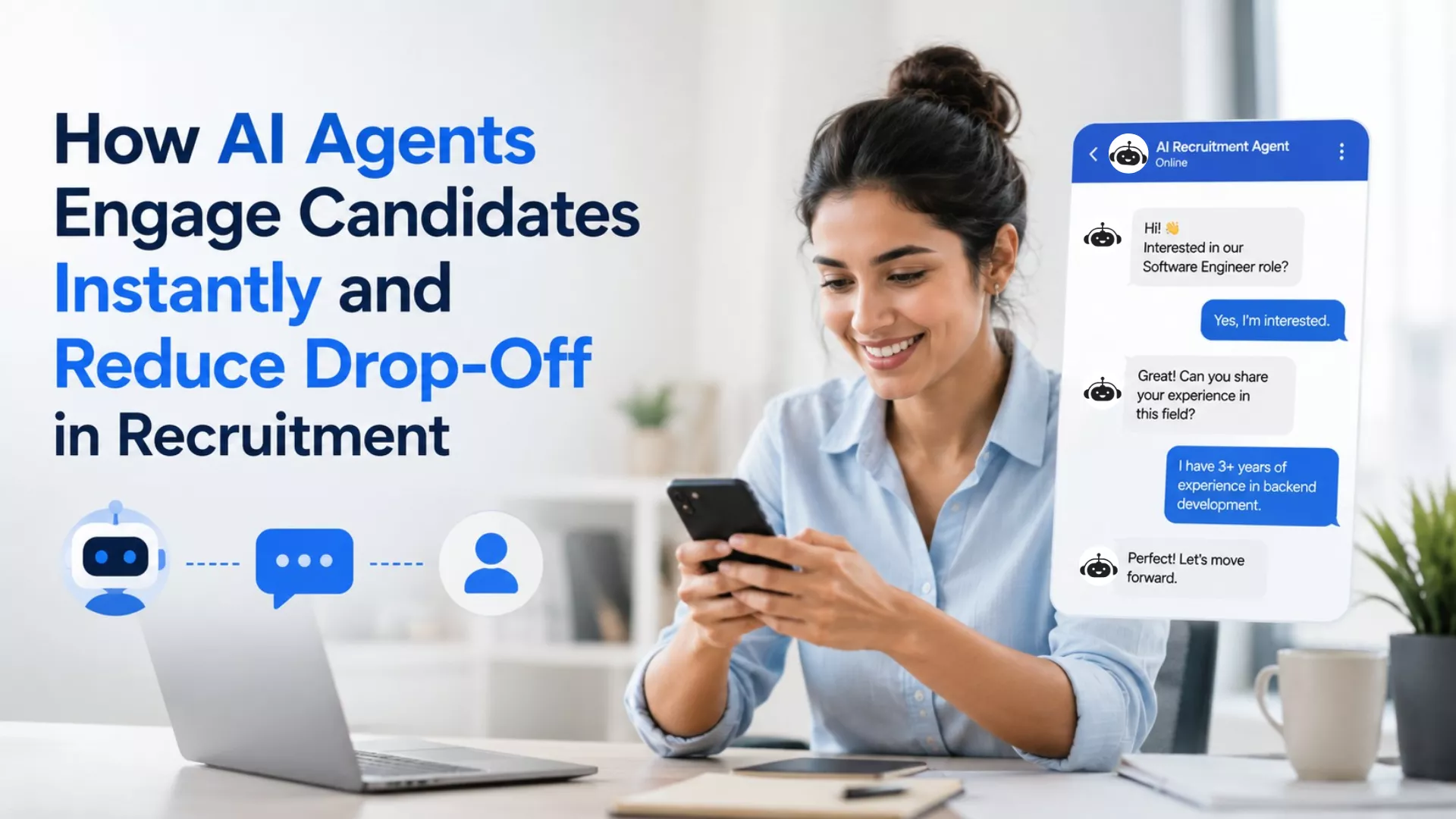
AI agents for recruitment reduce candidate drop-off by keeping candidates engaged throughout the hiring process. Unlike traditional chatbots, they understand context, qualify applicants, coordinate interviews, send timely updates and trigger actions across recruitment systems. Modern AI recruiting agents help recruiters respond faster, reduce administrative delays and create a hiring experience that keeps qualified candidates moving toward an offer instead of leaving for another opportunity.
Why Candidates Drop Off During the Recruitment Process
Your HR team replies on Friday. The candidate accepted another offer on Wednesday.
That is how many lose their next potential candidate all through a series of small delays that gradually convince candidates to move on. A lengthy application, a week without hearing from a recruiter, another round of interviews and no idea of what happens next all create anxiety.
- CareerPlug found that 34% of candidates assume they have been ghosted after seven days of silence.
- Lever reports that 80% would not apply to an employer again if they never received updates about their application.
These findings explain why AI-based candidate communication has become a priority for many hiring teams.
Candidates also compare hiring experiences with the digital services they use every day. They expect to apply from their phones, receive quick responses and know where they stand. When that does not happen, many abandon the process before recruiters even realize they have left. Improving candidate experience automation and investing in AI recruitment automation starts with fixing these hiring delays rather than simply attracting more applicants.
| Recruitment Stage | Common Drop-Off Reason | How it Impacts your Business |
| Application | Lengthy forms, repeated data entry and poor mobile experience | Lower application completion and fewer qualified candidates entering the pipeline. |
| Initial Response | Slow recruiter replies and limited communication | Candidates assume they have been ghosted, lose interest or accept another offer before the first conversation begins. |
| Interview Scheduling | Manual calendar coordination across recruiters and hiring managers | Longer time-to-interview, higher scheduling abandonment and slower hiring decisions. |
| Interview Process | Delayed feedback and inconsistent updates | Lower candidate trust, more interview no-shows and stronger interest in competing employers. |
| Offer Stage | Slow approvals and delayed offers | Qualified candidates leave the process before an offer reaches them. |
How AI Agents Keep Candidates Engaged from First Click to Final Offer
Every stage of recruitment leaves candidates with questions. Is this role right for me? Has my application been reviewed? When is the interview? If your hiring team cannot answer those questions quickly, many candidates stop waiting and continue with employers that can.
Career page exploration
- Answers questions about roles, benefits, work culture and hiring timelines.
- Candidates find information without leaving the site, increasing engagement with open positions.
Job discovery
- Recommends relevant vacancies based on skills, experience and preferences.
- Candidates discover suitable opportunities faster instead of abandoning the search.
Application assistance
- Guides applicants through forms, explains requirements and helps complete submissions.
- Fewer incomplete applications and a smoother experience.
Qualification screening
- Uses AI agents for candidate screening to assess eligibility, verify basic qualifications and route suitable applicants to recruiters.
- Recruiters spend more time with qualified candidates while applicants receive faster decisions.
Interview scheduling
- An AI interview scheduling agent coordinates calendars, confirms availability and sends reminders automatically.
- Interviews are booked sooner with fewer scheduling conflicts.
Automate Interview Scheduling
See how AI chatbots coordinate interviews, manage calendars and reduce scheduling delays across your recruitment process.
Interview preparation
- Shares interview details, directions, required documents and preparation guidance.
- Candidates arrive informed and better prepared.
Follow-ups
- Sends application updates, answers new questions and reminds candidates about upcoming steps.
- Candidates stay informed instead of wondering whether the process has stalled.
Offer stage
- Explains offer details, answers common questions and coordinates the next onboarding steps.
- Candidates move confidently from acceptance to joining the organization.
7 Ways AI Agents Reduce Candidate Drop-Off
Every unanswered message adds another opportunity for a competitor to step in. AI Agents don't reduce drop-off by "Talking". They reduce it by answering questions, completing tasks and keeping hiring moving without unnecessary delays. Every interaction removes a small obstacle before it turns into a reason for candidates to leave.
1. Respond Instantly to Candidate Questions
Candidates often have simple questions about job requirements, locations, salary ranges or application deadlines. When those answers arrive days later, many move on to another employer. AI agents for recruitment respond immediately with accurate, context-aware information. For example, a candidate asking whether hybrid work is available receives an instant answer instead of waiting for HR, keeping the application on track.
2. Guide Candidates Through Applications
Long applications become even more frustrating when candidates do not know what information is required. An AI agent walks applicants through each step, explains required documents and helps resolve common issues before they abandon the form. This type of candidate experience automation reduces incomplete applications while giving recruiters a larger pool of qualified candidates to review.
3. Qualify Applicants Without Unnecessary Delays
Recruiters often spend hours reviewing applications that do not meet basic requirements. Meanwhile, qualified candidates wait. AI agents for candidate screening assess eligibility against predefined criteria, ask follow-up questions and route suitable applicants to recruiters. For example, a sales candidate who meets the required experience can be shortlisted immediately instead of waiting until resumes are reviewed manually.
4. Schedule Interviews Automatically
Finding a common interview slot often requires multiple emails between recruiters, hiring managers and candidates. An AI interview scheduling agent checks calendar availability, suggests suitable times, confirms bookings and sends calendar invitations automatically. Candidates secure interview slots within minutes while recruiters spend less time coordinating schedules and more time preparing for interviews.
See AI Agents in Action
Explore the features that automate candidate engagement, qualification, interview scheduling and recruitment workflows.
5. Keep Candidates Updated Throughout the Hiring Process
Silence creates uncertainty. Candidates begin to wonder whether their application has been rejected or forgotten. Instead of waiting for someone to ask, AI agents send status updates after application reviews, interview completion and hiring decisions. A simple notification confirming that feedback is under review reassures candidates that the employer is still actively considering their application.
6. Send Proactive Reminders and Follow-Ups
Interview no-shows often happen because candidates forget appointments or miss important instructions. AI agents send reminders before interviews, share directions, provide joining links for virtual meetings and request missing documents when needed. This AI recruitment workflow keeps every participant informed and reduces delays caused by missed communications.
7. Escalate Complex Conversations to Recruiters When Needed
Some conversations require human judgment. Salary negotiations, accommodation requests or role-specific discussions should move directly to recruiters. Instead of attempting to answer everything, AI recruitment agents recognize these situations, collect the relevant context and hand the conversation to the right person. Recruiters receive complete background information before responding, allowing candidates to continue the conversation without repeating themselves.
Case in Point: General Motors & Conversational AI
As General Motors accelerated its transition toward electric vehicles (EVs) and autonomous technology, it needed to hire thousands of software engineers, technical specialists, and manufacturing professionals. However, coordinating interviews through its Workday Applicant Tracking System (ATS) created a significant bottleneck. Recruiters manually aligned candidate availability with hiring managers and engineering interview panels, resulting in an average scheduling time of 5–7 days.
To streamline the process, GM deployed EV-e, a conversational AI assistant integrated with Workday. The assistant automatically reached out to candidates via SMS or chat, answered common questions, verified basic qualifications, and synchronized calendars across multiple interviewers. Candidates could then select available interview slots directly from their phones, eliminating lengthy back-and-forth communication.
The results were substantial.
- 99% Faster Interview Scheduling
Reduced interview coordination time from 5–7 days to an average of 29 minutes, enabling GM to engage candidates before they accepted competing offers.
- 50,000+ Interviews Automated Annually
EV-e schedules more than 50,000 interviews every year without recruiter intervention, eliminating thousands of hours of manual coordination.
- $2M+ Annual Cost Savings
Automating interview scheduling saved over $2 million annually by significantly reducing administrative overhead.
- Recruiters Refocused on High-Value Work
With repetitive scheduling automated, recruiters spent more time building candidate relationships and evaluating technical talent instead of managing calendars.
GM's experience demonstrates how conversational AI can remove administrative friction from high-volume recruiting workflows, improving hiring speed while allowing recruitment teams to focus on higher-value work.
Start Automating Recruitment Today
Create your first AI recruitment agent and streamline candidate engagement with no complex implementation.
Measuring the Impact of AI Agents on Candidate Engagement
Think about the last hiring role that took longer than expected. Where did time disappear? Was it slow responses, interview scheduling or candidates accepting another offer? The same questions should shape how you measure AI. Focus on the hiring outcomes that change those delays, not on how many conversations the system handled.
| Metric | Positive Result for the Business |
| Candidate response time | Faster responses keep candidates engaged and reduce the chance they accept competing offers. CareerPlug found that text messages receive an average response in about 90 seconds, making response speed a measurable competitive advantage. (CareerPlug) |
| Application completion rate | A higher completion rate means fewer qualified candidates abandon the application because of lengthy forms or a poor user experience. (LinkedIn Business Solutions) |
| Interview attendance | Higher attendance reduces recruiter downtime, shortens hiring cycles and keeps interview calendars productive. |
| Candidate drop-off rate | Identifies the exact hiring stage where candidates leave, allowing recruiters to remove delays and improve conversion rates. (IBM) |
| Time-to-interview | Shorter wait times help recruiters engage qualified candidates before competitors do and reduce vacancy costs. (CareerPlug) |
| Candidate satisfaction | Positive hiring experiences strengthen employer brand, improve referrals and increase the likelihood that candidates apply again in the future. (IBM) |
| Recruiter workload | Less time spent answering repetitive questions, coordinating interviews and sending manual updates allows recruiters to focus on interviewing and hiring decisions. (IBM) |
| Offer acceptance rate | A higher acceptance rate indicates candidates remained engaged and trusted the hiring process from application to offer. SHRM identifies offer acceptance as one of the strongest indicators of recruiting effectiveness. (SHRM) |
The hiring funnel works like a series of checkpoints. When candidates stop progressing, the numbers usually point to the stage creating the delay. Fixing one weak stage often improves the performance of every stage that follows.
If you want to build a broader measurement framework, learn how to measure the ROI of AI agents in HR using operational, financial and productivity KPIs.
Best Practices for Implementing AI Agents in Recruitment
Start with Candidate Intent
Every interaction should begin with what the candidate wants to achieve, not what the organization wants to automate. Someone exploring career opportunities needs different information than a candidate waiting for interview feedback. Matching conversations to candidate intent makes interactions more relevant and keeps the hiring journey moving.
Personalize Every Conversation
Candidates expect employers to remember previous interactions. AI agents should use details such as the role applied for, hiring stage and earlier conversations to provide relevant answers. Personalization reduces repetitive questions and helps candidates feel that the hiring process is progressing.
Be Transparent
Candidates should know when they are interacting with an AI agent. Clear communication builds trust and sets realistic expectations. It also gives candidates confidence that they can request human assistance whenever the conversation requires it.
Enable Human Handoffs
Some situations need recruiter expertise. Salary discussions, accommodation requests and role-specific decisions should move to HR without forcing candidates to repeat their information. Smooth handoffs help recruiters continue conversations with the full context already available.
Connect Your Systems
AI agents become far more useful when they work with your ATS, calendars and HR platforms. Connected systems keep candidate records consistent, reduce manual updates and allow recruiters to manage the hiring workflow from a single source of truth.
Optimize Continuously
Candidate questions, application completion rates, interview attendance and hiring delays highlight where improvements are needed. Review these insights regularly and refine conversations, workflows and automations over time. AI agents support recruiters by reducing repetitive work, allowing hiring teams to focus on evaluating candidates and making better hiring decisions.
Why Choose GetMyAI for AI Recruitment Agents?
You already know where candidates drop off. The next step is choosing a platform that helps your team remove those delays without rebuilding the way you hire. We built GetMyAI to fit around your recruitment process, giving you AI agents for recruitment that support recruiters, keep candidates informed and automate the repetitive work that slows hiring down.
"Will it understand our hiring process?"
Every organization hires differently. Instead of asking you to adapt to a predefined workflow, we let you build AI agents using your own recruitment knowledge. Upload your careers page, job descriptions, hiring policies, FAQs, onboarding guides and other hiring resources. Your AI agent uses that information to answer candidate questions consistently, whether they ask about eligibility, interview timelines or company policies.
"Can it do more than answer questions?"
Absolutely. Your AI agent can collect candidate details, ask role-specific qualification questions, recommend the next step in the hiring journey and help candidates schedule interviews through integrations with Calendly, Google Calendar and Cal.com. Every interaction helps move qualified candidates closer to an interview while reducing repetitive work for your recruitment team.
"Will recruiters stay in control?"
Always. AI agents handle routine conversations, but recruiters remain responsible for hiring decisions. When a discussion requires human judgment, such as salary negotiations, special accommodations or role-specific conversations, the AI agent transfers the candidate with the full conversation history. Your recruiters pick up where the AI agent stopped, without asking candidates to repeat themselves.
"Will it continue improving with time?"
Hiring changes throughout the year, and your AI agent should change with it. Add new documents, expand your knowledge base and review unanswered candidate questions whenever your recruitment process evolves. Built-in analytics also help you understand engagement, response times, feedback and channel performance, giving your team clear insight into how candidates interact with the AI agent.
Build Your Recruitment AI Agent
See how GetMyAI can automate candidate communication, interview scheduling and hiring workflows for your recruitment team.
Whether you are hiring for specialist roles or managing high-volume recruitment, we help you build AI recruitment agents that keep candidates informed, reduce repetitive recruitment work and give your recruiters more time to focus on interviewing, evaluating and hiring the right people.
FAQs
What is the difference between an AI recruitment agent and a traditional chatbot?
Traditional chatbots follow predefined conversation flows. AI recruitment agents understand context, take actions such as scheduling interviews or qualifying applicants and support candidates across multiple stages of the hiring journey.
Does an AI agent replace recruiters, or does it assist them?
No. AI agents for recruitment handle repetitive tasks such as answering questions, screening candidates and scheduling interviews, allowing recruiters to focus on interviewing, evaluating candidates and making final hiring decisions.
Can an AI agent integrate directly with our ATS?
Yes. Most AI agents for talent acquisition integrate with ATS platforms, calendars and HR systems to synchronize candidate information, automate hiring workflows and reduce manual data entry throughout the recruitment process.
What happens if a candidate asks a question the AI agent cannot answer?
When an AI recruitment agent encounters a complex question, it can transfer the conversation to a recruiter with the full conversation history, ensuring candidates receive accurate answers without repeating information.
How does an AI agent support high-volume recruitment?
AI recruitment agents for high-volume hiring engage thousands of candidates simultaneously by answering questions, conducting automated candidate screening, coordinating interviews and sending updates, helping recruitment teams maintain a consistent candidate experience during hiring surges.