AI Agents vs Human Support in Banking: A Cost Comparison for Modern Customer Operations

Key Takeaways
- Reduce support costs without proportional headcount growth by using AI agents to absorb routine banking interactions while reserving human expertise for higher-risk customer scenarios.
- Optimize long-term support economics by focusing on hiring avoidance, since recruitment, turnover, onboarding, and backfill costs often exceed salary-related expenses.
- Evaluate AI investments using cost-per-resolution rather than cost-per-interaction, as unresolved automated contacts can generate expensive downstream human support demand.
- Strengthen operational efficiency through hybrid support models that combine AI automation with human oversight, improving resolution rates, handle times, and service scalability.
- Protect regulatory compliance and customer trust by maintaining human review for fraud, disputes, vulnerable customers, and other high-risk banking interactions.
For years, growing customer support in banking followed a familiar formula: more customers meant more agents, more supervisors, and bigger operating budgets. That model is becoming harder to sustain. Support costs continue to rise, customer expectations have shifted to always-on service, and recruiting and retaining frontline staff remains an ongoing challenge. As a result, banking leaders are asking a different question. Not whether AI can handle customer conversations, but whether it can help support operations grow without costs rising at the same rate.
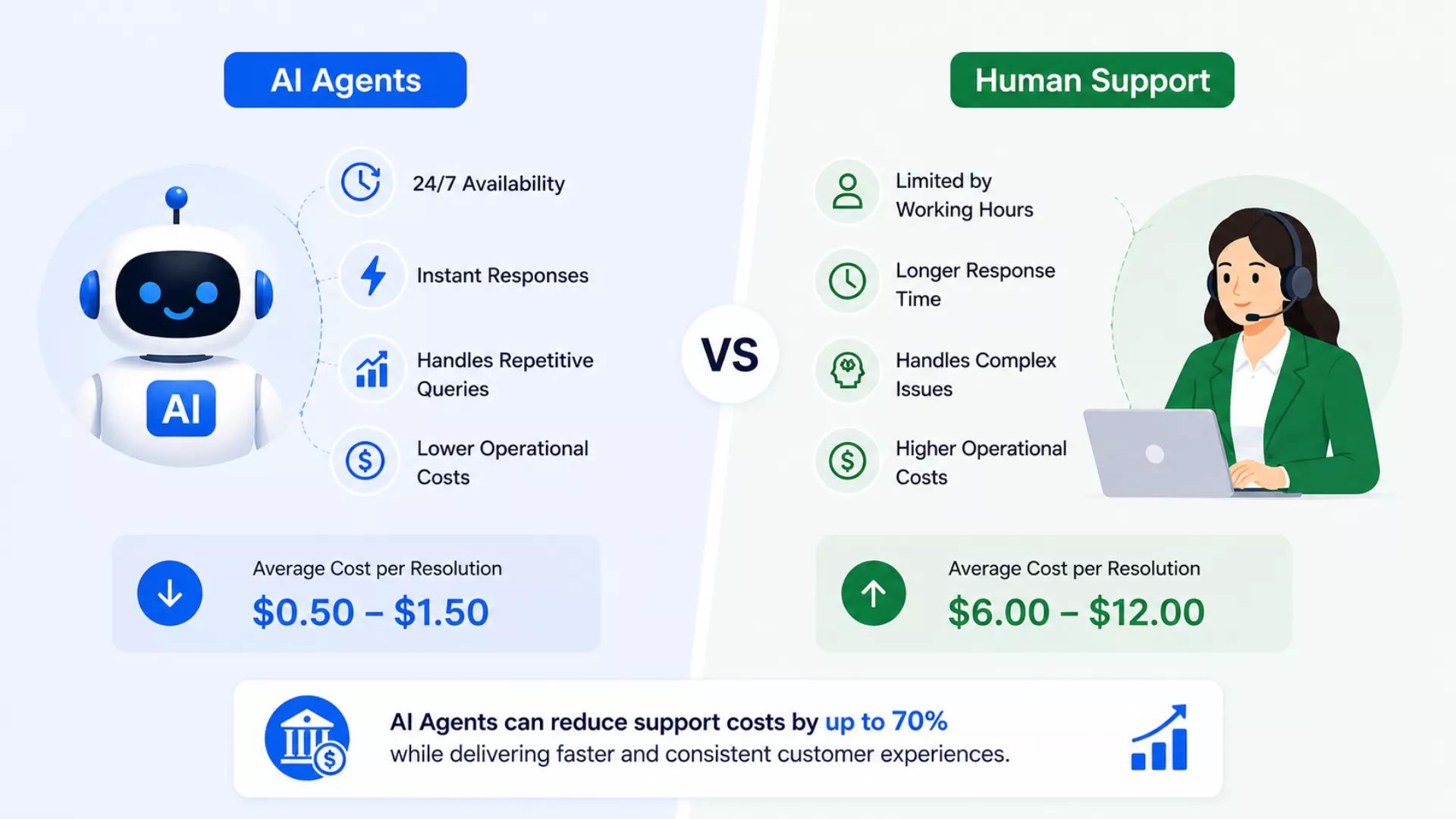
AI agents generally cost significantly less than human support in banking when handling high-volume, low-risk, and repetitive customer interactions. Human support remains essential for fraud investigations, financial hardship cases, complex disputes, and relationship-driven banking services. The lowest-cost operating model for most banks is a hybrid approach where AI agents for banks manage routine workflows while human specialists focus on complex, high-risk, and regulatory-sensitive interactions.
Why Growing Support Operations Have Become Increasingly Expensive for Banks
Most banking support cost discussions focus on salaries. That misses where the majority of operational costs actually accumulate.
As support volumes increase, banks are forced to absorb a growing mix of recruitment costs, onboarding expenses, productivity losses, management overhead, quality assurance requirements, and after-hours coverage. These costs scale alongside customer demand, making support one of the most expensive operational functions to expand.
The Hidden Cost of Support Team Turnover
Banking contact centers face some of the highest turnover rates in the service industry.
Annual attrition typically ranges between 40% and 45%, with high-pressure environments experiencing rates as high as 85%. The average support agent remains in role for only 13.7 to 15 months before leaving, a reality that increasingly shapes the ai agent cost vs employee cost discussion.
This creates a continuous cycle of:
- Recruiting replacements
- Training new hires
- Supervising ramp-up periods
- Managing productivity gaps
- Maintaining service quality during transitions
The result is a support operation that constantly reinvests resources simply to maintain existing capacity.
Why Growth Becomes Expensive
Every new customer, account, and support request creates additional operational pressure. Traditional support models scale linearly.
More volume usually requires:
| Growth Driver | Typical Human Support Response |
| More customers | More agents |
| Longer service hours | Additional shifts |
| Peak demand periods | Overtime or temporary staff |
| New products and services | Additional training |
For many banks, support costs rise almost in parallel with customer growth.
The Cost Most ROI Calculations Ignore
The financial impact of turnover extends far beyond recruitment. Research shows replacing a single support agent can cost between $31,000 and $46,000 once hiring, onboarding, training, and lost productivity are considered.
For a 100-seat banking contact center, annual backfill costs can reach $800,000 to $1.7 million. These expenses do not improve customer experience, increase revenue, or expand service capacity. They simply replace the capability that already existed, which is why the cost of human support vs AI agents in banks has become a growing focus for operations leaders.
Why Banks Are Reframing the AI Investment Case
This is why many banks are no longer evaluating AI agents as a workforce replacement initiative. They are evaluating them as a hiring avoidance strategy.
The objective is to absorb future support demand without increasing headcount at the same rate. Instead of continually expanding support teams, banks are using AI agents to handle growing volumes of routine requests while preserving human capacity for higher-value interactions.
Build Capacity More Efficiently
Use AI agents to absorb routine volume before additional hiring becomes necessary.
ROI Breakdown: Human Support vs AI Agents in Banking
With the underlying cost structure established, the financial comparison between human support and AI agents becomes more meaningful.
Direct Cost Comparison
At the interaction level, the gap between human and AI agent costs is significant. This AI agents vs human support in banking cost comparison begins with direct interaction costs. Human voice interactions in banking cost between $10 and $25 per contact. Live human chat ranges from $6 to $8. AI agent interactions, at industry benchmark pricing, cost between $0.50 and $0.70. On accessible SaaS-tier platforms, routine interactions can be resolved for approximately $0.05 to $0.06 per exchange.
| Support Model | Voice Cost | Chat Cost | Notes |
| Human Agent | $10 – $25 | $6 – $8 | Includes salary, overhead, benefits |
| AI Agent (Enterprise) | $0.50 – $0.70 | $0.50 – $0.70 | Industry benchmark |
| AI Agent (SaaS Tier) | $0.05 – $0.06 | $0.05 – $0.06 | Per resolved interaction |
These figures matter, but they require an important qualifier. Cost per interaction and cost per resolution are different metrics, and for banking operations, the second one is the one that actually affects the P&L. This distinction is particularly important when evaluating Financial Services AI Agents, where apparent efficiency gains do not always translate into lower resolution costs.
An interaction that is handled by an AI agent but leaves the customer's issue unresolved generates a follow-up human contact, often at full voice interaction cost. When that pattern occurs at scale, the apparent savings from AI deflection are partially or fully offset by the secondary contacts it produces, a challenge that frequently appears in chatbot vs human support in banking evaluations. This is one of the most overlooked realities in the AI Automation vs Human Support in Banking discussion. Measuring containment rate, the percentage of interactions completed without human escalation, without also tracking resolution rate, creates a misleading picture of actual cost savings.
24/7 Service Economics
Human support coverage across all hours requires shift premiums, night differentials, and holiday staffing, all of which carry cost structures that do not scale efficiently. After-hours interactions represent roughly 29 percent of daily banking support volume. Serving that segment through human teams requires either costly overnight staffing or accepting service gaps that drive customer dissatisfaction.
AI agents operate continuously without incremental labor cost, absorbing after-hours volume at the same per-interaction rate as peak-hour interactions. For banks evaluating AI Customer Support for Banks vs Traditional Call Centers, this represents a direct and calculable cost reduction.
Operational Leverage
The most strategically significant financial benefit is the non-linear scaling AI agents enable. Rather than adding headcount proportionally as volume grows, banks using AI agents to absorb 40 to 60 percent of Tier-1 support volume can grow their customer base without a matching expansion of support costs. Over a three-to five-year growth horizon, this divergence in cost curves represents one of the most significant Cost Benefits of AI Agents for Banks and the largest source of financial return in the AI agent investment case.
AI Agents vs Human Support: Who Wins Where
The framing of AI against humans as competing models misrepresents how leading banks are actually structuring their operations. The more useful question is where each model consistently delivers superior outcomes.
Where AI Agents Deliver the Greatest Value
When evaluating AI agents for banks, the strongest use cases share three characteristics: high frequency, deterministic outcomes, and low regulatory sensitivity. Balance inquiries, card activation, payment status checks, KYC document collection, and appointment scheduling all fit this profile. HDFC Bank's Eva and ICICI Bank's iPal resolve approximately 85 percent of routine interactions without human involvement, demonstrating what purpose-built deployment achieves at scale.
Focus Humans Where Needed Most
Let AI manage repetitive banking tasks and reserve specialists for exceptions.
Every routine interaction an AI agent resolves is one that avoids a hire, a training cycle, and an eventual replacement.
Where Human Support Delivers Greater Value
Human agents hold a clear advantage wherever the cost of a poor outcome exceeds the cost of the interaction itself. Fraud investigations, financial hardship conversations, mortgage forbearance discussions, and wealth management consultations all carry financial, regulatory, or relational consequences that automation cannot safely absorb. In these scenarios, AI vs human support in banking is not a cost optimization question. It is a risk management one.
Finding the Right Balance
The practical dividing line is interaction risk. Low risk and high frequency favor AI-driven banking operations. High stakes and emotional weight require human specialists. The middle ground is increasingly served by hybrid models where AI supports the human rather than replacing them.
Hidden Costs and Implementation Expenses Most ROI Models Ignore
Most pre-deployment business cases for AI customer service in banking are built around one number: cost per interaction. That number is real. It is also incomplete.
The costs that determine whether an AI deployment actually delivers its projected return tend to appear after go-live, not before. Three of them consistently show up in post-deployment reviews while remaining absent from vendor proposals.
- Governance infrastructure: AI models require ongoing retraining ($5,000–$20,000 annually), cloud monitoring ($1,500–$8,000/month), and compliance maintenance ($3,000–$15,000/year). API fees for account retrieval, workflow triggers, and identity verification compound at volume in ways that no flat per-interaction rate captures.
- Hallucination liability: When an AI agent misrepresents a fee structure or contradicts current policy, the institution absorbs the consequence. The Air Canada case, where a court held the airline liable for its chatbot's incorrect guidance, established a precedent that financial institutions handling regulated products cannot ignore.
- Demand elasticity: Frictionless support generates new contact volume, not just deflects existing volume. Post-deployment data shows a 35 percent increase in function-call requests following AI agent implementation in banking. Banks modeling savings on current contact volumes, without accounting for the demand that zero-friction access creates, routinely miss their projections. IBM's data confirms that 70 percent of AI projects experience significant cost overruns without structural safeguards.
Mapping customer service expenses at this depth is what separates a realistic business case from an optimistic one.
Compliance, Regulatory Risk, and Where AI Agents Need Human Oversight
Support costs are easy to calculate. Regulatory mistakes are not. This is one of the biggest reasons why the Cost of AI Agents vs human support in Banking cannot be evaluated through interaction costs alone.
Every banking interaction carries a different level of financial, legal, and regulatory exposure. While Enterprise AI Agents for Banking Operations can reduce operational costs significantly, they also introduce governance requirements that many ROI models fail to account for.
For Example:
- In the United States, regulators have increased scrutiny around automated customer service experiences that prevent consumers from reaching human representatives. The CFPB's "Time is Money" initiative specifically targets chatbot "doom loops" that trap customers in repetitive automated workflows when they are attempting to dispute transactions, stop fraud, or exercise legal rights.
- In the UK, FCA Consumer Duty requirements place additional responsibilities on financial institutions to identify and support vulnerable customers. This becomes particularly important because research shows that 58% of vulnerable customers never explicitly disclose their circumstances.
Human oversight becomes critical when interactions involve:
- Fraud investigations
- Financial hardship requests
- Vulnerable customers
- AML-related concerns
- Dispute resolution
- High-value financial decisions
There is also the issue of explainability. If an AI agent provides incorrect guidance, misrepresents fees, or produces a non-compliant response, the institution remains accountable. Regulators increasingly expect banks to maintain auditable decision trails, governance controls, and human review mechanisms.
This is why successful AI Agent Implementation in Banking Industry projects rarely pursue full autonomy. Instead, they combine automation with escalation frameworks, auditability, and human judgment at points where regulatory risk outweighs operational efficiency.
How Hybrid Support Models Work and Why Banks Are Adopting Them
The most effective answer to the AI Agents vs Human Support in Banking debate is neither full automation nor fully human service. It is a hybrid operating model that combines the speed and scalability of AI with the judgment and accountability of human specialists.
AI Handles Volume, Humans Handle Risk
In a hybrid environment, AI agents act as the first point of contact. They identify customer intent, collect information, authenticate requests, and resolve routine issues without human involvement.
When escalation is required, the AI transfers the interaction with context intact, allowing human agents to focus on decision-making rather than information gathering.
The Five-Layer Hybrid Support Architecture
Most successful Enterprise AI Agents for Banking Operations follow a similar structure:
- AI intake and triage
- Automated resolution of routine requests
- Intelligent routing and escalation
- Human specialist intervention
- Continuous learning and governance
AI agents serve as the first layer of support, handling routine requests, gathering context, and identifying intent before routing complex issues to the appropriate specialist. Because conversation history and customer context move with the escalation, customers avoid repeating information.
Design Smarter Support Workflows
Use AI agents to qualify, route, and escalate requests intelligently.
Why Hybrid Models Produce Better Economics
A fully human model struggles with scale. A fully automated model introduces risks around resolution quality, compliance, and customer trust.
Hybrid architectures balance both.
They reduce costs by automating routine volume while preserving human expertise for higher-risk interactions. Institutions deploying AI workforce augmentation models report 10–20% reductions in Average Handle Time and 15–25% improvements in First Contact Resolution. Banks including DNB, BAC Community Bank, and CNB Bank have used this approach to improve efficiency without sacrificing customer experience or operational control.
Support More Banking Conversations Without Expanding Support Costs at the Same Rate with GetMyAI
The strongest outcomes in banking support rarely come from replacing human teams. They come from reducing the volume of routine work reaching those teams, while keeping humans in control of interactions where judgment, trust, and regulatory accountability matter.
The core problem this solves: In traditional models, growth means hiring. More customers require more agents, more training cycles, and more exposure to the attrition costs this article has outlined. GetMyAI breaks that relationship.
Routine Tier-1 interactions, balance checks, onboarding queries, document requests, appointment bookings, resolve at approximately $0.05 to $0.06 per interaction. The equivalent human-managed contact costs $6 to $25. At volume, that gap is not an efficiency metric. It is a structural shift in how banking customer support automation scales.
Three things make this practically useful for banking operations:
- Cost predictability: A tiered subscription model replaces volatile, linear hiring cycles with a fixed operational expenditure. Demand spikes, after-hours volume, and new market growth are absorbed without triggering recruitment.
- Hybrid by design: AI handles routine requests. Anything requiring judgment, compliance sensitivity, or escalation reaches a human specialist with full conversation context already preserved.
- Continuous human oversight: Team members supervise interactions through a centralized dashboard, audit conversations in real time, and feed unresolved queries back into the AI training loop, keeping the system aligned with current business rules and enterprise AI automation standards.
For organizations moving toward the hybrid model this article has consistently pointed toward, GetMyAI provides the operational infrastructure to get there without custom enterprise development.
FAQs
Can AI agents improve the banking customer experience?
Yes. AI Customer Service in Banking can improve response times, provide 24/7 support, and reduce customer effort for routine requests. The greatest improvements occur when AI handles simple interactions while human specialists manage complex or sensitive situations.
Should banks invest in AI agents?
For many institutions, investing in AI agents for banks is less about replacing employees and more about increasing service capacity. AI helps manage growing support volumes without requiring customer service teams to expand at the same pace.
What is the ROI of AI agents in banking?
The ROI of AI Agent Implementation in Banking Industry projects typically comes from lower support costs, reduced future hiring requirements, improved service availability, and greater operational efficiency. Platforms such as GetMyAI help banks automate routine interactions while maintaining human oversight for more complex customer needs.
What banking interactions still require human support?
Even with Enterprise AI Agents for Banking Operations, human oversight remains important for fraud investigations, financial hardship requests, dispute resolution, vulnerable customer support, and other situations involving regulatory obligations or complex judgment.
How do banks reduce support costs without sacrificing service quality?
Many institutions use AI workforce augmentation strategies where AI handles routine inquiries and human agents focus on higher-value interactions. This improves efficiency, protects customer experience, and helps support operations scaling more sustainably.