Chatbot vs Human Agents: Why Customers Ask Differently Online

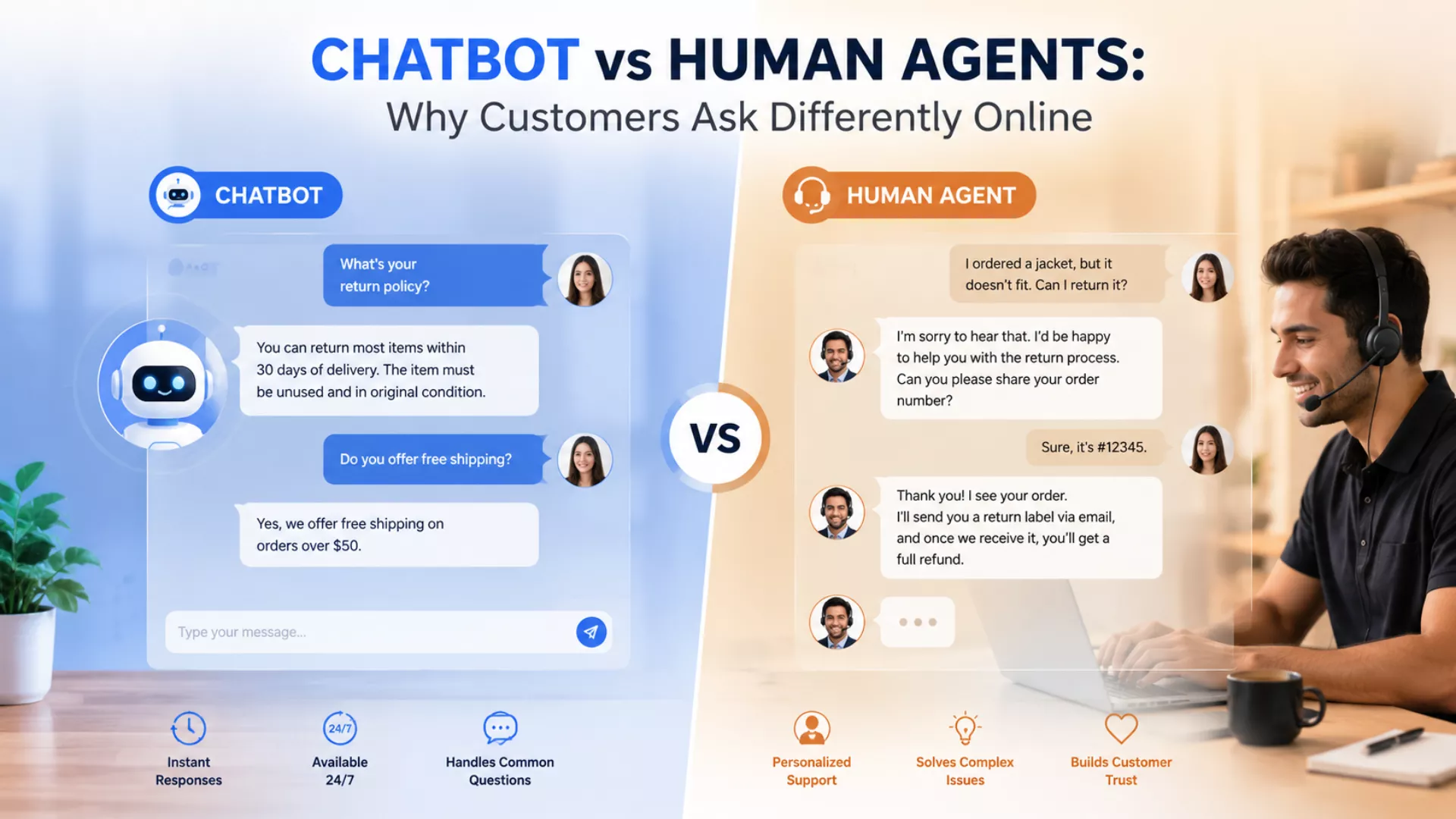
Customers aren’t asking fewer questions; they’re asking different ones.
When businesses analyze support data, they often focus on speed, ticket volume, or deflection. Those metrics matter, but they hide something far more valuable: the nature of the questions themselves. Comparing chatbot interactions with human agents reveals a fascinating truth: customers behave differently depending on who, or what, they’re talking to.
This is exactly why customer service chatbots are so valuable. They do a lot more than just fire off answers; they help you see how questions actually start, picking up on the kind of raw feedback that human teams almost never get to hear.
Human vs. AI: The Psychology of a Customer’s Question
When people talk to human agents, they tend to over-edit. Social pressure makes them "clean up" their thoughts so they only ask things that sound smart, cutting out the messy parts to avoid looking confused. But when they interact with a chatbot for customer support, those filters usually drop. Customers actually slow down, play around with different ideas, and aren't afraid to admit when they’re totally lost.
Key Insight: This is not about intelligence; it’s about emotional cost. Talking to a person carries social pressure; talking to a machine does not.
Research from the USC Institute for Creative Technologies shows people disclose more personal and emotional information when they believe they are speaking to a computer. The absence of judgment transforms behavior. Customers are not difficult; they’re seeking safety.
Why this matters:
- No hurry, no tone shift, no visible impatience
- Doubts surface naturally
- Questions arrive half-formed, explanations wander, curiosity replaces caution
When uncertainty is visible early, businesses can capture intent as it forms, not after it has been filtered or rehearsed.
How Customer Behavior Changes Based on Who They’re Talking To
Customer behavior is situational. People adjust how they speak depending on who they perceive as listening.
| Aspect | Human Agent | AI Chatbot |
| Social Pressure | High – fear of judgment, self-editing | Low – safe, experimental |
| Question Style | Polished, concise, filtered | Exploratory, layered, evolving |
| Disclosure Level | Limited – cautious, selective | High curiosity and doubts surface |
| Timing of Intent Capture | Post-decision | Real-time, as intent forms |
| Behavior Pattern | Skip context, shorten explanations | Start vague, refine through follow-ups |
Common human-agent behavior:
- Shortened explanations
- Polished questions
- Skipped background context
- Avoidance of “basic” doubts
With a customer support chatbot, customers type as they think. They ask questions in stages, test ideas, and revise understanding in real time. Psychologists call this the “Computers as Social Actors” effect: even when users know they are interacting with software, they respond socially, without the fear of evaluation that comes with human interaction.
This dynamic allows businesses to see questions in their raw form, before social filters hide hesitation and uncertainty.
The Role of Self-Consciousness
Most customer hesitation isn’t about complexity; it’s about impression management. When talking to a human, silent thoughts like:
- “I should already know this.”
- “I don’t want to sound careless.”
- “I might explain this wrong.”
- “I don’t want to waste time.”
all raise cognitive load, reduce tolerance for ambiguity, and increase decision anxiety.
The result? Customers often ask fewer questions and settle for a partial understanding, which can lead to frustration later.
This is where the customer support chatbot changes the game. By removing the "social mirror," these tools reduce fear and encourage total honesty. Customers feel free to:
- Ask questions meant purely for their own clarity.
- Explore sensitive ideas in private.
- Seek repeated reassurance without worrying about a human's reaction.
These advantages really shine in high-pressure situations, such as pricing strategy, setting up a new account, or fixing a messy technical bug. A chatbot for a website, when built correctly, can spot that split second of hesitation before it turns into a lost sale or a frustrated user giving up.
Why AI Chatbots Feel Non-Judgmental
People are naturally tuned into tiny social signals; a long pause, a change in tone, or a short, clipped answer can all feel like impatience or judgment. Those small moods usually change every time in a live chat. AI chatbots fully skip those old problems by giving a firm, no-mean-words zone. This gives customers the freedom to dig deeper, test things out, and ask questions that might feel a bit too awkward or risky with a real person.
Research Insight: A study from the University of Kansas News discovered that users actually find bots more comfortable for topics that are sensitive, embarrassing, or just plain confusing. Being anonymous takes away the fear of being judged.
Questions Customers Ask Bots (But Rarely Humans):
- "Can you explain this like I'm five?"
- "What actually happens if I click the wrong button?"
- "Is it normal to be confused by this step?"
- “Am I missing something obvious here?”
While these exploratory questions rarely reach a human agent, they reveal the critical emotional layers behind why a customer might be stuck.
What These Questions Reveal About Real Customer Intent
While support tickets and forms capture problems that have already happened, conversational AI captures intent while it is still in motion.
Intent Before Issues: People often show confusion long before a formal problem starts. Think of a service chatbot as a radar for friction, finding those fast signs before they grow into real help tasks.
Direct Feedback: Fans freely tell their top needs and fears without taking a long quiz to help them. It is the best real info you find.
Reality Checks: Chat logs expose the "gap", the difference between how a brand thinks people use their product and how customers actually approach it in their own heads.
These takeaways are vital for sharpening your website copy, refining onboarding, and fixing help guides. By tracking how raw questions change over time, you can finally speak the same language as your audience.
Why This Usually Goes Unheard
When talking to a real person, we all use a "social filter." Customers rehearse what they say to avoid looking confused or uninformed. This is known as evaluation apprehension, that subtle fear of being judged that quietly tweaks every human conversation.
A support chatbot catches the "messy middle." It records the thinking-out-loud moments where real doubts and half-baked questions live. This gives you a massive strategic edge by letting you fix hurdles before they ever become roadblocks.
How Businesses Can Use Chatbot Conversations to Improve Experience
Data on its own doesn’t do much; it’s what you do with it that counts. By balancing live chat with a chatbot strategy, businesses can truly play to the strengths of both their human team and their AI tools.
Tips for Maximizing Your Insights:
- Deploy Early: Put your AI right at the front door to capture raw, unfiltered questions from the moment a user arrives.
- Spot the Patterns: Keep an eye out for where people keep getting stuck. Use those insights to rewrite your help guides or tweak your product copy so it actually makes sense.
- Balance the Load: Let the chatbot handle the basic, "safe" exploratory stuff while saving your human agents for the emotionally charged or complex problems that need a real touch.
- Steal the Customer’s Language: Listen to the specific words your users choose. Using their own phrasing in your marketing will make your site much easier to find and much clearer to read.
- Monitor the Friction: Use "zero-party data" to see what’s actually worrying your customers before they decide to give up and leave.
The real goal here isn’t just to cut down on chat volume; it’s to make sure every conversation is useful and clear. When customers feel comfortable enough to ask what’s actually on their mind, they move forward with confidence, and your human support team gets the context they need to be truly helpful and empathetic.
Interactive / Website-Friendly Enhancements
To make this content more engaging and easy to navigate online, consider using interactive and visual elements that highlight the key differences between chatbot and human-agent interactions.
This makes better sense and also helps visitors quickly grasp the ideas.
1. Visual Flow Diagram – Side-by-Side Customer Journeys
A visual comparison of customer journeys can make the difference between human and chatbot interactions immediately clear:
- Human Path: Customers filter questions, simplify explanations, and hide doubts, often leaving frustration unspoken.
- Chatbot Path: Customers explore ideas openly, ask half-formed questions, and reveal uncertainty, providing early insights that human teams rarely capture.
This diagram helps illustrate how social pressure alters behavior and how chatbots create a safe space for curiosity and exploration.
2. Expandable Accordion Sections
Accordion-style sections allow readers to explore key topics in more detail without feeling overwhelmed:
- The Impact of Social Pressure on Human Conversations: How fear of judgment shapes questions and limits disclosure.
- Why Chatbots Feel Non-Judgmental: How anonymity and lack of social cues encourage honesty and experimentation.
- Types of Questions That Reveal True Intent: From basic doubts to exploratory inquiries, these questions reveal the early thought process behind decisions.
These expandable sections make dense concepts digestible while keeping the page clean and user-friendly.
3. Using Case Studies for Real-World Proof
Short, punchy highlight boxes are a great way to show how chatbots actually perform in the wild. They turn abstract theories into concrete wins that anyone can understand:
“A SaaS company recently noticed that about 40% of their chatbot queries never even needed a support ticket. By looking at that data, they tweaked their onboarding process and saw a 15% jump in successful sign-ups.”
Small case studies like this do the heavy lifting; they prove your point without a lot of fluff, making it easier for readers to see how this works for them.
4. The Power of Quotes and Hard Data
Pulling out a specific quote or a surprising stat is an easy way to break up long blocks of text and focus on the psychology of how we interact with tech:
“People actually tend to be more honest and emotional when they think they’re just talking to a computer.” — USC Institute for Creative Technologies
These call-outs aren't just eye-catching; they give your claims some serious credibility and expert backing.
5. Visualizing the Customer Journey
Think of a heatmap as a visual guide to where your customers are struggling. When you layer that over your chatbot data, it becomes clear:
- Where "social pressure" stops people from asking a human agent for help.
- Where a chatbot actually steps in to catch those unfiltered questions and doubts.
This kind of visual tool takes a mess of user behavior and turns it into a clear, actionable plan for making the entire customer experience smoother.
Chatbots Don’t Replace Humans; They Reveal What Humans Never Hear
AI chatbots aren’t a replacement; they’re a magnifier. By lowering social pressure, chatbots uncover
- Half-formed questions
- Hesitation
- Early-stage intent
Human agents hear polished, rehearsed queries. Bots hear thinking as it happens. The organization achieves better listening outcomes through its strategy of pairing chatbot and human agents which allows it to listen to customers earlier while reducing judgment and enabling human support to achieve its greatest effect.
Quick Recap Table: Human vs AI Chatbot Interactions
| Feature | Human Agent | Chatbot |
| Timing of insight | After decisions made | While intent forms |
| Social pressure | High | None |
| Question style | Polished, concise | Exploratory, evolving |
| Emotional disclosure | Low | High |
| Impact on support | Reactive | Proactive insight |
Frequently Asked Questions
1.Why do customers seem more open to a chatbot?
A customer service chatbot feels neutral and non-judgmental, allowing people to test ideas, admit confusion, and ask “basic” questions privately.
2.What changes in live chat vs chatbot conversations?
In live chat vs chatbot settings, customers edit themselves less with bots. They explore uncertainty instead of compressing their thoughts for efficiency.
3.Do chatbots really reveal more customer intent?
Yes. An AI chatbot captures early-stage hesitation before it becomes a formal ticket or escalated complaint.
4.Why don’t human agents hear these early doubts?
Because people edit messages before sharing with customer support. In chatbot vs human agents scenarios, teams often receive polished questions, while bots receive raw, exploratory thinking.
5.What kinds of questions are usually asked only to bots?
Customers ask reassurance and comparison questions more freely with a customer support chatbot than with human agents.