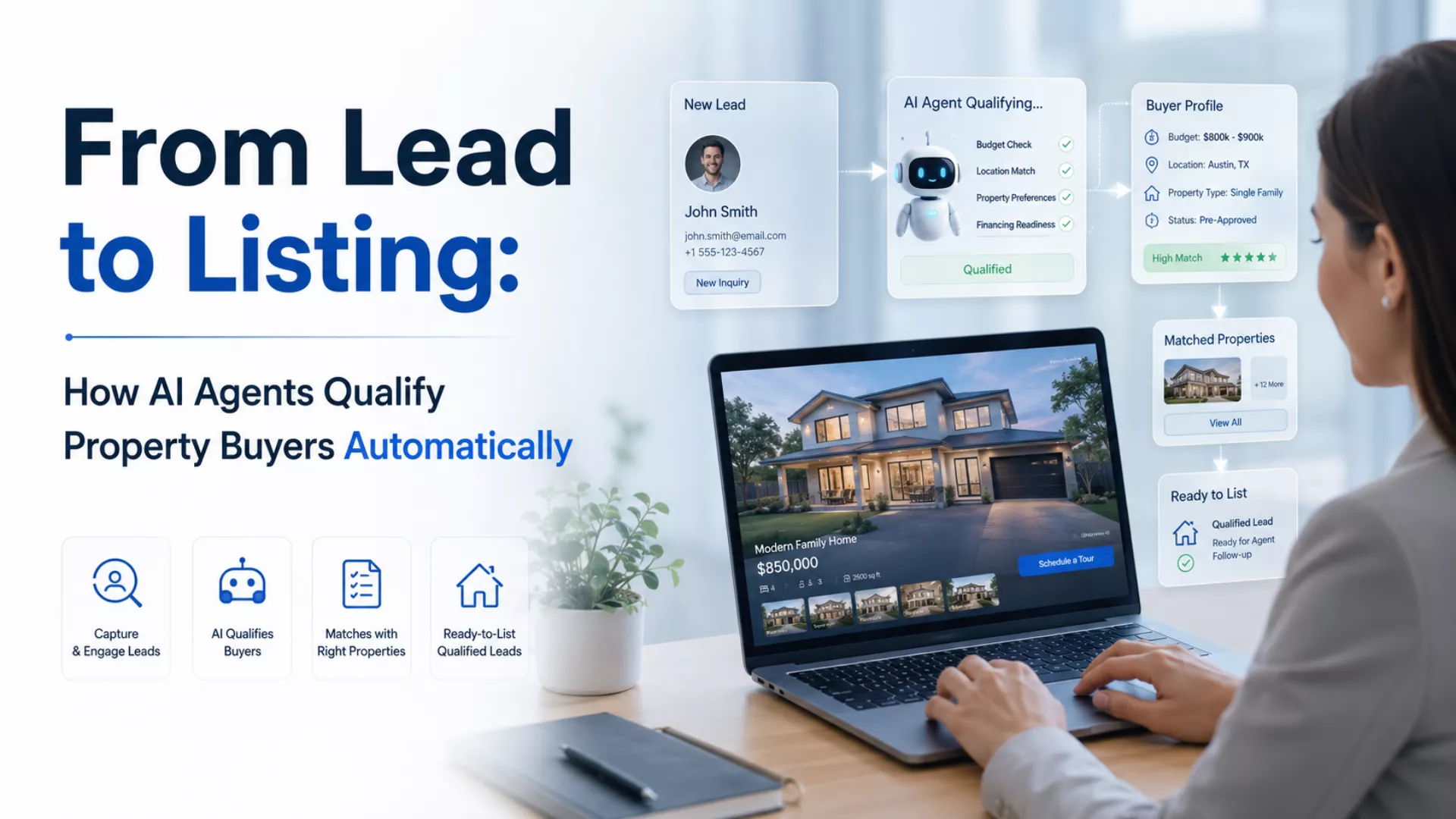
From Lead to Listing: How AI Agents Qualify Property Buyers Automatically

Key Takeaways
- Brokerages responding to enquiries within five minutes are 21 times more likely to qualify buyers than those waiting thirty minutes or longer.
- Manual qualification costs brokerages an estimated $192,000 annually in lost commission revenue from leads that decay before agents make contact.
- AI lead qualification continuously updates buyer intent scores across the entire search journey, ensuring cold leads from week one are reassessed as circumstances change.
- Automated confirmation sequences reduce property viewing no-show rates from 18% to 5%, recovering significant agent field time and operational revenue each week.
- AI agents log every qualification detail directly to the CRM in real time, eliminating manual entry errors and protecting contact data during agent turnover.
Picture this. You open your CRM on a Monday morning and 180 new enquiries are waiting. Some of those buyers have mortgage approval and a move-in date circled on their calendar. Others are eighteen months away from a decision. A few are neighbours who attended your open house out of curiosity and will never transact with you.
Your CRM doesn't tell you which is which. Neither does the enquiry form they filled out. So your agents start calling. They spend Tuesday and Wednesday working through the list. By Thursday, the buyers who were genuinely ready have already booked viewings with someone who responded faster. The browsers never pick up. And the hours are gone.
This is not a lead generation problem. It is a qualification problem. AI lead qualification solves it by running the qualification conversation before a human agent is ever involved. The system engages buyers instantly, asks the right questions, scores purchase intent, and routes serious prospects directly to the right agent at the right moment.
The Qualification Gap Is Costing Brokerages More Than They Realise
The average real estate professional takes 917 minutes to respond to a new enquiry. That is over fifteen hours.
In that same window, 78% of homebuyers will have already committed to the first agent who responded to them. By the time your team picks up the phone, the relationship has already been lost to a faster competitor.
Speed is only part of the problem. Even when agents do follow up, 44% stop after a single non-response. A further 22% stop after two attempts. That means nearly two-thirds of your licensed professionals never follow up a third time, despite research showing that 80% of high-value transactions require at least five touchpoints before a buyer commits.
The Qualification Math
A brokerage generating 500 enquiries per month and losing 20% of those opportunities to slow response or manual tracking failures is effectively abandoning 100 potential clients every month. At a 2% close rate and an average commission of $8,000 per transaction, that operational leak costs the brokerage approximately $192,000 in gross commission revenue annually. That is not a marketing budget problem. It is a qualification infrastructure problem.
The deeper issue is that manual qualification treats every enquiry the same. An agent calling a cold browser applies the same time and energy as an agent calling a pre-approved buyer with a move-in date two months away. Without a system that distinguishes between those two profiles before agent time is committed, the brokerage will always be working harder than necessary and converting less than it should.
What AI Agents Actually Do During Buyer Qualification
Most AI-powered lead qualification systems ask buyers what they are looking for. The better question is why they are looking.
A buyer answering "why are you moving?" reveals urgency, emotional motivation, timeline pressure, and budget flexibility in a single response. That answer shapes every subsequent question in the qualification conversation. AI agents are built to start there rather than defaulting to a property checklist.
Stop Losing Qualified Buyers Today
GetMyAI engages every property enquiry instantly, so serious buyers never reach a competitor first.
Here is how the qualification sequence actually runs.
1. Instant multi-channel engagement
The moment a lead arrives through WhatsApp, SMS, web chat, or a voice channel, the AI agent responds. Not within fifteen hours. Within seconds. This matters because the probability of qualifying a lead contacted within five minutes is 21 times higher than one contacted after thirty minutes.
2. Dynamic conversational qualification
Rather than presenting a static form, the agent conducts a structured conversation. This approach to conversational lead qualification gathers budget range, mortgage pre-approval status, purchase timeline, chain position, preferred location, property type, and move-in date. The questioning adapts based on responses rather than following a rigid script.
3. Behavioral signal tracking
Beyond what a buyer explicitly says, the system monitors what they do. Repeated views of the same neighborhood, engagement with specific listing types, and email click patterns all contribute to the intent profile.
4. Scoring and segmentation
Every data point feeds a real-time lead score. The system then segments the buyer automatically.
| Segment | Qualification Signals | AI Action |
| Hot | Pre-approved, immediate timeline, current home under offer | Viewing slot proposed within 2 hours |
| Warm | Financing in progress, 3 to 6-month window | Tailored property matches sent automatically |
| Cold | Vague timeline, budget misalignment | Long-term nurture sequence initiated |
The final output is not a score. It is a routine decision. Some buyers need an immediate agent call. Some need a mortgage advisor. Some need to be placed into a six-month nurture sequence. The AI's job is to send each buyer to the right destination, not simply rank them and wait.
Why Qualification Doesn't Stop at the First Conversation
Most qualification systems treat the initial conversation as the final verdict.
That assumption is expensive.
The average homebuyer spends ten weeks actively searching. They view eight properties in person and twenty more online before making a decision. A buyer who scores cold in week one because their financing isn't confirmed can become your most motivated lead by week six, once their mortgage clears and their lease renewal deadline arrives.
Static qualification misses that shift entirely.
AI agents update qualification scores continuously. Re-engagement signals such as returning to a listing page, opening a property email after two weeks of silence, or asking a new question via chat all trigger a score review. If a buyer's behavior indicates escalating intent, the system responds accordingly, upgrading their segment and adjusting the follow-up sequence without any manual intervention.
Source-specific qualification adds another layer of precision. A buyer arriving through a Rightmove listing, a Google Ads campaign, and an open house sign-in form represent three meaningfully different intent profiles. Each path should trigger a different qualification sequence, not the same generic conversation.
The compounding benefit is CRM depth. Every interaction the AI manages adds structured data to the buyer's record. By the time a human agent is involved, they are not starting a cold conversation. They are continuing one, with full visibility into what the buyer has said, what they have searched, and what they are actually looking for.
Start Qualifying Buyers Automatically
GetMyAI helps you engage enquiries instantly, collect buyer information through conversational lead forms, and prepare your team with the context they need before the first call.
From Qualified Lead to Confirmed Viewing
Even motivated buyers drop off during the back-and-forth of manual calendar coordination. The administrative friction of checking availability, proposing times, waiting for a response, and sending a confirmation gives a serious buyer four separate opportunities to disengage or accept a faster competitor's invitation.
Here is what that difference looks like in practice.
- Before automation: Lead qualifies through an agent call. Agent checks their calendar manually. Availability is proposed via email. Buyer responds the next day. Confirmation is sent. Viewing is scheduled for four days later. No-show rate: 18%.
- After automation: Lead qualifies through AI conversation. The system proposes available viewing slots immediately. Buyer confirms via a single SMS reply. Three-step reminder sequence activates automatically. Agent arrives at a prepared buyer. No-show rate: 5%.
That reduction from 18% to 5% is not a marginal improvement. For a brokerage running 80 viewings per week, it recovers approximately $149,760 in annual operational value, accounting for lost agent time, fuel, and the revenue cost of delayed transactions. This is business process automation delivering a measurable return. The no-show mitigation sequence that drives this result follows a specific structure.
Immediate booking confirmation delivered with a calendar attachment
- 24-hour SMS requiring a YES or NO confirmation from the buyer
- 2-hour reminder including parking instructions and property access details
- Automatic waitlist notification if a cancellation is received
The agent benefit extends beyond punctuality. Because the AI has already captured the buyer's budget, timeline, mortgage status, and property preferences, the showing agent arrives with a complete brief. The first in-person conversation starts in the middle, not at the beginning.
CRM Hygiene, Agent Handoff, and What Gets Logged
Ninety-one percent of brokerages with ten or more agents report using a CRM. Fifty-five percent of those implementations fail to meet their operational objectives.
The reason is almost always the same: manual data entry.
Agents spend approximately 18% of their working week inside CRM systems, and a significant portion of that time is spent entering information that should already be there. Contact details typed manually after a phone call. Notes added hours after a conversation ends. Follow-up tasks were logged inconsistently depending on how busy the agent's day was.
The downstream consequences are predictable: incomplete records, inaccurate pipeline forecasts, and total loss of transaction history when an agent leaves the brokerage.
| Metric | Manual Entry Environment | AI-Automated Entry |
| Daily admin time per agent | 60+ minutes | Zero; background synchronization |
| Data accuracy | High error rate | Near-perfect; enriched from source |
| Pipeline visibility | Static; manually updated | Live; behavior-triggered updates |
| Post-call update time | 2 to 5 minutes per call | Zero seconds |
| Contact data portability | Low; lost during agent turnover | High; centralized brokerage ownership |
When an AI agent qualifies a buyer, every answer is structured and logged at the moment it is captured. Budget range, pre-approval status, purchase timeline, preferred neighborhoods, property type requirements, and a full conversation transcript are all written to the CRM record automatically via API integration.
The showing agent receives a behavioral brief before the viewing. The operations manager sees a live pipeline. The brokerage principal retains every contact record, regardless of which agent handled the initial conversation.
That last point matters more than most principals realize until someone leaves.
Who Should Deploy This and Who Shouldn't
AI qualification systems are not the right fit for every brokerage. Getting this decision wrong in either direction is expensive.
Strong fit
Brokerages generating 50 or more enquiries per month are the natural home for this technology. The qualification burden at that volume is genuinely unsustainable manually, and the cost of lead decay is large enough to justify automation investment. Teams running paid lead generation through Rightmove, Zillow, or Google Ads face the clearest ROI case: they are already paying to generate leads that their manual systems cannot process fast enough to convert.
Agencies experiencing high no-show rates, inconsistent CRM records, or agent capacity constraints during peak periods will also see immediate operational gains.
Not the right fit
Agencies receiving fewer than 20 enquiries per month do not have a qualification volume problem. A well-structured manual follow-up process will serve them adequately without the implementation overhead.
Luxury brokerages where white-glove human contact from the very first touchpoint is a deliberate brand position should approach this carefully. The speed advantage of AI qualification may conflict with the premium experience their buyers expect.
Teams without an active CRM should solve that infrastructure gap first. AI qualification without a database to write to creates a different kind of chaos.
Two objections worth addressing directly
"Buyers won't engage with AI."
SMS carries a 98% open rate. Buyers engage with the channel, not the label. Research consistently shows that most buyers do not ask whether they are speaking to a human during an initial qualification conversation. They respond to relevance and speed.
"This is just another chatbot."
A chatbot answers FAQs from a decision tree. AI sales agents conduct dynamic conversations, score purchase intent, update your CRM, book viewings, and route buyers based on real behavioral data. The mechanism and the outcome are entirely different.
See How Buyer Qualification Works
GetMyAI runs structured qualification conversations, scores buyer intent, and routes serious leads to your agents automatically.
One compliance point before deployment: the Telephone Consumer Protection Act requires documented opt-in consent before automated outreach via SMS or voice. Every lead capture form needs unchecked consent boxes, clear disclosure language, and a backend log of the submission timestamp and source. Build this into your registration infrastructure before the system goes live.
How GetMyAI Qualifies Property Buyers Before Your Agents Pick Up the Phone
Instead of asking agents to spend the first call gathering basic information, GetMyAI begins the qualification process as soon as a property enquiry is received. The AI agent starts a natural conversation through your website or supported messaging channels, collecting the information your team needs before deciding the next step.
As the conversation progresses, it can ask about preferred locations, property type, budget, buying timeline, financing status, viewing availability, and the reason for moving. At the appropriate point, it can trigger a conversational lead form to collect contact details such as name, email, phone number, company, or other custom fields you define. Businesses can choose when this form appears, whether immediately after the first message, after a few exchanges, or only when buyers mention keywords like "viewing" or "buy."
Once submitted, each enquiry can be tagged as Hot, Warm, Cold, VIP, or with a custom label, making it easier to organise follow-up based on your own qualification process. The complete conversation, captured information, qualification details, and any booked appointments are recorded for review, so agents begin with context instead of starting from scratch. When buyers move beyond qualification into negotiations, pricing discussions, or offer management, the conversation transitions naturally to your team while the AI steps aside.
FAQ
How accurate is AI buyer qualification compared to a human agent?
AI agents consistently apply the same criteria across every conversation. For structured data like budget and timeline, accuracy is high. Human agents retain an edge in reading emotional nuance and managing complex objections.
How long does it take to deploy an AI qualification system for a real estate brokerage?
Brokerages with an established CRM typically go live within two to four weeks. Agencies building CRM infrastructure simultaneously should budget six to eight weeks for a fully production-ready deployment.
Can AI agents qualify buyers across WhatsApp, SMS, and web chat simultaneously?
Yes. AI qualification agents handle hundreds of concurrent conversations across channels without latency degradation. Every interaction is logged to the same CRM record regardless of which channel the buyer used.
Can AI automatically book property viewings after qualifying a buyer?
Yes. Once a buyer meets your qualification criteria, the AI can present available viewing slots, confirm the appointment, send reminders, and record the booking in your CRM or calendar. If the buyer needs pricing discussions or negotiation, the conversation can be handed over to an agent.
What information should an AI collect during property buyer qualification?
A typical qualification conversation collects information such as budget, preferred locations, property type, number of bedrooms, buying timeline, financing status, current home ownership, viewing availability, and reason for moving. Agencies can customize the qualification flow to match their sales process.
Can AI qualification reduce time spent on manual lead follow-up?
Yes. Instead of agents contacting every enquiry individually, AI can handle initial conversations, collect qualification details, schedule appointments, and update CRM records automatically. Agents can then focus on buyers who are ready for viewings or purchase discussions.