AI Agent for Business: Where Your Business Actually Stands in 2026

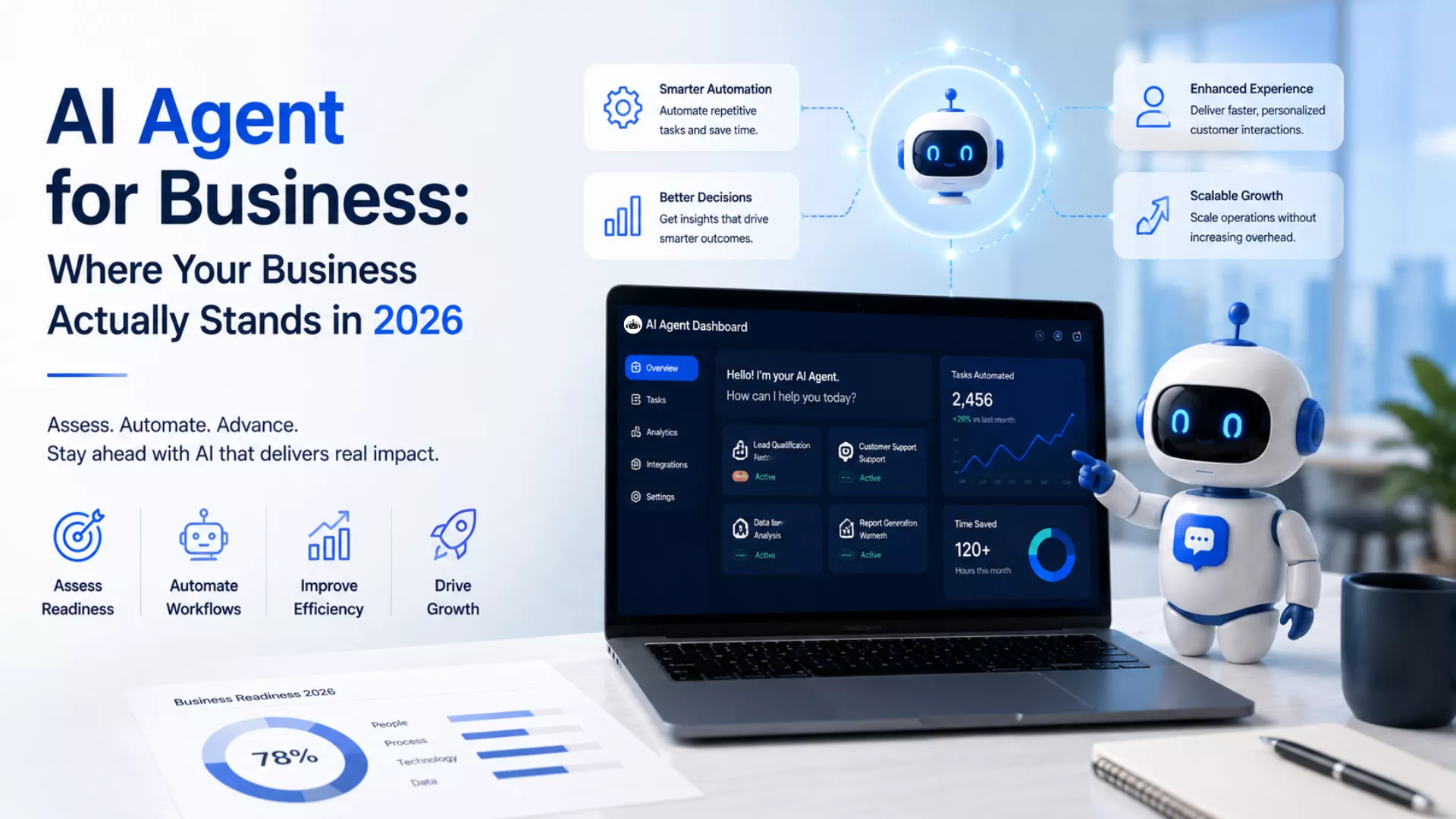
Most companies say they are “using AI.” But are they really operating it? Or just experimenting?
In 2026, almost every organization is testing something new. In fact, 88% of companies report using AI in at least one business function. That sounds impressive. It feels like progress. But here’s the harder truth. Only 1% have reached full maturity, where AI is truly integrated and driving real competitive advantage.
The gap between trying and operating is wider than most leaders think.
Before Stage 1 experimentation, there is Stage 0. Curiosity. Shadow tools. Isolated tests. A chatbot here. A small pilot there. Teams move fast. Leadership watches. No one is fully aligned. It feels active, but not accountable. This is where the AI capability ladder becomes useful. It helps answer a simple question:
Are you experimenting, or are you building a real AI agent for business?
Most organizations stall at Stage 1. They deploy pilots. They test features. They measure activity. But they never redesign workflows. They never connect AI to revenue or margins. They mistake motion for maturity. The shift from curiosity to structured deployment is not about adding complexity.
- Clear ownership.
- Defined escalation.
- Measurable outcomes.
- Continuous improvement.
Recognition is the first step. Progression is the next. The urgency comes when competitors stop testing and start operating.
Stage 0: AI Curiosity It usually starts small
Someone on the team opens a new tool. Someone else pastes a document into a chatbot. A marketer drafts copy faster. An engineer tests code suggestions. It feels exciting. It feels modern. It feels like progress.
But Stage 0 is not progress. It is curiosity.
In 2026, 88% of organisations report using AI in at least one business function. That number sounds powerful. It signals adoption. It suggests momentum. Yet only 1% have reached full maturity, where AI is fully integrated and driving real competitive advantage. The gap between trying and operating is massive.
Stage 0 lives inside that gap.
What Stage 0 Actually Looks Like
At this stage, AI is personal. Not operational.
You will see teams exploring different AI agent examples online. You will hear conversations about the types of AI agents that exist. Planning agents. Support agents. Sales assistants. But inside the company, nothing is connected.
Stage 0 typically shows up when people use ChatGPT or similar tools individually.
- There is no shared system
- No structured document training
- No visibility controls
- No monitoring
- No performance signals
- No shared learning
- No improvement loop
It feels active. But it is isolated.
The Illusion of Innovation
Stage 0 feels innovative because activity is visible. People talk about AI. Screens light up in meetings. Drafts are produced in seconds. Reports look sharper. The energy is real. But the structure is missing.
Individual Wins, Organisational Blind Spots
When AI is used only at the individual level, every benefit is local. A manager saves time. A marketer writes faster. A developer tests more quickly. The organisation does not learn from these interactions. No one tracks what questions are asked. No one reviews what answers were wrong. No system improves over time.
There is no shared memory.
No Control, No Context
In Stage 0, there are no visibility controls. Leaders cannot see how AI is being used. There are no logs. No structured review. No insight into patterns.
That creates risk.
Without monitoring, the company cannot answer basic questions:
- What data is being shared?
- What answers are being given?
- Where are mistakes happening?
- What is improving over time?
The absence of structure is not neutral. It is exposure.
Why Curiosity Is Not Capability
Curiosity is the starting line. Not the destination.
Stage 0 is broad exploration. People test prompts. They copy answers. They tweak results. But there is no shared system where a business AI agent operates under rules, learns from feedback, and aligns with company goals. There is no ownership. And without ownership, there is no accountability.
No Training Foundation
At this stage, there is no structured document training. Employees may paste content manually into tools. They may experiment with drafts. But there is no single knowledge source that grounds responses. That means answers vary. Tone shifts. Accuracy depends on who asked the question and how it was phrased. Consistency does not exist.
No Improvement Loop
Perhaps the most important gap is the lack of an improvement loop. When a response is wrong, nothing happens. No one adds a better answer to a shared Q&A. No one updates documents in a structured way. No one reviews unanswered questions and feeds corrections back into the system. The mistake stays local. The next user repeats it.
Stage 0 produces repetition, not refinement.
The Strategic Misread
Many leaders believe Stage 0 is enough. They see employees using AI. They hear positive feedback. They assume maturity is growing naturally. It is not.
Stage 0 broadens awareness. It does not create capability. The difference between Stage 0 and Stage 1 is structure. The difference between curiosity and experimentation is design. Stage 0 feels modern. But it is not operational.
Signals You Are Still at Stage 0
If you are unsure where your business stands, ask these questions:
- Is AI usage tracked centrally?
- Can you see conversation logs across teams?
- Do you have performance signals like response time or engagement?
- Is there a shared improvement workflow?
- Can you measure outcomes tied to revenue or cost?
If the answer to most of these is no, you are at this level. That is not failure. It is recognition.
Recognition Before Progression
The AI capability ladder begins with awareness. Stage 0 is important because it reveals interest. It shows willingness. It proves that your team sees potential. But curiosity without structure creates drift. To move forward, companies must shift from isolated usage to structured experimentation. From scattered tools to shared systems. From invisible activity to monitored deployment.
Progression does not mean adding complexity. It means adding clarity. It means moving from individual experimentation to designed experimentation.
That is Stage 1. And only from there can a business begin building something durable.
Stage 1: Experimental AI
The AI Capability Ladder Begins. Stage 0 was curiosity. Stage 1 is intention.
This is where teams stop playing alone and start building something small, but real. Not perfect. Not enterprise-wide. Just focused. Controlled. Measured. Many companies never reach this point. They jump from excitement to frustration. Why? Because most AI projects never scale beyond early tests. In fact, 95% of enterprise AI pilots fail to move into sustained production impact. That number is not about bad technology. It is about a weak structure.
Stage 1 is the first step away from chaos. It is disciplined experimentation.
What Stage 1 Actually Looks Like
At this stage, a team chooses one direction. They may begin with an AI chatbot platform to centralize usage instead of relying on scattered tools. They test how a conversational AI platform behaves with real documents. They try a simple AI chatbot integration on a website or internal system. The scope is small. The learning is focused.
Here is what defines Stage 1:
- One agent
- Limited credits
- Limited training links
- Testing customization
- Learning how document quality affects answers
- Observing unanswered questions
- Using Playground message controls
This is structured. But it is not yet systemic.
How We Can Smartly Use GetMyAI’s Free Plan
Stage 1 does not require a large budget. It requires attention. The goal is not scale. The goal is understanding.
Start with One Agent
Do not build five at once. Create one agent. Give it a clear purpose. Support questions. Internal help. Simple workflows. Focus on clarity. This keeps complexity low and feedback high.
Work Within Limited Credits
Limited credits are not a restriction. They are disciplined. When usage is capped, teams think carefully about prompts, training data, and response quality. Waste is visible. Patterns become clearer. Small limits force smart design.
Use Limited Training Links Wisely
When you only have a few training links, every document matters. This is where teams begin to notice something important. The quality of answers depends directly on the clarity of documents. If the source material is messy, the responses are messy. If the information is outdated, the agent reflects that.
Stage 1 teaches this lesson quickly. It becomes obvious that document quality is not optional.
What You Learn at This Stage
This stage is not about performance yet. It is about insight.
Testing Customization
Teams begin testing how the interface looks and feels. Display names. Initial messages. Suggested prompts. They see how tone shapes behavior. Small changes in wording shift how users interact. That insight matters later.
Observing Unanswered Questions
This is one of the most powerful lessons of Stage 1. When the agent cannot answer confidently, it reveals gaps. These gaps are not failures. They are signals.
Unanswered questions show:
- Where knowledge is thin
- Where documents are unclear
- Where assumptions were wrong
Instead of guessing, the system exposes blind spots. That is disciplined learning.
Using Playground Message Controls
Inside testing, teams use simple controls.
- Like message.
- Unlike a message.
- Retry message.
They compare variations. They check tone. They refine prompts. They see how small changes shift outcomes. This builds instinct. Experimentation becomes a structured review.
Why Most Companies Get Stuck Here
Stage 1 feels productive. You have an agent. It responds. It looks real. It answers some questions correctly. It feels like progress. But here is the problem.
Organisations often confuse structured experimentation with full capability. They measure activity, not outcomes. They celebrate launches, not long-term performance. That is why so many pilots stall. Research shows that while many organisations test AI, very few tie it directly to a core business advantage.
Stage 1 builds a sandbox. It has not yet built a system.
The Discipline Behind Real Experimentation
True experimentation has boundaries.
It has:
- Defined scope
- Measured inputs
- Visible feedback
- Clear review
Without those, it becomes random testing. With them, it becomes preparation.
Stage 1 should answer practical questions:
- How does training data shape output?
- How often are questions unanswered?
- What tone resonates with users?
- How much review effort is required?
These answers shape what comes next.
Structured, But Not Yet Systemic
This stage is a bridge. It connects curiosity to deployment.
But it does not yet include:
- Enterprise-wide visibility
- Cross-channel analytics
- Governance frameworks
- Revenue alignment
Those belong to later stages. Stage 1 is focused. Narrow. Intentional. It teaches control and builds comfort with structured tools instead of scattered usage. It introduces review habits. It creates early feedback loops.
From Experiment to Direction
The AI capability ladder begins here.
- Not with scale.
- Not with automation everywhere.
- Not with bold claims.
With structure.
Stage 1 shows that experimentation can be disciplined. That learning can be intentional. That small systems can produce meaningful insight. The risk is staying here too long. The opportunity is to use this stage to prepare for structured deployment.
- Curiosity brought you in.
- Experimentation stabilises you.
The next stage demands commitment. And that is where capability truly begins.
Stage 2: Structured Deployment
Moving from Experiment to Operational Presence. There is a moment when testing stops feeling safe. At Stage 1, the agent lives in a sandbox. It answers questions. It learns from review. It is helpful, but contained. Stage 2 changes the tone; the system moves from internal testing to public responsibility. It is no longer just a tool. It becomes a visible part of how your business communicates. And that shift is bigger than most teams expect.
From Experiment to Representation
Stage 2 is not about building more agents. It is about building presence.
The mindset changes:
From
“Let’s test this.”
To
“This now represents our business.”
That difference matters. When an Enterprise AI chatbot goes live, it is no longer an experiment. It is part of your brand voice. Your service promise. Your operational layer. This is where structured deployment begins.
What Stage 2 Looks Like in Practice
Stage 2 is defined by control and clarity.
It includes:
- Visibility control (public/private clarity)
- Brand-aligned customization
- Defined scope
- Deployment via website embed
- Slack integration
- Telegram integration
- Structured oversight
- Activity log review
Each element shifts the agent from isolated use to operational presence.
Visibility Control Comes First
Public vs Private Clarity
At Stage 2, you decide who sees the agent.
- Is it public?
- Is it private?
- Is it still being tested?
This control removes confusion. It protects reputation. It prevents unfinished work from reaching customers. Clear visibility rules create confidence.
Customisation Is Not Cosmetic
At this stage, customisation is no longer just visual polish. It is alignment.
Brand-Aligned Customisation
Display names. Initial messages. Tone. Interface style. These are not design tweaks. They shape how users perceive your business. When the chatbot speaks, it should sound like your company. Calm. Clear. Helpful. That is the difference between a tool and an Enterprise-grade AI chatbot. It feels native.
Scope Is Defined, Not Assumed
Stage 1 allowed broad exploration. Stage 2 demands focus.
Defined Scope
You choose exactly what the agent handles.
- Support questions.
- Service requests.
- Internal knowledge.
Not everything. This prevents overreach. It reduces risk. It protects trust. Many AI projects fail because the scope expands too fast. Research shows that 95% of enterprise AI pilots fail to move into sustained production impact. Often, the failure is not technical. It is structural. Stage 2 avoids that trap.
Deployment Across Real Channels
This is where operational presence becomes visible.
Website Embed
When deployed via website embed, the agent becomes part of the customer journey.
- It greets visitors.
- It answers questions.
- It supports decisions.
It must be reliable.
Slack Integration
With Slack integration, the agent supports internal collaboration. Teams can ask questions, find documents, and reduce repetitive requests. It becomes an AI chatbot for support teams.
Telegram Integration
Telegram integration extends reach into conversational environments. Customers or communities can interact without switching platforms. The system remains grounded in the same training. The same rules. The same oversight and fragmentation disappear.
Structured Oversight Is the Turning Point
Stage 2 is not about deployment alone. It is about a review.
Activity Log Review
Every conversation is visible.
You can see:
- What was asked
- What was answered
- Where response time slowed
- Where the agent did not understand
This creates accountability. Activity log review turns deployment into a learning system. Without it, errors repeat silently. With it, patterns emerge.
Research shows that while most companies experiment with AI, only a small fraction reach full maturity. The difference is oversight. Structured oversight closes the gap between testing and trust.
The Shift in Responsibility
Stage 2 carries weight. The agent now functions as an AI chatbot for customer service. It influences real interactions. It answers real people.
That means:
- Accuracy matters
- Tone matters
- Escalation matters
There is no hiding behind “beta.” When customers interact with an Enterprise AI chatbot, they assume it reflects your standards. And it should.
Why Stage 2 Is a Strategic Advantage
Structured deployment does not mean complexity. It means clarity.
At this level, you gain:
- Visibility into real usage
- Alignment with brand identity
- Control over scope
- Oversight of performance
- Unified channel presence
It transforms an isolated tool into an operational infrastructure. This is where GetMyAI becomes more than a testing environment. It becomes part of how a business communicates at scale. Stage 2 is not the final level of maturity. It does not yet include advanced orchestration or autonomous decision layers.
But it marks a critical transition.
- From scattered activity to structured presence.
- From internal testing to public accountability.
- From curiosity to capability.
When Testing Becomes Commitment
Every company experimenting with AI faces this decision. Stay in the lab. Or step into operations. Stage 2 is the point of commitment.
It is where leaders say, “We trust this system to represent us.” That trust is not built on hype. It is built on a structure.
- Visibility
- Customization
- Defined scope
- Channel deployment
- Oversight
When those elements come together, experimentation evolves into operational presence. And that is where real transformation begins.
How to Move from Stage 1 to Stage 2
Turning Structured Experiments into Operational Presence. Most companies stall between testing and operating. They built one agent. They test prompts. They refine documents. It works. Sometimes. Then momentum fades. The system never becomes part of the real workflow. This gap is not rare. Research shows that 95% of enterprise AI pilots fail to move into sustained production impact. Not because the tools are weak. Because the transition is unclear.
- Stage 1 is structured experimentation.
- Stage 2 is operational presence.
The move between them is deliberate.
The Real Difference Between Stage 1 and Stage 2
Stage 1 proves that something can work; the agent lives in testing. Limited credits. Limited training links. Careful observation.
Stage 2 proves that it does work in the real world; it represents your business. It appears publicly, supports real users, and operates under defined oversight.
That shift requires five clear triggers.
The Five Triggers That Move You Forward
To move from Stage 1 to Stage 2, you must:
- Define scope
- Set visibility
- Begin log reviews
- Treat Activity as operational feedback
- Align customisation with brand identity
Each trigger adds structure.
Define Scope Before You Deploy
In Stage 1, the scope is flexible. In Stage 2, it must be defined.
- What will the agent handle?
- What will it not handle?
A clear scope protects trust. It prevents overreach. It avoids situations where the agent answers outside its knowledge area. Without scope, confidence collapses quickly. When an AI chatbot for customer service handles only the workflows it is trained for, reliability increases. Consistency improves. Stage 2 begins with boundaries.
Set Visibility With Intention
At this stage, visibility is no longer optional.
You decide:
- Public or private
- Testing or live
- Internal only or customer-facing
Clear visibility prevents unfinished deployments from reaching real users. This is where control replaces experimentation. An Enterprise AI chatbot is not judged as a pilot. It is judged as part of the company.
Begin Log Reviews Immediately
Stage 1 allows occasional review. Stage 2 requires routine review. Every conversation matters. When you begin reviewing logs consistently, patterns appear:
- Repeated unanswered questions
- Tone inconsistencies
- Response delays
- Edge cases
Research shows that while most organizations use AI in some capacity, only 1% reach full maturity where systems are fully integrated and driving core advantage. The difference is not intelligence. It is a feedback discipline.
Treat Activity as Operational Feedback
Activity is no longer a testing tool. It becomes a management tool. Every unanswered question is insight, correction is learning, and update strengthens the system. When Activity is treated as operational feedback, the system evolves naturally. It stops being reactive. It becomes adaptive.
This is the turning point.
Align Customisation With Brand Identity
Customisation in Stage 1 is exploratory. Customisation in Stage 2 is strategic.
- Display name.
- Initial message.
- Tone.
- Interface style.
These are not cosmetic. They shape user trust. An AI chatbot for support teams should sound consistent with company standards. Calm. Clear. Helpful. Brand alignment signals stability. When users feel continuity, they accept automation more easily.
Direct Answers for Decision Makers
What are the essential features to look for in an AI customer support solution?
A mature solution must provide knowledge grounding, structured escalation, unified analytics, and clear oversight controls. It should log every conversation, allow visibility management, support defined scope deployment, and enable continuous improvement through structured feedback review.
How much investment is typically required for a basic AI customer service chatbot?
Low-code deployments typically require $5,000 to $15,000 and two to four weeks for implementation. Enterprise builds can range from $100,000 upward, depending on integration and compliance requirements. Managed platforms reduce cost and time-to-value.
Where Investment Meets Structure
Investment alone does not create maturity. You can spend heavily and remain in Stage 1. What matters is alignment.
Stage 2 requires that the deployment is tied to a defined purpose. Support resolution. Customer guidance. Internal knowledge clarity.
When scope, visibility, and review discipline align, even modest investment produces real operational value. That is how tools like GetMyAI shift from sandbox to infrastructure.
Why Most Organisations Hesitate
The hesitation is psychological.
- Stage 1 feels safe.
- Stage 2 feels exposed.
Once deployed publicly, mistakes are visible. Responses are judged. Performance matters. But avoiding deployment does not reduce risk. It increases stagnation. The cost of staying experimental grows quietly. Competitors refine. Systems improve elsewhere. Movement requires decision.
The Operational Shift
The shift from Stage 1 to Stage 2 is not technical. It is cultural.
From:
“Let’s test this.”
To:
“This now represents our business.”
That statement changes behaviour. Teams review more carefully, scope becomes tighter, customisation becomes deliberate, and Activity becomes monitored. Structure replaces curiosity.
The Practical Path Forward
If you are at Stage 1 today, the path is clear:
- Narrow the use case.
- Formalise visibility rules.
- Schedule regular log reviews.
- Use Activity to identify gaps.
- Align the interface with brand standards.
These are not complex steps. They are disciplined ones.
When Experimentation Becomes Presence
The AI capability ladder is not about scale first. It is about readiness. Stage 2 signals that your organisation is ready to treat automation as operational. Not as a novelty, side experiment, or demo. But as part of how your business functions. This is where experimentation turns into representation. And once representation begins, accountability follows. That is the moment maturity truly starts.
Stage 3: From One Bot to an AI System
One agent is helpful. A system is powerful. Stage 2 made the agent visible. It went live. It answered real users. It carried the brand tone. It logged conversations. It handled scope. Stage 3 changes the architecture. This is where you stop thinking about one assistant and start thinking about coordinated roles. From assistant to system and from tool to infrastructure.
Why One Agent Is Not Enough
In early deployment, a single agent works. It handles support. It answers common questions. It fits within defined boundaries. But growth changes pressure. Different teams want different responses, departments need different tones, and workflows require separate knowledge. Trying to force everything into one agent creates friction.
That is the signal you are entering Stage 3.
The Rise of AI Agents for Business
At this stage, companies deploy multiple AI agents for business, each with a defined purpose. Not copies. Not clones. Specialised roles. This structure mirrors how human teams operate. You do not hire one person to handle sales, legal, HR, support, and operations. You divide responsibility.
The same logic applies here.
What Stage 3 Actually Looks Like
Stage 3 introduces structural separation.
It includes:
- Multiple bots
- Different personas
- Different knowledge sets
- Credit limits per agent
- Knowledge separation
- Dedicated responsibilities
Each element strengthens reliability.
Multiple Bots, Clear Roles
Dedicated responsibilities, one agent may handle customer questions. Another may assist internal teams. Yet another may support documentation workflows. Each has one clear job. When responsibilities are defined, performance improves. Confusion drops. Escalation becomes cleaner. This is not duplication. It is a specialisation.
Different Personas for Different Contexts
Tone matters. A support-facing agent may sound calm and reassuring. An internal operations agent may be direct and concise. Personas shape interaction. An Intelligent AI agent for businesses understands not just content, but context. Different environments require different communication styles.
Stage 3 formalises that.
Knowledge Separation
One of the biggest mistakes in scaling is mixing knowledge bases. If sales data blends with internal policy. If product documentation merges with HR guidance. Answers become inconsistent.
Different Knowledge Sets
Each agent carries its own knowledge set.
- Customer agent wth product and service documentation.
- Internal agent with policies and internal systems.
- Operations agent with process and workflow data.
Knowledge separation protects accuracy. It also reduces unintended responses.
Credit Limits per Agent
Scaling requires control. Stage 3 introduces credit limits per agent to manage resource distribution. This prevents one high-volume use case from draining shared capacity. Operational teams gain predictability. Budget alignment becomes easier. Infrastructure must be managed, not guessed.
The Emergence of an Autonomous AI Agent for Business
As roles mature, autonomy increases. An Autonomous AI agent for business does not simply answer. It executes within its scope. It resolves questions without escalation when possible. It operates consistently within defined rules. This autonomy is structured. It is not random decision-making. It is rule-based confidence built on training and oversight.
AI Agent Use Cases for Enterprises Expand
At this level, deployment moves beyond basic support.
AI agent use cases for enterprises may include:
- Dedicated customer response systems
- Internal knowledge routing
- Department-specific information agents
- Workflow assistance
Each use case has its own boundaries. Each role strengthens the system. This modular approach mirrors enterprise architecture.
Why Stage 3 Requires Discipline
Stage 3 is powerful. But it is not casual. Without governance, multiple bots can create fragmentation. Personas may drift. Knowledge sets may overlap. Structure must remain tight. This is why maturity is rare. Globally, only 1% of organizations reach full AI maturity, where systems are fully integrated and driving strategic advantage. Scaling without structure does not create maturity. It creates noise.
The Shift in Identity
Stage 2 said: “This represents our business.”
Stage 3 says: “This is part of our infrastructure.”
That is a different level of commitment.
Infrastructure is:
- Maintained
- Monitored
- Allocated
- Reviewed
It is not temporary. When a company reaches this stage, the system is embedded in daily operations.
From Tool to Infrastructure
A tool assists occasionally. Infrastructure is supported continuously.
In Stage 3:
- Multiple bots operate simultaneously
- Roles are defined
- Knowledge is separated
- Credits are controlled
- Responsibilities are assigned
This creates reliability. It also creates scalability. Studies show that AI adoption is widespread, with 88% of organisations using AI in at least one function. But adoption alone does not equal integration. Stage 3 is where integration begins to resemble system design.
Where Platforms Enable Structure
Scaling to multiple agents requires a controlled environment.
Platforms like GetMyAI allow teams to manage:
- Separate agents
- Separate knowledge
- Defined credit limits
- Dedicated roles
Without rebuilding everything from scratch. The platform becomes the control layer. Structure remains centralized, even as roles multiply.
The Threshold of System Thinking
Stage 3 is not the final stage. But it is the threshold where thinking changes. You stop asking: “How can this help us?” You start asking: “How do we design this properly?” That question signals maturity. From system assistant, tool to infrastructure. When specialisation is intentional and roles are defined, the organisation moves beyond experimentation and into architecture. That is the foundation for true enterprise capability. And once infrastructure exists, performance can finally be measured at scale.
How to Move from Stage 2 to Stage 3
When deployment becomes system design, Stage 2 feels like success. Your agent is live. It answers real users. It reflects your brand. You review logs. You refine responses. It works. Then something shifts. More teams want access. More workflows need support. More questions appear from different departments. The single agent that once felt powerful starts to feel stretched.
This is the moment between deployment and system design. And this is where many companies stall.
In 2026, 88% of organizations report using AI in at least one business function. But only 1% reach full maturity, where AI systems are fully integrated and driving a core advantage. The gap is not about intelligence. It is about structure.
Recognising the Limits of One Agent
In Stage 2, one agent handles a defined scope. It supports customer queries. It assists internal teams. It operates under visibility controls. That works. For a while.
But eventually:
- Questions expand beyond original boundaries
- Different departments require different tones
- Knowledge grows too broad
- Credit usage spikes unpredictably
The single general-purpose agent becomes a bottleneck. This is your signal.
The Transition Triggers
To move from Stage 2 to Stage 3, you must:
- Separate use cases
- Assign ownership
- Define specialization
- Stop using one general-purpose agent
- Control credit allocation per agent
Each trigger shifts thinking from tool management to system design.
Separate Use Cases Before Scaling
At Stage 2, the scope is defined. At Stage 3, the scope multiplies. Instead of expanding one agent’s responsibility, separate use cases.
One agent for customer interactions. Another for internal documentation. And another for operational workflows. This separation protects clarity. When use cases blend together, confusion grows. Responses become inconsistent. Knowledge overlaps. Trust declines. Separation creates precision.
Assign Ownership Clearly
A system without ownership drifts. At Stage 3, each agent must have an owner. A team. A responsible lead.
Ownership means:
- Reviewing activity regularly
- Updating knowledge sets
- Monitoring performance
- Managing scope changes
Without assigned ownership, specialisation collapses. An Enterprise AI agent platform depends on defined accountability.
Define Specialisation Intentionally
Specialisation is not just about knowledge. It is about the role.
Role-Based Focus
One agent may handle support queries, one will assist internal teams, and another may guide documentation access. Each role must be narrow and deliberate. When roles are clear, performance improves naturally. The system becomes predictable.
Knowledge Separation
Each agent should operate within its own knowledge boundary. Customer-facing content stays separate from internal policies. Operational workflows remain distinct from support scripts. Knowledge separation prevents accidental cross-contamination of answers. This is the foundation of reliability.
Stop Using One General-Purpose Agent
The temptation to keep everything inside one agent is strong. It feels simple. It feels efficient. But it is fragile. A general-purpose agent must juggle too many responsibilities. Tone shifts become inconsistent. Scope becomes blurred. Escalation becomes unclear. Scaling requires division. This is the moment where enterprise positioning naturally enters the conversation. Not because you need complexity. But because you need architecture.
Control Credit Allocation per Agent
As roles multiply, usage must be managed carefully. Stage 3 introduces controlled credit allocation per agent. Why does this matter? Because resource consumption becomes uneven. A high-volume customer agent may require more capacity. An internal documentation agent may require less. Allocating credits intentionally ensures stability.
Without control, growth becomes unpredictable. An AI agent platform for business must balance performance and resource discipline.
From Deployment to Architecture
Stage 2 proved the agent could represent the business. Stage 3 proves the system can scale responsibly. This is the shift: From “It works.” To “It is designed.” Architectural thinking replaces experimental thinking. Instead of asking, “Can this handle more?” You ask, “How should this be structured?” That difference marks maturity.
Enterprise Positioning Emerges Naturally
When use cases are separate, ownership is defined, and credit allocation is controlled, the conversation changes. You are no longer discussing a chatbot. You are discussing infrastructure. An Enterprise AI agent platform is not defined by size. It is defined by structure.
It supports:
- Multiple roles
- Defined responsibility
- Managed resource allocation
- Clear knowledge boundaries
This design reduces risk and increases clarity. GetMyAI makes this transition manageable because they allow teams to control multiple agents within a unified environment. The system grows, but governance remains centralized.
Why Most Organisations Pause Here
The move from Stage 2 to Stage 3 feels heavy. This step needs careful planning, defined ownership, and strong discipline. Teams often slow down because going live feels like the final goal. Yet without specialisation, the system cannot stay strong. Remember, only 1% of organisations reach full maturity where AI systems drive true strategic advantage. The issue is not adoption. It is architecture.
Stage 3 is where architecture begins.
The System Mindset
When you separate use cases, assign ownership, define specialisation, and control resource allocation, something subtle happens. The system stabilises. Each agent knows its role, the team knows its responsibility, and its knowledge base remains clean. Performance improves not because of more intelligence, but because of better structure. This is enterprise thinking.
When One Becomes Many, and Many Become One
Moving from Stage 2 to Stage 3 is not about adding more bots randomly. It is about intentional division. You stop stretching one agent beyond its limits. You design roles, allocate responsibility, and manage resources deliberately. That is how a deployment evolves into a system. And once you operate as a system, scale stops feeling chaotic. It starts feeling controlled. That control is the gateway to real maturity.
Stage 4: Performance-Driven AI
At Stage 4, something changes. You are no longer asking, “Does it work?” You are asking, “How well does it perform?” This is the level where numbers speak. Not guesses. Not impressions. Clear signals. It is about optimizing. This is measurable and operational AI. This is maturity.
From Activity to Accountability
In earlier stages, you focused on deployment and structure. Now, you focus on outcomes.
You monitor:
- Engagement rate
- Positive rate
- Average response time
- Channel performance comparison
- Improvement loop usage
- Q&A expansion based on real gaps
Every metric has meaning. When engagement drops, you investigate. When the positive rate shifts, you review conversations. And when response time increases, you check the system load. This is no longer an experimental review. It is performance management.
Why Metrics Matter Now
In Stage 4, AI becomes part of financial performance. An AI chatbot to reduce support costs is not evaluated by its presence. It is evaluated by impact.
- How many tickets were avoided?
- How many questions were resolved without escalation?
- How quickly were users helped?
These questions require measurement. According to Yellow.ai’s 2026 Customer Service Metrics report, mature AI deployments reach 40–60% ticket deflection when structured correctly.
AI Chatbot Analytics as a Control Panel
Engagement Rate
Engagement rate shows how interactive sessions are. If users ask follow-up questions and explore suggestions, engagement rises. If sessions end quickly or feedback is low, engagement drops. High engagement often signals relevance. Low engagement can signal confusion.
Positive Rate
Positive rate reflects how often users respond with approval. It is not perfect. But it is directional. A consistent positive rate means tone and answers align with expectations. A decline means something needs adjustment. Stage 4 teams treat feedback seriously.
Average Response Time
Speed matters. If response time slows, trust declines. If responses are fast and stable, confidence grows. Average response time becomes a performance benchmark. It is watched regularly.
Channel Performance Comparison
By Stage 4, the system operates across channels.
- Website
- Slack
- Telegram
Each channel behaves differently. Channel performance comparison reveals:
- Where engagement is strongest
- Where response times vary
- Where unanswered questions cluster
This prevents blind spots. You do not assume performance is equal everywhere. You verify it.
Improvement Loop Usage
In Stage 2 and 3, you began using Activity logs for review. In Stage 4, Improvement becomes proactive. Unanswered questions are not occasional events. They are structured input.
Teams monitor:
- How many unanswered questions appear weekly
- How quickly are answers added
- Whether the same gaps repeat
Improvement loop usage is tracked intentionally. When Q&A expansion is based on real gaps, the system grows stronger over time. This is how maturity compounds.
Q&A Expansion Based on Real Gaps
At this stage, Q&A is not static. It evolves based on real conversation data. If multiple users ask a similar question, you add clarity. If confusion appears around one topic, you update the documents. Expansion is deliberate. There is no guesswork. This process reduces repetition and strengthens containment.
AI Chatbot for Ticket Deflection
Stage 4 brings operational clarity. An AI chatbot for ticket deflection is measured by the actual reduction in repetitive queries reaching human teams.
You calculate:
- Volume of resolved conversations
- Escalation frequency
- Repeat question rates
When ticket deflection increases, support teams focus on complex tasks. Cost structure improves. This is where performance meets finance.
AI Chatbot to Reduce Support Costs
Reducing support costs does not mean replacing teams. It means optimising effort. When routine questions are handled automatically, human agents focus on nuanced issues. Mature organisations understand this balance. According to McKinsey’s State of AI report, only 1% of organizations have reached full AI maturity, where systems drive core competitive advantage.
Optimization Is Ongoing
Stage 4 is not static. Metrics are reviewed weekly or monthly. Trends matter more than single spikes. If the engagement rate declines over several weeks, the review begins. If response time increases steadily, capacity is reassessed. Optimisation is continuous. There is no “final version.”
Channel Expansion With Discipline
As performance stabilises, channel expansion becomes safer. New environments are added only after metrics prove readiness. Performance is compared across channels before scaling further. This avoids uncontrolled growth. Expansion follows data, not enthusiasm.
From Deployment to Performance Culture
Stage 4 builds a performance culture around automation.
Teams understand:
- Data drives decisions
- Feedback drives improvement
- Metrics reveal blind spots
AI chatbot analytics becomes part of the management review. This is no longer a side project. It is an operational infrastructure. GetMyAI supports this phase by combining Activity, Improvement, and analytics in one environment, enabling structured review without fragmentation. Structure enables scale.
When AI Becomes Measurable Infrastructure
Every stage builds on the last. Stage 0 was curiosity. People explored tools without structure. Stage 1 was experimentation. Teams tested ideas in small, controlled settings. Stage 2 was deployment. The system went live and began serving real users. Stage 3 was system design. Roles were separated, and responsibilities became clear. Stage 4 is accountability. Performance is tracked, reviewed, and improved.
This is measurable AI. This is operational AI. This is maturity.
At this level, success is not based on opinion. It is based on engagement rate, positive rate, average response time, channel performance comparison, improvement loop usage, and Q&A expansion based on real gaps. Each metric reinforces discipline. When numbers guide refinement and feedback drives updates, the system strengthens over time.
This is not about hype. It is about control. And control is what separates experimentation from advantage.
| Stage | Focus | Core Behavior | Outcome |
| Stage 0 | Curiosity | Individual use | Awareness |
| Stage 1 | Experimentation | Structured testing | Learning |
| Stage 2 | Deployment | Live operations | Representation |
| Stage 3 | System Design | Role specialization | Scalability |
| Stage 4 | Accountability | Performance tracking | Strategic advantage |
How to Move from Stage 3 to Stage 4
When System Design Becomes Measured Performance, Stage 3 becomes powerful. You have multiple agents. Roles are clear. Knowledge is separated. Ownership is defined. Credit allocation is controlled. The structure is stable. But here is the real question. Is it performing? Stage 4 is not about building more. It is about measuring what you built.
This is where scaling becomes intentional.
The Difference Between Structure and Performance
At Stage 3, you designed a system. At Stage 4, you validate it.
You stop asking: “Is it organised?”
You start asking: “Is it delivering value?”
That shift requires discipline.
Most organisations never reach this point. According to McKinsey’s State of AI report, only 1% of organizations reach full AI maturity where systems drive core competitive advantage. The difference is not adoption. It is a measurement. Stage 4 is where the advantage becomes visible.
The Transition Triggers
To move from Stage 3 to Stage 4, you must:
- Introduce metrics formally
- Monitor engagement rate
- Track the positive rate
- Review response time trends
- Formalise review cycles
- Expand Q&A from real unanswered gaps
- Compare channel performance
These are not optional. They define maturity.
Introduce Metrics Formally
In Stage 3, you review the activity. In Stage 4, you formalise metrics. Metrics are written into operating routines. They are reviewed consistently. They are discussed at leadership levels. This is where a Business AI chatbot platform becomes part of operational reporting. Performance becomes visible.
Monitor Engagement Rate
Engagement rate shows whether users are interacting meaningfully.
- Are conversations one message long?
- Do users ask follow-ups?
- Are suggested prompts being used?
A healthy engagement rate signals relevance. A declining rate signals friction. Stage 4 teams do not guess. They observe trends over time. They adjust accordingly.
Track Positive Rate
Positive rate reflects satisfaction signals. It shows whether responses meet expectations. One bad response may not matter. A pattern does. Tracking the positive rate over time reveals deeper alignment. When the positive rate drops, teams investigate knowledge quality, tone, or scope. Accountability grows from visibility.
Review Response Time Trends
Speed builds trust. If response time increases gradually, users feel a delay. If performance remains stable, confidence grows. Stage 4 requires trend review, not snapshot review. You do not react to one slow day. You observe patterns.
Formalise Review Cycles
Review cannot be occasional. It must be scheduled.
Weekly or monthly cycles ensure:
- Metrics are evaluated
- Gaps are identified
- Updates are applied
Without formal review cycles, improvement becomes random. With them, refinement becomes systematic.
Expand Q&A From Real Unanswered Gaps
Stage 3 introduced knowledge separation. Stage 4 strengthens it. Unanswered questions are no longer passive logs. They are input signals. Each gap becomes an opportunity. You expand Q&A based on real patterns. You update documents intentionally. The system evolves through evidence, not assumptions. This reduces repetition and strengthens reliability.
Compare Channel Performance
By Stage 3, your system likely operates across channels.
- Website
- Slack
- Telegram
Stage 4 requires comparison.
- Is engagement stronger on one channel?
- Is the response time slower on another?
- Is the positive rate uneven?
Channel performance comparison prevents blind spots. Scaling without comparison creates imbalance.
Financial Clarity Enters the Conversation
At this stage, leaders begin asking about value. Enterprise AI chatbot agent becomes part of the evaluation. Investment must align with outcomes. Performance metrics provide context:
- Higher engagement may reduce support workload.
- Faster response time may improve retention.
- A strong positive rate may reduce repeat contacts.
Yellow.ai’s 2026 Customer Service Metrics report outlines 40–60% ticket deflection as a benchmark for mature deployments. When structured properly, measurable outcomes follow disciplined architecture. This is not theoretical. It is operational leverage.
From Scaling to Intentional Scaling
Stage 3 created a structure. Stage 4 validates it.
Intentional scaling means:
- Metrics guide expansion
- Channel growth follows performance
- Resource allocation aligns with demand
- Review cycles prevent drift
Scaling becomes strategic. Not reactive.
The Leadership Shift
Stage 4 is a leadership decision.
It says: “We will measure what we deploy.”
That commitment changes culture. Teams focus on quality. Owners track trends. Review becomes routine. GetMyAI supports this transition by giving one clear view of both activity and analytics, so teams can measure results in a single place. Measurement strengthens governance.
Why Many Organisations Stall
Many companies stop at Stage 3 because system design feels complete. It is organized, functional, and looks mature. But without metrics, performance remains unclear. Only 1% of organisations achieve full maturity where AI systems drive a core advantage. The difference lies in discipline. Stage 4 introduces that discipline.
When Performance Defines Maturity
- Stage 0 explored the possibility.
- Stage 1 tested structure.
- Stage 2 deployed presence.
- Stage 3 designed systems.
- Stage 4 measures impact.
Now scaling is intentional. Engagement rate is monitored, positive rate is tracked, response time trends are reviewed, and Q&A expands from real gaps. After channel performance is compared, and review cycles are formalized. This becomes measurable AI. Once performance becomes visible, advantage is no longer assumed. It is proven.
Investment, Cost Models, and Scaling Signals
Money changes the tone of every AI conversation. At first, teams talk about features. Then they talk about the results. Soon, they talk about cost. That shift matters. Because when investment enters the room, maturity follows. This stage is not about experimenting. It is about choosing the right AI chatbot pricing model and knowing how it scales.
Pricing Models for AI Chatbots Used in Customer Support?
Pricing models for AI chatbots used in customer support usually fall into three categories. Usage-based pricing charges per resolution or message. Subscription pricing includes a fixed monthly fee with usage limits. Hybrid models combine both for predictability and flexibility. Mature teams prefer models that align cost with measurable outcomes.
In 2026, hybrid and credit-based structures have become common because they balance control and growth. Leaders want predictable spending. They also want flexibility when usage increases.
That balance defines smart scaling.
AI Chatbot Pricing Model Explained
An AI chatbot payment model explains how organisations cover usage costs. Typical methods include charging per successful resolution, billing by tokens used, or fixed subscription plans. The ideal option depends on how many conversations happen, what tools are connected, and the results required. Strong usage visibility reduces billing shocks.
The key is alignment. If pricing is tied to outcomes, teams measure outcomes. If pricing is tied to usage, teams monitor activity carefully. Credit-based scaling supports this balance. Credits allow teams to allocate usage across agents. High-demand roles receive more. Experimental ones receive less. That structure supports discipline.
Enterprise AI Chatbot Cost Overview
Enterprise AI chatbots' cost is not fixed and shifts based on system complexity. Fully custom enterprise solutions often begin at $100,000 and can reach $500,000 or more, with added monthly support expenses. Managed platforms tend to reduce the total cost of ownership and deliver value sooner.
These numbers create clarity. Cost is not just about technology. It reflects integration, compliance, oversight, and governance. Organisations that manage this well see faster returns. Research from MIT highlights that 95% of enterprise AI pilots fail to scale into production impact. Investment without structure leads to waste. Investment with discipline leads to leverage.
Free Plan Strategy
The free plan is not a toy. It is a learning phase.
Smart teams use it to:
- Test document quality
- Observe unanswered questions
- Monitor response patterns
They treat it as structured experimentation, not casual testing. When performance signals become clear, scaling decisions become easier.
Credit-Based Scaling
Credit allocation changes behaviour. Instead of adding seats, teams assign credits to agents. This aligns cost with workload. When conversation volume grows, usage expands naturally.
Credit-based systems provide:
- Budget visibility
- Usage tracking
- Controlled expansion
It keeps growing intentionally.
Model Selection and Cost Discipline
Model choice also affects cost. Some models focus on reasoning strength. Others prioritize speed or efficiency. Selecting the right model depends on expected complexity. High-performance models may cost more per interaction. Efficient models reduce spending for routine tasks. Disciplined selection ensures that the enterprise AI chatbot cost aligns with business value.
Subscription Predictability
Leaders want predictability. Subscription tiers offer that baseline. Monthly budgets become stable. Finance teams gain clarity. However, predictability alone is not maturity. Performance must justify cost. This is where scaling signals matter.
Only 1% of organisations reach full maturity where AI systems drive strategic advantage. Those who measure both investment and outcome. Cost is reviewed alongside engagement rate, resolution impact, and channel growth. Scaling signals confirm readiness.
Scaling Signals That Justify Investment
Investment decisions should follow signals, not hype.
Look for:
- Stable engagement patterns
- Improving satisfaction trends
- Consistent response time performance
- Expanding usage across channels
When these signals align, scaling becomes rational. When they do not, refinement comes first.
When Cost Reflects Capability
AI maturity is not defined by spending. It is defined by structured allocation. Free plan strategy builds awareness. Credit-based scaling builds control. Model selection builds efficiency. Subscription predictability builds financial clarity. GetMyAI supports this shift by bringing usage, analytics, and oversight together in one organized space.
Investment becomes intentional. When cost matches clear performance results, scaling no longer feels risky. It becomes a decision guided by real evidence.
Self-Diagnostic: Where Do You Stand?
You have read the stages. You have seen the signals. Now comes the honest question. Where are you really? Most teams believe they are further ahead than they are. That is natural. Activity feels like progress. Deployment feels like success. But maturity is measured differently. Only 1% of organisations reach full maturity where AI systems drive real strategic advantage. That is not a small gap. It is a wide one.
Let us make this simple.
Stage 0 Indicators
You are here if:
- AI tools are used individually
- There is no shared system
- No visibility control exists
- No monitoring is in place
- No structured learning loop
This stage feels exciting. It is curiosity. It is not operational.
Stage 1 Indicators
You are here if:
- One agent is deployed
- Credits are limited
- Document quality is still being tested
- Unanswered questions are observed
- Playground message controls are often used
This is structured experimentation. It is disciplined. But it is still early.
Stage 2 Indicators
You are here if:
- Visibility is clearly defined
- Deployment happens via website embed
- Slack integration or Telegram integration is active
- Activity logs are reviewed
- Customisation reflects brand identity
This is operational presence. The system now represents your business.
Stage 3 Indicators
You are here if:
- Multiple agents exist
- Knowledge sets are separated
- Credit limits are assigned per agent
- Roles and responsibilities are clear
This is system design. Structure is intentional. Ownership exists. But measurement may still be loose.
Stage 4 Indicators
You are here if:
- Metrics are formally introduced
- Engagement rate is monitored
- Positive rate is tracked
- Response time trends are reviewed
- Q&A expands based on real gaps
- Channel performance comparison guides decisions
This is measurable AI. This is operational AI. Research from MIT highlights that 95% of enterprise AI pilots fail to move into production impact. That is not because models are weak. It is because discipline is missing. Stage 4 is discipline.
The Honest Moment
Take a breath. Do not choose the stage you want to be in. Choose the stage your behavior reflects. Maturity is not about ambition. It is about structure, oversight, and measurement.
- If you are at Stage 1, build visibility.
- If you are at Stage 2, introduce metrics.
- If you are at Stage 3, formalise accountability.
Progression is natural. Avoiding stagnation is intentional. GetMyAI supports this journey by giving structure, visibility, and measurable control inside one platform. The ladder is clear. Now the decision is yours. Move from curiosity to control. From experimentation to accountability. From activity to advantage. The next stage is waiting.
Frequently Asked Questions
1. When should leadership move from pilot to full deployment?
When the use case is clear, someone owns it, and results can be tracked. Scaling an AI agent for business without structure usually leads to confusion and weak adoption.
2. How many AI agents should a growing company deploy?
Begin with one clear purpose. Add more only when teams truly need separation. Different types of AI agents should handle specific roles, knowledge areas, and clear ownership.
3. How will AI reduce our expenses without harming service quality?
By handling repetitive questions instantly and passing complex cases to humans. A smart AI chatbot to reduce support costs saves time while keeping customer experience strong.
4. What makes GetMyAI suitable for enterprise environments?
It gives leaders visibility, control, and clear role separation. That’s why it works as an Enterprise AI chatbot built for responsibility and long-term use.
5. Once it’s live, what numbers should we actually pay attention to?
Look at engagement rate, response speed, user feedback, and how many issues are resolved automatically. Strong AI chatbot analytics help you see what’s working and what needs fixing.