GDPR Compliant AI Chatbot: Complete EU Compliance Guide for Enterprises

Key Takeaways
- GDPR and the EU AI Act work together, requiring enterprises to address both data protection and AI governance.
- A GDPR compliant AI chatbot depends on architecture, governance, secure data processing and operational controls, not privacy policies.
- AI Act obligations depend on deployment context, making chatbot use cases more important than the underlying AI model.
- Lawful basis, transparency and human oversight must be built into chatbot deployments before processing personal data.
- Integrating DPIA, FRIA, logging and vendor governance early reduces compliance risk and supports responsible enterprise AI deployment.
You have chosen an AI chatbot. Your legal team asks whether it is GDPR compliant. Your security team raises questions about the EU AI Act. Your vendor says their platform is compliant. Now you have to decide what that actually means for your organization. That is where many enterprise AI projects become more complicated than expected. A GDPR compliant AI chatbot is no longer judged only by how it protects personal data
Regulators also examine how AI systems are governed, whether they support human oversight and whether the deployment falls into a high-risk category under the AI Act. The same chatbot can face completely different legal obligations depending on whether it answers customer questions, supports HR teams or assists with financial decisions.
This guide explains how AI chatbot GDPR compliance works in practice, the difference between GDPR and the AI Act and what to look for in a GDPR compliant chatbot platform before deploying AI across your business.
The Shift: GDPR Is No Longer the Only Framework
Many organizations ask, "Is an AI chatbot GDPR compliant?" That is still the right question, but it is no longer the only one. More than 55% of large EU enterprises now use AI, making AI governance an operational priority rather than a future concern. As AI adoption grows, enterprise chatbots must comply with two complementary regulations. GDPR governs personal data protection, lawful processing, user consent management and individual rights whenever an AI chatbot processes names, emails, chat transcripts or other identifiable information.
The EU AI Act regulates AI systems based on how they are used, introducing requirements for transparency, risk management and human oversight. A GDPR compliant AI chatbot can still fail AI Act obligations if it supports high-risk activities such as recruitment or employee management. Effective AI chatbot GDPR compliance now requires layered governance that combines secure data processing, data retention policies and AI risk controls from the start, not after deployment.
What Makes an AI Chatbot GDPR Compliant?
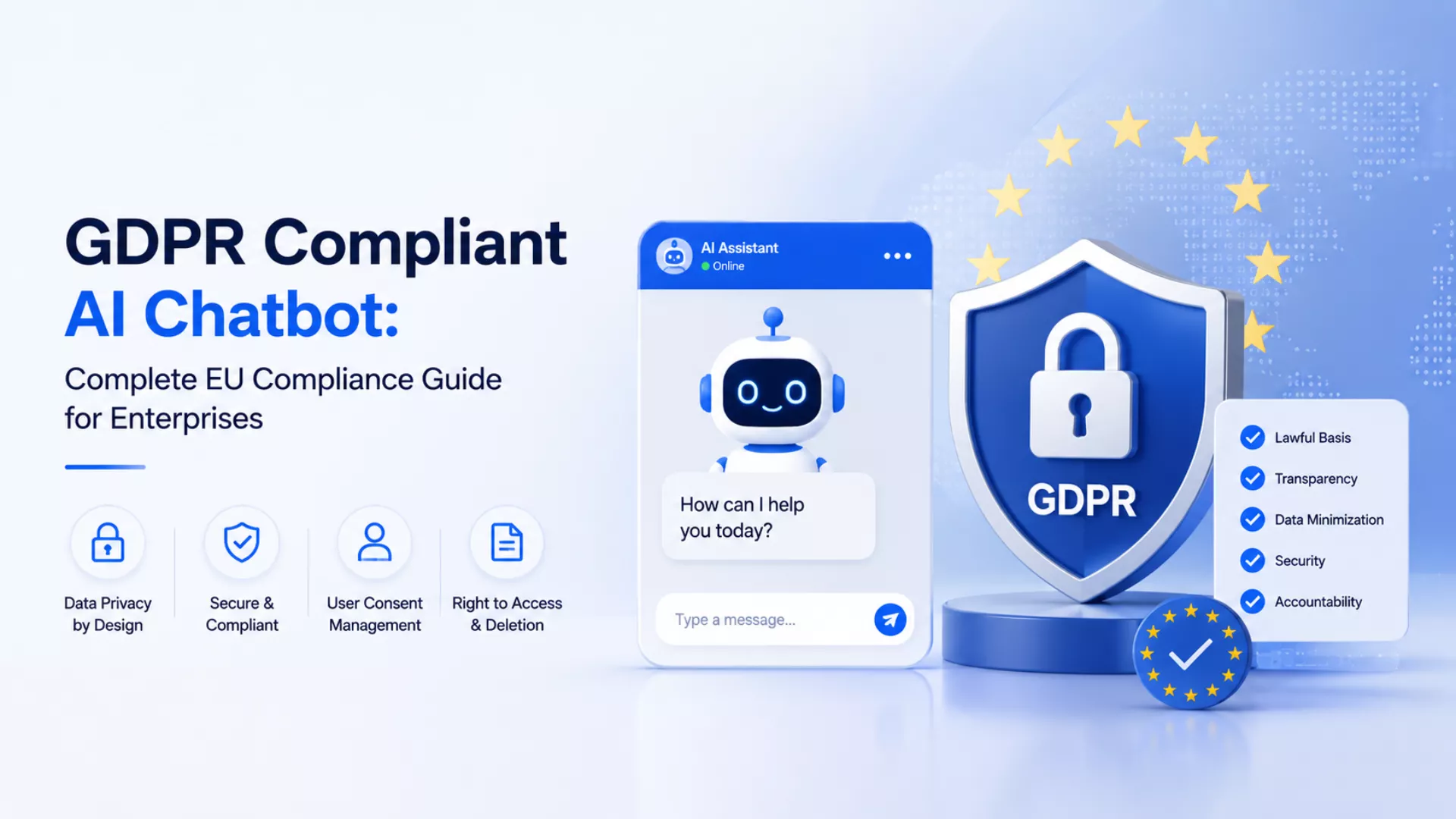
A GDPR compliant AI chatbot protects personal data throughout its lifecycle, from the first user interaction to data deletion. Compliance depends on governance, security controls and operational processes, not privacy statements alone.
GDPR Checklist for AI Chatbot Deployment
- Clearly disclose AI interactions from the first message
- Collect only the personal data required
- Encrypt data in transit and at rest
- Support access, correction and deletion requests
- Maintain searchable audit logs
- Integrate only with GDPR-compliant vendors
- Define retention and deletion policies
- Escalate sensitive or high-risk conversations to a human
Without these controls, even a secure AI chatbot platform can expose an organization to compliance risk.
Launch Your AI Chatbot
Build AI assistants with centralized knowledge, auditability and controls that support GDPR-ready deployments.
6 Common GDPR Risks in AI Chatbots
Most AI chatbot GDPR compliance failures result from implementation decisions rather than technology limitations. The biggest risks include:
- Collecting data without clear disclosure or valid user consent.
- Capturing more personal data than necessary, violating data minimization principles.
- Storing unstructured chat logs that contain sensitive information without defined data retention policies.
- Failing to support access, deletion or correction requests, making GDPR rights difficult to fulfill.
- Training or fine-tuning AI models on personal data without a valid legal basis, creating regulatory risk under recent EDPB guidance.
- Sharing data with third-party AI providers without adequate contractual and technical safeguards.
A GDPR compliant enterprise chatbot combines secure data processing, strong governance and operational controls. Privacy policies alone cannot protect customer data or demonstrate compliance during regulatory audits.
When GDPR Applies to Enterprise Chatbots
GDPR applies whenever an AI chatbot processes personal data, whether during customer interactions or when personal data is used to train or fine-tune AI models. If you are wondering Can AI chatbots store personal data? the answer is yes, but only under GDPR-compliant processing with an appropriate legal basis.
During deployment, an enterprise chatbot may process:
- Customer names and contact details
- Purchase history
- Account numbers
- HR records
- Employee performance data
- Chat transcripts and complaint logs
When AI chatbots support HR teams or internal employee workflows, organizations should also consider the additional privacy and governance requirements that apply to workplace AI deployments.
All of this qualifies as personal data under GDPR. Recent EDPB guidance also makes clear that using unlawfully collected personal data to train AI models can create regulatory obligations beyond deleting individual records.
For enterprises, AI chatbot GDPR compliance extends across CRM systems, vector databases, third-party AI providers and cloud infrastructure. A GDPR compliant AI chatbot is not a standalone product feature. It is the outcome of sound architecture, governance and secure data processing across the entire AI ecosystem.
Planning an Enterprise AI Chatbot?
See what enterprises must consider beyond GDPR, including AI Act risk classification, DPIAs and governance.
GDPR vs. the EU AI Act for Chatbots
A GDPR compliant AI chatbot is not automatically compliant with the EU AI Act. GDPR governs personal data protection, while the AI Act regulates AI system risk, transparency and governance. Enterprise chatbots must satisfy both frameworks because compliance with one does not guarantee compliance with the other.
| Aspect | GDPR | EU AI Act |
| Primary Focus | Personal data protection and user rights | AI system safety, transparency and governance |
| Scope Trigger | Processing personal data through chatbots or AI agents | Deployment and intended use of AI systems |
| Core Objective | Ensure lawful, secure data processing | Ensure trustworthy, accountable AI |
| Required Assessment | Data Protection Impact Assessment (DPIA), where applicable | Fundamental Rights Impact Assessment (FRIA) for high-risk AI systems |
| Key Requirements | Lawful basis, consent where required, data subject rights, security and retention | Risk classification, Article 50 AI disclosure, human oversight and continuous risk management |
| Enterprise Chatbot Examples | Any chatbot processing customer or employee data | HR screening, recruitment, credit assessment and other Annex III high-risk use cases |
| Maximum Penalties | Up to €20 million or 4% of global annual turnover | Up to €15 million or 3% for high-risk obligations, and €35 million or 7% for prohibited AI practices |
| Compliance Outcome | Secure AI chatbot with lawful data processing | Transparent, safe and regulated AI deployment |
AI Act Risk Classification: Context Matters More Than Technology
The AI Act classifies AI systems by how they are used, not simply by the underlying technology. That means the same AI chatbot can face different compliance obligations depending on its deployment.
The four AI Act risk categories are:
- Unacceptable risk
- High risk
- Limited risk
- Minimal risk
Most GDPR compliant AI chatbots for customer support fall under limited risk, requiring transparency measures such as informing users they are interacting with AI under Article 50. However, chatbots used for recruitment, employee evaluations, credit scoring or access to essential services can become high-risk AI systems under Annex III.
These deployments require risk management, human oversight and additional conformity assessments. For enterprise teams, AI chatbot GDPR compliance starts with protecting data, but AI Act compliance depends on the business decision the chatbot supports, not the model it uses.
DPIA vs FRIA: Two Impact Assessments, Two Perspectives
Under Article 35 GDPR, organizations must conduct a Data Protection Impact Assessment when processing is likely to result in a high risk to individuals’ rights and freedoms.
Triggers include:
- Systematic monitoring
- Large-scale data processing
- Profiling with significant effects
Many enterprise chatbot deployments meet at least one of these criteria. The AI Act introduces another instrument: the Fundamental Rights Impact Assessment. This applies to certain high-risk AI systems before deployment.
The difference is important.
- A DPIA focuses on data protection risks. It asks whether processing respects privacy rights.
- A FRIA goes further. It looks at discrimination, fairness, safety, and broader fundamental rights.
This creates potential parallel oversight. Data protection authorities may review GDPR compliance. Market surveillance authorities may review AI Act compliance. Enterprise governance must integrate both assessments into one coherent framework. Treating them as separate compliance exercises increases complexity and risk.
Lawful Basis: The Foundation of Any GDPR Compliant AI Chatbot
Under Article 6 GDPR, processing personal data requires a lawful basis.
In enterprise chatbot deployments, the most common lawful bases are:
- Contractual necessity
- Legitimate interest
- Consent
Each has strict conditions.
When relying on legitimate interest as the legal basis for an AI chatbot, organizations must document a balancing test showing that business objectives do not outweigh individuals' rights and freedoms. If consent is used instead, it must be freely given, specific, informed and unambiguous. Bundled, implied or forced consent does not satisfy GDPR compliance.
Recent supervisory authority guidance emphasizes that there is no hierarchy between legal bases. The choice must be justified and documented. For executives, this means a Secure AI chatbot built for GDPR compliance must have clear legal mapping before launch. Not after.
Using chatbot conversations for secondary purposes, such as training or fine-tuning AI models, requires a separate legal assessment. The original lawful basis does not automatically extend to future AI training. For AI chatbot GDPR compliance, organizations should document every processing purpose, as regulators routinely scrutinize lawful basis decisions during enforcement investigations.
Accuracy and Hallucination Risk: Accountability Remains
One of the most debated issues in AI governance is hallucination risk.
Article 5(1)(d) GDPR requires that personal data be accurate and kept up to date. With large language models, two types of accuracy matter:
- Statistical accuracy of the model
- Factual accuracy of outputs
Supervisory authorities have confirmed that organizations remain accountable for inaccurate personal data produced by AI systems. When an AI chatbot shares false details about someone, it may break the accuracy requirement. The statistical design of the model does not cancel that obligation.
The UK Information Commissioner’s Office has reinforced this in its AI guidance. Organizations must put proper controls in place to make sure AI-generated information about individuals is accurate, trustworthy, and easy to explain when reviewed.
In practice, this means:
- Human oversight in sensitive contexts
- Clear escalation mechanisms
- Logging and correction workflows
- Prompt engineering controls
- Guardrails against fabrication
GetMyAI makes sure that a GDPR compliant AI chatbot does not run without clear human supervision, proper escalation rules, and active monitoring whenever personal data is being processed.
Transparency Is Not a UX Feature. It Is a Legal Obligation.
Articles 12 to 14 of the GDPR require information to be concise, transparent, intelligible, and easily accessible.
In chatbot deployments, transparency means:
- Clear notice that the user is interacting with AI
- Clear explanation of what data is collected
- Clear description of purpose
- Disclosure if conversations are used for training
Supervisory authorities have emphasized that generic privacy notices are insufficient in AI contexts. Transparency must be contextual. If the chatbot is embedded in a website, the explanation should appear at the point of interaction. Not buried in a footer link.
A GDPR compliant chatbot for websites should present layered notices that are understandable without legal training. Transparency failures are common in enforcement decisions. Many large fines across Europe have involved insufficient disclosure about profiling or data use. For enterprise leaders, transparency is risk mitigation.
Data Subject Rights: Operational Readiness Is Mandatory
GDPR gives individuals the right to access, rectify, erase, restrict, port and object to the processing of their personal data. For an AI chatbot, these rights must be built into the system, not handled through manual processes. Organizations responding to a Data Subject Access Request (DSAR) must perform reasonable and proportionate searches, regardless of dataset size.
With data protection authorities now receiving an average of 443 personal data breach notifications every day, operational readiness has become a regulatory necessity rather than an administrative task.
This means chatbot systems must:
- Store logs in searchable formats
- Link conversations to identifiable users where appropriate
- Enable DSAR record extraction
- Support deletion and retention workflows
An enterprise chatbot embeds these capabilities into its architecture, making AI chatbot GDPR compliance scalable, auditable and operational.
International Transfers: Schrems II Still Shapes AI Governance
Many enterprise chatbot platforms rely on cloud infrastructure located outside the European Economic Area. Often in the United States.
The Court of Justice of the European Union, in the Schrems II decision, ruled that Standard Contractual Clauses alone are insufficient if the destination country’s laws undermine EU protections. Data exporters must conduct Transfer Impact Assessments. They must evaluate surveillance laws and implement supplementary measures where necessary.
For AI deployments, this means:
- Mapping data flows across jurisdictions
- Evaluating cloud provider exposure
- Assessing access risks
- Implementing encryption and technical safeguards
International transfers are not a footnote. They are one of the most enforced areas of GDPR compliance. Executives must ask vendors precise questions about data residency and government access exposure.
Enforcement Trends: Signals for Enterprise Strategy
Recent enforcement actions across Europe highlight recurring themes:
- Transparency failures
- Weak lawful basis documentation
- Unlawful international transfers
- Profiling without adequate safeguards
Large fines against major technology firms demonstrate that regulators are willing to pursue cross-border data governance issues aggressively. The lesson for enterprise leaders is straightforward. AI does not create new immunity. It increases scrutiny. If anything, AI systems are likely to attract more attention because of their scale and societal impact.
A GDPR compliant AI chatbot must be defensible not only technically, but also legally and operationally.
Designing Governance That Works
Compliance cannot be bolted on at the end of deployment. It must start at the design stage.
Key elements include:
- Classify chatbot risk before design and deployment begins.
- Complete DPIA and FRIA for applicable high-risk AI.
- Document lawful basis for every processing purpose.
- Disclose AI interactions directly within the chat interface.
- Build searchable logs supporting Data Subject Rights requests.
- Separate data retrieval from AI model training.
- Assess vendors, transfers and processor compliance before deployment.
- Define human oversight, escalation and ongoing AI monitoring.
- Establish incident response, audits and governance review processes.
Data protection by design is not a slogan. It is a requirement.
When organizations approach chatbot deployment as a strategic governance project rather than a quick automation win, risk becomes manageable.
The Strategic View for Executives
Board-level responsibility now extends beyond simple privacy compliance.
Executives must ask:
- What risk category does our chatbot fall into under the AI Act?
- Have we documented lawful basis decisions?
- Have we conducted DPIA and, if required, FRIA?
- Can we respond to access and deletion requests efficiently?
- Are international transfers defensible?
- Is our model architecture designed to prevent memorization risk?
These questions shape enterprise resilience.
At GetMyAI, a General Data Protection Regulation-compliant AI Chatbot is not positioned as a marketing claim. It is built through structured governance frameworks, documented lawful basis mapping, technical guardrails, and operational controls aligned with EU regulatory standards.
The organizations that succeed in this regulatory environment will not be those who deploy fastest. They will be those who deploy responsibly and can demonstrate it.
Conclusion: Compliance as Strategic Infrastructure
A GDPR compliant AI chatbot is no longer defined solely by how it protects personal data. It must also satisfy the EU AI Act through appropriate risk classification, transparency, human oversight and governance. As regulators increase scrutiny of enterprise AI, organizations that treat compliance as a deployment checklist will struggle to scale AI responsibly.
The strongest enterprise AI strategies begin with governance, not technology. Assess risk before deployment, document every processing decision and build compliance into the architecture from day one. A secure AI chatbot platform should make AI chatbot GDPR compliance operational through privacy controls, auditability and lifecycle governance, enabling organizations to deploy AI with confidence while meeting evolving European regulatory requirements.
FAQs
What makes an AI chatbot GDPR compliant?
A chatbot is GDPR compliant when it collects minimal data, has clear consent, ensures security, enables user rights, and maintains transparent data usage practices.
How is the EU AI Act different from GDPR?
GDPR focuses on personal data protection, while the AI Act regulates AI system risk, transparency, and accountability. Both apply together, not separately.
Do all AI chatbots fall under high-risk classification?
No. Most general chatbots are limited risk, but they become high risk if used in areas like hiring, finance, or access to essential services.
Why is the lawful basis important in chatbot deployment?
Without a valid lawful basis, such as consent or legitimate interest, any data processing by the chatbot becomes non-compliant and legally risky.
Can AI chatbot data be used for training models?
Only if separately justified under GDPR. Original data collection does not automatically allow reuse for training without a proper legal assessment.
Is an AI chatbot GDPR compliant by default?
No. An AI chatbot is not automatically GDPR compliant. Compliance depends on how it collects, processes, stores and deletes personal data. Organizations must establish a lawful basis, support data subject rights, implement security controls and maintain transparent data processing throughout the chatbot's lifecycle.
How do you make an AI chatbot GDPR compliant?
To make an AI chatbot GDPR compliant, organizations should identify a lawful basis for processing, collect only necessary personal data, disclose AI interactions, support access and deletion requests, implement retention policies and maintain appropriate technical and organizational safeguards.
Can AI chatbots store and use personal data?
Yes. AI chatbots can process and store personal data when there is a valid legal basis under the GDPR. However, using chatbot conversations for secondary purposes, such as AI model training or fine-tuning, requires a separate legal assessment and cannot rely automatically on the original purpose of collection.
What should you look for in a GDPR compliant chatbot platform?
A GDPR compliant chatbot platform should provide encryption, configurable data retention, searchable audit logs, consent management, support for Data Subject Access Requests (DSARs), human oversight controls and transparent AI disclosures. Enterprise deployments should also evaluate vendor compliance and international data transfer safeguards.
What is the difference between a GDPR compliant AI chatbot and an AI Act compliant chatbot?
GDPR governs how an AI chatbot processes personal data, while the EU AI Act regulates the AI system's transparency, risk classification and governance. A chatbot may satisfy GDPR requirements but still require additional AI Act obligations, such as Article 50 transparency measures or Annex III high-risk controls, depending on its use case.